Standardized Kt/V
Standardized Kt/V, also std Kt/V, is a way of measuring (renal) dialysis adequacy. It was developed by Frank Gotch and is used in the United States to measure dialysis. Despite the name, it is quite different from Kt/V. In theory, both peritoneal dialysis and hemodialysis can be quantified with std Kt/V.
Derivation
Standardized Kt/V is motivated by the steady state solution of the mass transfer equation often used to approximate kidney function (equation 1), which is also used to define clearance.

where
- is the mass generation rate of the substance - assumed to be a constant, i.e. not a function of time (equal to zero for foreign substances/drugs) [mmol/min] or [mol/s]
- t is dialysis time [min] or [s]
- V is the volume of distribution (total body water) [L] or [m3]
- K is the clearance [mL/min] or [m3/s]
- C is the concentration [mmol/L] or [mol/m3] (in the United States often [mg/mL])

From the above definitions it follows that is the first derivative of concentration with respect to time, i.e. the change in concentration with time.

Derivation equation 1 is described in the article clearance (medicine).
The solution of the above differential equation (equation 1) is

where
- Co is the concentration at the beginning of dialysis [mmol/L] or [mol/m3]
- e is the base of the natural logarithm
The steady state solution is

This can be written as
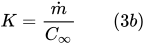
Equation 3b is the equation that defines clearance. It is the motivation for K' (the equivalent clearance):

where
- K' is the equivalent clearance [mL/min] or [m3/s]
- is the mass generation rate of the substance - assumed to be a constant, i.e. not a function of time [mmol/min] or [mol/s]
- Co is the concentration at the beginning of dialysis [mmol/L] or [mol/m3]
Equation 4 is normalized by the volume of distribution to form equation 5:
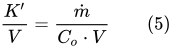
Equation 5 is multiplied by an arbitrary constant t to form equation 6:

where t is defined as 7×24×60×60 seconds, the number of seconds in a week.
Equation 6 is then defined as standardized Kt/V (std Kt/V):

Interpretation of std Kt/V
Standardized Kt/V can be interpreted as a concentration normalized by the mass generation per unit volume of body water.
Equation 7 can be written in the following way:

If one takes the inverse of Equation 8 it can be observed that the inverse of std Kt/V is proportional to the concentration of urea (in the body) divided by the production of urea per time per unit volume of body water.

Comparison to Kt/V
Kt/V and standardized Kt/V are not the same. Kt/V assumes a process described by (no mass generation) while std Kt/V considers a term. After solving both differential equations, Kt/V appears as a function of the ratio of the pre- and post-dialysis urea concentrations, while std Kt/V as one that only depends on C0 (compare equation 8 and equation 10).

Kt/V is defined as (see article on Kt/V for derivation):

Since Kt/V and std Kt/V model different processes, they cannot be compared to each other clinically.
Advantages of std Kt/V
- Can be used to compare any dialysis schedule (i.e. nocturnal home hemodialysis vs. daily hemodialysis vs. conventional hemodialysis)
- Applicable to peritoneal dialysis.
- Can be applied to patients with residual renal function; it is possible to demonstrate that Co is a function of the residual kidney function and the "cleaning" provided by dialysis.
- The model can be applied to substances other than urea, if the clearance, K, and generation rate of the substance, , are known.[2]
Criticism/disadvantages of std Kt/V
- It is complex and tedious to calculate, although web-based calculators are available to do this fairly easily.
- Many nephrologists have difficulty understanding it.
- Urea is not associated with toxicity.[4] Standardized Kt/V only models the clearance of urea and thus implicitly assumes the clearance of urea is comparable to more relevant toxins. It ignores molecules that (relative to urea) have diffusion-limited transport - so called middle molecules.
- When used on non-urea solutes, it ignores the mass transfer between body compartments and across the plasma membrane (i.e. intracellular to extracellular transport), which has been shown to be important for the clearance of molecules such as phosphate.
- The Standardized Kt/V is based on body water volume (V). The Glomerular filtration rate, an estimate of normal kidney function, is usually normalized to body surface area (S). The S/V ratio differs markedly between small vs. large people and between men and women. A man and a woman of the same S will have similar levels of GFR, but their values for V may differ by 15-20%. Because standardized Kt/V incorporates residual renal function into the calculations, it makes the assumption that kidney function should scale by V. This may disadvantage women and smaller patients of either sex, in whom V is decreased to a greater extent than S.
Calculating stdKt/V
For stdKt/V to be useful, it needs to be calculatable from more basic measurements such as treatment Kt/V and number of sessions per week. The various ways of computing standardized Kt/V by Gotch,[1] Leypoldt,[5] and the FHN trial network [6] are all a bit different, as assumptions differ on equal spacing of treatments, use of a fixed or variable volume model, and whether or not urea rebound is taken into effect.[7]
The KDOQI 2015 Update of their Hemodialysis Adequacy includes two formulas, the Leypoldt (fixed volume model without Kr) and the Daugirdas (variable volume model with Kru).[8]
Leypoldt
The simplified Leypoldt model assumes no residual kidney function Kru.[8]

where
- t is the session duration in minutes (and 10080 the number of minutes in a week),;
- N is the number of sessions per week;
- sp.Kt/V is the single-pool Kt/V, computed as described in Kt/V section using a simplified equation or ideally, using urea modeling;
- e.Kt/V is the urea-equilibrated Kt/V, computed from t and sp.Kt/V using a modification of the Tattersall equation here.[9]
This may be compared to the version from the 2006 KDOQI guidelines (difference in red sans-serif),[10] sometimes called Leypoldt-Depner:

Daugirdas
The Daugirdas correction takes into account some residual kidney function and the ultrafiltration rate.[8]: 912

where
- std.Kt/VLey is the std kt/V estimate from the Leypoldt model;
- Uf is the weekly ultrafiltration volume in mL;
- V is the volume of distribution for urea in mL;
- Kru is the residual native kidney function of urea in mL/min.
Although the true std Kt/v model takes into account Kru and Uf, the contribution of Kru is underestimated when using modelled values of urea generation rate ṁ (also called G), e.Kt/V, and average predialysis BUN C0 (also called avCpre). The left half of the correction works fixes the Leypoldt estimate by using modelled values of G and V while the right half adds the effect of Kru.[8]: 912
When Kru = 0 (so when only considering the left part), std.Kt/VDau is about 7% higher on average than std.Kt/VLey.[8]: 912
Other methods
The regular "rate equation" [11] also can be used to determine equilibrated Kt/V from the spKt/V, as long as session length is 120 min or longer.
Plot showing std Kt/V depending on regular Kt/V for different treatment regimens

One can create a plot to relate the three grouping (standardized Kt/V, Kt/V, treatment frequency per week), sufficient to define a dialysis schedule. The equations are strongly dependent on session length; the numbers will change substantially between two sessions given at the same schedule, but with different session lengths.
For the present plot, a session length of 0.4 Kt/V units per hour was assumed, with a minimum dialysis session length of 2.0 hours.
References
- 1 2 Gotch FA (1998). "The current place of urea kinetic modelling with respect to different dialysis modalities". Nephrol Dial Transplant. 13 Suppl 6 (90006): 10–4. doi:10.1093/ndt/13.suppl_6.10. PMID 9719197.
- 1 2 Gotch FA, Sargent JA, Keen ML (August 2000). "Whither goest Kt/V?". Kidney Int. Suppl. 76: S3–18. doi:10.1046/j.1523-1755.2000.07602.x. PMID 10936795.
- ↑ Gotch FA, Sargent JA (September 1985). "A mechanistic analysis of the National Cooperative Dialysis Study (NCDS)". Kidney Int. 28 (3): 526–34. doi:10.1038/ki.1985.160. PMID 3934452.
- ↑ Johnson WJ, Hagge WW, Wagoner RD, Dinapoli RP, Rosevear JW (January 1972). "Effects of urea loading in patients with far-advanced renal failure". Mayo Clinic Proceedings. 47 (1): 21–9. doi:10.1016/S0025-6196(25)07825-5. PMID 5008253.
- ↑ Leypoldt JK, Jaber BL, Zimmerman DL (2004). "Predicting treatment dose for novel therapies using urea standard Kt/V". Seminars in Dialysis. 17 (2): 142–5. doi:10.1111/j.0894-0959.2004.17212.x. PMID 15043617.
- ↑ Suri RS, Garg AX, Chertow GM, et al. (February 2007). "Frequent Hemodialysis Network (FHN) randomized trials: study design". Kidney Int. 71 (4): 349–59. doi:10.1038/sj.ki.5002032. PMID 17164834.
- ↑ Diaz-Buxo JA, Loredo JP (March 2006). "Standard Kt/V: comparison of calculation methods". Artificial Organs. 30 (3): 178–85 Erratum in 30(6):490. doi:10.1111/j.1525-1594.2006.00204.x. PMID 16480392.
- 1 2 3 4 5 National Kidney, Foundation (November 2015). "KDOQI Clinical Practice Guideline for Hemodialysis Adequacy: 2015 update". American Journal of Kidney Diseases. 66 (5): 884–930. doi:10.1053/j.ajkd.2015.07.015. PMID 26498416. / (DRAFT - differs slightly)
- ↑ Tattersall JE, DeTakats D, Chamney P, Greenwood RN, Farrington K (December 1996). "The post-hemodialysis rebound: predicting and quantifying its effect on Kt/V". Kidney Int. 50 (6): 2094–102. doi:10.1038/ki.1996.534. PMID 8943495.
- ↑ Hemodialysis Adequacy 2006 Work Group (July 2006). "Clinical Practice Guidelines for Hemodialysis Adequacy, Update 2006". American Journal of Kidney Diseases. 48: S2–S90. doi:10.1053/j.ajkd.2006.03.051. PMID 16813990.
{{cite journal}}: CS1 maint: numeric names: authors list (link) - ↑ Daugirdas JT, Greene T, Depner TA, et al. (January 2004). "Factors that affect postdialysis rebound in serum urea concentration, including the rate of dialysis: results from the HEMO Study" (PDF). J Am Soc Nephrol. 15 (1): 194–203. doi:10.1097/01.ASN.0000103871.20736.0C. PMID 14694173.
External links
- Standardized Kt/V , HDP(HemoDialysis Product calculation - hdtool.net
- Standardized Kt/V using formal 2-pool kinetics - Ureakinetics.org
- Standardized Kt/V calculator - HDCN