Sree Soepramaniem Nagarattar Temple
| Sree Soepramaniem Nagarattar Temple | |
|---|---|
ஸ்ரீ சுப்ரமணியம் நாகரத்தர் கோயில் Kuil Sree Soepramaniem Nagarattar | |
 Inside the temple, circa 1925 | |
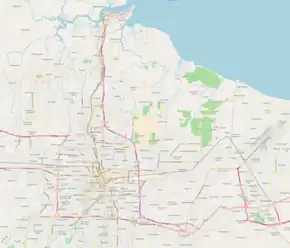  Location in Medan, Indonesia | |
| Religion | |
| Affiliation | Hinduism |
| District | Medan Petisah |
| Deity | Murugan, Ganesha, Shiva |
| Festival | Thaipusam |
| Location | |
| Location | Medan |
| State | North Sumatera |
| Country | Indonesia |
| Coordinates | 3°35′14″N 98°40′09″E / 3.587098210282087°N 98.6690912644686°E |
| Architecture | |
| Type | Dravidian architecture |
| Completed | 1892 |
Sree Soepramaniem Nagarattar Temple or Nagarathar Temple is one of the oldest Hindu temples in Medan, Indonesia. This temple is dedicated to Lord Murugan or also known as Subramaniam who is one of the main deities among Tamil people.[1][2] This temple plays an important role in preserving the cultural and spiritual heritage of the Tamil community in Medan. Apart from being a place of worship, the temple is also a symbol of togetherness and cultural identity for the Indian Indonesians community, especially those of Tamil descents. This temple is famous for the celebration of Thaipusam, a hundred year old wooden chariot which is locally known as Radhoo is placed in this temple, and it will be carried around during Thaipusam festival to Sri Mariamman Temple, Medan.[3]
History
The Sree Soepramaniem Nagarattar Temple was built by the Chettiar community of the Tamils, which also known as the Natukotai Chettiar. This community originated from Tamil Nadu, India, and has a long history of trade and other economic activities among Southeast Asia, mainly in Indonesia, Malaysia and Singapore. They brought their religious and cultural traditions to Medan, including the establishment of this temple, which has become a spiritual and cultural center for the early Tamil community in Dutch East Indies era. The temple is not only a place of worship but also an important symbol of their heritage and identity.
Gallery
 The devotees taking picture outside the temple, circa 1900-1923s
References
- ↑ Times, I. D. N.; Sari, Indah Permata. "Festival Thaipusam, Kereta Kencana Tetap Keliling Medan Meski Hujan". IDN Times Sumut.
- ↑ Siregar, Farid Achyadi. "Sejarah Kampung Keling di Medan yang Kini Dikenal Little India". detiksumut.
- ↑ Medan, Pemerintah Kota. "BERITA | Perayaan Thaipusam di Medan, Warga: Sangat Meriah, Tidak perlu ke Negara Tetangga". portal.medan.go.id.
- Hindu temples in Indonesia
- Buildings and structures in Medan
- Dutch colonial architecture in Indonesia
- Religious buildings and structures completed in 1884
- Tourist attractions in North Sumatra
- Mariamman temples outside India
- Hindu temples completed in the 19th century
- Cultural Properties of Indonesia in North Sumatra