Speed limits in Canada
Canadian speed limits are set by different levels of government (federal, provincial, and municipal), depending on the jurisdiction under which the road falls, resulting in differences from province to province.[1] The limits have been posted in kilometres per hour (km/h) since September 1, 1977. Before then, when Canada used Imperial units, speed limits were in miles per hour (mph).
Statutory speed limits
Statutory speed limits are default speed limits set by statute in each province or territory. They apply on roads which do not have posted speed limits.
In most provinces and territories, statutory speed limits are 50 km/h (31 mph) in urban areas, 80 km/h (50 mph) in rural areas.[2][3][4] There is no statutory speed limit for grade-separated freeways; however the typical speed limit in most provinces is 100 km/h (62 mph) or 110 km/h (68 mph). Statutory speed limits for school zones tend to be 30 or 40 km/h (19 or 25 mph) in urban areas and 50 km/h (31 mph) in rural areas.[5] The highest posted speed limit in the country is 120 km/h (75 mph) and can be found on the Coquihalla Highway and a 22 km (14 mi) stretch of Alberta Highway 2 south of Leduc.[6][7]
"N/A" means there is no such roadway in the province or territory. This table contains the statutory maximum speed limits, in kilometres per hour, on roads in each category.
| Province/territory | Rural | Urban |
|---|---|---|
 Alberta[8] |
100 km/h on provincial highways. 80 km/h on all other roads | 50 km/h |
 British Columbia[9] | 80 km/h | 50 km/h |
 Manitoba[10] |
90 km/h | 50 km/h |
 New Brunswick[11] | 80 km/h | 50 km/h |
 Newfoundland and Labrador[12] | 100 km/h on Trans Canada Highway. 80 km/h on other paved roads. 60 km/h on unpaved roads | 50 km/h |
 Northwest Territories[13] | 90 km/h | 50 km/h |
 Nova Scotia[14] | 80 km/h | 50 km/h |
 Nunavut[15] | 90 km/h | 50 km/h |
 Ontario[16] | 80 km/h | 50 km/h |
 Prince Edward Island[17] | 100 km/h during daytime. 90 km/h during night. 80 km/h on unpaved roads | 50 km/h in urban districts. 60 km/h in business districts |
 Québec[18] | 100 km/h on controlled access highways. 90 km/h on paved roads. 70 km/h on unpaved roads | 50 km/h |
 Saskatchewan[19] | 80 km/h | Discretion of municipality |
 Yukon[20] | Discretion of road authority | 50 km/h |
Posted speed limits
Posted speed limits may differ significantly from the statutory speed limit. For example, in Alberta, Highway 1A has a statutory maximum speed limit of 100 km/h but a posted speed limit of 30 km/h near 51°10′11″N 115°39′31″W / 51.169832°N 115.658684°W.
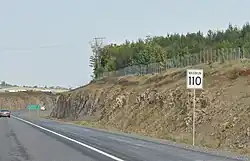
The highest speed limits in Canada are found on British Columbia's Coquihalla Highway with a speed limit of 120 km/h (75 mph)[21] as well as Alberta Highway 2 on a 22 km (14 mi) stretch south of Leduc. Formerly, British Columbia's Okanagan Connector and Highway 19 also possessed 120 km/h limits, but were reduced to 110 km/h in 2018.[22]
This table contains typical daytime speed limits, in kilometres per hour, on typical roads in each category. The values shown are not necessarily the fastest or slowest posted limit.
| Province/Territory | Freeway (rural) | Freeway (urban) | Divided Highway (rural) | Undivided (rural) | Urban |
|---|---|---|---|---|---|
| Alberta | 90 - 120 | 50 - 110 | 80 - 110 | 60 - 100 | 50 |
| British Columbia | 100 - 120 | 60 - 100 | 80 - 110 | 60 - 100 | 50 |
| Manitoba | N/A | 100 | 100 - 110 | 100 | 50 |
| New Brunswick | 110 | 100 - 110 | 110 | 80 - 100 | 50 |
| Newfoundland and Labrador | 100 | 80 - 100 | 100 | 80 - 100 | 50 |
| Northwest Territories | N/A | 100 | 45 | ||
| Nova Scotia | 100 - 110 | 100 | 100 - 110 | 80 - 100 | 50 |
| Nunavut | N/A | 50 | 30 | ||
| Ontario | 100 - 110 | 80 - 110 | 90 - 110 | 80 - 90 | 40 - 50 |
| Prince Edward Island | N/A | 80 - 90 | 50 | ||
| Saskatchewan | 110 | 90 - 100 | 100 - 110 | 100 | 50 |
| Québec | 100 | 70 - 100 | 100 | 80 - 90 | 50 |
| Yukon | N/A | 70 | 100 | 50 | |
Regulations


Community safety zones and automated speed enforcement
In Ontario, speeding fines are doubled in areas identified as "Community Safety Zones". On November 14, 2025, the section of the Highway Traffic Act that permitted automated speed enforcement was struck.[23][24] Instead, the government launched a $210 million road safety initiatives fund for municipalities to implement traffic calming measures.[25][26]
Construction zones
In most Canadian provinces, as in most other locales, speed violation fines are double (or more) in construction zones, although in Ontario and Alberta, this only applies if workers are present in the construction zone.
Racing, contests and stunt driving
In Ontario, as of September 2007, drivers caught exceeding the posted speed limit by 50 km/h or more may have the vehicle that they are driving impounded immediately for seven days, have their licence suspended for seven days, and have to appear before the court. For a first conviction, they face an additional $2,000–$10,000 fine and six demerit points; they may also face up to six months in jail and licence suspension of up to two years. For a second conviction within 10 years of the first conviction, their licence may be suspended for up to 10 years.[27]
Truck speed limiters
Since 2009 in both Ontario[28] and Québec,[29] trucks must be equipped with devices to electronically limit their speed to 105 km/h (65 mph). In 2012, an Ontario court ruled that the law violated the Canadian Charter of Rights and Freedoms, however the law was upheld by the Ontario Court of Appeal in 2015.[30] In April 2024, 105 km/h speed limiters also became mandatory for commercial trucks in British Columbia.[31]
Radar detectors
Radar detectors in Canada are legal only in British Columbia, Alberta and Saskatchewan. They are illegal to use or possess in the other provinces and all three territories. Regardless of whether they are used or not, police and law enforcement officers may confiscate radar detectors, operational or not, and impose substantial fines in provinces where radar detectors are illegal.[32] Quebec penalizes $500 for use of a radar detector, along with confiscation of the device.[33]
Signage
A speed limit sign reads "MAXIMUM XX", such as "MAXIMUM 80" for 80 km/h. A minimum speed sign reads "XX MINIMUM", such as "60 MINIMUM" for 60 km/h.
 Speed limit sign
 Minimum speed limit sign
 Speed limit sign in Ontario
 Speed limit sign in British Columbia and Yukon
 Upcoming/advance notice of speed limit change sign
 Upcoming/advance notice of speed limit change sign in British Columbia and Yukon
 Speed limit change sign in Ontario
 Speed limit sign in Quebec
 Speed limit ends sign in British Columbia
 Recommended speed sign
 Exit recommended speed sign in Quebec; Anglophone signs read EXIT or RAMP
 Exit recommended speed sign in Ontario
 Metric signage reminder in British Columbia, posted on highways near the US border, to and from ferry terminals on Vancouver Island, and international airports
 Metric signage reminder in Quebec, posted near US border
Review of speed limits
British Columbia
In British Columbia, a review of speed limits conducted in 2002 and 2003 for the Ministry of Transportation found that posted limits on investigated roads were unrealistically low for 1,309 km and unrealistically high for 208 km. The report recommended increasing speed limits on multi-lane limited-access highways constructed to high design standards from 110 km/h to 120 km/h.[34] As described in that report, the Ministry is currently using "Technical Circular T-10/00 ... to assess speed limits. The practice considers the 85th percentile speed, road geometry, roadside development, and crash history." In July 2014, speed limits were adjusted on many of the province's highways, including some which were increased to 120 km/h (75 mph), currently the highest speed limit in Canada.[35] Some of the sections were later rolled back due to a study finding "marked deterioration in road safety",[36] which critics called the study misleading due to an oversimplification of the data.[37]
Alberta
On April 29, 2026, Alberta increased the speed limit on a 22 km (14 mi) stretch of Highway 2 south of Leduc from 110 km/h (68 mph) to 120 km/h (75 mph) on a trial basis,[38] with considerations to increase the speed limit to 120 km/h (75 mph) on most rural highways depending on the outcome of the trial.[39]
Ontario
Ontario's first provincial legislation governing automobile use came into effect in 1903, which included a 15 mph (24 km/h) speed limit. The first provincial Highway Traffic Act (passed in 1923)[40] changed the speed limit for highways to 25 mph (40 km/h).[41]
Limits were later increased, for rural roads, to 50 mph (80 km/h) and then again to 60 mph (97 km/h). In 1968, the maximum speed limit for freeways was raised to 70 mph (110 km/h). In 1976, due to the oil crisis, the maximum speed limit was reduced while simultaneously being metrified to 100 km/h (62 mph) for freeways, while the rural limit was reduced to 80 km/h (50 mph), except for main highways running through northern Ontario, which were reduced to 90 km/h (56 mph). In 1977, as a result of the metrification, the speed limits increased slightly to a maximum ranging from 80 to 100 km/h (50 to 62 mph) while signs were being changed.[42]
In 2013, an Ontario-based group lobbied to increase speed limits on the 400-series highways from 100 km/h to 120 to 130 km/h (75 to 81 mph).[43] However, the Minister of Transportation at the time Bob Chiarelli rejected the petition, citing speed accounted for 20% of fatal collisions, and that Ontario highways were among the safest in North America and he intended to keep it that way.[44]
In 2015, the Ontario government announced a plan to reduce residential speed limits from the statutory default 50 km/h, either by reducing the statutory limit to 40 km/h or by giving municipalities the option to set their own statutory speed limits, as well as allowing posted speed limits in school zones to be lowered to 30 km/h.[45]
On May 10, 2019, the government announced plans to increase the speed limit on 400-series highways on a trial basis.[46] Later that year on September 26, 2019, speed limits were raised in a two-year trial from 100 km/h (62 mph) to 110 km/h (68 mph) on three sections of highways.[47] In 2021, due to the COVID-19 pandemic significantly reducing traffic in 2020, the trial was extended until 2023.[48] On April 22, 2022, the three trialed sections were made permanent along three additional sections while two new sections were trialed.[49][50] On July 12, 2024, the two trialed sections were made permanent, in addition to 10 new sections.[51] Later that year on October 2, 2024, Premier Doug Ford mentioned in a news conference that he had directed Transportation Minister Prabmeet Sarkaria to raise the speed limit to 110 km/h (68 mph) on all remaining 400-series highway sections "where it is safe to do so".[52] On June 24, 2026, the government announced that the speed limit would be increased to 110 km/h (68 mph) on all remaining highways "where it was safe to do so", bringing the total number highways posted at 110 km/h (68 mph) to about 89%.[53]
References
- ↑ Gilchrist, C.W. "Roads and Highways". www.thecanadianencyclopedia.ca. The Canadian Encyclopedia. Archived from the original on 14 December 2017. Retrieved 31 October 2017.
- ↑ "Driving to Prince Edward Island". 21 January 2015. Archived from the original on 28 September 2013.
- ↑ "Archived copy" (PDF). Archived (PDF) from the original on 2013-09-28. Retrieved 2013-09-26.
{{cite web}}: CS1 maint: archived copy as title (link) - ↑ Highway Traffic Act (R.S.O. 1990, c. H.8), 2024, s.128(1)
- ↑ "Safer School Zone Q&A - novascotia.ca". novascotia.ca. Archived from the original on 2017-11-06.
- ↑ "U.S. Driver caught speeding on Coquihalla, going 262 km/H near Merritt | Globalnews.ca".
- ↑ "'Common sense': Ontario raising speed limits on these long stretches of Highway 401 and Highway 403 along with Highway 406 and Highway 416". 24 April 2024.
- ↑ "Driving Awareness Refresh". Wheatland County. 2021-06-01. Retrieved 2026-06-22.
- ↑ "Motor Vehicle Act". Laws Publications - Government. 2026-06-16. Retrieved 2026-06-22.
- ↑ "The Highway Traffic Act". Government of Manitoba. 2026-06-15. Retrieved 2026-06-22.
- ↑ "Traffic on the Highway - Rules of the Road" (PDF). Government of New Brunswick. Retrieved 2026-06-22.
- ↑ "Highway Traffic Act". House of Assembly - Newfoundland and Labrador. 2024-01-08. Retrieved 2026-06-22.
- ↑ "NWT Basic Driver's Manual" (PDF). Infrastructure. Retrieved 2026-06-22.
- ↑ "Drivers Handbook PREFLIGHT" (PDF). Government of Nova Scotia. Retrieved 2026-06-22.
- ↑ "Traffic Safety Act, Consolidation of". Nunavut Legislation. 2019-12-06. Retrieved 2026-06-22.
- ↑ "Motor Vehicles Act". Government of Ontario. 2026-06-02. Retrieved 2026-06-22.
- ↑ "Highway Traffic Act" (PDF). Government of Prince Edward Island. November 29, 2024. Retrieved 2026-06-22.
{{cite web}}: CS1 maint: url-status (link) - ↑ "Code de la sécurité routière". Gouvernment du Québec. 2022-07-25. Retrieved 2026-06-22.
- ↑ "Traffic Safety Act" (PDF). Heavy Construction Safety Association of Saskatchewan. 2006-07-01. Retrieved 2026-06-22.
- ↑ "Motor Vehicles Act" (PDF). Yukon Legislation - Legislation. Retrieved 2026-06-22.
- ↑ Greson, Jen (July 3, 2014). "B.C. speed limit bump to 120 km/h reflects growing consensus that faster is often safer". National Post. Retrieved April 14, 2023.
- ↑ "Speed limits lowered across B.C. — but not on the Coquihalla". Merritt Herald. November 6, 2018. Retrieved April 14, 2023.
- ↑ "Building a More Competitive Economy Act, 2025, S.O. 2025, c. 11 - Bill 56". ontario.ca.
- ↑ "Speed enforcement camera ban is now in effect in Ontario". cp24.com. November 14, 2025.
- ↑ "Ontario Launching Road Safety Initiatives Fund". ontario.ca. November 13, 2025.
- ↑ "Ontario to spend $210M on non-speed camera road safety measures following ban". cbc.ca. November 14, 2025.
- ↑ "Law Document English View". 24 July 2014. Archived from the original on 23 August 2017.
- ↑ Brennan, Richard J. (7 June 2012). "Ontario court declares speed limiters for trucks unconstitutional". Toronto Star. Retrieved 29 July 2019.
- ↑ "Quebec truckers admit to tampering with speed limiters". CBC News. 24 April 2012. Retrieved 29 July 2019.
- ↑ Craggs, Samantha (3 September 2015). "Court rejects truckers' bid to go faster on Ontario highways". CBC News. Retrieved 29 July 2019.
- ↑ "Mandatory devices limit speed for commercial trucks in British Columbia" (Press release). Victoria, BC. British Columbia Ministry of Transportation and Infrastructure. 3 April 2024. Retrieved 2024-06-04.
- ↑ "United States Department of State: Consular Information Sheet for Canada". Travel.state.gov. Archived from the original on 2008-09-13. Retrieved 2010-10-17.
- ↑ "Getting around Québec". Archived from the original on 2010-08-23. Retrieved 2011-07-15.
- ↑ "MoT Speed Review Report" (PDF). Archived (PDF) from the original on 2009-12-29.
- ↑ "Speed limits on some B.C. highways to hit 120 km/h". CBC News. 2 July 2014. Archived from the original on 19 November 2015. Retrieved 9 December 2015.
- ↑ "Province rolls back speed limits on 570 km of highway" (PDF) (Press Release). Ministry of Transportation and Infrastructure of British Columbia. November 6, 2018. Retrieved July 11, 2026.
- ↑ Zussman, Richard; Stanton, Kylie (October 10, 2018). "B.C. premier 'shocked' at increase in fatalities and crashes on highways with increased speed limits | Globalnews.ca". Global News. Retrieved July 11, 2026.
- ↑ "Common-sense speed limits" (Press Release). Government of Alberta. April 29, 2026. Retrieved July 11, 2026.
- ↑ "Map of divided highways being considered for a speed limit increase in Alberta" (PDF) (Press Release). Government of Alberta. Retrieved July 11, 2026.
- ↑ "Changes To The Highway Traffic Act Coming In Ontario". LifeSafer of Canada. 2015-03-06. Retrieved 2020-04-27.
Although the act itself has been around since 1923 ...
- ↑ Government of Ontario, Ministry of Transportation (25 April 2018). "History of Ministry of Transportation". www.mto.gov.on.ca.
- ↑ "c 66 The Highway Traffic Amendment Act, 1977 (No 5.)". Ontario: Annual Statutes. 1977 (1). York University. 1977. ISSN 0709-227X.
- ↑ "Ontario org. wants highway speed limits increased from 100 km/h". 18 April 2012. Archived from the original on 22 April 2012.
- ↑ "Ontario rejects call to raise highway speed limits". Global News. April 18, 2012. Retrieved July 11, 2026.
- ↑ "Lower residential speed limit considered by Ontario government". CBC News Ottawa. 29 January 2015. Archived from the original on 4 December 2015. Retrieved 9 December 2015.
- ↑ Winterburn, Mike (May 10, 2019). "Ontario Introduces Speed Limit Pilots and Consultations" (Press Release). Ministry of Transportation of Ontario.
- ↑ "Highway speed limits jump to 110 km/h in pilot project". cbc.ca. September 24, 2019.
- ↑ "Raising speed limits on Ontario highways". Ministry of Transportation of Ontario. 24 September 2019. Retrieved 2021-11-25.
- ↑ "Ontario to permanently set speed limits on some highway sections at 110 km/h". toronto.ctvnews.ca. March 29, 2022. Archived from the original on March 29, 2022.
- ↑ Brasier, Dakota; Ikotun, Simisola (March 29, 2022). "Ontario Raising Highway Speed Limits" (Press Release). Ministry of Transportation of Ontario. Retrieved July 15, 2024.
- ↑ Brasier, Dakota; Blazina, Tanya (April 24, 2024). "Ontario Raising Highway Speed Limits" (Press Release). Ministry of Transportation of Ontario. Retrieved July 15, 2024.
- ↑ Froude, Bruce (October 3, 2024). "Revving up the speed: Here is what's behind Ontario Premier Doug Ford's push for higher highway speed limits". Inside Halton. Retrieved July 11, 2026.
- ↑ Brasier, Dakota; Caslin, Julia (June 24, 2026). "Ontario Raising Speed Limits on Most Provincial Highways" (Press Release). Ministry of Transportation of Ontario. Retrieved July 11, 2026.