Sparta (rocket)
 | |
| Function | Sounding rocket Launch system |
|---|---|
| Manufacturer | ABMA/Chrysler |
| Country of origin | United States |
| Size | |
| Height | 21.8 meters (72 ft) |
| Diameter | 1.78 meters (5 ft 10 in) |
| Mass | 30,000 kilograms (66,000 lb) |
| Stages | 3 |
| Capacity | |
| Payload to LEO | |
| Mass | 45 kilograms (99 lb) |
| Associated rockets | |
| Family | Redstone |
| Comparable | Jupiter-C Juno I |
| Launch history | |
| Status | Retired |
| Launch sites | Woomera Test Range LA-8 |
| Total launches | 10 |
| Success(es) | 9 |
| Failure | 1 |
| First flight | November 28, 1966 |
| Last flight | November 29, 1967 |
| Carries passengers or cargo | Sparta re-entry vehicles, WRESAT |
| First stage – Redstone | |
| Powered by | 1 A-7 |
| Maximum thrust | 416 kilonewtons (94,000 lbf) |
| Specific impulse | 265 sec |
| Burn time | 155 seconds |
| Propellant | LOX/Ethanol |
| Second stage – Antares-2 | |
| Powered by | 1 X-259 |
| Maximum thrust | 93 kilonewtons (21,000 lbf) |
| Specific impulse | 293 sec |
| Burn time | 36 seconds |
| Propellant | Solid |
| Third stage – BE-3 Alcyone | |
| Powered by | 1 solid |
| Maximum thrust | 34 kilonewtons (7,600 lbf) |
| Burn time | 9 seconds |
| Propellant | Solid |
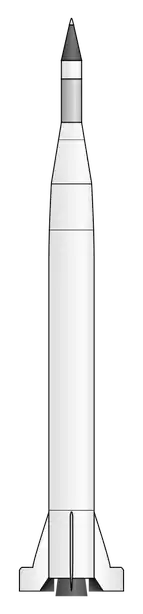
The Sparta (or Redstone-Sparta, both from the acronym ‘Special Anti-missile Research Tests, Australia’) was a three-stage orbital-capable rocket launched between 1966 and 1967 from Woomera Test Range LA8 in Woomera, South Australia. Australia's first Earth satellite, WRESAT, was launched into a polar orbit on the final Sparta on November, 29 1967.[1][2][3][4]
Ten Sparta rockets were developed, one of which was placed in reserve. The first nine launched as part of the joint United States–United Kingdom–Australian research program, known as Project SPARTA, aimed at better understanding re-entry phenomena from various model warheads, made as a follow-up to previous similar joint projects.[5]
Sparta used modified surplus American Redstone rockets as its first stage, a Thiokol Antares 2 from the Scout rocket as a second stage, and a BE-3 Alcyone solid-propellant engine as a third stage. Both of these upper stages were spin-stabilized during launch to approximately 150 rpm prior to first stage separation.[2][3][6]
In 1990, the first stage of the Sparta rocket that had launched WRESAT was recovered from the Simpson Desert after being found in searches by explorer Dick Smith the previous year.[7]: 76–80
Launches
The re-entry profiles of the SPARTA test vehicles would be closely monitored and examined from ground-based systems to aid in the development of anti-missile counter-weapon systems. For these launches, the BE-3 third stage was used to achieve higher descent speeds of around 6 kilometers per second (13,000 mph).[5]
Early into the Sparta program, the idea of using the final launch vehicle for sending a scientific payload into orbit was proposed, leading to the planning, creation, and launching of WRESAT.[8][2][3]
Re-entry payloads launched by the Redstone Sparta were simply referred to as Sparta 1 through 9. The first launch was a failure and was destroyed by range safety, while the rest were successful.[3]
| Date | Mission Description | Nation | Agency | Apogee (km) |
|---|---|---|---|---|
| November 28, 1966 | Sparta SV-1 (re-entry vehicle) | US | US Army | 90 |
| December 13, 1966 | Sparta SV-2 (re-entry vehicle) | US | US Army | 90 |
| April 20, 1967 | Sparta SV-3 (re-entry vehicle) | US | US Army | 90 |
| July 4, 1967 | Sparta SV-4 (re-entry vehicle) | US | US Army | 90 |
| July 24, 1967 | Sparta SV-5 (re-entry vehicle) | US | US Army | 90 |
| August 17, 1967 | Sparta SV-6 (re-entry vehicle) | US | US Army | 90 |
| September 15, 1967 | Sparta SV-7 (re-entry vehicle) | US | US Army | 91 |
| October 11, 1967 | Sparta SV-8 (re-entry vehicle) | US | US Army | 137 |
| October 31, 1967 | Sparta SV-9 (re-entry vehicle) | US | US Army | 111 |
| November 29, 1967 | WRESAT (satellite) | Australia | WRE | 1252 |
Gallery
 Redstone-Sparta at Woomera LA8
 Preparation for launch of Redstone-Sparta CC-2029 at Woomera LA8
 Preparation for launch of Redstone-Sparta CC-2029 at Woomera LA8
 Launch of Redstone-Sparta CC-2029 with WRESAT satellite (November 29, 1967)
 Launch of Redstone-Sparta CC-2029 with WRESAT satellite (November 29, 1967)
On display
Sparta first stage remains are displayed at the Woomera Rocket Park, Woomera, South Australia).[9]
References
- ↑ Wade, Mark. "Redstone". Encyclopedia Astronautica. Archived from the original on 2024-02-07.
- 1 2 3 4 Wade, Mark. "SPARTA". Encyclopedia Astronautica. Archived from the original on 2022-11-09. Retrieved 2023-10-16.
- 1 2 3 4 5 Krebs, Gunter D. "Redstone with solid fuel upper stage". Gunter's Space Page. Archived from the original on 2023-12-09. Retrieved 2023-10-21.
- ↑ Krebs, Gunter. "Spacecraft Acronyms". Gunter's Space Web. Retrieved 11 May 2026.
- 1 2 LePage, Andrew. "Australia's First Satellite & The Last Redstone". Drew Ex Machina. Retrieved 11 May 2026.
- ↑ "Antares 2". www.astronautix.com. Retrieved 2025-01-14.
- ↑ Dougherty, Kerrie. "Retrieving Woomera's heritage: recovering lost examples of the material culture of Australian space activities" (PDF). Artefacts: Studies in the History of Science and Technology. Vol. 6. p. 80. Archived from the original (PDF) on 2023-10-11. Retrieved 2024-04-24.
- ↑ LePage, Andrew J. (May 2, 2011). "Old Reliable: The story of the Redstone". spacereview.com. Archived from the original on June 2, 2023. Retrieved February 7, 2023.
- ↑ Dougherty, Kerrie. "Retrieving Woomera's heritage: recovering lost examples of the material culture of Australian space activities" (PDF). pp. 80–84. Archived from the original (PDF) on 2023-10-11. Retrieved 2024-09-07.