Spadina subway line
| Spadina subway line | |||
|---|---|---|---|
 The line running along the median of Allen Road | |||
| Overview | |||
| Locale | Toronto | ||
| Stations | 8 | ||
| Service | |||
| Type | Rapid transit | ||
| Operator | Toronto Transit Commission | ||
| History | |||
| Opened | January 28, 1978 | ||
| Technical | |||
| Track gauge | 1,495 mm (4 ft 10+7⁄8 in) Toronto gauge[1] | ||
| |||

The Spadina subway line (usually called either the Spadina subway or the Spadina line) was the former name of a portion of the northwestern branch of the Toronto subway's Line 1 Yonge–University built in 1978 and extended in 1996.
The first section was a 9.9-kilometre (6.2 mi) eight-station extension of Line 1 which opened on January 28, 1978, along the route of the partially built Spadina Expressway from St. George station to Wilson station. Initially proposed to run along Christie Street as a separate line, the plan was revised to follow the expressway route in 1959. The project was then postponed twice: first in 1964, to build extensions of the Bloor–Danforth line and then again in 1965, to build a northerly extension of the Yonge Street branch of the Yonge subway. In the 1970s, the impending construction of the expressway meant that the TTC decided to pursue the project if funds could be found. However, the partially built Spadina Expressway's cancellation in 1971 led the TTC to consider running the route down Bathurst Street, south of the constructed section of the expressway. Despite the City of Toronto's strong opposition, the TTC and Ontario government moved forward with the Spadina route.
Construction on the extension began in 1974 and opened in January 1978. In a first for the TTC, external architects designed most of the stations on the extension and all stations featured public art. Following the opening of the extension, ridership was less than expected; however, the extension's opening did reduce crowding on the Yonge branch.
Construction of an extension northwards to Sheppard Avenue began in 1992, with Downsview station (later renamed Sheppard West) opening on time and under budget in 1996. It was the first step to either loop Line 1 or extend it further to York University. A further extension north to York University, known as the Toronto–York Spadina subway extension (TYSSE) during planning and construction, to Vaughan Metropolitan Centre in the City of Vaughan opened in 2017. In 2014, the TTC removed "Spadina" from Line 1's name, with the line thereafter known as Line 1 Yonge–University.
Background
The Yonge line, Toronto's first subway, began construction in 1949 and opened on March 30, 1954, running between Union and Eglinton stations.[2][3][4] The line was extended north along University Avenue to St. George station at Bloor Street in February 1963 as part of the Bloor–University subway project. The Bloor–University project also saw construction of the initial section of Line 2 Bloor–Danforth, which opened in February 1966.[5][6][7]
Study of an expressway extension of Spadina Road began in 1954 and was approved by Metropolitan Toronto in 1957, though construction was not expected to begin for five to ten years.[8][9] However, construction was accelerated over threats by the developers of Yorkdale Shopping Centre to only build the mall if the expressway were constructed.[10] The expressway had already received opposition from York Township over destruction of the Cedarvale Ravine. The township preferred subway construction.[11] The expressway would lead to major protest from residents and ratepayer groups in the 1960s and 1970s.[12][13]
Planning
Initial plans and route dispute (1955–1961)

By the end of 1955, city planners at Metropolitan Toronto had begun studying a subway to be built as part of the Spadina Expressway project to provide an additional connection to the proposed Bloor–Danforth line.[14][15] As originally proposed, it would be a new line running along Christie Street as it approached Bloor Street, connecting with the Bloor–Danforth line at the proposed Christie station. North of St. Clair Avenue, the route would enter the Cedarvale Ravine and join the Spadina Expressway there.[16][17] A Christie route was planned to be extended further south in the future to the proposed Queen subway line but, when initially opened, would require passengers to transfer to the Bloor–Danforth line to reach downtown.[16][18] TTC transit consultant Norman D. Wilson called for the line to form a large U, continuing on Queen to Leslie Street then running northeast to Thorncliffe Park, Don Mills, and Scarborough.[10]

However, the plan was revised in 1959 to run fully along the Spadina Expressway route (which was to be built along Spadina Road and Spadina Avenue south of the Cedarvale Ravine) and connect with the Bloor–Danforth line at St. George station. A route along Christie would have been shorter and served a more densely populated area, but a route connecting at St. George would be able to function as an extension of the University line or at least connect directly with it. However, it would prevent Bloor trains from running directly downtown via the University line as then proposed.[18][19][17] The connection between the two lines would be about 1.6 kilometres (1 mi) east of its originally proposed location.[20] At the time, construction was expected to be done in conjunction with the Spadina Expressway.[19][21]
This revision was reversed by the TTC in March 1960, causing friction between the TTC and Metropolitan Toronto, which had approved the Spadina Expressway route. The TTC argued the Christie route was $3 million cheaper and avoided complications at the wye junction between the Bloor and University lines.[16] The TTC reversed its decision, initially that April and again in May, reinstating the Spadina route.[18][22] The April meeting had been done in secret by three of the commissioners while Christie line supporter Ford Brand was vacationing. Brand only heard of the meeting from a phone call by a reporter. This led to infighting between the TTC's commissioners as well as with Metropolitan Toronto.[16][10][23] The issue of which riders would need to transfer and construction of the necessary wye to interline Bloor and University services were the primary sources of disagreement.[24] In June 1960, Metropolitan Toronto Council voted to build the full wye and the line as an extension of the University subway. The TTC continued to prefer the Spadina route over the Christie route despite Brand's continued protest.[17][25]
Postponement (1961–1970)
Since 1959, the Spadina line had been expected to be constructed following the completion of the Bloor–Danforth line. However, in 1962, Metropolitan Toronto chair William Allen proposed extending the Bloor–Danforth line first, with a busway to occupy the median of the Spadina Expressway temporarily. This move was opposed by Metro planning commissioner Murray Jones, who noted the Yonge line was already nearing capacity.[26] In 1962, Metropolitan Toronto's transportation committee recommended extensions of the Bloor–Danforth line be given priority despite the possibility of delaying the Spadina line and by 1964, the Bloor–Danforth extensions were to be built before the Spadina line.[27][28]
In 1964, there was again debate on which subway line would be built next. Being considered were the Spadina line, the Queen line, a line to Weston, and a northerly extension of the Yonge line. Supporters of the Spadina line stated the Yonge line would be overcrowded if its extension were built first. Despite this, in October 1965, Metropolitan Toronto voted in favour of extending the Yonge line first.[28][29][30] Additionally, a long-term plan released by the TTC in 1966 called for the Queen line to be constructed first, which would potentially further delay the Spadina line.[31][32] This led Allen to endorse the Christie route, which would again be voted down by the TTC in July 1968.[33][34]
In 1968, the TTC recommended the Spadina line be the first subway extension built once the Yonge extension is completed, which was then expected to be in 1972.[35] At this point, the line was expected to open in 1983, but Metro Toronto's 1969 decision to speed up construction of the Spadina Expressway caused the TTC to start looking for the $53 million required to build the Spadie line, as the tax levy normally used for subway construction was being used for the Yonge extension.[36] Metro Toronto Council considered delaying the section of the Yonge subway extension from Sheppard to Finch to build the Spadina line faster, but this was defeated by a 16–6 vote in August 1970.[37]
Approval after cancellation of Spadina Expressway (1970–1973)
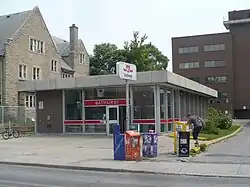
In late 1969, construction work on the Spadina Expressway was halted while the Ontario government reviewed the project, which was unpopular with area residents. The review ended with the June 1971 decision by Premier Bill Davis and his cabinet to cancel the expressway but support the quick construction of the proposed subway along its route.[13][38] In 1970, the Toronto Planning Board recommended another review of the subway route, this time proposing the line run down Vaughan Road and Bathurst Street south of Eglinton Avenue. The board did not believe the Spadina Expressway routing would be cheaper than a Bathurst route, which was the reason the TTC was supporting it at the time.[39] Anti-expressway activist and author Jane Jacobs also criticized the Spadina route and preferred a subway on Bathurst, believing a Spadina route would be more difficult for pedestrians to access, leading to lower ridership.[40]
In October 1971, following the expressway's cancellation, Davis announced the line would continue to follow the expressway's route. Metro Toronto chair Albert Campbell protested Davis' decision, believing Metro should decide the route. Metro had already formed a committee to determine which route would work best, which was expected to report on its findings within a month. The TTC did not want the route to change.[41][42][43] The committee recommended a route just west of the Bathurst route despite determining it would cost $169 million and require 150 expropriations, compared to $141 million and fewer expropriations for the Spadina route without the expressway. The Spadina route was forecast to be the cheapest and quickest to build.[44][45] The proposed Bathurst-area routings all went to St. George, and route alternatives continued to be considered in 1972. Early that year, Metro Toronto was sent 130 briefs recommending the Spadina route under the belief it would allow the Spadina Expressway to be built.[46]
While the routing was undecided, the TTC began design work on the section of the line north of Eglinton Avenue.[47] The City of Toronto strongly opposed the Spadina route, voting in favour of a route under Bathurst Street or Dufferin Street in March 1972.[48] Metro Toronto's transportation committee supported the Bathurst route, but Metro again approved the Spadina route in a September 1972 council vote.[49][50] It was estimated to cost $154 or 155 million and take four and a half years to complete. The Bathurst route was expected to cost $40 million more.[44][49][51] The City of Toronto appealed to the Ontario Municipal Board, then to the Ontario Cabinet, calling the route a waste of money and arguing it would destroy the Cedarvale Ravine, but both also approved the Spadina route, respectively in May and August 1973.[52][53][54]
Continued dispute with the City of Toronto (1974)

In early 1974, residents of the Annex asked the TTC not to build Lowther station, which was planned approximately 150 metres (490 ft) north of Spadina station. The TTC studied it that spring and approved the station in May.[55][56] In July 1974, the TTC admitted that Lowther station would possibly be the terminus of the line and require passengers to transfer to the Bloor–Danforth line to go downtown. However, the TTC was not planning this and would only do it if passenger volumes warranted it.[57][58][59] Additionally, an underground pedestrian connection with Spadina station via a moving sidewalk would allow some riders to avoid transferring at St. George.[60]
Lowther was planned to be built north of Spadina to allow trains to turn into St. George station, but the TTC did not believe St. George would have the required capacity for another line. Lowther could also be used to turn trains back in case of an emergency. Toronto City Council reacted angrily, stating the station would harm the Annex and passing a motion for the TTC to study not building Lowther station despite such a study likely delaying the line by up to a year.[57][61] Metropolitan Toronto's Executive Committee asked the TTC to consider not building Lowther but the TTC refused due to the potential delay and increased costs.[62] A week later, the TTC persuaded Metro Toronto to stop opposing the station.[59]
Design

The line runs 9.9 kilometres (6.2 mi) with eight stations from Wilson station near Wilson Heights to St. George station as part of Line 1 Yonge–University.[63][64] All stations from Glencairn north have centre platforms, with the others having side platforms.[65] Only 600 metres (2,000 ft) of the line was tunnelled, through an escarpment from Davenport Road to just south of St. Clair Avenue near Casa Loma.[66][67] The remaining underground sections were built using cut-and-cover construction, and the section north of Eglinton Avenue was built in the median of the existing sections of the Spadina Expressway (now Allen Road).[64][68] The line's route travels under the Cedarvale and Nordheimer Ravines between St. Clair and Eglinton Avenues.[69] The tracks were equipped with shock absorbers to make the trains run more smoothly.[70]
Architecture and public art
Unlike previous subway stations in Toronto, all stations on the Spadina line have unique designs in contrast to the "sterile" designs the Toronto subway had been criticized for, especially in comparison to the architecture of the Montreal Metro.[71] In 1974, the TTC selected three architecture firms (Adamson Associates, Dunlop Farrow Aitken and Arthur Erickson Architects) to design six of the stations, with in-house TTC architects led by Herta Freyberg designing St. Clair West and Wilson owing to their complexity.[72][73] Stations would also have public art, the first public art in Toronto's subway system. 400 entries were received in an open competition, and nine artists from Ontario were selected: Ted Bieler, Claude Breeze, Louis de Niverville, Michael Hayden, Rita Letendre, Gordon Rayner, James Sutherland, Joyce Wieland and Gerald Zeldin.[72]

In late 1974, the TTC agreed to spend up to $500,000 for art in the line's stations.[74] However, they postponed it after receiving hundreds of angry calls in January 1975. Later that month, the TTC began exhibiting art from the artists proposed to work on the line's stations at the Art Gallery of Ontario, hoping the public would appreciate it.[75] By that point, the TTC had begun raising money from individuals and corporations to finance the art and obtained enough money to move forward with the project that July, aided by matching funds of up to $175,000 from the Ontario government through Wintario funds.[76][77] However, the TTC was still $90,000 short of the amount required to purchase the proposed eight art works for the line, down from the originally proposed ten. The TTC decided to fund the remaining amount not raised through its 1977 capital budget.[78]
All stations had at least one artwork when the line opened, with works including wall art, a tile mosaic flower mural at Dupont station, 230 metres (750 ft) of colourful mercury-vapour lamps at Yorkdale that would light up in a pattern when a train passed and a coloured stained glass work above Glencairn station. The total cost of the art was $330,000.[65][79] Owing to maintenance issues, the deteriorated stained glass artwork at Glencairn and the colourful lighting at Yorkdale were removed in the 1990s.[80] The work at Glencairn was reinstalled in 2020,[64] and the light artwork at Yorkdale is planned to be restored in future.[80][81]

The architecture of the stations has been praised, with Canadian Architect stating that they "reflected the exuberance and expressionism of Canada's Centennial", and Spacing noting that stations had "architectural verve with vibrant and well-integrated artwork".[82][72]
| Station | Architect | Public art |
|---|---|---|
| Spadina | Adamson Associates | Barren Ground Caribou by Joyce Wieland |
| Morning Glory by Louis de Niverville | ||
| Dupont | Dunlop Farrow Aitken | Miscellaneous Hardware by Ron Baird |
| Spadina Summer Under All Seasons by James Sutherland | ||
| St. Clair West | In-house TTC architects | Tempo by Gordon Rayner |
| Eglinton West | Arthur Erickson Architects | Summertime Streetcar by Gerald Zeldin |
| Glencairn | Adamson Associates | Joy by Rita Letendre |
| Lawrence West | Dunlop Farrow Aitken | Spacing... Aerial Highways by Claude Breeze |
| Yorkdale | Arthur Erickson Architects | Arc en ciel by Michael Hayden |
| Wilson | In-house TTC architects | Canyons by Ted Bieler |
Parking

During construction of the line, the City of Toronto supported the construction of a parking garage at Eglinton West station, at the south end of Allen Road. This was partly to provide an easy way for drivers to leave their cars but also to prevent its extension farther south.[83] While the Ontario government supported providing parking on the line, the City of Toronto protested their inclusion of potential sites north of Lawrence Avenue for parking.[84] Metro Toronto preferred to build parking at Wilson station and to offer it potentially at Yorkdale Shopping Centre near Yorkdale station.[85] Yorkdale ultimately refused to provide parking to commuters.[86] The line opened with only Wilson station offering parking at a 1,405-space surface lot.[65] In September 1976, Metro Toronto and North York agreed that Metro would own and North York would operate parking at the end of the line at Wilson station.[87]
In February 2017, the TTC opened 1,000 parking spaces as part of a multi-level garage at Yorkdale Mall exclusively for commuters arriving between 5:30 and 9:30 a.m., replacing a smaller lot at Wilson station which closed the previous December.[88] In November 2024, the remaining parking lot at Wilson station was closed for condominium development. Additional parking remains as part of the farther-north Toronto–York Spadina subway extension and at Sheppard West station. 72 parking spaces remain at Wilson station.[89][90]
Construction

Despite the project's approval, the City of Toronto refused to hand over land needed for the extension and declared some homes required to be demolished along the route historic sites, threatening a delay as contracts had already been awarded.[60] At the time, the city wanted the TTC to move St. Clair West station further east but the TTC denied their request.[91] In late October 1974, the City of Toronto agreed to let the TTC demolish the homes. Construction on the line had started earlier that year.[92][93]

To facilitate construction of the line, lane restrictions were implemented on Spadina Road between Bloor Street and Dupont Street and Spadina Road was closed just north of Dupont Street.[94] The road was given temporary decking and would be restored in 1976. Tunnelling was finished by the end of 1975 and major structural work was nearly complete by April 1976.[66] In September 1975, the project's estimated cost surged 42 percent to $220 million. The increase was mostly blamed on inflation, though $10 million of the increase was caused by design changes.[95] Completion was nearly delayed six months due to budget cuts in January 1976, but an agreement between Metro Toronto and the Ontario government prevented such a delay from occurring.[96][97]
The construction of Eglinton West station (later renamed Cedarvale station) was slowed significantly due to a mid-1976 strike. To avoid delaying the line's opening, the possibility of opening the line without Eglinton West being serviced was proposed within the TTC in March 1977. The TTC preferred to increase the construction budget to ensure the line would still open on time, but the opening was not delayed at the time.[63] However, a 1977 electrical workers' strike forced the opening of the line to be delayed: first to November 1977 then later to January 1978.[98][99] Due to the strike, a 3.5-hour test of the line used a diesel locomotive rather than the subway's electric power.[98]
To provide enough service on the Spadina line and future extensions of the Bloor–Danforth line, the TTC ordered 134 subway cars at a cost of $66 million in July 1975.[100] By the line's completion, its cost had decreased to $215 million.[70]
Opening and operation
The Spadina line was officially opened on January 27, 1978, by Premier of Ontario William G. Davis, with passenger service beginning the day after. Initially, all off-peak trains ran the full length of the extension while half of rush-hour trains ended at St. Clair West station, with the other half making the full journey to Wilson.[101][102] The TTC offered free rides and souvenirs along the Spadina line until 5 p.m. on opening day. The artists who made the line's public art were present and trains were crowded until midafternoon.[79] The line operated slower than expected initially, but the Toronto Star found the subway saved 11 minutes despite a 10-minute delay. Passengers also noted faster journeys upon the line's opening.[103][104] Also concurrent with the opening of the extension, the University segment of Line 1, which had previously closed after 9:30 p.m. and did not operate on Sundays, began operating during the same hours as the rest of the system.[105]
The first few months of the line's operation were plagued by delays and vibrations affecting nearby homes.[106][107] The line was found to have lightened the passenger load of the Yonge line. However, ridership growth levelled off by mid-1978 at levels just over half of what the TTC was expecting. Advertising the line to commuters using the adjacent Allen Road, which had already been under consideration, was recommended and implemented in mid-1978.[108][109][110] While TTC general manager Michael Warren felt the signs were successful in attracting riders, the line continued to be under-used in the coming years.[110][111] In 1989, the line was operating 20 percent below capacity during rush hours.[112]
In 1991, all afternoon trains began serving the entire line to Wilson station, with short turns at St. Clair West only remaining in effectd during the morning peak.[113][114] In September 2016, the short-turn location was moved to Glencairn station.[115] In 2020, the short turns during the morning rush hour were eliminated, ending scheduled short-turn service on the line.[116][117]
Following the Spadina line's opening, the Yonge–University line became known as the Yonge–University–Spadina line.[101][118] The Spadina section continued to be referred to as the Spadina line, including later extensions to it.[64]
Extension to Downsview

During the line's opening ceremony in 1978, North York mayor Mel Lastman voiced his support for extending the Spadina branch to Finch Avenue.[102]
In 1987, the Ontario government and Metropolitan Toronto began considering an extension of the route from Wilson to York University.[119] Lastman felt it could help create a second downtown for North York.[120][121] A group of local and provincial politicians from Vaughan and North York, including Ontario minister of Labour Greg Sorbara, wanted the plan to go farther, extending the route to the proposed Highway 407 in Vaughan.[122][123] A plan was additionally considered to extend the branch as a Sheppard route to Scarborough, though this was opposed by Scarborough politicians.[124] The Ontario government's transport plan released in May 1988 listed an extension to York University as a long-term plan. However, they committed that November to extending Line 1 from Wilson to Sheppard Avenue, which would allow for either plan to be built.[125][126]
In April 1989, the Ontario government approved the extension to Sheppard Avenue, expecting construction to start in 1991. It was expected to cost $159 million at the time but not generate significant new ridership. There was still debate over what to do next, with the province supporting the extension to York University while the TTC preferred to curve the extension east to interline with a later phase of the proposed Sheppard Line (which was only approved with a western terminus at what was then Sheppard station on the Yonge line).[127][128][112] Later that year, a new proposal to loop the Yonge–University–Spadina line via a power transmission corridor north of Finch Avenue began being considered.[129] However, Lastman disapproved of the plan, preferring to build the Sheppard line instead.[130] The plan made it onto the Ontario government's "Let's Move" transportation plan, which would be expanded under Premier Bob Rae the following year. Rae's government, however, considered looping the line at Steeles Avenue. The preferred plan would see the extension end at Steeles Avenue, which would allow service to York University.[131][132][133]
The extension of Line 1 to Sheppard was delayed due to objections from York University, which wanted to prevent the loop plan from being built.[134] The extension would be approved again in 1992 and construction began that same year, with the station built on a north–south alignment as the plan to interline it with the Sheppard line had been dropped by this time. The tunnel would be entirely covered.[135][136] The extension to the new Downsview station at Sheppard Avenue opened on March 29, 1996, at a cost of $117 million, significantly less than the $185 million expected when construction started. The extension was opened as expected in the second quarter of 1996.[136][137] The planned extension to York University was voted down by Metropolitan Toronto in February 1995.[138]
In 2014, the TTC rolled out line numbers on its subway lines to reduce passenger confusion, with the Yonge–University–Spadina line becoming Line 1.[139] In the same year, the TTC also removed Spadina from the line's name, referring to Line 1 as the "Yonge–University" line.[140]
Toronto–York Spadina subway extension
In 2000, the City of Toronto and York Region instead proposed an extension of Line 1 into Vaughan after further lobbying by Vaughan politicians.[141] The TTC determined there were insufficient projected population densities to justify building Line 1 north of Steeles Avenue, and the area was noted for being surrounded by big-box stores. However, provincial funding for the extension required it to reach the future Vaughan Metropolitan Centre.[142][143][144] The TTC had already finalized the planned alignment of an extension to York University in 2005.[145] Construction started on the six-station extension in 2008.[146] At the time, it was expected to open in late 2014 or early 2015 and cost $2.6 billion, up from a projected $2.09 billion in 2006.[147][148] Tunnel boring began in June 2011 and was completed in November 2013.[149][150] The projected completion was delayed to 2016 and then to 2017 due to various issues.[151] In 2015, the TTC hired a new contractor to complete the project.[152] The extension ultimately opened on December 17, 2017, to Vaughan Metropolitan Centre station at Highway 7 at a cost of $3.2 billion.[153]
Station renamings

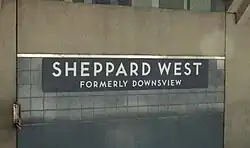
Two stations on the Spadina subway line have been renamed since it opened:
- Downsview station was renamed Sheppard West on May 7, 2017, in preparation for the opening of the adjacent Downsview Park station on the TYSSE later that year,[154] as the TTC felt the name Downsview did not accurately reflect the station's location and would mislead passengers into thinking Downsview Park was easily accessible from the station, when in actuality, the upcoming northern station would offer a more direct connection to the park.[155] The display of the original name on the platform walls was unique in the system as it was rendered in mixed-case lettering. The Shepaprd West name is rendered in all-uppercase lettering using the Toronto Subway typeface with smaller text at the bottom acknowledging the previous name. The new name is printed on a placard placed atop the previous name.
- Eglinton West station was renamed Cedarvale on December 7, 2025, shortly before the opening of Line 5 Eglinton in 2026 to avoid confusion with Eglinton station on the Yonge line and on Line 5.[156]
References
- ↑ Thompson, John (February 20, 2018). "TTC's subway to the suburbs". Railway Age. Retrieved March 24, 2026.
- ↑ "Canada's First Subway – Construction Begins". City of Toronto. Retrieved April 4, 2026.
- ↑ Thornburn, Margaret (March 6, 1954). "Yonge Street - From bush road to subway". The Globe and Mail. p. 17.
- ↑ Toronto Transit Commission (March 29, 1954). "Yonge Subway opens 1:30 P.M. Tuesday, March 30". Toronto Daily Star. p. 13.
- ↑ "Subway Spur to Run Deep in Red". Kitchener-Waterloo Record. February 26, 1963. p. 9.
- ↑ "University Subway Cars Ready to Roll in January". The Globe and Mail. August 23, 1962. p. 5.
- ↑ "Toronto opens new 8-mile subway line: Three train routings will provide improved service to downtown and crosstown areas. Additional extensions are coming". Railway Age. Vol. 160, no. 9. March 7, 1966. p. 23.
- ↑ "Expropriation Cleared For Spadina Route". The Globe and Mail. October 8, 1957. p. 4.
- ↑ "Spadina Rd. Extension Study Is Proposed". The Globe and Mail. February 17, 1954. p. 5.
- 1 2 3 Haggart, Ron (June 3, 1960). "North Shopping Plaza Forced 'Y' Change". Toronto Daily Star. Torstar. p. 7.
- ↑ "York Twp. Protests Again On Spadina Expressway Plan". The Globe and Mail. October 30, 1956. p. 28.
- ↑ "Chaos Feared If Expressways Slice Up Metro". The Globe and Mail. December 9, 1961. p. 5.
- 1 2 Hoy, Claire (June 3, 1971). "Cabinet rejects Spadina Expressway, OKs rapid transit". Toronto Daily Star. Torstar. pp. 1–2.
- ↑ "Planning Board Studies Subway For Spadina Rd". The Globe and Mail. December 22, 1955. p. 5.
- ↑ "Spadina Must Wait: Bloor Subway Report Is Expected This Week". The Globe and Mail. April 4, 1956. p. 5.
- 1 2 3 4 "Christie St. Subway Replaces Spadina Ave. Route in TTC Plans". The Globe and Mail. April 2, 1960. p. 5.
- 1 2 3 Best, Michael (November 18, 1961). "Story behind the subway 'blunder': Now It's the $22 Million Question". Toronto Daily Star. Torstar. p. 8.
- 1 2 3 "Don't Want Spadina Route Yet, TTC Informs Metro". Toronto Daily Star. Torstar. May 6, 1960. p. 37.
- 1 2 "Metro Council Orders Study Of New Subway". The Globe and Mail. September 23, 1959. p. 5.
- ↑ Haggart, Ron (May 31, 1960). "What the Subway Argument Means to the Rider". Toronto Daily Star. Torstar. p. 7.
- ↑ "1968 Set for Start On Spadina Subway". The Globe and Mail. February 26, 1959. p. 5.
- ↑ "TTC Reinstates Spadina Ave. Route in Surprise Measure: Lamport Calls Plan Befrayal of Riders". The Globe and Mail. April 27, 1960. p. 5.
- ↑ Haggart, Ron (June 1, 1960). "Personal Antagonisms Impair TTC Policy Making". Toronto Daily Star. Torstar. p. 7.
- ↑ Haggart, Ron (June 2, 1960). "Transfer Problem Is Basis of Subway Disagreement". Toronto Daily Star. Torstar. p. 7.
- ↑ "Bloor-University Y Subway Intersection Ordered by Metro: End to TTC Bickering Is Hope of Gardiner". The Globe and Mail. June 29, 1960. p. 5.
- ↑ Best, Michael (April 28, 1962). "Where Should Metro Build That Subway?". Toronto Daily Star. Torstar. pp. 1, 5.
- ↑ "Support Given To Extension Of New Subway". The Globe and Mail. February 23, 1963. p. 5.
- 1 2 Best, Michael (February 22, 1964). "Where should we build Toronto's next subway line? This computer holds the key". Toronto Daily Star. Torstar. p. 8.
- ↑ Baker, Alden (March 30, 1974). "TTC has contingency plan: Finch terminal opens amid fears of Yonge line congestion". The Globe and Mail. p. 5.
- ↑ "67 Yonge Subway Start Urged". The Globe and Mail. October 5, 1965. p. 5.
- ↑ "TTC gives priority to Queen subway over Spadina". The Globe and Mail. February 2, 1966. p. 1.
- ↑ "Row looms on delay of transit". The Globe and Mail. February 11, 1966. p. 5.
- ↑ "Wants Christie link: Allen asks new Spadina subway route". Toronto Daily Star. Torstar. September 17, 1966. p. 4.
- ↑ "Spadina subway, road to share same route". The Globe and Mail. July 30, 1968. p. 5.
- ↑ "TTC urges priority for Spadina transit". The Globe and Mail. September 14, 1968. p. 4.
- ↑ "Spadina order leaves TTC with problems". The Globe and Mail. February 26, 1969. p. 5.
- ↑ "Council votes to delay Spadina line funds until subway finished". The Globe and Mail. August 12, 1970. p. 5.
- ↑ "TTC is hoping for quick action on Spadina subway line, Day says". The Globe and Mail. June 9, 1971. p. 5.
- ↑ "Flaws in Spadina proposal cited: Planners urge subway review". The Globe and Mail. April 18, 1970. p. 5.
- ↑ "Jacobs testifies: Transit bankruptcy foreseen on Spadina". The Globe and Mail. January 21, 1971. p. 5.
- ↑ "Ready to begin building Spadina subway line within a year: TTC". The Globe and Mail. October 13, 1971. p. 5.
- ↑ "'If the province has made a decision.... . .then we have been seriously misled': Metro, not province, should make decision on route of Spadina subway, Campbell says". The Globe and Mail. October 5, 1971. p. 5.
- ↑ Valpy, Michael (October 4, 1971). "Word near on subway for Spadina". The Globe and Mail. p. 5.
- 1 2 "Task force report: Spadina route worst of five for subway". Toronto Star. Torstar. January 7, 1972. pp. 1, 3.
- ↑ "Ferocious opposition from ratepayers forecast: Proposed Spadina-Bathurst subway route would involve $180 million, 150 expropriations". The Globe and Mail. December 31, 1971. p. 5.
- ↑ MacKenzie, James (March 20, 1972). "Public confused over Spadina subway plans". The Globe and Mail. p. 5.
- ↑ "$1-million approved for Spadina subway design". The Globe and Mail. May 3, 1972. p. 5.
- ↑ "Toronto does not want subway to be built on Spadina route". The Globe and Mail. March 31, 1972. p. 39.
- 1 2 "No public hearings: Metro approves paving Spadina ditch down to Eglinton". Toronto Star. Torstar. September 9, 1972. pp. 1, 4.
- ↑ "Bathurst tunnel route chosen for new subway". The Globe and Mail. August 9, 1972. p. 5.
- ↑ "Hopes for 1976 completion: Campbell opposes rail plan, presses for Spadina subway". The Globe and Mail. December 21, 1972. p. 5.
- ↑ Coleman, Thomas (May 25, 1973). "Route of expressway is approved by OMB for Spadina subway". The Globe and Mail. p. 1.
- ↑ Szende, Andrew (August 2, 1973). "Cabinet gives go-ahead to Spadina subway line". Toronto Star. Torstar. p. B1.
- ↑ Coleman, Thomas (August 3, 1973). "City's position: a waste of taxpayers' money: Opponents resigned to decision on Spadina subway". The Globe and Mail. p. 5.
- ↑ "TTC okays 2nd Spadina station". Toronto Star. Torstar. May 23, 1974. p. A16.
- ↑ "TTC staff to restudy Lowther subway stop". The Globe and Mail. April 11, 1974. p. 5.
- 1 2 Baker, Alden (July 10, 1974). "City politicians angry at transfer possibility from Spadina subway". The Globe and Mail. p. 5.
- ↑ "Spadina line won't end at Bloor, TTC says". The Globe and Mail. July 11, 1974. p. 5.
- 1 2 "Way cleared for Lowther station as executive drops its opposition". The Globe and Mail. July 24, 1974. p. 5.
- 1 2 McNenly, Pat (August 19, 1974). "Spadina subway delay costs $50,000 a day TTC chairman says". Toronto Star. Torstar. p. C3.
- ↑ "Subway delayed for further study of Spadina station". Toronto Star. Torstar. July 10, 1974. p. B1.
- ↑ "TTC won't reconsider Lowther station need". Toronto Star. Torstar. July 18, 1974. p. B1.
- 1 2 Fear, Jonathan (March 2, 1977). "TTC opposes delayed opening". The Globe and Mail. p. 5.
- 1 2 3 4 "Spadina Subway". City of Toronto. Retrieved March 31, 2026.
- 1 2 3 Christie, Alan (December 31, 1977). "Zip! You're downtown in 25 minutes". Toronto Star. Torstar. p. A3.
- 1 2 Shepherd, Harvey (April 16, 1976). "Spadina subway on schedule". The Globe and Mail. p. 5.
- ↑ "SPADINA SUBWAY GROWING". Calgary Herald. The Canadian Press. July 30, 1975. p. 36.
- ↑ "Subway opening a year away". The Globe and Mail. September 23, 1976. p. 47.
- ↑ "Spadina line starts to roll". The Globe and Mail. March 4, 1975. p. 33.
- 1 2 Christie, Alan (January 28, 1978). "Take a ride on Spadina -- it's free". Toronto Star. Torstar. p. A6.
- ↑ McHugh, Patricia (2017). Toronto Architecture: A City Guide. Alex Bozikovic. Toronto: McClelland & Stewart. p. 216. ISBN 978-0-7710-5989-6.
- 1 2 3 4 Moffatt, Robert (July 3, 2013). "MOD TORONTO: Art and architecture on the Spadina subway". Spacing Toronto. Retrieved May 23, 2026.
- ↑ "Notes from the underground: Spadina rapid transit system, Toronto". The Canadian Architect. Business Information Group. August 1, 1978. pp. 36–45.
- ↑ "Toronto subway to get art". Calgary Herald. The Canadian Press. December 13, 1974. p. 74.
- ↑ Slater, Tom (January 31, 1976). "Subway Art: Is it worth $457,348? TTC wants to know what you think". Toronto Star. Torstar. pp. A1–A2.
- ↑ Shepherd, Harvey (January 30, 1976). "Welch to match: $80,000 is raised for subway art work". The Globe and Mail. p. 5.
- ↑ Fear, Jonathan (July 7, 1976). "Spadina line: Subway art back on tracks". The Globe and Mail. p. 1.
- ↑ "8 art works planned for Spadina subway". The Globe and Mail. January 19, 1977. p. 5.
- 1 2 Bruner, Arnold (January 30, 1978). "First day on Spadina subway a packed tube of good cheer". The Globe and Mail. p. 4.
- 1 2 Derek Flack (November 4, 2010). "Michael Hayden's Arc en ciel might return to Yorkdale Station". blogTO. Archived from the original on September 28, 2011. Retrieved September 19, 2011.
- ↑ "Members Motion - Authorization to Release Section 37 Funds to the Toronto Transit Commission for the Installation of Public Art at Yorkdale Subway Station" (PDF). City of Toronto. December 8, 2025. Retrieved May 23, 2025.
- ↑ Novakovic, Stefan (February 1, 2019). "Riding the Rocket: Toronto-York Spadina Subway Extension, Toronto, Ontario". Canadian Architect. Retrieved May 23, 2026.
In contrast, the Spadina line, whose generous stations were designed by Arthur Erickson and others, reflected the exuberance and expressionism of Canada's Centennial.
- ↑ Fraser, Graham (April 29, 1976). "Crombie backs plan for garage at Spadina's end". The Globe and Mail. p. 5.
- ↑ "Toronto's study team at odds with Premier over Spadina parking". The Globe and Mail. December 18, 1976. p. 5.
- ↑ Baker, Alden (May 14, 1976). "City's Spadina garage proposal rejected in Metro-TTC report". The Globe and Mail. p. 5.
- ↑ Christil, Alan (January 24, 1976). "Yorkdale mall plans to ban all-day parking by subway riders". Toronto Star. Torstar. p. A3.
- ↑ Shepherd, Harvey (September 21, 1976). "Metro would own, North York run them: Deal backed for parking lots at end of subways". The Globe and Mail. p. 41.
- ↑ Kurek, D (February 1, 2017). "TTC opens 1,000 new parking spaces at Yorkdale Station". North York Mirror. Metroland Media. Retrieved April 2, 2026.
- ↑ Toronto Transit Commission (2024). "Wilson Station Main Lot Permanent Closure (50 Wilson Heights Boulevard)". Archived from the original on November 28, 2024. Retrieved April 2, 2026.
- ↑ Mitchell, Don (September 26, 2017). "Toronto to survey use of TTC commuter parking lots facing closure". Global News. Corus Entertainment. Retrieved April 2, 2026.
- ↑ "TTC won't change station design, is called schizoid". The Globe and Mail. August 21, 1974. p. 5.
- ↑ "13 houses will fee razed for library, subway line". The Globe and Mail. October 25, 1974. p. 5.
- ↑ "SUBWAY EXTENSION". The Globe and Mail. September 18, 1974. p. 5.
- ↑ "Spadina Road to be closed". The Globe and Mail. March 21, 1975. p. 5.
- ↑ Baker, Alden (September 27, 1975). "Metro transport plan reaches $1 billion mark: Spadina subway spending estimates increase 41.9% to $220 million because of inflation". The Globe and Mail. p. 2.
- ↑ "Metro urged not to delay Spadina subway". The Globe and Mail. January 6, 1976. p. 5.
- ↑ Anderson, Marilyn (January 17, 1976). "Subcommittee recommends $123.4 million for rapid transit". Toronto Star. Torstar. p. A6.
- 1 2 Mironowicz, Margaret (July 30, 1977). "Spadina line: Test of subway is slow going". The Globe and Mail. p. 5.
- ↑ Mietkiewicz, Henry (August 13, 1977). "1977 opening now ruled out for Spadina line". Toronto Star. Torstar. p. A6.
- ↑ "Company news: Hawker Siddeley gets TIC order of $66 million". The Globe and Mail. July 9, 1975. p. B12.
- 1 2 "Yonge-University-Spadina one big subway". The Globe and Mail. January 25, 1978. p. 4.
- 1 2 "Spadina subway officially opens with lots of talk, loud music". The Globe and Mail. January 28, 1978. p. 5.
- ↑ "New Spadina line proves a timesaver". Toronto Star. Torstar. January 30, 1978. p. A3.
- ↑ Christie, Alan (January 31, 1978). "Delays -- but Spadina's a winner". Toronto Star. Torstar. p. A3.
- ↑ Christie, Alan (December 15, 1977). "Spadina subway opens Jan. 28 -- with free rides for everyone". Toronto Star. Torstar. p. B1.
- ↑ Jefferson, James (February 15, 1978). "New subway wasn't ready to open, TTC unionist says". The Globe and Mail. p. 1.
- ↑ "Subway-closing idea greeted with cheers". The Globe and Mail. February 17, 1978. p. 4.
- ↑ "Transit ads urged on Spadina overpasses: Leave the driving to us, TTC says". The Globe and Mail. April 26, 1978. p. 5.
- ↑ "TTC change not needed, report says". The Globe and Mail. July 29, 1978. p. 5.
- 1 2 "TRANSVERSE: A rhymer for Spadina". The Globe and Mail. August 22, 1979. p. 5.
- ↑ Baker, Alden (May 1, 1982). "Spadina: the expressway controversy without an end". The Globe and Mail. p. 5.
- 1 2 Fine, Sean (April 27, 1989). "Metro councillors approve Spadina subway extension". The Globe and Mail. pp. A1, A18.
- ↑ Toronto Transit Commission (July 21, 1991). "Service Summary" (PDF) – via Steve Munro.
- ↑ Toronto Transit Commission (November 24, 1991). "Service Summary" (PDF) – via Steve Munro.
- ↑ "TTC introduces new changes to improve service levels and reliability". City Centre Mirror. Metroland Media. September 4, 2016. Retrieved April 1, 2026.
- ↑ Toronto Transit Commission (February 16, 2020). "Service Summary" (PDF) – via Steve Munro.
- ↑ Toronto Transit Commission (June 21, 2020). "Service Summary" (PDF) – via Steve Munro.
- ↑ "If it could go wrong, it did on the subway". The Globe and Mail. February 8, 1978. p. 4.
- ↑ Stevens, Victoria (January 24, 1987). "Plan to extend Spadina subway to York University considered". Toronto Star (SA2 ed.). Torstar. p. A8.
- ↑ Board, Star Editorial (December 19, 2021). "Star Editorial Board: Mel Lastman's mayoralty was both an end and a beginning for Toronto". Toronto Star. Retrieved May 17, 2026.
- ↑ Rider, David; Pagliaro, Jennifer (December 11, 2021). "Mel Lastman, former mayor of Toronto, has died at 88". Toronto Star. Retrieved May 17, 2026.
- ↑ Duffy, Andrew (May 10, 1988). "Sorbara urges Spadina line extension to York U". Toronto Star (Final ed.). Torstar. p. A2.
- ↑ Swainson, Gail (March 29, 1990). "Politicians join forces to get subway". Toronto Star (NOR ed.). Torstar. p. N1.
- ↑ Wong, Tony (November 5, 1988). "Faubert criticizes foes of Spadina subway plan". Toronto Star (SA2 ed.). Torstar. p. A8.
- ↑ James, Royson (November 1, 1988). "Ontario plans Spadina subway extension to Sheppard". Toronto Star (Final ed.). Torstar. p. A6.
- ↑ Stevens, Victoria (May 31, 1988). "Regions to benefit more than Metro". Toronto Star (final ed.). Torstar. p. N11.
- ↑ Smith, Michael (April 27, 1989). "$160 million project starts in 2 years Spadina subway extension okayed". Toronto Star (Final ed.). Torstar. p. A6.
- ↑ Howell, Peter (April 21, 1989). "Minister considers 3 major options for improved transit service in Metro". Toronto Star (Final ed.). Torstar. p. A16.
- ↑ Howell, Peter (August 21, 1989). "Circular subway line under serious study Proposal links Spadina line to Yonge route". Toronto Star (Final ed.). Torstar. p. A6.
- ↑ "Finch subway 'dumb idea' Lastman says". Toronto Star (ME2 ed.). Torstar. August 30, 1989. p. A6.
- ↑ "Green light for transit". Toronto Star (Final ed.). Torstar. November 27, 1990. p. A20.
- ↑ James, Royson (January 6, 1993). "$1.8 billion subway loop gets new life". Toronto Star. Torstar. p. A2.
- ↑ James, Royson (January 7, 1993). "Metro gives green light to York U subway line". Toronto Star. Torstar. p. A6.
- ↑ MacLeod, Robert (November 26, 1991). "University blamed for helping delay Spadina extension Moscoe accuses York administration of trying to increase property value". The Globe and Mail. p. A12.
- ↑ DeMara, Bruce (January 8, 1992). "Spadina subway extension approved". Toronto Star (ME2 ed.). Torstar. p. A1.
- 1 2 "Work to start on Spadina subway line". Toronto Star (AM ed.). Torstar. June 22, 1992. p. A6.
- ↑ "All aboard! TTC goes to Downsview". Toronto Star (Final ed.). Torstar. March 30, 1996. p. A4.
- ↑ "Subway plan is rejected". Waterloo Region Record (Final ed.). February 24, 1995. p. A3.
- ↑ Nursall, Kim (March 4, 2014). "New system is as easy as 1-2-3, TTC says". Toronto Star. Torstar. p. GT3.
- ↑ "New TTC signage: Yonge-University-Spadina line becomes 1". CBC News. March 3, 2014. Retrieved May 24, 2026.
- ↑ Ferenc, Leslie (November 16, 2000). "Politicians revisit Vaughan subway plan; Extension would pass through York University". Toronto Star. Torstar. p. B7.
- ↑ Javed, Noor (April 6, 2012). "Toronto's subway brings downtown vision to Vaughan". Toronto Star. Archived from the original on August 15, 2016. Retrieved June 30, 2016.
- ↑ Moore, Oliver; Gray, Jeff (December 14, 2017). "Next stop, Vaughan: Inside the Toronto subway's big move beyond the city limits". The Globe and Mail. Archived from the original on December 15, 2017. Retrieved December 15, 2017.
- ↑ "Liberal budget heavy on money for transportation". CBC News. March 23, 2006. Archived from the original on June 1, 2008. Retrieved July 27, 2024.
$670 million to extend TTC subway system to Vaughan, north of the city.
- ↑ "Spadina North extension preferred alignment". City of Toronto. February 12, 2012. Archived from the original on May 24, 2006. Retrieved February 17, 2012.
- ↑ "Toronto-York Spadina Subway Extension breaks ground". Railway Gazette. November 30, 2009. Archived from the original on October 8, 2012. Retrieved April 5, 2026.
- ↑ TTC (March 26, 2008). "Toronto-York Spadina Subway Extension Project Delivery Strategy Process". Archived from the original on April 2, 2015. Retrieved March 6, 2015.
- ↑ "Work begins on subway extension into York". CTV News. July 9, 2008. Archived from the original on May 22, 2011. Retrieved April 4, 2026.
- ↑ "Tunnel boring for Toronto-York Spadina Subway Extension begins" Archived July 9, 2011, at the Wayback Machine TTC. June 17, 2011
- ↑ ""TTC Project News December 2013"". Archived from the original on February 22, 2014. Retrieved February 13, 2014.
- ↑ "Spadina subway extension may miss 2016 completion date". CBC News. November 5, 2014. Retrieved July 26, 2024.
- ↑ Hui, Ann (April 13, 2015). "TTC hires firm to manage troubled Spadina subway extension". The Globe and Mail. Archived from the original on August 18, 2015. Retrieved May 9, 2015.
- ↑ "Justin Trudeau joins premier, mayor at TTC line 1 extension opening". CBC News. Canadian Broadcasting Corporation. December 15, 2017. Retrieved April 4, 2026.
- ↑ "Downsview station officially becomes Sheppard West". CBC News. May 7, 2017. Retrieved July 26, 2024.
- ↑ "TORONTO-YORK SPADINA SUBWAY EXTENSION – STATION NAMES" (PDF). Toronto Transit Commission. September 30, 2010. Archived (PDF) from the original on July 28, 2017. Retrieved April 14, 2017.
- ↑ Smith, Joshua (December 2, 2025). "TTC to officially rename Dundas and Eglinton West stations this weekend". Toronto Star. Retrieved December 9, 2025.
| Subway | |||||||||
|---|---|---|---|---|---|---|---|---|---|
| Streetcars | |||||||||
| Bus | |||||||||
| History |
| ||||||||
| Predecessors |
| ||||||||
| Facilities | |||||||||
| Proposed | |||||||||
| Miscellaneous | |||||||||
Projects under construction are listed in italics and with a dagger (†) | |||||||||


