Soprano cornet
 An E♭ cornet | |
| Brass instrument | |
|---|---|
| Classification | |
| Hornbostel–Sachs classification | 423.231[1] (Valved aerophone sounded by lip vibration featuring a conical bore) |
| Developed | 19th century |
| Playing range | |
 | |
| Related instruments | |
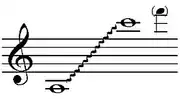
The soprano cornet is a cornet, similar in design to the standard B♭ cornet, but smaller and pitched in E♭, a fourth higher. It is a transposing instrument.
History
The soprano cornet was invented around 1844, and it gradually replaced the difficult soprano saxhorn in ensembles. In the twenty years after its invention the soprano cornet was more commonly pitched in D♭. [3]
Playing technique and sound
Soprano cornets often have issues with intonation.[3][4] It is harder to play than a B♭ cornet because of the smaller mouthpiece, and it produces a lighter and airier sound.[5][6] It has also been described as having a "wispy, flute-like" sound.[3]
Ensembles
A single soprano cornet is usually seen in brass bands and silver bands and can be found playing lead or descant parts in other musical ensembles.[5] They can be heard clearly within a group of B♭ cornets.[7]
Notable players
Notable players of the soprano cornet include Charlie Cook, John Distin, Paul Duffy, and Peter Roberts.[3][5]
Further reading
- Introduction to the E♭ soprano cornet by Bram Gay original from Sounding Brass, Issue 6, 1977.
References
- ↑ "Discussion of brass instruments". Retrieved 2009-08-19.
- ↑ "The Brass Crest, Cornet". Retrieved 2009-08-19.
- 1 2 3 4 Chen, Yanbin (2019). "Soprano Cornet: The Hidden Gem of the Trumpet Family" (PDF). ibew.org.uk. Athens, Georgia. Retrieved 13 September 2025.
- ↑ "The Art of Soprano Playing – Gary Fountain – The Salvation Army USA East Music Department". music.saconnects.org. Retrieved 2025-09-13.
- 1 2 3 "History and Types of Cornets". Brass 'n Wind. Retrieved 2025-09-13.
- ↑ "Introducing the Soprano Cornet - North Tyneside Brass in Schools". 2020-12-09. Retrieved 2025-09-13.
- ↑ "Brass Band Information". www.saskatoonbrassband.org. Retrieved 2025-09-13.