Siege of Constantinople (1394–1402)
| Siege of Constantinople | ||||||||
|---|---|---|---|---|---|---|---|---|
| Part of the Byzantine–Ottoman wars | ||||||||
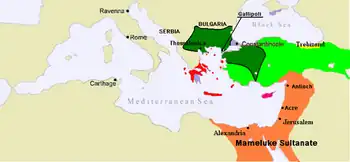 Map of the Middle East c.1389. Serbia has been reduced to vassal status and Byzantium (purple) consists only of Constantinople and a few outer posts. | ||||||||
| ||||||||
| Belligerents | ||||||||
 Byzantine Empire  Republic of Venice |
 Ottoman Empire | Timurid Empire | ||||||
| Commanders and leaders | ||||||||
|
Manuel II Palaiologos Jean II Le Maingre |
Bayezid I Ali Pasha | Timur | ||||||
| Strength | ||||||||
| Larger than the Christians | |||||||
  Location within Mediterranean | ||||||||

The siege of Constantinople from 1394 to 1402 was a long blockade of the capital of the Byzantine Empire by the Ottoman sultan Bayezid I. Already in 1391, the rapid Ottoman conquests in the Balkans had cut off the city from its hinterland. After constructing the fortress of Anadoluhisarı to control the Bosporus strait, Bayezid tried to starve the city into submission by blockading it both by land and, less effectively, by sea.
The Crusade of Nicopolis was launched to relieve the city, but it was decisively defeated by the Ottomans. In 1399, a French expeditionary force under Marshal de Boucicaut arrived, but was unable to achieve much. The situation became so dire that in December 1399 the Byzantine emperor, Manuel II Palaiologos, left the city to tour the courts of Western Europe in a desperate attempt to secure military aid. The emperor was welcomed with honours, but secured no definite pledges of support. The city was relieved when Bayezid had to confront the invasion of Timur in 1402. Bayezid's defeat in the Battle of Ankara in 1402 and the subsequent Ottoman civil war enabled the Byzantines to regain some lost territories in the Treaty of Gallipoli.
Background
Siege of 1394
After the capture of Gallipoli in 1354, the Ottomans gained a base for constant raids on the Balkan states. In 1374, Byzantium became a vassal of the Ottoman Sultan. The Byzantine Emperor John V Palaiologos died on February 16, 1391. His son, Manuel II Palaiologos, who was held hostage by Bayezid I in Bursa, managed to escape to take the Byzantine throne. This angered Bayezid I and led to Bayezid's siege of Constantinople, which lasted 7 months.[2][3] After Manuel made significant concessions, the siege was lifted. In particular, in addition to the establishment of an Islamic court in Constantinople, a six-thousand-strong Ottoman garrison was also stationed in the city, and an entire quarter of the city was allocated for Muslim settlers.[4][5]
Prelude
Soon Manuel was summoned to the Sultan's camp in Anatolia, demanding that he join Bayezid's campaign. Leaving his mother as regent in Constantinople, Manuel submitted to the Sultan's order on June 8, 1391. Manuel was forced to remain with Bayezid until January 1392. What he observed and experienced is reflected in letters sent home. Bayezid's campaign, in which Manuel and his nephew John took part, aimed to conquer Kastamonu and Sinop, cities of the Jandarids. In this campaign, Manuel was able to see what the Greek cities conquered by the Ottomans were becoming and the destruction they were subjected to.[6]
In the winter of 1393/94, Bayezid I gathered his vassals in Serres to reassert his authority and denounce the Palaiologoi and their policies in the Morea.[7] The rulers of the states under Bayezid's control received the summons personally, each unaware that someone else had been summoned. They were surprised to meet each other under such circumstances and decided that the sultan had gathered them all to kill them. Manuel left the meeting retaining his imperial crown, but when he received a new summons from Bayezid I, he refused to obey, remembering his fright. Combined with the resistance of Theodore, the despot of the Morea, this aroused the wrath of the sultan, who in September 1394 ravaged the environs of Constantinople and began a blockade of the city.[8]
Siege
Crusade of 1394–1396
Between 1394 and 1396, Constantinople was blockaded by land. It was enough for the Ottomans that no one could enter or leave the city. In early 1394, Manuel II contacted the Venetians, who feared for the success of their trade operations if the city were captured by the Turks. The Venetians sympathized with Manuel's situation, sending grain to Constantinople and making efforts to reach an agreement with their competitor and enemy, Genoa. They also suggested that Manuel seek help from the Pope.[9]

The risk of seeing Constantinople in Turkish hands mobilized many in Europe, especially in Hungary, which could become the next victim of the Ottoman advance in the Balkans. Despite Mircea the Old's victory in 1394 or 1395 at the Battle of Rovine, Wallachia became an Ottoman vassal in 1395.[10] The Despotate of Morea survived the Turkish invasion of 1394–1395. Byzantine ambassadors went to the court of Charles VI and the Duke of Lancaster, who was in Bordeaux. Eventually, the Duke of Mézières gathered several thousand Frankish knights. This army, led by Jean de Nevers, included Marshal Boucicaut and other famous and noble knights of the time. They joined the Hungarian army led by Sigismund . The Venetians hesitated, delaying the campaign that began in April 1396. The armies assembled in Buda in July. The French favored an offensive, while Sigismund advocated caution, but he was forced to agree with the allies' point of view.[11] Meanwhile, the Venetian flotilla, led by Tommaso Mocenigo, managed to reach Constantinople by sea.[12] This fleet was supposed to protect the straits and ensure communication between Byzantium and the crusaders. However, despite several successes against the Turks, on September 25, 1396, the crusaders suffered a heavy defeat near Nicopolis.[13]
The consequences of this defeat were dramatic for Constantinople, whose leaders were counting on the Crusaders' success to free themselves from the Ottoman blockade. Thus, Bayezid I was quickly able to resume his actions against the Byzantine Empire and captured the suburbs of Constantinople and its outpost, Silivri. The blockade developed into a full-fledged siege. Moreover, Mocenigo's departure allowed the Turks to strengthen the blockade of the city.[14] Most of Bayezid I's troops remained at Constantinople, with the exception of 30,000 men under Evrenos, who were sent to ravage the Morea.[15]

The Venetians recognized the scale of the threat to Byzantium and their trade interests. By the end of 1396, they had allocated funds for the maintenance of a fleet to defend Constantinople. The Genoese, whose colony in Galata had already suffered, also agreed to add their ships to the Venetian squadron. Manuel refused to surrender the city without a fight. To increase the pressure, Bayezid I built the fortress of Anadoluhisarı on the Asian shore of the Bosphorus and planned to use John VII Palaiologos to depose Manuel II. Supplying the city became difficult, the inhabitants suffered from hunger, and many fled. As for Manuel II, he continued to hope for outside support and sent out pleas for help.[16][17]
The French intervention
In 1397, the blockade was less severe, but Manuel II sent several embassies to request support. The Patriarch of Constantinople called on the kings of Poland and Hungary to launch a new crusade. An embassy requesting assistance from the Patriarch of Constantinople came to the Grand Prince of Moscow Vasily. Although Vasily did not plan to send troops, he announced a fundraising campaign. Princes Mikhail of Tver, Oleg of Ryazan, and Vitovt were involved in the collection. A large sum of 20,000 silver rubles was collected for the Byzantines.[18] It was rumored that in 1397, John VII, through Genoese intermediaries, offered to sell his title to the French king. Boniface IX attempted to provide financial support to the Byzantine Empire by asking Catholic princes to provide money to Constantinople in exchange for indulgences. The King of England, Henry IV, managed to collect about 2,000 pounds sterling, which, however, never reached the Byzantine capital.[19]
Theodore Cantacuzene, uncle of Manuel II, went as an envoy to London and Paris. After meeting with him, King Charles VI decided to send Marshal Boucicaut, who had taken part in the Battle of Nicopolis, to Constantinople. The marshal left Aigues-Mortes on June 26, 1399, with a detachment (of 1,200[20][21] or 2,000[22]) men and went to the Aegean Sea, where he joined a joint squadron of Venice, Rhodes, and Lesbos. In the summer, he reached Constantinople, where he was welcomed by the inhabitants, who had been under siege for almost 5 years. Several sorties undertaken against the Turks brought the Byzantines some temporary victories. Boucicaut managed to destroy the castle of Riva Kalesi, which protected the exit to the Black Sea.[20][22]
However, Boucicaut's detachment was not enough. While strengthening the defense of Constantinople, the marshal managed to reconcile Manuel II with John VII. Boucicaut then persuaded Manuel to travel with him to Europe to urge the Catholic princes to a new crusade. Manuel II accepted this proposal. Leaving John VII as his deputy, Manuel II set out for the West on December 10, 1399. In his place, Boucicaut left his officer Jean de Châteaumorant with a detachment of 100 men.[23][24]
Diplomatic efforts of the Greeks

Manuel started in Venice and then visited various Italian cities, such as Milan and Padua. He also met with the Pope, who renewed calls for crusades and financial support from Constantinople. At that time, Italy was beginning to take an interest in Greek culture, and the Italian princes warmly welcomed Manuel. But Manuel was looking for military assistance, so in June 1400 he went to Paris, where he met Charles VI . The latter promised him to send Marshal Boucicaut to Constantinople at the head of a new expedition. The Emperor also made contact with the kings of Castile and Aragon. Likewise, he tried to appeal for help to King Henry IV of England, whom he met at the end of 1400. Encouraged, Manuel returned from his trip to England in February 1401 without having achieved any real assistance, except for the sum of 3,000 marks provided by Henry IV.[26] Upon returning to Paris, Manuel sent letters to Aragon and Portugal , but also received no concrete assistance. Little by little, Manuel II's enthusiasm evaporated, as none of the European rulers showed interest in the pleas of Constantinople or the requests of Venice, which refused to intervene alone.[27][28]
In Constantinople, separate French troops under the command of Châteaumorand carried out several sorties against the Turks, especially in search of food :[29]
And thus he held it [the city] for three years against the Turks. In short, he and his men did so much that those who know the truth say that through him and the good Frenchmen who were with him, the noble and ancient city of Constantinople was saved from ruin and destruction. This, without a doubt, was highly pleasing to God and brought great honor to the King of France and the French, who proved their bravery and became a blessing to Christians.[30]
As for Bayezid I, he did not undertake any offensive actions on a scale sufficient to capture Constantinople. The city's residents, as they did later in 1422, attributed this to the intercession of the Virgin Mary. Some sources attributed the sultan's inaction to the activities of John VII and Patriarch Matthew. There are dubious reports of attempts by John in the summer of 1401 to reach an agreement with Bayezid I. Rumors circulated that the Genoese in Galata, out of desperation, agreed to pay an annual tribute to the sultan. Even Patriarch Matthew was suspected of secret dealings with the enemy, although he refuted this accusation in an encyclical.[31]
At this time, Timur appeared on the eastern borders of the Ottoman Empire. In 1399, Sultan Bayezid I began to demand tribute from the emir of Erzincan, a vassal of Tamerlane. This caused a conflict and Tamerlane undertook a campaign in Anatolia. In 1400, Tamerlane took Sivas. Byzantium hoped to use Tamerlane as an ally. In August 1401, John VII sent a Dominican monk as an ambassador to Tamerlane to express his respect and offer to pay the tribute that Byzantium paid to Bayezid I in case of the latter's destruction.[32] On July 28, 1402, the two armies met near Ankara, and the Ottoman army was defeated and Bayezid I was captured. Thus, the siege of Constantinople ended in the summer of 1402.[33]
Result
Manuel learned of Bayezid I's defeat in September 1402 in Paris, when Châteaumorant returned from Constantinople. The emperor returned to Constantinople on June 9, 1403, the same day John VII signed a treaty with Bayezid's son, Suleiman Çelebi , who governed Rumelia. The siege itself had no direct consequences for the events of the Byzantine-Ottoman War. The Byzantine Empire did not lose this confrontation only thanks to the intervention of Timur.[34] After the siege ended, the Byzantine Empire was able to take advantage of the Ottoman interregnum to recapture some cities, including Thessaloniki, but was never able to recover enough to become an important political player.[35] One of the reasons Bayezid I did not force an active assault was the lack of firearms. Although it is known that the Ottomans used cannons in 1394 and 1402, these were isolated instances. The next use of artillery by the Ottomans, albeit unsuccessful, occurred at the walls of Constantinople in 1422.[36]
Aftermath
According to a Byzantine short chronicle compiled in c. 1425, "on 10 June, Wednesday, at the fourth hour after midday, Mihaloğlu attacked Constantinople", thus beginning the siege of the city. The eyewitness John Kananos describes how the vanguard under Mihaloğlu ravaged the city's suburbs, before Murad himself arrived on 20 June with the main army and the siege engines, and the siege began in earnest.[37] Murad was forced to lift the siege due to the rebellion of his younger brother, Küçük Mustafa, in Anatolia. This was supported with men by the Anatolian beyliks of Germiyan and Karaman, who feared a revival of Ottoman power, as well as, according to Doukas, money given by the Byzantine emperor. Mustafa was thus able to gather a significant army, and in late August or early September laid siege to the Ottoman capital, Bursa.[38] Contemporary Byzantine tradition ascribed the deliverance of Constantinople to a miraculous intervention by the Theotokos.
References
- ↑ Setton 1976, p. 608.
- ↑ Bréhier 2006, p. 447.
- ↑ Nicol 1972, p. 296.
- ↑ Kinross 1999, p. 74–75.
- ↑ Nicol 1972, p. 296–297.
- ↑ Nicol 1972, p. 297–298.
- ↑ Bréhier 2006, p. 450–461.
- ↑ Nicol 1972, p. 300–302.
- ↑ Nicol 1972, p. 302.
- ↑ Ostrogorsky 2011, p. 573.
- ↑ Nicol 1972, p. 304.
- ↑ Le Roulx 1886, p. 286–287.
- ↑ Ostrogorsky 2011, p. 661.
- ↑ Nicol 1972, p. 305.
- ↑ Nicol 1972, p. 305–306.
- ↑ Nicol 1972, p. 306.
- ↑ Ostrogorsky 2011, p. 664.
- ↑ Vasiliev 1912, p. 48–49.
- ↑ Nicol 1972, p. 307.
- 1 2 Nicol 1972, p. 307–308.
- ↑ Vasiliev 1912, p. 51.
- 1 2 Bréhier 2006, p. 453.
- ↑ Bréhier 2006, p. 453–454.
- ↑ Nicol 1972, p. 308.
- ↑ "St Alban's chronicle". p. 245.
- ↑ Nicol 1972, p. 308–313.
- ↑ Ostrogorsky 2011, p. 664–665.
- ↑ Bréhier 2006, p. 454–455.
- ↑ Nicol 1972, p. 312.
- ↑ Livre des 1840, p. 607.
- ↑ Gautier 1965, p. 100–117.
- ↑ Nicol 1972, p. 314.
- ↑ Ostrogorsky 2011, p. 666–667.
- ↑ Nicol 1972, p. 318–320.
- ↑ Nicol 1972, p. 320–335.
- ↑ Penskoy 2010.
- ↑ Imber 1990, p. 94.
- ↑ Imber 1990, p. 95.
Sources
- Vasiliev, Alexander A. (1912). "The Journey of the Byzantine Emperor Manuel II Palaiologos through Western Europe". Journal of the Ministry of National Education. XXXIX. Saint Petersburg: V. S. Balashev Printing House: May: 41–78, June: 260–304.
- Imber, Colin (1990). The Ottoman Empire: 1300-1481. Isis. ISBN 978-975-428-015-9.
- Kinross, Lord (1999). The Ottoman Centuries: The Rise and Fall of the Turkish Empire (in Russian). Moscow: Kron-Press. p. 696. ISBN 5-232-00732-7.
- Ostrogorsky, George A. (2011). P. V. Kuzenkov (ed.). History of the Byzantine State. Translated by M. V. Graziansky. Moscow: Sibirskaya Blagozvonnitsa. p. 895. ISBN 978-5913624581.
- Penskoy, Vitaly V. (2010). "Guns for the Sultan: The Ottoman Army at the Height of its Power (Late 15th–Early 16th Centuries)". The Great Firearms Revolution. Moscow: Eksmo. ISBN 978-5-699-40936-5.
- Livre des (1840). Livre des faits du bon messire Jean le Maingre, dit Bouciquaut, mareschal de France et gouverneur de Jennes. Les chroniques: qui traitent des merveilleuses emprises, nobles aventures et faits d'armes advenus en son temps en France, Angleterre, Bretaigne, Bourgogne, Escosse, Espaigne, Portingal et ès autres parties (in French). Paris: Desrez. p. 708.
- Bréhier, Louis (2006). Vie et mort de Byzance (in French). Paris: Albin Michel.
- Gautier, Paul (1965). "Un récit inédit du siège de Constantinople par les Turcs (1394–1402)". Revue des études byzantines (in French). 23: 100–117.
- Nicol, Donald M. (1972). The Last Centuries of Byzantium. Cambridge: Cambridge University Press. pp. 296–317.
- Setton, Kenneth M. (1976). The Papacy and the Levant, 1204–1571: The Fifteenth Century. New York: American Philosophical Society. p. 608. ISBN 9780871691279.
- Le Roulx, Joseph Delaville (1886). La France en Orient au XIVe siècle (in French). Paris: E. Thorin. p. 354.