Shivalik Fossil Park
| Shivalik Fossil Park | |
|---|---|
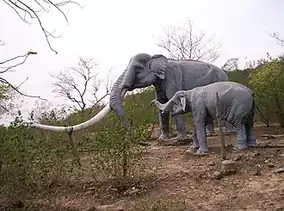 Model of the extinct Stegodon at the park | |
  Location within Himachal Pradesh | |
| Location | Saketi, Sirmaur district, Himachal Pradesh, India |
| Coordinates | 30°38′24″N 77°26′24″E / 30.64000°N 77.44000°E |
| Created | 1969 |
| Operator | |
Official name | Shivalik Fossil Park |
| Designated | 1974 |
Designated by | Geological Survey of India |
Shivalik Fossil Park, also known as the Suketi Fossil Park, is a protected paleontological site in Suketi in Sirmaur district in the Indian state of Himachal Pradesh. The park was notified as a National Geological Monument by the Geological Survey of India in 1974. It contains prehistoric vertebrate fossils and skeletons recovered from the Siwaliks. The park displays these fossil finds along with six life-sized fiberglass models of extinct mammals, recreated in a Plio-Pleistocene landscape dating to about 2.5 Ma. A museum within the park houses and exhibits the fossils.
Geography and history
The fossil park is located in Saketi in Sirmaur district, Himachal Pradesh.[1][2] It is located in the Markanda River valley, in the Siwalik range of the Himalayas. The park, extensively forested, is spread out over an area of 15 km2 (5.8 sq mi) at Suketi.[1]
The site was discovered by the Geological Survey of India in 1969 and the park was established in association with the Government of Himachal Pradesh on 23 March 1974.[1][3] It was notified as a National Geological Monument in the same year.[1][4]
Fossils and geology
The park is located on rocks of the Saketi Formation, which forms the lower part of the Upper Siwalik Subgroup and Tatrot Formation of the Middle Siwalik sequence, dating to the Upper Pliocene (about 5.3–2.6 Ma). It rocks of the Siwalik Group, dating to Middle Miocene and Pleistocene (10 to 1.5 Ma), contain several fossils. The Siwaliks are the southernmost and geologically youngest division of the Himalayas. It is mainly composed of mudstone, sandstone, and conglomerate rock formations.[1] The park provides a miniature representation of the prehistoric biological record preserved in the Upper Siwalik rocks.[5][6] The park preserves a collection of fossils recovered from Saketi and nearby areas.[1]
Features
Museum
The Siwalik Fossil Museum was opened in May 2014 in the premises of the park. The museum exhibits skeletal and fossil remains of prehistoric biota from across India.[1][7][8] These include fossilised jaws and skulls of the extinct species such as Stegodon insignis, Stegodon ganesa, Hexaprotodon sivalensis, Enhydriodon sivalensis, Colossochelys atlas, Gavialis browni, Sivatherium giganteum, and Paramachairodus sp. The collection also includes fossil turtle shells, ancient fish remains, skulls and teeth of crocodilians.[9][10][11] The museum also displays stone tools used by Early Paleolithic humans, dating back about 2.5 Ma and recovered from the Indian subcontinent.[1] It also houses antiquities discovered by Proby Cautley in the area, including remains considered to be among the oldest evidence of human ancestors in Asia.[12]
Mammalian models

The park displays six life-sized fiberglass models of prehistoric animals that lived in the region about millions of years ago. These include a sabre-toothed cat, which had very long upper canine teeth and became extinct about a million years ago; a hippopotamid with a large mouth, small brain cavity, long lower jaw and short, pig-like legs; and a giant tortoise that was much larger than its modern relatives. The park also displays models of giant proboscians that lived in the region between about 7 and 1.5 million years ago. They had smaller skulls, very long tusks and large limbs compared with modern elephants. Another model represents a four-horned giraffe that lived in the region during the same period and had a large skull and relatively short neck. The last of these models feature an extinct crocodilian species from the gharial family. These models are placed in a recreated landscape representing the environment of the Plio-Pleistocene period.[1][9]
See also
- Ghughua Fossil Park – National Park in Madhya Pradesh, India
- Kalesar National Park – Protected area in Haryana, India
- Khol Hi-Raitan Wildlife Sanctuary – Protected area in Haryana, India
- Marine Gondwana Fossil Park – Paleontology site in Chhattisgarh
- Mandla Plant Fossils National Park – National Park in Madhya Pradesh, India
- National Fossil Wood Park, Sathanur – Fossil park and protected area in Sathanur, India
- National Fossil Wood Park, Tiruvakkarai – Fossil park in Tiruvakkarai, India
References
- 1 2 3 4 5 6 7 8 9 National Geo-heritage of India (PDF) (Report). Indian National Trust for Art and Cultural Heritage. pp. 39–41. Archived from the original (PDF) on 11 January 2017.
- ↑ Chatterjee, Ramananda (1974). The Modern Review. Vol. 134. Modern Review Office. p. 351.
- ↑ Chand, Diwan (1974). Indian Recorder and Digest. Vol. 20. Indian Information Centre. p. 22.
- ↑ "Geo-Heritage Sites". Press Information Bureau (Press release). 9 March 2016. Archived from the original on 29 September 2022. Retrieved 1 September 2018.
- ↑ Anantharāmu, Ṭi. Ār; Sundaram, R. (2001). Rāshṭrīya Bhūvaijñānika smārakeṃ. Geological Survey of India. p. 23.
- ↑ Wang, Xiaoming; Flynn, Lawrence John (1 January 2013). Fossil Mammals of Asia: Neogene Biostratigraphy and Chronology. Columbia University Press. p. 356. ISBN 978-0-231-15012-5.
- ↑ Levrault, F.G. (1994). Mémoires de la Société géologique de France. Société géologique de France. pp. 67–68.
- ↑ Mukerji, Anath Bandhu (1992). Himalayan environment, man, and the economic activities. Pointer Publishers. p. 171. ISBN 978-8-17132-046-2.
- 1 2 "Asia's lone fossil park". The Tribune. 26 July 2003. Archived from the original on 28 December 2024. Retrieved 1 June 2026.
- ↑ "Siwalik Fossil Museum". Geological Survey of India. Retrieved 1 June 2026.
- ↑ "The Siwaliks: Fossil Heaven On Earth". Wildlife Conservation Trust. Archived from the original on 6 December 2025. Retrieved 1 June 2026.
- ↑ Aitken, Bill (2003). Footloose in the Himalaya. Orient Blackswan. p. 161. ISBN 978-81-7824-052-7.
External links
- 1974 establishments in Himachal Pradesh
- 1974 in paleontology
- Buildings and structures in Sirmaur district
- Cenozoic paleontological sites
- Fossil parks in India
- Himalayan studies
- Museums in Himachal Pradesh
- National Geological Monuments in India
- Protected areas of Himachal Pradesh
- Protected areas established in 1974