Sheffield is traditionally an industrial city that grew rapidly during the late 18th and early 19th centuries, with steelmaking and coal mining being the predominant industries. Much of the city was redeveloped after World War II; the city's steel industry made it a target for the Luftwaffe in the Sheffield Blitz. Sheffield Hallam is one of the country's most affluent constituencies with very low levels of deprivation.[3] Suburbs like Ranmoor, Whirlow and Dore contain many large detached and semi-detached properties,[4] many of which were built for the city's wealthy industrialists.[5] These neighbourhoods lie in the foothills of the Peak District and the constituency stretches past the suburbs to include an area of rural hamlets, farms and moorland. House prices across the constituency are generally higher than the UK average and considerably higher than the rest of Yorkshire.[6]
Residents of Sheffield Hallam are older than average; there is a large student population due to the constituency's proximity to Sheffield's universities, however there is a low working-age adult population and a high proportion of retirees.[7] Residents have very high levels of income and homeownership and the child poverty rate is less than half the overall UK figure.[6][8] Residents are very well-educated and a high proportion work in the education, health and finance sectors.[6][9] The percentage claiming unemployment benefits is less than half the UK-wide rate.[8]White people made up 88% of the population at the 2021 census.[10]
Most of Sheffield Hallam is represented by Liberal Democrats at the local city council, with some Labour Party councillors elected in Crookes and Crosspool and Green Party councillors elected in Ecclesall. Voters in this constituency strongly supported remaining in the European Union in the 2016 referendum; an estimated 69% voted to remain compared to the UK-wide figure of 48%.[6]
History
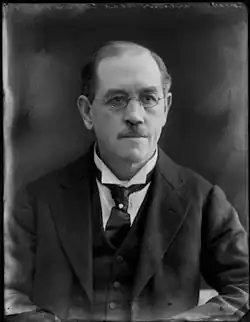
Prior to its creation Hallam was a part of the larger Sheffield Borough constituency, which was represented by two Members of Parliament (MPs). In 1885 the Redistribution of Seats Act, which sought to eliminate constituencies with more than one MP and for the first time allow approximately equal representation of the people, led to the break-up of the constituency into five divisions: each represented by a single MP, as today. Hallam was one of these new divisions. Its first MP, the Conservative Charles Stuart-Wortley, had previously been an MP in the Sheffield constituency, elected for the first time in 1880.
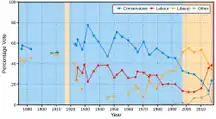
Hallam was regarded in 2004 as the wealthiest constituency in the north of England[11] and was held by the Conservative Party for all but two years from 1885 to 1997. At the 1997 general election, Richard Allan of the Liberal Democrats took the seat with an 18.5% swing, becoming only the second non-Tory ever to win it. He handed the seat to fellow Lib Dem and future UK Deputy Prime Minister, Nick Clegg in 2005; who held it until his defeat by Labour's Jared O'Mara at the 2017 snap general election. That year saw the constituency record its highest turnout in 66 years, with 77.8% of the electorate going to the polls.
Sheffield Hallam was once only constituency in South Yorkshire not to be considered a Labour stronghold, returning its first Labour MP in 2017. It was a safe Conservative seat from 1885 until 1997. This long period of Conservative dominance included the period under Margaret Thatcher's premiership, starkly contrasting with most seats in the county and the neighbouring county of Derbyshire; the constituency was the only Conservative seat in South Yorkshire in the three elections before the 1997 General Election.
At the 1997 general election, Richard Allan of the Liberal Democrats took the seat with an 18.5% swing. He was followed by Nick Clegg in 2005, who was leader of the Liberal Democrats from 2007 to 2015 and Deputy Prime Minister from 2010 to 2015. Clegg held it until his defeat by Labour's Jared O'Mara at the 2017 snap general election.[12] That year saw the constituency record its highest turnout in 66 years, with 77.8% of the electorate going to the polls.
From 25 October 2017 until 3 July 2018, O'Mara had the whip withdrawn as a Labour MP and sat as an independent. It was later restored but he quit the Labour Party shortly afterwards.[13] He then sat as an independent MP until leaving parliament.[14] O'Mara announced he would resign as an MP in September 2019, citing mental health issues.[15] He postponed his resignation until the 2019 general election.[16]
In 2010, Sheffield Hallam was one of a number of constituencies that experienced problems on polling day leading to some people being unable to cast their vote. In this case, voters at the Ranmoor polling station were subjected to long queues and some voters were turned away when polls closed at 10pm, with Liberal Democrat candidate Nick Clegg apologising to those voters affected. Acting Returning Officer John Mothersole said that staff had been "caught out" by a high turnout, and the Electoral Commission instigated a review of procedures in Hallam and other constituencies where similar problems had occurred.[31]
Constituency polls during the 2010–2015 Parliament
Due in part to the high profile of the constituency's then-MP Nick Clegg, who served as Deputy Prime Minister during the 2010–15 Parliament, Sheffield Hallam was unusual in having had seven constituency-specific opinion polls conducted between 2010 and 2015. Each of these polls suggested significant changes in the vote share compared to 2010 general election.
The first poll, in October 2010, suggested a drop in the Lib Dem lead in the seat to just 2%, from nearly 30% at the general election five months earlier. Five of the six remaining polls, which appeared between May 2014 and May 2015, suggested that Labour was in the lead in the seat by this time, with the Labour lead fluctuating to between 1% and 10%, and one put the Lib Dems in the lead.
On average across all seven opinion polls, Labour had a lead over the Lib Dems of 2.5%. The Conservatives came second in one poll, and third in the other six polls. The May 2015 ICM poll scores displayed are those of the constituency voting intention question. The same poll also carried the standard voting intention question, which showed a Labour lead.[40][41][42][43][44][45][46]
↑At the 1997 general election the seat saw an unprecedented 18.2% one-party swing from the other parties, particularly the large Conservative vote, towards the Liberal Democrat winning candidate.
↑After 28 years as MP for the seat, John Osborn stood down at the 1987 general election. His replacement as the Conservative Party candidate, local businessman Irvine Patnick, held the seat for the Conservatives with a slightly reduced majority.
12David Blunkett, the losing February 1974 Labour candidate, won the Sheffield Brightside seat in 1987 enabling his later positions in government as Secretary of State (1997–2005).