Seven Sages of Meishan
The Seven Sages of Meishan (also known as the Seven Sages of Mount Mei, Seven Saints of Meishan, or Seven Sages of Plum Mountain; simplified Chinese: 梅山七圣; traditional Chinese: 梅山七聖; pinyin: Méishān Qī Shèng) are a group of deities and spirit-generals in Chinese folklore and Daoism. They are described as followers of the god Erlang Shen and are associated with the Meishan mountain region. Stories about the Seven Sages appear in the novels Investiture of the Gods and Journey to the West, as well as in the religious text The Precious Scroll of Erlang (二郎宝卷).[1]
Description and origin
The earliest known version of the Six Brothers of Meishan (梅山六兄弟) appears in the Yuan dynasty religious text The Precious Scroll of Erlang. The group was later featured in the late Ming dynasty novel Journey to the West, in which Erlang Shen is the sworn brother of six men from Mount Mei. The novel places the seven figures in the Spring and Autumn period.[2]
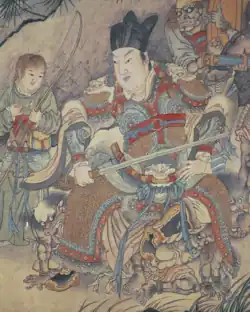
In Journey to the West, the Six Brothers of Meishan and Erlang Shen are known together as the Seven Sages of Meishan (梅山七圣). They are different from the Seven Monsters of Meishan (梅山七怪) in the later novel Investiture of the Gods. In that novel, the Seven Monsters are led by the ape spirit Yuan Hong, while Erlang Shen is their opponent. The group appears to have been based in part on the earlier group in Journey to the West.[3]
The two groups are also linked by their stories of transformation. In Investiture of the Gods, Yang Jian, another name for Erlang Shen, fights Yuan Hong in a contest of transformations. This resembles the transformation contest between Erlang Shen and Sun Wukong in Journey to the West. Some scholars have suggested that Journey to the West adapted Yuan Hong into the character of Sun Wukong. On this view, the removal of Yuan Hong from the Seven Monsters leaves six figures, matching the six sworn brothers of Erlang Shen.[3][4][5]
The Seven Sages are also associated with the Meishan Sect, a polytheistic belief system associated with the Meishandong region of Anhua County and Xinhua County in Hunan Province, China. According to Folk Hunting Customs of Western Sichuan (川西狩猎民俗), the Meishan ancestral deity Zhang Wulang, who is worshipped by hunters, is one of the Seven Sages of Meishan.[6]
Journey to the West
In Journey to the West, the six brothers are not described in much detail and appear only twice. In Chapter 6, the Jade Emperor seeks help in defeating Sun Wukong after the heavenly generals fail to subdue him. Guanyin tells the Jade Emperor that Erlang Shen, his imperial nephew, lives at Guanzhou near the Guan River. She also says that Erlang Shen had previously defeated six demons, was accompanied by the Brothers of Meishan, and commanded 1,200 Grass-Head Deities. She advises the Jade Emperor to summon him with a military decree.[7]
"Your Majesty’s imperial nephew, the Illustrious Sage Erlang Zhenjun, currently resides in Guanzhou, at the mouth of the Guan River, where he receives incense offerings from the mortal realm. In former days, he once vanquished six demons. He is accompanied by the Brothers of Meishan and commands 1,200 Grass-Head Deities. His supernatural powers are immense. However, Erlang only obeys military orders and not civil summons. If Your Majesty issues a formal decree of military deployment, commanding his assistance, the demon can surely be subdued."
The Jade Emperor follows Guanyin's advice and summons Erlang Shen. Erlang Shen then goes to fight Sun Wukong with his six sworn brothers. They are Kang Anyu (康安裕), Zhang Boshi (张伯时), Li Huanzhang (李焕章), Yao Gonglin (姚公麟), Guo Shen (郭申), and Zhi Jian (直健).[8]
In Chapter 63, the six brothers help Sun Wukong fight the Nine-Headed Prince Consort.[7]
Investiture of the Gods
In Investiture of the Gods, the "Meishan Seven Monsters" (梅山七怪) appear to have been based on the "Seven Sages of Meishan" from Journey to the West. The main difference is the role of Yang Jian. In Journey to the West, Yang Jian is one of the Seven Sages and the sworn brother of the other six.[9][10]
In Investiture of the Gods, the Seven Monsters are instead seven demons from Mount Mei. Yang Jian is not one of them and is sent to fight them. He eventually defeats the Seven Monsters and becomes their master.[10][11]
The Seven Monsters are called from Mount Mei to help defend Mengjin Pass for the Shang dynasty against the Zhou army. They use their supernatural powers to defeat several Zhou generals. As demons with many years of cultivation, they cannot easily be killed by ordinary weapons. Yang Jian uses his "Eye of Heaven" to see through their disguises and identify their animal forms. He then defeats each of them by taking advantage of the weaknesses of those forms.[12][13][10]
Yuan Hong

Yuan Hong is a white ape demon and the leader of the Seven Monsters. He is a powerful opponent of Yang Jian and has also learned the "Eight-Nine Arcane Art" (八九玄功), which allows him to perform transformations. Yuan Hong and Yang Jian fight by changing into different forms, but neither is able to defeat the other.[14]
Yang Jian seeks help from the goddess Nüwa, who gives him the "Map of Mountains, Rivers, and States" (山河社稷圖). Yang Jian uses the map to trap Yuan Hong. However, Yuan Hong cannot be killed with ordinary weapons. Jiang Ziya therefore borrows the "Demon-Slaying Sword" (斬仙飛刀) from the immortal Lu Ya and uses it to kill Yuan Hong. After the gods are given their titles, Yuan Hong becomes Sihu Xingjun (四废星君; Lord of the Four Wastes Star).[14][15]
Jin Dasheng
Jin Dasheng is a buffalo demon who fights the Zhou general Zheng Lun. He uses two swords and can spit an "ox bezoar" (牛黃) from his stomach. The projectile kills Zheng Lun. The goddess Nüwa then uses the "Demon-Subduing Lasso" (伏妖索) to capture Jin Dasheng. He is taken to the Zhou camp, where Jiang Ziya orders his execution. After the gods are given their titles, Jin Dasheng becomes Tianwen Xingjun (天瘟星君; Lord of the Heavenly Plague Star).[14]
Dai Li
Dai Li is a dog demon who first fights Nezha. He spits a red pearl from his mouth, forcing Nezha to retreat. Yang Jian then joins the fight and uses his Howling Celestial Dog against Dai Li. The celestial dog defeats Dai Li, allowing Yang Jian to kill him. After the gods are given their titles, Dai Li becomes Huangwu Xingjun (荒芜星君; Lord of the Desolate Star).[14]
Zhu Zizhen
Zhu Zizhen is a pig demon with great physical strength. When he fights Yang Jian, he swallows him. Yang Jian then causes pain from inside the demon's body and seizes its heart and liver. Zhu Zizhen submits and goes with Yang Jian to the Zhou camp. Jiang Ziya orders his execution, and a soldier cuts off his head. Yang Jian then emerges from the body unharmed. After the gods are given their titles, Zhu Zizhen becomes Fuduan Xingjun (伏断星君; Lord of the Severing Star).[14]
Yang Xian
Yang Xian is a goat demon who can emit a bright white light from his mouth. When he uses this attack against Yang Jian, Yang Jian transforms into a white-browed tiger. Yang Xian is frightened by the tiger and is killed by Yang Jian. After the gods are given their titles, Yang Xian becomes Fanyin Xingjun (反吟星君; Lord of the Reversing Chant Star).[14]
Chang Hao
Chang Hao is a snake demon who can swallow enemies and release poisonous mist. Yang Jian transforms into a centipede and allows Chang Hao to swallow him. Yang Jian then destroys the demon from inside its body. After the gods are given their titles, Chang Hao becomes Daozhen Xingjun (刀砧星君; Lord of the Blade-Anvil Star).[14][16]
Wu Long
Wu Long is a centipede demon. It uses black smoke to hide itself and attacks with its many legs. Yang Jian transforms into a five-colored rooster, which is able to find the centipede through the smoke. He then kills Wu Long. After the gods are given their titles, Wu Long becomes Poshui Xingjun (破碎星君; Lord of the Shattered Star).[14]
Other legends
Records of Li Bing and Son's Water Control
Another version appears in the Records of Li Bing and Son's Water Control (灌志文征·李冰父子治水记). In this account, the main character is Li Erlang, a legendary figure based on the second son of Li Bing, the historical governor of Shu during the Qin dynasty. Li Erlang is described as a skilled hunter. His father orders him to kill a dragon, and seven friends help him. The seven friends are identified as the Meishan Seven Sages.[17][18]
Comprehensive Collection of Deities from the Three Religions
Another version appears in texts such as the Comprehensive Collection of Deities from the Three Religions. It concerns Zhao Yu, a historical figure from the Sui dynasty. Zhao Yu was the prefect of Jia Prefecture, in present-day Leshan, Sichuan, an area historically associated with Meishan. According to the legend, a flood dragon was causing trouble in the area. Zhao Yu entered the water and killed the dragon, accompanied by seven of his followers. The seven men were later worshipped as the Seven Sages of Meishan (眉山七圣).[18]
In zaju and folktales
By the Yuan dynasty, stories about Erlang and the Seven Sages had also become subjects of zaju, a form of Chinese opera. Plays such as Erlang of Guankou Slays the Ferocious Flood Dragon (灌口二郎斩健蛟), Erlang Shen Shoots the Demon-Locking Mirror While Drunk (二郎神醉射锁魔镜), and Erlang Shen Locks the Great Sage Equal to Heaven (二郎神锁齐天大圣) feature Erlang Shen as the main character. In these plays, Erlang Shen is identified with the historical figure Zhao Yu, and his followers are called the "Seven Sages of Mount Mei".[19][20]
According to Sichuan folklore, the seven sages were originally seven hunters who were friends of Erlang, the son of Li Bing. They are also called the "Seven Friends of Meishan". The area around Mount Yulei in Guan County, where Erlang was said to have defeated an evil dragon, was known for coal production. One theory is that the seven friends were originally coal miners. The Two Kings Temple in Guan County once had a "Hall of the Seven Sages", with statues of the seven sages. The hall no longer exists, but a gilt wood carving from the early Qing dynasty survives on a horizontal plaque above the small opera stage inside the temple's main gate. It shows Erlang and the Seven Sages of Meishan helping Li Bing fight a rhinoceros.[21]
Mythology evolution
The early stories of the Meishan Sages often involve Erlang and his companions fighting a dragon or other water-related threat. In Journey to the West, the Seven Sages assist Erlang Shen in fighting Sun Wukong.[21]
In Investiture of the Gods, the role of the Meishan group is different. The Seven Monsters are demons who fight for the Shang dynasty. Yang Jian fights and kills them, rather than fighting alongside them. The novel thus presents the Meishan group as opponents of Yang Jian.[21]
In Investiture of the Gods, the deaths of many characters are followed by their appointment as gods. After the war, Jiang Ziya gives the deceased characters their divine titles according to the List of Creation (封神榜, Fēngshén Bǎng). The seven Meishan Monsters are also given positions among the gods after their deaths.[22]
Sacrificial activity
During the Southern Song dynasty, Wu Zimu recorded in volume 1 of the Record of a Dream of Sorghum that six dragon boats were used during the celebration of the Mountain God's birthday. The boats were decorated with images of the Ten Grand Marshals, the Seven Sages, Erlang Shen, various gods and spirits, the Swift Messengers (快行), the Brocade-Bodied Wanderers (锦体浪子), and the Yellow Fatty (黄胖). They also carried colorful flags, parasols, flower baskets, festive poles, drums, and other musical instruments.[23]
In popular culture
The Meishan Seven Monsters are the main antagonists in the 1973 Hong Kong film Na Cha and the Seven Devils, an adaptation of Investiture of the Gods.[24][25]
References
- ↑ 跟著廟口說書人看廟趣: 聽!郭喜斌戲說彩繪╳剪黏╳交趾╳木雕╳石雕經典裝飾故事 (in Chinese (Taiwan)). Morning Star Publishing Inc (晨星出版有限公司). 5 December 2021. ISBN 978-626-320-040-1.
- ↑ 胡適致友人書:自由主義思想家 (in Chinese). 千華駐科技. 15 June 2023. ISBN 978-626-368-726-4.
- 1 2 封神榜故事探原 (in Chinese). 偉興印務所印. 1960.
- ↑ "二郎神杨戬和他的六个结拜兄弟,为什么被称为"梅山七圣"?". 手机新浪网. 25 June 2019.
- ↑ 封神雙龍傳(9): 繁体中文版 (in Chinese (Taiwan)). 天下书盟.
- ↑ 行业神崇拜: 中国民众造神运动硏究 (in Chinese). 中国文联出版社. 2000. ISBN 978-7-5059-3570-9.
- 1 2 穿越敗局:廣告與公關篇 (in Chinese (Taiwan)). 飛翔時代. 21 December 2017.
- ↑ 降魔修心:彩繪西遊記 (in Chinese (Taiwan)). eCrowd Media Inc. 群傳媒股份有限公司. ISBN 978-986-5506-30-8.
- ↑ 文史存稿 (in Chinese). 三秦出版社. 2004. ISBN 978-7-80628-708-8.
- 1 2 3 雲山麗水: 府城傳統畫師潘麗水作品之研究 (in Chinese). National Center for Traditional Arts. 2001. ISBN 978-957-02-8068-5.
- ↑ Zhongnan minzu daxue xuebao (in Chinese). 中南民族大学出版社. 2007.
- ↑ 第一屆哪吒學術硏討會論文集 (in Chinese). 國立中山大學文學院清代學術硏究中心. 2003. ISBN 978-957-01-3554-1.
- ↑ 經典名著選:中國古典小說集 (in Chinese). 崧博出版. 15 November 2023. ISBN 978-626-363-531-9.
- 1 2 3 4 5 6 7 8 "足本全圖封神演義" (in Chinese). 廣益書局. 1922.
- ↑ 中國劇目辭典 (in Chinese). 河北敎育出版社. 1997. ISBN 978-7-5434-2993-2.
- ↑ 猛鬼十八層地獄 (遊地獄見聞) (in Chinese (Taiwan)). 超媒體出版有限公司. 5 February 2016. ISBN 978-988-15712-8-1.
- ↑ 中国行业神崇拜 (in Chinese). 中国华侨出版公司. 1990. ISBN 978-7-80074-193-7.
- 1 2 中国神话史 (in Chinese). 上海文艺出版社. 1988. ISBN 978-7-5321-0167-2.
- ↑ 中国民俗大观 (in Chinese). 广东旅游出版社. 1988. ISBN 978-7-80521-014-8.
- ↑ 小說戲曲研究 (in Chinese). 聯經出版事業公司. 1988. ISBN 978-957-08-0046-3.
- 1 2 3 中國行業神: 下卷 (in Chinese). 知書房出版集團. 1996. ISBN 978-957-9086-94-3.
- ↑ 古今 (in Chinese). 广陵书社.
- ↑ "《梦粱录》". 360doc.
- ↑ 三十年細說從頭 (in Chinese). 天地圖書有限公司. 1982.
- ↑ "梅山收七怪 ( 1973 )". movie.mtime.com.
Sichuan topics | |||||
|---|---|---|---|---|---|
| General | |||||
| History |
| ||||
| Geography | |||||
| Culture |
| ||||
| People | |||||
| Religion | |||||
| Languages |
| ||||
| Tourist attractions | |||||

