Sant Quirc de Durro
| Sant Quirc de Durro | |
|---|---|
 | |
  Location within Spain | |
| Religion | |
| Affiliation | Roman Catholic |
| Location | |
| Location | Durro, Catalonia, Spain |
| Coordinates | 42°29′42″N 0°48′41″E / 42.495108°N 0.811497°E |
| Architecture | |
| Type | Chapel |
| Style | Romanesque |
| Official name: Catalan Romanesque Churches of the Vall de Boí | |
| Type | Cultural |
| Criteria | ii, iv |
| Designated | 2000 (24th session) |
| Reference no. | 988 |
Region | Europe and North America |
Sant Quirc de Durro is an isolated chapel situated in the village of Durro, in the territory of Vall de Boí, a commune in the valley with the same name and in Comarca of Alta Ribagorça in the north of Province of Lleida and the autonomous communities of Catalonia in Spain. It is one of the best known places of Roman art in the valley and since November 2000, is part of the world heritage site of UNESCO with eight other Catalan Romanesque Churches of the Vall de Boí.[1]
The chapel is situated at an altitude of 1498m, giving a very large panorama closed by the massifs of Comaloforno and those of Besiberri. A path allows to reach the small lake of Durro at height of 2250m. It is dedicated to Saint Cyr of Tarse, child saint, son of Saint Julietta, both of them martyred in 304. Their feast day is celebrated in their honour on June 16.[2]
Architecture
The chapel presents a plan of unique nave, barrel vault ending with a semi-circular apse vaulted in semi-dome. Masonry work can be found around the tower of nave. The building has three openings: a narrow window in arrowslit in the centre of apse, an oculus above the apse, illuminating the nave and another arrowslit on east façade.
 Plan of the Chapel
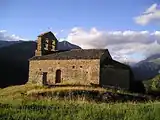 General view of the Chapel
 Apse
 Occidental facade and wall of bell-gable
Interior
In the interior of the Chapel, we find the antependium, representing the martyrdom of Saint Cyr of Tarse and of Saint Julietta, a major work of art of Catalan Romanesque painting, acquired in 1923 and exposed in Museu Nacional d'Art de Catalunya.
 Antependium: Martyrdom of Saint Cyr and Saint Julietta
See also
References
- ↑ Centre, UNESCO World Heritage. "Catalan Romanesque Churches of the Vall de Boí". whc.unesco.org. Retrieved 2017-05-14.
- ↑ Martyrologium Romanum (2004). Vatican City: Administrationem Patrimonii Sedis Apostolicae in Civitate Vaticana. 2004. pp. 341–342. Retrieved 30 May 2026.
External links
|  | |