Samuel Storey, Baron Buckton
Samuel Storey, Baron Buckton | |
|---|---|
 Samuel Storey in 1958. | |
| Deputy Speaker of the House of Commons Chairman of Ways and Means | |
| In office 26 October 1965 – 31 March 1966 | |
| Speaker | Horace King |
| Preceded by | Horace King |
| Succeeded by | Eric Fletcher |
| Deputy Chairman of Ways and Means | |
| In office 3 November 1964 – 26 October 1965 | |
| Speaker | Harry Hylton-Foster |
| Preceded by | Robert Grimston |
| Succeeded by | Roderic Bowen |
| Member of Parliament for Stretford | |
| In office 23 February 1950 – 31 March 1966 | |
| Preceded by | Herschel Austin |
| Succeeded by | Ernest Davies |
| Member of Parliament for Sunderland | |
| In office 27 October 1931 – 26 July 1945 | |
| Preceded by | Marion Phillips |
| Succeeded by | Richard Ewart |
| Personal details | |
| Born | Samuel Storey 18 January 1896 |
| Died | 17 January 1978 (aged 81) |
| Party | Conservative |
| Parents |
|
| Education | Haileybury and Imperial Service College |
| Alma mater | Trinity College, Cambridge |
| Profession | Barrister |
Samuel Storey, Baron Buckton (18 January 1896 – 17 January 1978),[1] known as Sir Samuel Storey, 1st Baronet, from 1960 to 1966, was a British Conservative politician.
Early life and career
Storey was the son of Frederick George Storey and his wife Mary Dagmar née Hutton, and was educated at Haileybury and Trinity College, Cambridge. After graduation, he became a barrister in the Inner Temple in 1919 and joined Sunderland Borough Council in 1928.
Political career
He was elected as Member of Parliament (MP) for the Sunderland constituency at the 1931 general election[2] (a post his namesake grandfather had held from 1881 to 1895 and briefly in 1910), and held the seat in the House of Commons until his defeat at the 1945 general election.[3] He joined the East Riding of Yorkshire County Council in 1946.
Storey returned to Parliament at the 1950 general election, when he was elected MP for Stretford[4] and during his tenure was Chairman of the Standing Committees and Temporary Chairman of the Committees of the House of Commons in 1957 and Chairman of the Committee of Ways and Means from 1965–66.
He was created a baronet in February 1960[5] and, after his defeat at the 1966 general election,[6] he was given a life peerage as Baron Buckton,[7] of Settrington in the East Riding of the County of York.[8]
Personal life
Lord Buckton died in January 1978, aged 81. The life barony became extinct on his death while he was succeeded in the hereditary baronetcy by his son, Richard.
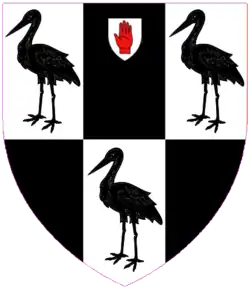
Arms
  |
|
References
- ↑ Leigh Rayment's Historical List of MPs – Constituencies beginning with "S" (part 6)
- ↑ Craig, F. W. S. (1983) [1969]. British parliamentary election results 1918–1949 (3rd ed.). Chichester: Parliamentary Research Services. p. 254. ISBN 0-900178-06-X.
- ↑ Craig, op. cit., page 255
- ↑ "UK General Election results February 1950". Richard Kimber's political science resources. Retrieved 28 January 2010.
- ↑ "No. 41945". The London Gazette. 2 February 1960. p. 858.
- ↑ "UK General Election results March 1966". Richard Kimber's political science resources. Retrieved 28 January 2010.
- ↑ "No. 41945". The London Gazette (Supplement). 2 February 1960. pp. 5785–5786.
- ↑ "No. 44024". The London Gazette. 17 June 1966. p. 7005.
- ↑ Debrett's Peerage. 1973.
External links
- 1896 births
- 1978 deaths
- Conservative Party (UK) MPs for English constituencies
- Deputy speakers of the British House of Commons
- Conservative Party (UK) life peers
- Councillors in Tyne and Wear
- Alumni of Trinity College, Cambridge
- People educated at Haileybury and Imperial Service College
- Storey baronets
- UK MPs 1931–1935
- UK MPs 1935–1945
- UK MPs 1950–1951
- UK MPs 1951–1955
- UK MPs 1955–1959
- UK MPs 1959–1964
- UK MPs 1964–1966
- UK MPs who were granted peerages
- Life peers created by Elizabeth II