Saluzzo–Cuneo Tramway
| Saluzzo–Cuneo tramway | ||||||||||||||||||||||||||||||||||||||||||||||||||||||||||||||||||||||||||||||||||||||||||||||||||||||||||||||||||||||||||||||||||||||||||||||||||||||||||||||||||||||||||||||||||||||||||||||||||
|---|---|---|---|---|---|---|---|---|---|---|---|---|---|---|---|---|---|---|---|---|---|---|---|---|---|---|---|---|---|---|---|---|---|---|---|---|---|---|---|---|---|---|---|---|---|---|---|---|---|---|---|---|---|---|---|---|---|---|---|---|---|---|---|---|---|---|---|---|---|---|---|---|---|---|---|---|---|---|---|---|---|---|---|---|---|---|---|---|---|---|---|---|---|---|---|---|---|---|---|---|---|---|---|---|---|---|---|---|---|---|---|---|---|---|---|---|---|---|---|---|---|---|---|---|---|---|---|---|---|---|---|---|---|---|---|---|---|---|---|---|---|---|---|---|---|---|---|---|---|---|---|---|---|---|---|---|---|---|---|---|---|---|---|---|---|---|---|---|---|---|---|---|---|---|---|---|---|---|---|---|---|---|---|---|---|---|---|---|---|---|---|---|---|---|
 Verzuolo, corso Re Umberto | ||||||||||||||||||||||||||||||||||||||||||||||||||||||||||||||||||||||||||||||||||||||||||||||||||||||||||||||||||||||||||||||||||||||||||||||||||||||||||||||||||||||||||||||||||||||||||||||||||
| Overview | ||||||||||||||||||||||||||||||||||||||||||||||||||||||||||||||||||||||||||||||||||||||||||||||||||||||||||||||||||||||||||||||||||||||||||||||||||||||||||||||||||||||||||||||||||||||||||||||||||
| Termini | ||||||||||||||||||||||||||||||||||||||||||||||||||||||||||||||||||||||||||||||||||||||||||||||||||||||||||||||||||||||||||||||||||||||||||||||||||||||||||||||||||||||||||||||||||||||||||||||||||
| Service | ||||||||||||||||||||||||||||||||||||||||||||||||||||||||||||||||||||||||||||||||||||||||||||||||||||||||||||||||||||||||||||||||||||||||||||||||||||||||||||||||||||||||||||||||||||||||||||||||||
| Type | Interurban tramway | |||||||||||||||||||||||||||||||||||||||||||||||||||||||||||||||||||||||||||||||||||||||||||||||||||||||||||||||||||||||||||||||||||||||||||||||||||||||||||||||||||||||||||||||||||||||||||||||||
| Operator | SATIP | |||||||||||||||||||||||||||||||||||||||||||||||||||||||||||||||||||||||||||||||||||||||||||||||||||||||||||||||||||||||||||||||||||||||||||||||||||||||||||||||||||||||||||||||||||||||||||||||||
| History | ||||||||||||||||||||||||||||||||||||||||||||||||||||||||||||||||||||||||||||||||||||||||||||||||||||||||||||||||||||||||||||||||||||||||||||||||||||||||||||||||||||||||||||||||||||||||||||||||||
| Opened | 1880 | |||||||||||||||||||||||||||||||||||||||||||||||||||||||||||||||||||||||||||||||||||||||||||||||||||||||||||||||||||||||||||||||||||||||||||||||||||||||||||||||||||||||||||||||||||||||||||||||||
| Closed | 1948 | |||||||||||||||||||||||||||||||||||||||||||||||||||||||||||||||||||||||||||||||||||||||||||||||||||||||||||||||||||||||||||||||||||||||||||||||||||||||||||||||||||||||||||||||||||||||||||||||||
| Technical | ||||||||||||||||||||||||||||||||||||||||||||||||||||||||||||||||||||||||||||||||||||||||||||||||||||||||||||||||||||||||||||||||||||||||||||||||||||||||||||||||||||||||||||||||||||||||||||||||||
| Line length | 30.200 km (18.765 mi) | |||||||||||||||||||||||||||||||||||||||||||||||||||||||||||||||||||||||||||||||||||||||||||||||||||||||||||||||||||||||||||||||||||||||||||||||||||||||||||||||||||||||||||||||||||||||||||||||||
| Track gauge | 1,100 mm (3 ft 7+5⁄16 in) | |||||||||||||||||||||||||||||||||||||||||||||||||||||||||||||||||||||||||||||||||||||||||||||||||||||||||||||||||||||||||||||||||||||||||||||||||||||||||||||||||||||||||||||||||||||||||||||||||
| ||||||||||||||||||||||||||||||||||||||||||||||||||||||||||||||||||||||||||||||||||||||||||||||||||||||||||||||||||||||||||||||||||||||||||||||||||||||||||||||||||||||||||||||||||||||||||||||||||


The Saluzzo–Cuneo tramway was an interurban tram line that connected the cities of Saluzzo and Cuneo in Piedmont, Italy from 1880 to 1948.
History

The first steps towards the construction of a tramway network in the Saluzzo area were taken in July 1877, when an assembly of interested municipalities, deputies and provincial councillors resolved to promote the construction of a railway between Airasca, Saluzzo, Cuneo and Mondovì, with a branch from Busca to Dronero.[1] Shortly after, the French banker Alfonso Raoul Berrier-Delaleu submitted an application for the concession of the Cuneo–Dronero, Cuneo–Busca–Saluzzo, Cuneo–Mondovì and Saluzzo–Moretta–Pancalieri tram lines (the latter extendable as far as Turin): on 29 October 1877, the provincial council of Cuneo accepted the application, granting on the following 4 November the construction and operation of the Cuneo–Dronero and Cuneo–Busca–Saluzzo tramways.[2] The Cuneo–Dronero opened on 23 November 1879.[3]
In that same 1879, the delegates of the interested municipalities meeting in Busca voted a subsidy of 80,000 lire to Berrier-Delaleu on condition that he completed the Saluzzo–Cuneo line by 1880; work began on Monday 14 June 1880, and on 24 October 1880 the line was solemnly inaugurated[4] with great celebrations.[5] In the meantime, on 2 August 1880, the Società Anonima Tramway Cuneo-Busca-Saluzzo was established in Savigliano for the construction and management of the line, with its registered office in Saluzzo, authorised by Royal Decree the following year.[6]
In 1882, the Belgian banker Rodolfo Coumond, concessionaire of the Turin–Saluzzo tramway, took over from Berrier-Delaleu—who was in financial difficulties due to the construction of the Asti–Cortanze and Asti–Canale Tramway tramways—the concessions for the Cuneo–Saluzzo, Cuneo–Dronero, Pinerolo–Cavour and Saluzzo–Revello lines.[7] With the absorption of Berrier-Delaleu's lines, the Compagnia Generale dei Tramways Piemontesi (CGTP) was established, with its registered office in Brussels, which expanded its network until the First World War, reaching a total length of 189.965 km;[8] between 1903 and 1907, the company declared a profit equal to 32% of operating revenue, the highest among all Piedmontese tramways.[9]

After the First World War, the CGTP, in order to reduce operating costs (labour, fuel, maintenance) and increase speeds, experimented with a petrol railcar in the second half of the 1920s,[10] later opting for the use of battery electric railcars on the initiative of the general manager, Dr. Pietro Lo Balbo.[11] Battery traction, which was also used in those years on various Italian tramways and railways (San Bonifacio–Lonigo–Cologna Veneta Tramway, Verona–Caprino–Garda, Udine–San Daniele Tramway, and the interurban tramways of Parma and Mantua),[12] was also favoured by the Government: Article 35 of Royal Decree-Law No. 2150 of 2 August 1929[13] granted kilometre subsidies of up to 10,000 lire for 35 years.[14]
After experiments that began in December 1925 and proved successful,[15] the CGTP purchased larger bogie railcars for the Turin–Saluzzo–Cuneo line, which entered service on Sunday 2 November 1930.[16]
With the electric railcars, the service improved, but it was not enough to counter the advance of bus lines: on 1 May 1935, part of the network, with low traffic or difficult terrain, was converted into bus lines entrusted to the Società Anonima Autolinee Piemontesi, an affiliate of the CGTP.[17] The following year, the CGTP's capital passed into Italian hands; the company changed its name to Società Anonima Tramvie Interprovinciali Piemontesi (SATIP) with its registered office in Turin and operational management in Saluzzo.[18]
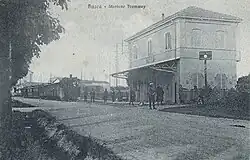
During the Second World War, one bogie railcar, six two-axle trailers, thirteen high-sided wagons and twenty covered wagons were seriously damaged,[19] and the bridge over the Stura was damaged and rebuilt in 1945.[20] The conflict heavily engaged the SATIP, especially regarding the transport of displaced persons.[21]
Despite several proposals for the reconstruction of the SATIP network put forward by various public and private entities, some of which envisaged route variations on reserved track, electrification (or dieselisation), and conversion to standard gauge,[22] on 30 November 1948, the Saluzzo–Cuneo line, together with the Pilone Virle–Carmagnola, Cuneo–Dronero and Costigliole–Venasca Tramway sections, were closed and replaced by buses;[23] of the SATIP network, after protests from users,[24] only the Turin–Saluzzo line remained active, which closed on 10 April 1950 and was replaced by buses of the Nuova SATIP,[25] the new name of SATIP.[26]
Characteristics
The tramway was a narrow-gauge line of 1,100 mm (3 ft 7+5⁄16 in), and extended for 30.200 km; the minimum curve radius was 50 metres, and the maximum gradient was 27 per thousand. The maximum permitted speed was 27 km/h.[27]
Route

The line departed from the Saluzzo tramway station, located in Piazza XX Settembre and connected to the railway.[28] After the tramway closed, the building was used as a bus station for the SATIP bus lines; partially modified in the following years, it closed in 1977, replaced by the new bus station in Via Circonvallazione,[29] and was subsequently demolished: several apartment blocks were built in its place.[30]
Leaving Saluzzo, the tramway followed State Highway 589, passing through Manta and Verzuolo, before reaching Costigliole Saluzzo, a location where the tramway connected with the railway[28] and from which the Costigliole–Venasca Tramway branched off; after passing through Busca, the line reached Cuneo, whose tramway station was located shortly after the bridge over the Stura di Demonte,[28] near the Cuneo Gesso railway station, in the locality of Basse di San Sebastiano.[31]
The line had several goods connections:[28]
- at Saluzzo with the Pellini Albonico brickworks;
- at Verzuolo with the Fissore & Sandri mill and with the Burgo paper mills.
Rolling stock
Locomotives and railcars
Three two-axle steam tank locomotives, built by the SLM of Winterthur and similar to those in service on the Cuneo–Dronero line, initially operated on the tramway.[32] With the takeover of the line's operation by the CGTP, the locomotives became part of that company's rolling stock, and were withdrawn by 1920. The rolling stock also included a two-axle locomotive built by Hagans.[32]
These were followed by other tramway locomotives, built by Krauss and Henschel, delivered up to 1909: the CGTP fleet totalled 40 of them; to these were added two Breda and two Borsig locomotives coming from the Pinerolo–Perosa Argentina tramway.[32]
In 1925, the CGTP ordered a DWK Type IV railcar from Romeo for its own network, where it served for about a decade[33] with poor results.[10] (Molino reports that after six to seven months of unsatisfactory trials it was withdrawn from service).
Shortly afterwards, battery traction, already tested on other Italian tram lines, was experimented with: the Officine di Savigliano built two railcars on the chassis of two-axle Grondona carriages, powered by two 13 HP motors each; these electric railcars gave good results, reducing travel times by 30%.[15] A further series of four railcars was subsequently built, two built by the Savigliano workshops and two by the CGTP workshops based on carriages, powered by two motors for a total of 40 HP.[34]
The experiment was successful, so much so that in 1929 the CGTP ordered three bogie railcars,[35] built by Carminati&Toselli with electrical equipment from TIBB, which entered service in 1930; three more were delivered in 1933.[36]
Carriages and freight wagons
The first carriages were supplied by Locati of Turin (no more than 12 units, two-axle with open platforms); subsequently, Grondona supplied about sixty carriages, also two-axle with open platforms, but more comfortable. The Locati carriages were withdrawn between 1910 and 1920; in those years, the Officine Meccaniche di Pinerolo supplied 28 closed-vestibule carriages (four mixed first and second class, the others second class), longer than the previous ones and mainly used on the Turin–Carmagnola, Turin–Saluzzo–Cuneo and Cuneo–Dronero lines;[37] moreover, part of the Grondona carriages were converted to closed platforms.[38] In the early 1930s, two two-axle carriages with open platforms arrived from the Messina–Barcellona Pozzo di Gotto Tramway, whose shareholders were the same as those of the CGTP, but they never entered service.[39]
In 1930, about 400 freight wagons were in service, of which 60 were covered and 45 had low sides.[40]
Motor stock - summary table
| Unit | Year of construction | Builder | Type | Notes |
|---|---|---|---|---|
| 1÷5 | 1879–1880 | SLM | 2-axle tank locomotive | ex Berrier-Delaleu for the Cuneo–Dronero line |
| 1÷3 | 1879–1880 | SLM | 2-axle tank locomotive | ex Berrier-Delaleu for the Saluzzo–Cuneo line |
| 4 | 1881 | Hagans | ex Berrier-Delaleu | |
| 5÷7 | 1881 | Krauss | 2-axle | built for the Pinerolo–Cavour line |
| 10÷17 | 1881 | Henschel | 2-axle | |
| 18 | 1909 | Henschel | 2-axle | |
| 19÷27 | 1882 | Henschel | 2-axle | |
| 28÷35 | 1888 | Henschel | 2-axle | |
| 36÷38 | 1907 | Henschel | 2-axle | |
| 1÷2 | Breda | |||
| 1÷2 | Borsig | ex Pinerolo–Perosa Argentina | ||
| 51, 57 | 1925 | SNOS | 2-axle battery railcar | built for the Turin–Carmagnola line |
| 3÷4 | 1927 | SNOS | 2-axle battery railcar | built for Saluzzo–Revello–Paesana, Revello–Barge, Costigliole–Venasca |
| 5÷6 | 1927 | SNOS | 2-axle battery railcar | built for Saluzzo–Revello–Paesana, Revello–Barge, Costigliole–Venasca |
| 101÷106 | 1929–1932 | C&T-TIBB | Bogie battery railcar | built for Turin–Saluzzo–Cuneo, Cuneo–Dronero, Cuneo–Boves |
See also
- Saluzzo–Pinerolo tramway
- Saluzzo–Revello–Paesana tramway
- Cuneo–Dronero tramway
- Udine–San Daniele Tramway
- San Bonifacio–Lonigo–Cologna Veneta Tramway
- Costigliole–Venasca Tramway
- Turin–Saluzzo/Carmagnola Tramway
References
- ↑ Ogliari & Sapi 1968, p. 114.
- ↑ Ogliari & Sapi 1968, pp. 114–115.
- ↑ Ogliari & Sapi 1968, p. 115.
- ↑ Molino 1981, p. 11.
- ↑ "La tranvia Cuneo-Saluzzo" [The Cuneo-Saluzzo tramway]. Gazzetta Piemontese. 26 October 1880. p. 1.
- ↑ Royal Decree No. 105 of 3 March 1881, published in the Official Gazette of the Kingdom of Italy No. 92 of 20 April 1881 Archived 31 October 2016 at the Wayback Machine
- ↑ Molino 1981, p. 12.
- ↑ Molino 1981, p. 13.
- ↑ Brogiato 1977, p. 59.
- 1 2 Molino 1981, p. 56.
- ↑ Ogliari & Sapi 1968, p. 486.
- ↑ Molino 1981, p. 58.
- ↑ Published in the Official Gazette of the Kingdom of Italy No. 304 of 31 December 1929 Archived 31 October 2016 at the Wayback Machine
- ↑ Ogliari & Sapi 1968, p. 489.
- 1 2 Molino 1981, pp. 58–59.
- ↑ "Il primo convoglio elettrico Torino-Saluzzo" [The first electric train Turin-Saluzzo]. La Stampa. 3 November 1930. p. 6.
- ↑ Molino 1981, p. 93.
- ↑ Ogliari & Sapi 1968, p. 493.
- ↑ Ogliari & Sapi 1968, p. 624.
- ↑ Molino 1981, p. 124.
- ↑ Molino 1981, p. 104.
- ↑ Molino 1981, pp. 106–118.
- ↑ "Necessita d'una generale sistemazione nel servizio delle tranvie interurbane" [There is a need for a general overhaul of the interurban tramway service]. La Nuova Stampa. 17 January 1950. p. 2.
- ↑ "Sospesa la soppressione della Torino-Saluzzo" [The suppression of the Turin-Saluzzo line is suspended]. La Nuova Stampa. 1 December 1948. p. 2.
- ↑ Grosso, Giuseppe (2 August 1981). "Quel trenino che a Saluzzo da trent'anni non arriva più" [That little train that hasn't arrived in Saluzzo for thirty years]. La Stampa - Cuneo e Provincia. p. 1.
- ↑ Ogliari & Sapi 1968, p. 660.
- ↑ Ogliari & Sapi 1968, p. 766.
- 1 2 3 4 Molino 1981, p. 15.
- ↑ "Saluzzo: nuova stazione pullman" [Saluzzo: new bus station]. La Stampa - Cronache di Alessandria Asti e Cuneo. 16 April 1977. p. 11.
- ↑ "Saluzzo, la vecchia stazione del tramway" [Saluzzo, the old tramway station]. La Stampa - Cuneo e provincia. 29 November 1991. p. 38.
- ↑ Molino 1981, p. 120.
- 1 2 3 Molino 1981, p. 28.
- ↑ Molino, Domenico (October 1979). "Le prime automotrici FS" [The first FS railcars]. Italmodel Ferrovie (231). Verona: Modeltecnica: 21.
- ↑ Molino 1981, p. 59.
- ↑ Molino 1981, p. 63.
- ↑ Molino 1981, p. 70.
- ↑ Molino 1981, pp. 34–35.
- ↑ Molino 1981, p. 42.
- ↑ Molino 1981, p. 43.
- ↑ Molino 1981, p. 39.
Bibliography
- Brogiato, Giovanni (1977). "Le tramvie extraurbane in Piemonte 1875-1914" [The interurban tramways in Piedmont 1875-1914]. Cronache Economiche - Rivista della Camera di Commercio Industria Artigianato e Agricoltura di Torino (1–2): 55–63.
{{cite journal}}: CS1 maint: ref duplicates default (link) - Molino, Nico (1981). Il trenino di Saluzzo. Storia della Compagnia Generale Tramways Piemontesi [The little train of Saluzzo. History of the Compagnia Generale Tramways Piemontesi]. Turin: Immagini e Parole.
{{cite book}}: CS1 maint: ref duplicates default (link) - Ogliari, Francesco; Sapi, Franco (1968). Scintille tra i monti. Storia dei trasporti italiani vol. 8 e 9. Piemonte-Valle d'Aosta [Sparks among the mountains. History of Italian transport vols. 8 and 9. Piedmont-Aosta Valley]. Milan: Autori.
{{cite book}}: CS1 maint: ref duplicates default (link)

External links
- "Museo Virtuale dei Tram di Torino - Torino-Carignano-Saluzzo" [Virtual Museum of Turin Trams - Turin-Carignano-Saluzzo]. Archived from the original on 4 March 2016. Retrieved 26 September 2015.