Saluzzo–Revello–Paesana Tramway
| Saluzzo–Revello–Paesana tramway | |||
|---|---|---|---|
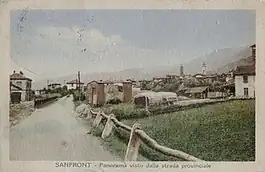 Sanfront with the tramway track on the left | |||
| Overview | |||
| Termini |
| ||
| Service | |||
| Type | Interurban tram | ||
| Operator(s) | CGTP (later); S.A. Tramway Cuneo-Busca-Saluzzo (1881–1882) | ||
| History | |||
| Opened | 30 October 1881 (Saluzzo–Revello) 20 March 1905 (Revello–Paesana) | ||
| Closed | 1 May 1935 | ||
| Technical | |||
| Track gauge | 1,100 mm (3 ft 7+5⁄16 in) | ||
| |||

The Saluzzo–Revello–Paesana tramway was an interurban tram line that connected the towns of Saluzzo, Revello and Paesana from 1881 to 1935.
History
The first steps towards the construction of a tram network in the Saluzzo area were taken in July 1877, when an assembly of interested municipalities, deputies and provincial councillors resolved to promote the construction of a railway between Airasca, Saluzzo, Cuneo and Mondovì, with a branch from Busca to Dronero.[1] Shortly after, the French banker Alfonso Raoul Berrier-Delaleu applied for the concession of the tram lines Cuneo–Dronero, Cuneo–Busca–Saluzzo, Cuneo–Mondovì and Saluzzo–Moretta–Pancalieri (the latter extendable to Turin); on 29 October 1877 the provincial council of Cuneo accepted the application, granting on 4 November the construction and operation of the Cuneo–Dronero and Cuneo–Busca–Saluzzo tramways,[2] which opened between 1879[3] and 1880.[4]
In 1878, the municipal council of Saluzzo voted a resolution to promote the construction of tramways to Revello, Paesana and Barge, offering a subsidy of 100,000 lire.[5] The first section, from Saluzzo to Revello, was inaugurated on 30 October 1881;[6] in Berrier-Delaleu's intentions, it was to be extended to Barge and from there connected to the Pinerolo–Cavour line opened a few months earlier.[7] This did not become possible due to the construction of the Bricherasio–Barge Railway.[8]
In 1882, the Belgian banker Rodolfo Coumond, who had in the meantime opened the Turin–Saluzzo tramway, took over from Berrier-Delaleu, who was in financial difficulties due to the construction of the Asti–Cortanze and Asti–Canale tramways, the concessions of the Cuneo–Saluzzo, Cuneo–Dronero, Pinerolo–Cavour and Saluzzo–Revello lines.[7] With the takeover of Barrier-Delaleu's lines, the Compagnia Generale dei Tramways Piemontesi (CGTP) was established, with headquarters in Brussels, which until World War I expanded its network to a total length of 189.965 km.[9]

In 1890, the CGTP established a freight service to Envie, Barge, Sanfront and Paesana. Beyond Revello, goods travelled by pack animals and carts;[10] only on 20 March 1905, in fact, was the Revello–Barge section inaugurated,[11] and in 1915 it was the turn of the Revello–Barge branch.[9] The tramway connected the Po valley, a producer of timber and chestnuts, to Saluzzo.[12] Between 1903 and 1907, the CGTP declared a profit equal to 32% of operating revenue, the highest among all Piedmontese tramways; the situation was completely opposite for the Revello–Paesana line, whose profit was only 1.50% of operating revenue.[13]
After World War I, the CGTP, in order to reduce operating costs (labour, fuel, maintenance) and increase speeds, experimented in the second half of the 1920s with a benzole railcar[14] and, starting from 1920, suppressed some runs on the Saluzzo–Paesana and Revello–Barge lines, replacing them with buses,[15] then from December 1925 oriented itself towards the use of battery electric railcars at the instigation of the managing director Dr. Pietro Lo Balbo.[16]
With the electric railcars, tested on the Saluzzo–Revello–Paesana line from 1927,[17] the service improved (to the point that the previously suppressed runs were restored),[15] but operating costs continued to be heavily affected by low passenger traffic, absence of freight traffic, steep gradients and competition from bus lines, leading to the closure of the line on 1 May 1935, replaced by buses of the Società Anonima Autolinee Piemontesi, an associate of CGTP.[18]
Characteristics
The tramway was a narrow-gauge line of 1100 mm, and extended for 21.396 km; the minimum curve radius was 50 metres, the maximum gradient 45 per mille, reached on the Revello–Paesana section. The maximum permitted speed was 24 km/h.[19]
Route
Saluzzo–Revello–Paesana tramway | ||||||||||||||||||||||||||||||||||||||||||||||||||||||||||||||||||||||||||||||||||||||||||||||||||||||||||||||||||||||||||||||||||||||||||||||||||||||||||
|---|---|---|---|---|---|---|---|---|---|---|---|---|---|---|---|---|---|---|---|---|---|---|---|---|---|---|---|---|---|---|---|---|---|---|---|---|---|---|---|---|---|---|---|---|---|---|---|---|---|---|---|---|---|---|---|---|---|---|---|---|---|---|---|---|---|---|---|---|---|---|---|---|---|---|---|---|---|---|---|---|---|---|---|---|---|---|---|---|---|---|---|---|---|---|---|---|---|---|---|---|---|---|---|---|---|---|---|---|---|---|---|---|---|---|---|---|---|---|---|---|---|---|---|---|---|---|---|---|---|---|---|---|---|---|---|---|---|---|---|---|---|---|---|---|---|---|---|---|---|---|---|---|---|---|
| ||||||||||||||||||||||||||||||||||||||||||||||||||||||||||||||||||||||||||||||||||||||||||||||||||||||||||||||||||||||||||||||||||||||||||||||||||||||||||


The line started from the Saluzzo tram station, located in Piazza XX Settembre and connected to the railway.[20] After the tramway closed, the building was used as a bus station for SATIP bus lines; partially modified in subsequent years, it was closed in 1977, replaced by the new bus station in Via Circonvallazione,[21] and later demolished: in its place some apartment buildings were built.[22]
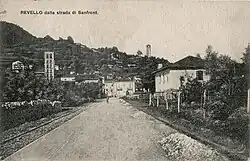
Leaving Saluzzo, the line crossed the localities of Revello (where the line to Barge branched off), Rifreddo and Sanfront, before ending at Paesana in the Santa Maria locality.[22]
Rolling stock
Locomotives
The steam locomotives of the CGTP fleet served on the tramway[23] (it had a total of 40).[23]
In 1925, the CGTP ordered a DWK Type IV railcar from Romeo for its network, on which it served for about a decade[24] with poor results.[14]
Soon after, accumulator traction was experimented, already tested on other Italian tram lines: the SNOS workshops built two railcars on the frames of two-axle Grondona carriages, driven by two 13 hp motors each: these electric railcars gave good results, reducing travel times by 30%.[16] A further series of four railcars was subsequently built, two built by the Savigliano workshops and two by the CGTP workshops based on carriages, moved by two motors for a total of 40 hp.[25]
The experiment was successful, so much so that the CGTP ordered three bogie railcars in 1929,[26] built by Carminati & Toselli with electrical equipment from TIBB, in service from 1930; in 1933, another three were delivered.[27]
Carriages and freight wagons
The first carriages were supplied by Locati of Turin (no more than 12 units, two-axle with open platforms); later, Grondona supplied about sixty carriages, also two-axle with open platforms but more comfortable. The Locati carriages were withdrawn between 1910 and 1920; in those years, the Officine Meccaniche di Pinerolo supplied 28 closed-vestibule carriages (four mixed first and second class, the others second class), longer than the previous ones and used mainly on the Turin–Carmagnola, Turin–Saluzzo–Cuneo and Cuneo–Dronero lines;[28] furthermore part of the Grondona carriages were converted to closed platforms.[29] In the early 1930s, two two-axle carriages with open platforms arrived from the Messina–Barcellona Pozzo di Gotto Tramway, whose shareholders were the same as the CGTP, but they never entered service.[30]
In 1930, about 400 freight wagons were in service, of which 60 closed and 45 with low sides.[31]
Summary of motive power
| Unit | Year of construction | Builder | Type | Notes |
|---|---|---|---|---|
| 1÷5 | 1879-1880 | SLM | 0-4-0T (two-axle) | ex Berrier-Delaleu for the Cuneo–Dronero line |
| 1÷3 | 1879-1880 | SLM | 0-4-0T (two-axle) | ex Berrier-Delaleu for the Saluzzo–Cuneo line |
| 4 | 1881 | Hagans | ex Berrier-Delaleu | |
| 5÷7 | 1881 | Krauss | Two-axle | built for the Pinerolo–Cavour line |
| 10÷17 | 1881 | Henschel | Two-axle | |
| 18 | 1909 | Henschel | Two-axle | |
| 19÷27 | 1882 | Henschel | Two-axle | |
| 28÷35 | 1888 | Henschel | Two-axle | |
| 36÷38 | 1907 | Henschel | Two-axle | |
| 1÷2 | Breda | |||
| 1÷2 | Borsig | ex Pinerolo–Perosa Argentina line | ||
| 51, 57 | 1925 | SNOS | Two-axle battery railcars | built for the Turin–Carmagnola line |
| 3÷4 | 1927 | SNOS | Two-axle battery railcars | built for Saluzzo–Revello–Paesana, Revello–Barge, Costigliole–Venasca |
| 5÷6 | 1927 | SNOS | Two-axle battery railcars | built for Saluzzo–Revello–Paesana, Revello–Barge, Costigliole–Venasca |
| 101÷106 | 1929-1932 | C&T-TIBB | Bogie battery railcars | built for Turin–Saluzzo–Cuneo, Cuneo–Dronero, Cuneo–Boves |
See also
- List of tram and light rail transit systems
- History of rail transport in Italy
- Saluzzo–Pinerolo tramway
- Asti–Cortanze Tramway
- Asti–Canale Tramway
- Messina–Barcellona Pozzo di Gotto Tramway
- Turin–Saluzzo/Carmagnola Tramway
- Revello–Barge Tramway
References
- ↑ Ogliari & Sapi 1968, vol. 8, p. 114.
- ↑ Ogliari & Sapi 1968, vol. 8, pp. 114-115.
- ↑ Ogliari & Sapi 1968, vol. 8, p. 115.
- ↑ Molino 1981, p. 11.
- ↑ Molino 1981, p. 120.
- ↑ Ogliari & Sapi 1968, vol. 8, p. 126.
- 1 2 Molino 1981, p. 12.
- ↑ Molino 1981, p. 121.
- 1 2 Molino 1981, p. 13.
- ↑ Molino 1981, p. 78.
- ↑ Ogliari & Sapi 1968, vol. 8, p. 262.
- ↑ Brogiato 1977, p. 62.
- ↑ Brogiato 1977, p. 59.
- 1 2 Molino 1981, p. 56.
- 1 2 Molino 1981, p. 123.
- 1 2 Molino 1981, pp. 58–59.
- ↑ Molino 1981, pp. 59–60.
- ↑ Molino 1981, p. 93.
- ↑ Ogliari & Sapi 1968, vol. 9, p. 766.
- ↑ Molino 1981, p. 15.
- ↑ "Saluzzo: nuova stazione pullman" [Saluzzo: new bus station]. La Stampa - Cronache di Alessandria Asti e Cuneo. 16 April 1977. p. 11.
- 1 2 "Saluzzo, la vecchia stazione del tramway" [Saluzzo, the old tramway station]. La Stampa - Cuneo e provincia. 29 November 1991. p. 38.
- 1 2 Molino 1981, p. 28.
- ↑ Molino 1981, p. 21.
- ↑ Molino 1981, p. 59.
- ↑ Molino 1981, p. 63.
- ↑ Molino 1981, p. 70.
- ↑ Molino 1981, pp. 34–35.
- ↑ Molino 1981, p. 42.
- ↑ Molino 1981, p. 43.
- ↑ Molino 1981, p. 39.
Bibliography
- Ogliari, Francesco; Sapi, Franco (1968). Scintille tra i monti. Storia dei trasporti italiani vol. 8 e 9. Piemonte-Valle d'Aosta [Sparks among the mountains. History of Italian transport vols. 8 and 9. Piedmont–Aosta Valley]. Milan: Editi a cura degli autori.
- Brogiato, Giovanni (1977). "Le tramvie extraurbane in Piemonte 1875-1914" [The interurban tramways in Piedmont 1875–1914]. Cronache Economiche - Rivista della Camera di Commercio Industria Artigianato e Agricoltura di Torino (1–2): 55–63.
- Molino, Nico (1981). Il trenino di Saluzzo. Storia della Compagnia Generale Tramways Piemontesi [The little train of Saluzzo. History of the Compagnia Generale Tramways Piemontesi]. Turin: Immagini e Parole.
External links
- "Museo Virtuale dei Tram di Torino - Torino-Carignano-Saluzzo" [Virtual Tram Museum of Turin - Turin-Carignano-Saluzzo]. Archived from the original on 4 March 2016. Retrieved 3 November 2015.