S Pegasi
| Observation data Epoch J2000 Equinox ICRS | |
|---|---|
| Constellation | Pegasus |
| Right ascension | 23h 20m 32.61474s[2] |
| Declination | +08° 55′ 08.1627″[2] |
| Apparent magnitude (V) | 6.9–13.8[3][4] |
| Characteristics | |
| Spectral type | M5e – M8.5e[4] |
| Variable type | Mira[4] |
| Astrometry | |
| Radial velocity (Rv) | 5.0±4.6[5] km/s |
| Proper motion (μ) | RA: −18.494 mas/yr[2] Dec.: −17.197 mas/yr[2] |
| Parallax (π) | 1.399±0.083 mas[6] |
| Distance | 2,300 ± 100 ly (710 ± 40 pc) |
| Details | |
| Radius | 278–316[6] R☉ |
| Luminosity | 6,545+583 −531[6] L☉ |
| Surface gravity (log g) | −0.45 to −0.39[6] cgs |
| Temperature | 2,910–2,932[6] K |
| Other designations | |
| S Peg, BD+08°5047a, HD 220033, HIP 115242 | |
| Database references | |
| SIMBAD | data |
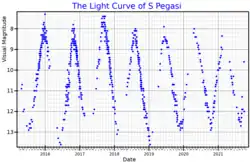
S Pegasi (S Peg) is a Mira variable star in the constellation Pegasus located about 2,300 light-years away. It varies between apparent magnitude 6.9 and 13.8 with a period of 319 days (10 months),[3][4] representing a nearly 600–fold change in brightness. S Pegasi enters solar conjunction and is hidden by the Sun's glare each year from late February through late March. It reaches opposition in mid-September, when it is visible all night.
It is believed to be pulsating in the first overtone. First overtone pulsators have masses less than 1.8 M☉ at a temperature of 2,107 K, and less than 1.4 M☉ at the luminosity of S Pegasi.[7]
References
- ↑ "Download Data". aavso.org. AAVSO. Retrieved 1 October 2021.
- 1 2 3 4 Vallenari, A.; et al. (Gaia collaboration) (2023). "Gaia Data Release 3. Summary of the content and survey properties". Astronomy and Astrophysics. 674: A1. arXiv:2208.00211. Bibcode:2023A&A...674A...1G. doi:10.1051/0004-6361/202243940. S2CID 244398875. Gaia DR3 record for this source at VizieR.
- 1 2 "S Peg". AAVSO Website. American Association of Variable Star Observers. Retrieved 30 June 2026.
- 1 2 3 4 Samus, N. N.; Durlevich, O. V.; et al. (2009). "VizieR Online Data Catalog: General Catalogue of Variable Stars (Samus+ 2007-2013)". VizieR On-line Data Catalog: B/GCVS. Originally Published in: 2009yCat....102025S. 1. Bibcode:2009yCat....102025S.
- ↑ Gontcharov, G. A. (2006). "Pulkovo Compilation of Radial Velocities for 35 495 Hipparcos stars in a common system". Astronomy Letters. 32 (11): 759–771. arXiv:1606.08053. Bibcode:2006AstL...32..759G. doi:10.1134/S1063773706110065. S2CID 119231169.
- 1 2 3 4 5 Béguin, E.; Chiavassa, A.; Ahmad, A.; Freytag, B.; Uttenthaler, S. (2024-10-01). "Retrieving stellar parameters and dynamics of AGB stars with Gaia parallax measurements and CO5BOLD RHD simulations". Astronomy & Astrophysics. 690: A125. arXiv:2409.03422. doi:10.1051/0004-6361/202450245. ISSN 0004-6361.
- ↑ Serkowski, Krzysztof; Shawl, Stephen J. (2001). "Polarimetry of 167 Cool Variable Stars: Data". The Astronomical Journal. 122 (4): 2017. Bibcode:2001AJ....122.2017S. doi:10.1086/323105.
External links
- S Peg lightcurve at AAVSO
