Spinocerebellar ataxia type 2
| Spinocerebellar ataxia type 2 | |
|---|---|
| Other names | Spinocerebellar ataxia, Cuban type; Spinocerebellar atrophy 2, Olivopontocerebellar atrophy, Holguin type; Olivopontocerebellar atrophy, 2; Wadia-Swami syndrome.[1] |
| Specialty | Neurology, Genetics |
| Causes | CAG expansion in ATXN2 gene. |
| Treatment | Symptomatic |
Spinocerebellar ataxia type 2 (SCA2) is a rare autosomal dominant disorder caused by a (CAG)n trinucleotide expansion in a gene ATXN2.[1] It usually debuts at the age of 40, and symptoms include difficulty articulating speech, dysmetria, ataxia, supranuclear ophthalmoplegia, slow saccadic eye movements, peripheral neuropathy (decreased sense of vibration, decreased/absent ankle and knee jerks).[2] Perioral spasm, tremor of the head, and cramps are another common feature of this disorder.[2] One quarter of the patients can have pyramidal signs such as Babinski sign and increased muscle tone.[2] Average life expectancy is 11 years.[3]
This disorder is common in India and Cuba, especially in province of Holguin with incidence of 4 of every 10,000.[4][5]
Symptoms

SCA2 usually has 3 stages: asymptomatic, prodrome, and ataxic stage.[6] In some cases, patients can experience parkinsonism as sole symptom of this disorder, and some patients can develop amyotrophic lateral sclerosis (ALS) in case of intermediate CAG expansions.[7][8]
SCA2 stages and infantile-/juvenile-onset
Asymptomatic and prodrome stage
In asymptomatic stage, patients don't develop any signs of this disorder, but in prodrome, patients usually develop sleep issues, muscle cramps, defects in sway control, dysautonomia, olfactory disorder, exaggerated reflexes, positive Babinski sign, sensory issues, and slowing of saccades; it can precede ataxic stage up to 15 years.[6][9] Also, volume loss in pons, and specific frontal and parietal parts on MRI can be seen.[10]
Ataxic stage
In this stage patients experience slowing of saccades, truncal ataxia, dysmetria, dysdiachokinesia, dysarthria, postural instability, and occasionally decreased muscle tone.[6][11] As this disorder progresses, fasciculation of arm and mouth, ophthalmoparesis, dysphagia, sphincter function disruption, myoclonus, dystonia, neuronopathy, chorea, and dementia can be seen.[11]
Purkinje cells show poor branching and torpedo-like malformation of axons. Parallel fibers are scant, and Purkinje cells and granule cells are decreased in number.[12] MRI shows atrophy of the white matter of the cerebellum, middle cerebellar peduncle, corticospinal tract, and pons. Later, atrophy spreads to cerebellar grey matter and cerebro-cerebellar tract. In severe stages, there is a severe degeneration of the corpus striatum, cortex, and thalamus.[13]
Infantile-onset and juvenile-onset
In infantile-onset SCA2 begins at an age of 0–1.[14] Patients first experience developmental delays with hypotonia which then progresses into rapid developmental regression with epilepsy, and gaze aversion; patients usually die at the age of 0.5–3 years.[14]
Juvenile-onset SCA2 debuts at the age of 2–15.[14] Patients experience cerebellar tremor and ataxia at first, which then progresses into regression, oculomotor disease, and involvement of extrapyramidal and peripheral nervous system; patients usually die at the age of 26 to more than 50 years.[14]
Parkinsonism
Parkinsonism is a term for motor symptoms, which include hypokinesia, tremors, and rigidity.[15] In some occasions patients develop parkinsonism which has good response to levedopa, some patients might additionally develop ataxia.[16]
ALS
ALS is neurodegenerative condition which causes death of motor neurons.[17] Intermediate expansion (30-33 repeats) of CAG in ATXN2 allele can cause increased risk of ALS, although some patients can develop SCA2 and ALS at the same time.[8]
Diagnosis
Suspicion of SCA2 can be made by its symptoms (such as slowing of saccade, ataxia), and by family history; diagnosis can be confirmed by genetic testing of CAG expansion in ATXN2 gene.[12]
Polymerase chain reaction (PCR) can be used to detect CAG expansion less than 100, but southern blotting (a laboratory technique to study DNA[18]) can used to detect expansions more than 100.[12]
Cause
SCA2 is caused by (CAG)n nucleotides expansion in a gene ATXN2.[1] Normally, ATXN2 contains less than 31 repeats, although 30-33 repeats can increase risk of ALS.[12] Patients usually have from 33 to more than 200 CAG repeats; occasionally homozygous 31 repeats can cause SCA2.[12] Anticipation (a phenomnon when symptoms get worse each generation[19]) can be seen in this disorder; usually fathers pass more CAG repeats.[12] Interruption by (CAA)n repeats can confer stability to expansion.[2]
| Age of onset | Repeat size |
|---|---|
| Normal allele | Less than 31 CAG |
| ALS-predisposing allele | 30-33 CAG |
| Reduced penetrance | 34-35 CAG |
| Full penetrance | 37-202 CAG |
Pathophysiology
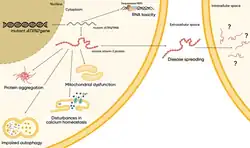
Ataxin-2 is a protein which contains 1312 amino acids; polyglutamine stretch is located near the N-terminus in the coding region of exon 1.[21] CAG (CAA nucleotides too) nucleotides expansion causes stretching of the polyglutamine tract, which in turn might make the ataxin-2 protein aggregate and form inclusion bodies in neurons; these inclusion bodies contain other proteins, such as ataxin-1, ataxin-3.[22][20] These mutated proteins cause disruption of endoplasmic reticulum membrane by BAX insertion, which in turn activates caspase-7 and might lead to apoptosis.[22] Also, superoxide dismutase levels are elevated, while catalase levels are decreased, which causes oxidative stress and mitochondrial dysfunction.[22]
Dysfunction of autophagy
Autophagy is a process when a part of cytoplasm gets engulfed and forms autophagosome, and consequent fusion with lysosome causes degradation of its content.[23] In SCA2 this process is hampered, which is evident by accumulation of p62/SQSTM1 and LC3-II (both of them are autophagy markers).[20]
RNA toxicity
ATXN2 locus encodes 2 transcripts, one of them is ATXN2-AS.[24] ATXN2-AS has CUG repeats which are toxic; CUG repeats bind to MBNL1 protein and causes APP and NMDA-R1 missplicing.[24] ATXN2 sense transcripts cause aberrant interaction with TBL3, which causes hampering in rRNA maturation and contributes to apoptosis of neurons.[20]
Issues in calcium homeostasis
A2BP1 normally binds to ATXN2 C-terminus, which in turn target exon 5 of GLUN1, but in SCA2 A2BP1 cannot bind to mutated ATXN2, which in turn causes missplicing and can trigger excitotoxicity (by increased levels of calcium ions) which causes apoptosis.[20] Also, SCA2-induced pluripotent cells show altered expression of other glutamate receptor subinit genes (such as GRM3 and GRIA4) which again can cause exciotoxicity.[25] Mutated ataxin-2 binds to inositol 1,4,5-trisphosphate receptor in the ER membrane, and causes release of calcium into the cytoplasm; there is an alteration in the expression of the calcium channels and transporters, genes related to IP3 metabolism and calmodulin dependent kinases.[20] There is an upregulation of SAM68 protein which causes NRXN1 mRNA to be spiliced to specific isoforms which alters connections between Purkinje and granule cells.[20]
Alteration of stress granule dynamics
Ataxin-2 is a part of stress granules and interacts with TDP-43 and STAU1; mutated ataxin-2 causes mislocalisation of TDP-43 and there is an overabundance of STAU1; STAU impairs the assembly of stress granules.[20]
Treatment
This disorder doesn't have a cure, but supportive care is possible.[26] Pharmacological treatments, such as high-doses of vitamin B, magnesium, mexiletine, quinine might alleviate muscle cramps; anticholinergics and dopaminergics are effective in management of dystonia, hypokinesia, and tremor.[26] Postural tremor can be treated using DBS.[26] Physiotherapy can be used to ease symptoms.[6]
Research

In 2011, researchers showed that zinc supplementation decreased symptoms of ataxia, dysdiadochocinesia, and slowed saccade.[27] In 2014, researchers showed that lithium didn't show change of symptoms and brain volume, but it showed decreased points in Beck depression inventory test.[28] Later, in 2022, researchers showed that riluzole didn't show any effects in patients with SCA2.[29]
In 2017, researchers used ASOs in mice model of SCA2 which showed positive results, specifically it decreased levels of ataxin-2 and improved motor function.[30]
History
Wadia and Swami reported 9 Indian families with SCA2 in 1971.[31] In 1993, Gispert and colleagues mapped SCA2 to long arm of chromosome 12, and later ATXN2 was discovered by Pulst and collagues.[32][33]
In 2010, Elden and colleagues showed that intermediate CAG expansion in ATXN2 increased risk for ALS.[34]
References
- 1 2 3 "SPINOCEREBELLAR ATAXIA 2". omim.org.
- 1 2 3 4 Antenora, Antonella; Rinaldi, Carlo; Roca, Alessandro; Pane, Chiara; Lieto, Maria; Saccà, Francesco; Peluso, Silvio; De Michele, Giuseppe; Filla, Alessandro (2017). "The Multiple Faces of Spinocerebellar Ataxia type 2". Annals of Clinical and Translational Neurology. 4 (9): 687–695. doi:10.1002/acn3.437. ISSN 2328-9503. PMC 5590519. PMID 28904990.
- ↑ Diallo, Alhassane; Jacobi, Heike; Cook, Arron; Labrum, Robyn; Durr, Alexandra; Brice, Alexis; Charles, Perrine; Marelli, Cecilia; Mariotti, Caterina; Nanetti, Lorenzo; Panzeri, Marta; Rakowicz, Maria; Sobanska, Anna; Sulek, Anna; Schmitz-Hübsch, Tanja (2018-04-01). "Survival in patients with spinocerebellar ataxia types 1, 2, 3, and 6 (EUROSCA): a longitudinal cohort study". The Lancet Neurology. 17 (4): 327–334. doi:10.1016/S1474-4422(18)30042-5. ISSN 1474-4422. PMID 29553382.
- ↑ Saucier, Jacob; Al-Qadi, Mohammad; Allain, Eric Pierre; Robichaud, Philippe-Pierre; Chamard-Witkowski, Ludivine; Alvarez, Mario; Dion-Côté, Anne-Marie; Richard, Luc; Crapoulet, Nicolas; Ben Amor, Mouna (2026-02-02). "Expanding the Genetic Landscape of ATXN2 Variants". Neurology Genetics. 12 (1) e200345. doi:10.1212/NXG.0000000000200345. PMC 12854297. PMID 41630926.
- ↑ Stefan, M. Pulst (2025-01-27). "Spinocerebellar Ataxia Type 2--A Review and Personal Perspective". Neurology. Genetics. 11 (1) e200225. doi:10.1212/NXG.0000000000200225. PMC 11772019. PMID 39872677.
- 1 2 3 4 Velázquez-Pérez, Luis C.; Rodríguez-Labrada, Roberto; Fernandez-Ruiz, Juan (2017-09-11). "Spinocerebellar Ataxia Type 2: Clinicogenetic Aspects, Mechanistic Insights, and Management Approaches". Frontiers in Neurology. 8 472. doi:10.3389/fneur.2017.00472. ISSN 1664-2295. PMC 5601978. PMID 28955296.
- ↑ Kim, Young Eun; Jeon, Beomseok; Farrer, Matthew J.; Scott, Erika; Guella, Ilaria; Park, Sung Sup; Kim, Jong Min; Park, Hye Young; Kim, Aryun; Son, Young Don; Cho, Zang Hee (2017-04-12). "SCA2 family presenting as typical Parkinson's disease: 34 year follow up". Parkinsonism & Related Disorders. 40: 69–72. doi:10.1016/j.parkreldis.2017.04.003. ISSN 1873-5126. PMID 28462804.
- 1 2 Ghahremani Nezhad, Helia; Franklin, John P.; Alix, James J. P.; Moll, Tobias; Pattrick, Michael; Cooper-Knock, Johnathan; Shanmugarajah, Priya; Beauchamp, Nick J.; Hadjivissiliou, Marios; Paling, David; Mcdermott, Christopher; Shaw, Pamela J.; Jenkins, Thomas M. (2021-10-02). "Simultaneous ALS and SCA2 associated with an intermediate-length ATXN2 CAG-repeat expansion". Amyotrophic Lateral Sclerosis and Frontotemporal Degeneration. 22 (7–8): 579–582. doi:10.1080/21678421.2020.1853172. ISSN 2167-8421. PMID 33284045.
- ↑ Velázquez-Pérez, Luis; Rodríguez-Labrada, Roberto; Laffita-Mesa, José Miguel (2017-03-03). "Prodromal spinocerebellar ataxia type 2: Prospects for early interventions and ethical challenges". Movement Disorders. 32 (5): 708–718. doi:10.1002/mds.26969. ISSN 0885-3185. PMID 28256108.
- ↑ Laffita-Mesa, Jose Miguel; Paucar, Martin; Svenningsson, Per (2021-05-26). "Ataxin-2 gene: a powerful modulator of neurological disorders". Current Opinion in Neurology. 34 (4): 578–588. doi:10.1097/WCO.0000000000000959. ISSN 1350-7540. PMC 8279897. PMID 34010218.
- 1 2 "Spinocerebellar ataxia type 2", Handbook of Clinical Neurology, vol. 103, Elsevier, pp. 423–436, 2012-01-01, retrieved 2026-06-13
- 1 2 3 4 5 6 7 Pulst, Stefan M. (1993), Adam, Margaret P.; Bick, Sarah; Mirzaa, Ghayda M.; Pagon, Roberta A. (eds.), "Spinocerebellar Ataxia Type 2", GeneReviews®, Seattle (WA): University of Washington, Seattle, PMID 20301452, retrieved 2026-06-13
- ↑ Robertson, Jason W.; Adanyeguh, Isaac; Bender, Benjamin; Boesch, Sylvia; Brunetti, Arturo; Cocozza, Sirio; Coutinho, Léo; Deistung, Andreas; Diciotti, Stefano; Dogan, Imis; Durr, Alexandra; Fernandez-Ruiz, Juan; Göricke, Sophia L.; Grisoli, Marina; Han, Shuo (2025). "The Pattern and Stages of Atrophy in Spinocerebellar Ataxia Type 2: Volumetrics from ENIGMA-Ataxia". Movement Disorders. 40 (4): 651–661. doi:10.1002/mds.30143. ISSN 1531-8257. PMC 12006884. PMID 39927598.
- 1 2 3 4 Rive Le Gouard, Nicolas; G. Bah, Maissa; Coarelli, Giulia; Heinzmann, Anna; Fauret, Anne-Laure; de Sainte-Agathe, Jean-Madeleine; Cazeneuve, Cécile; Gerasimenko, Anna; Gras, Domitille; Capri, Yline; Renaud, Mathilde; Brais, Bernard; Grenenko, Cecile; Masurel, Alice; Berquin, Patrick (2025). "The Two Faces of Pediatric SCA2". European Journal of Neurology. 32 (8) e70314. doi:10.1111/ene.70314. ISSN 1468-1331. PMC 12311840. PMID 40741828.
- ↑ Shrimanker, Isha; Tadi, Prasanna; Schoo, Caroline; Sánchez-Manso, Juan Carlos (2026), "Parkinsonism", StatPearls, Treasure Island (FL): StatPearls Publishing, PMID 31194381, retrieved 2026-06-29
- ↑ Kim, Young Eun; Jeon, Beomseok; Farrer, Matthew J.; Scott, Erika; Guella, Ilaria; Park, Sung Sup; Kim, Jong Min; Park, Hye Young; Kim, Aryun; Son, Young Don; Cho, Zang Hee (2017-07-01). "SCA2 family presenting as typical Parkinson's disease: 34 year follow up". Parkinsonism & Related Disorders. 40: 69–72. doi:10.1016/j.parkreldis.2017.04.003. ISSN 1353-8020. PMID 28462804.
- ↑ "Amyotrophic Lateral Sclerosis (ALS) | National Institute of Neurological Disorders and Stroke". www.ninds.nih.gov. Retrieved 2026-06-13.
- ↑ "Southern Blot". www.genome.gov. Retrieved 2026-06-13.
- ↑ "What do geneticists mean by anticipation?: MedlinePlus Genetics". medlineplus.gov. Retrieved 2026-06-13.
- 1 2 3 4 5 6 7 8 Costa, Rafael G.; Conceição, André; Matos, Carlos A.; Nóbrega, Clévio (2024-06-14). "The polyglutamine protein ATXN2: from its molecular functions to its involvement in disease". Cell Death & Disease. 15 (6): 415. doi:10.1038/s41419-024-06812-5. ISSN 2041-4889. PMC 11178924. PMID 38877004.
 This article incorporates text from this source, which is available under the CC BY 4.0 license.
- ↑ Albrecht, Mario; Golatta, Michael; Wüllner, Ullrich; Lengauer, Thomas (2004-07-15). "Structural and functional analysis of ataxin-2 and ataxin-3". European Journal of Biochemistry. 271 (15): 3155–3170. doi:10.1111/j.1432-1033.2004.04245.x. ISSN 0014-2956. PMID 15265035.
- 1 2 3 Egorova, Polina A.; Bezprozvanny, Ilya B. (2019-10-01). "Molecular Mechanisms and Therapeutics for Spinocerebellar Ataxia Type 2". Neurotherapeutics. 16 (4): 1050–1073. doi:10.1007/s13311-019-00777-6. ISSN 1878-7479. PMC 6985344. PMID 31435879.
- ↑ Jimenez-Sanchez, Maria; Thomson, Frances; Zavodszky, Eszter; Rubinsztein, David C. (2011-09-09). "Autophagy and polyglutamine diseases". Progress in Neurobiology. 97 (2): 67–82. doi:10.1016/j.pneurobio.2011.08.013. ISSN 1873-5118. PMC 3712188. PMID 21930185.
- 1 2 Li, Pan P.; Sun, Xin; Xia, Guangbin; Arbez, Nicolas; Paul, Sharan; Zhu, Shanshan; Peng, H. Benjamin; Ross, Christopher A.; Koeppen, Arnulf H.; Margolis, Russell L.; Pulst, Stefan M.; Ashizawa, Tetsuo; Rudnicki, Dobrila D. (2016-08-17). "ATXN2-AS , a gene antisense to ATXN2 , is associated with spinocerebellar ataxia type 2 and amyotrophic lateral sclerosis". Annals of Neurology. 80 (4): 600–615. doi:10.1002/ana.24761. ISSN 0364-5134. PMC 6555153. PMID 27531668.
- ↑ Chuang, Ching-Yu; Yang, Chih-Chao; Soong, Bing-Wen; Yu, Chun-Ying; Chen, Shu-Hwa; Huang, Hsiang-Po; Kuo, Hung-Chih (2019-02-04). "Modeling spinocerebellar ataxias 2 and 3 with iPSCs reveals a role for glutamate in disease pathology". Scientific Reports. 9 (1): 1166. Bibcode:2019NatSR...9.1166C. doi:10.1038/s41598-018-37774-2. ISSN 2045-2322. PMC 6361947. PMID 30718627.
- 1 2 3 Magaña, J. J.; Velázquez-Pérez, L.; Cisneros, B. (2012-09-05). "Spinocerebellar Ataxia Type 2: Clinical Presentation, Molecular Mechanisms, and Therapeutic Perspectives". Molecular Neurobiology. 47 (1): 90–104. doi:10.1007/s12035-012-8348-8. ISSN 0893-7648. PMID 22996397.
- ↑ Velázquez-Pérez, Luis; Rodríguez-Chanfrau, Jorge; García-Rodríguez, Julio Cesar; Sánchez-Cruz, Gilberto; Aguilera-Rodríguez, Raúl; Rodríguez-Labrada, Roberto; Rodríguez-Díaz, Julio Cesar; Canales-Ochoa, Nalia; Gotay, Dennis Almaguer; Almaguer Mederos, Luis E.; Laffita Mesa, José M.; Porto-Verdecia, Marlene; Triana, Consuelo González; Pupo, Noemí Rodríguez; Batista, Idania Hidalgo (2011-10-01). "Oral Zinc Sulphate Supplementation for Six Months in SCA2 Patients: A Randomized, Double-Blind, Placebo-Controlled Trial". Neurochemical Research. 36 (10): 1793–1800. doi:10.1007/s11064-011-0496-0. ISSN 1573-6903. PMID 21562746.
- ↑ Saccà, Francesco; Puorro, Giorgia; Brunetti, Arturo; Capasso, Giovambattista; Cervo, Amedeo; Cocozza, Sirio; de Leva, Mariafulvia; Marsili, Angela; Pane, Chiara; Quarantelli, Mario; Russo, Cinzia Valeria; Trepiccione, Francesco; De Michele, Giuseppe; Filla, Alessandro; Morra, Vincenzo Brescia (2015-01-01). "A randomized controlled pilot trial of lithium in spinocerebellar ataxia type 2". Journal of Neurology. 262 (1): 149–153. doi:10.1007/s00415-014-7551-0. ISSN 1432-1459. PMID 25346067.
- ↑ Coarelli, Giulia; Heinzmann, Anna; Ewenczyk, Claire; Fischer, Clara; Chupin, Marie; Monin, Marie-Lorraine; Hurmic, Hortense; Calvas, Fabienne; Calvas, Patrick; Goizet, Cyril; Thobois, Stéphane; Anheim, Mathieu; Nguyen, Karine; Devos, David; Verny, Christophe (2022-03-01). "Safety and efficacy of riluzole in spinocerebellar ataxia type 2 in France (ATRIL): a multicentre, randomised, double-blind, placebo-controlled trial". The Lancet Neurology. 21 (3): 225–233. doi:10.1016/S1474-4422(21)00457-9. ISSN 1474-4422. PMID 35063116.
- ↑ Scoles, Daniel R.; Meera, Pratap; Schneider, Matthew D.; Paul, Sharan; Dansithong, Warunee; Figueroa, Karla P.; Hung, Gene; Rigo, Frank; Bennett, C. Frank; Otis, Thomas S.; Pulst, Stefan M. (2017-04-12). "Antisense oligonucleotide therapy for spinocerebellar ataxia type 2". Nature. 544 (7650): 362–366. Bibcode:2017Natur.544..362S. doi:10.1038/nature22044. ISSN 1476-4687. PMC 6625650. PMID 28405024.
- ↑ WADIA, N. H.; SWAMI, R. K. (1971). "A New Form of Heredo-Familial Spinocerebellar Degeneration with Slow Eye Movements (Nine Families)". Brain. 94 (2): 359–374. doi:10.1093/brain/94.2.359. ISSN 0006-8950. PMID 5571047. Archived from the original on 2024-08-16.
- ↑ Gispert, S.; Twells, R.; Orozco, G.; Brice, A.; Weber, J.; Heredero, L.; Scheufler, K.; Riley, B.; Allotey, R.; Nothers, C.; Hillermann, R.; Lunkes, A.; Khati, C.; Stevanin, G.; Hernandez, A. (1993-07-01). "Chromosomal assignment of the second locus for autosomal dominant cerebellar ataxia (SCA2) to chromosome 12q23–24.1". Nature Genetics. 4 (3): 295–299. doi:10.1038/ng0793-295. ISSN 1546-1718. PMID 8358438.
- ↑ Pulst, Stefan-M.; Nechiporuk, Alex; Nechiporuk, Tamilla; Gispert, Suzana; Chen, Xiao-Ning; Lopes-Cendes, Iscia; Pearlman, Susan; Starkman, Sidney; Orozco-Diaz, Guillermo; Lunkes, Astrid; DeJong, Pieter; Rouleau, Guy A.; Auburger, Georg; Korenberg, Julie R.; Figueroa, Carla (1996-11-01). "Moderate expansion of a normally biallelic trinucleotide repeat in spinocerebellar ataxia type 2". Nature Genetics. 14 (3): 269–276. doi:10.1038/ng1196-269. ISSN 1546-1718. PMID 8896555.
- ↑ Elden, Andrew C.; Kim, Hyung-Jun; Hart, Michael P.; Chen-Plotkin, Alice S.; Johnson, Brian S.; Fang, Xiaodong; Armakola, Maria; Geser, Felix; Greene, Robert; Lu, Min Min; Padmanabhan, Arun; Clay-Falcone, Dana; McCluskey, Leo; Elman, Lauren; Juhr, Denise (2010-08-26). "Ataxin-2 intermediate-length polyglutamine expansions are associated with increased risk for ALS". Nature. 466 (7310): 1069–1075. Bibcode:2010Natur.466.1069E. doi:10.1038/nature09320. ISSN 1476-4687. PMC 2965417. PMID 20740007.