STAU1


Double-stranded RNA-binding protein Staufen homolog 1 also known as Staufen1 is a protein that in humans is encoded by the STAU1 gene.[5][6][7]
Staufen is a member of the family of double-stranded RNA (dsRNA)-binding proteins involved in the transport and/or localization of mRNAs to different subcellular compartments and/or organelles. These proteins are characterized by the presence of multiple dsRNA-binding domains which are required to bind RNAs having double-stranded secondary structures. The human homologue of staufen encoded by STAU, in addition contains a microtubule-binding domain similar to that of microtubule-associated protein 1B, and binds tubulin. Five transcript variants resulting from alternative splicing of STAU gene and encoding three isoforms have been described. Three of these variants encode the same isoform, however, differ in their 5'UTR.[7]
STAU1 is associated with stress granules.[8]
Gene
Mature STAU1 mRNAs produce five alternative splice variants that are different in their 5’UTR regions.[7]
Tissue distribution
STAU1 is expressed in many cell types and tissues and STAU2 is expressed in the brain and heart.[9]
Structure
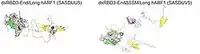
Staufen1 is a modular double-stranded RNA-binding protein that contains four dsRNA-binding domains (dsRBD2–dsRBD5, PF00035) separated by flexible linkers. Staufen1 also contains a microtubule/tubulin-binding domain between dsRBD4 and dsRBD5 and a short Staufen-swapping motif (SSM) immediately N-terminal to dsRBD5.[10]
The RNA-binding core of Staufen1 is the tandem dsRBD3–dsRBD4 region. Each of these domains belongs to the dsRBD fold family that contain two α-helices packed against a three-stranded antiparallel β-sheet (α–β–β–β–α). The tandem domains bind A-form RNA through contacts with the sugar–phosphate backbone and RNA grooves.[10]
The free staufen1 structure is not globular, but it is rather elongated and flexible.[11]
STAU1-binding sites (SBS) are located in 3’UTR, 5’UTR, and coding regions of over 1000 transcripts.[10]
Function
STAU1 is a double-stranded RNA-binding protein that regulates post-transcriptional RNA metabolism.[10] By binding to structured regions o RNAs and assembling into ribonucleoprotein complexes, Staufen1 contributes to mRNA transport, translational regulation, and transcript turnover. Binding of Staufen1 to a structured Staufen-binding site, often in an mRNA 3′ untranslated region can recruit the RNA helicase UPF1 and initiate Staufen-mediated mRNA decay, thereby reducing the abundance of targeted transcripts. Staufen1 can also influence nuclear RNA export and alternative pre-mRNA splicing.[12][13]
Regulation
RNA metabolism
STAU1 has a role in RNA metabolism. Motor proteins dynein and kinesin are recruited and actively transport mRNAs to subcellular locations using cytoskeletal networks.[10][14]
Staufen-mediated mRNA decay (SMD) is an mRNA degradation process that involves direct binding of STAU1 to SBS, which is located downstream of the stop codon of the target mRNA.[12] The STAU1 binding site (SBS) within the human ADP-ribosylation factor1 3'UTR binds STAU1 and downregulates ARF1 cytoplasmic mRNA levels by SMD.[11][15][16] The molecolar complex made of mRNA and two dimerized Staufen protein particles is called dimerized Staufen complex, a complex involved in SMD.[10][12]


Cell growth
In vitro, STAU1 may regulate mRNA translation of the cell cycle.[10] Expression of STAU1 may be involved in mitosis.[10]
Clinical significance
STAU1 regulates multiple aspects of post-transcriptional RNA metabolism. As such, its dysregulated expression or activity has been implicated in several diseases. Altered STAU1 expression has been associated with neuromuscular and neurodegenerative disorders (including myotonic dystrophy type 1, amyotrophic lateral sclerosis, spinocerebellar ataxia type 2, and Huntington’s disease) as well as with worse prognosis in several cancer types (such as prostate cancer, high-grade glioma, lung cancer, and rhabdomyosarcoma). Consequently, STAU1 has been proposed as a potential biomarker and therapeutic target. However, these applications remain investigational and require clinical validation.[10]
Research
Cell polarity
Various cell polarity proteins are classified as tumor suppressors or proto-oncogenes as a disruption of cell polarity has been linked to cancer.[17] STAU1 has been shown to be asymmetrically distributed in the apical pole in differentiated intestinal epithelial cells, which reveals a possible role for STAU1-induced cell polarity in normal tissue development. In vitro, STAU1 may exhibit tumor suppressor or oncogenic effects depending on the source and type of cancer stem cells. For example, the expression of STAU1 in vitro has shown a negative impact on the differentiation of mouse myoblasts.[10]
Stau1-mediated mRNA decay
STAU1-mediated mRNA decay is being investigated for its potential role in cancer cell proliferation. SMD of transcriptional factor retina and anterior neural fold homobox2 transcript may be required for the inhibition of tumor growth and metastasis.[10]
Cellular differentiation
In differentiated human neuroblastoma cell lines, localization of ribonucleoprotein complexes containing STAU1 in some dendrites is necessary for dendrite formation and morphology. Regulating STAU1-mediated alternative splicing is being studied for how it may affect neural growth, proliferation, and axon development.[10]
References
- 1 2 3 GRCh38: Ensembl release 89: ENSG00000124214 – Ensembl, May 2017
- 1 2 3 GRCm38: Ensembl release 89: ENSMUSG00000039536 – Ensembl, May 2017
- ↑ "Human PubMed Reference:". National Center for Biotechnology Information, U.S. National Library of Medicine.
- ↑ "Mouse PubMed Reference:". National Center for Biotechnology Information, U.S. National Library of Medicine.
- ↑ DesGroseillers L, Lemieux N (February 1997). "Localization of a human double-stranded RNA-binding protein gene (STAU) to band 20q13.1 by fluorescence in situ hybridization". Genomics. 36 (3): 527–529. doi:10.1006/geno.1996.0499. PMID 8884277.
- ↑ Kim YK, Furic L, Desgroseillers L, Maquat LE (January 2005). "Mammalian Staufen1 recruits Upf1 to specific mRNA 3'UTRs so as to elicit mRNA decay". Cell. 120 (2): 195–208. doi:10.1016/j.cell.2004.11.050. PMID 15680326. S2CID 16786108.
- 1 2 3 "STAU1 staufen double-stranded RNA binding protein 1 [Homo sapiens (human)]". US National Library of Medicine. 5 August 2026. Retrieved 20 August 2026.
- ↑ Thomas MG, Martinez Tosar LJ, Loschi M, Pasquini JM, Correale J, Kindler S, et al. (January 2005). "Staufen recruitment into stress granules does not affect early mRNA transport in oligodendrocytes". Molecular Biology of the Cell. 16 (1): 405–420. doi:10.1091/mbc.E04-06-0516. PMC 539183. PMID 15525674.
- ↑ Heraud-Farlow JE, Kiebler MA (September 2014). "The multifunctional Staufen proteins: conserved roles from neurogenesis to synaptic plasticity". Trends in Neurosciences. 37 (9): 470–479. doi:10.1016/j.tins.2014.05.009. PMC 4156307. PMID 25012293.
- 1 2 3 4 5 6 7 8 9 10 11 12 Almasi S, Jasmin B (July 2021). "The multifunctional RNA-binding protein Staufen1: an emerging regulator of oncogenesis through its various roles in key cellular events". Cellular and Molecular Life Sciences. 78 (23): 7145–7160. doi:10.1007/s00018-021-03965-w. PMC 8629789. PMID 34633481.
 This article incorporates text available under the CC BY 4.0 license.
- 1 2 3 4 Tripepi A, Shakoor H, Zlobina M, Klumpler T, Kubíčková M, Houser J, et al. (July 2026). "Staufen-swapping motif is crucial for Staufen dimerization, structure, and Staufen-mediated mRNA decay". Protein Science. 35 (7) e70669. doi:10.1002/pro.70669. PMC 13270411. PMID 42300088.
- 1 2 3 Park E, Maquat LE (2013). "Staufen-mediated mRNA decay". Wiley Interdisciplinary Reviews. RNA. 4 (4): 423–435. doi:10.1002/wrna.1168. PMC 3711692. PMID 23681777.
- ↑ Bondy-Chorney E, Crawford Parks TE, Ravel-Chapuis A, Klinck R, Rocheleau L, Pelchat M, et al. (January 2016). "Staufen1 Regulates Multiple Alternative Splicing Events either Positively or Negatively in DM1 Indicating Its Role as a Disease Modifier". PLoS Genetics. 12 (1) e1005827. doi:10.1371/journal.pgen.1005827. PMC 4733145. PMID 26824521.
- ↑ Gagnon JA, Mowry KL (June 2011). "Molecular motors: directing traffic during RNA localization". Critical Reviews in Biochemistry and Molecular Biology. 46 (3): 229–239. doi:10.3109/10409238.2011.572861. PMC 3181154. PMID 21476929.
- ↑ Yadav DK, Zigachova D, Zlobina M, Klumpler T, Beaumont C, Kubickova M, et al. (2020). "Staufen1 reads out structure and sequence features in ARF1 dsRNA for target recognition". Nucleic Acids Research. 48 (4): 2091–2106. doi:10.1093/nar/gkz1163. PMC 7038937. PMID 31875226.
- 1 2 Gleghorn ML, Gong C, Kielkopf CL, Maquat LE (April 2013). "Staufen1 dimerizes through a conserved motif and a degenerate dsRNA-binding domain to promote mRNA decay". Nature Structural & Molecular Biology. 20 (4): 515–524. doi:10.1038/nsmb.2528. PMC 4096160. PMID 23524536.
- ↑ Fomicheva M, Tross EM, Macara IG (February 2020). "Polarity proteins in oncogenesis". Current Opinion in Cell Biology. 62: 26–30. doi:10.1016/j.ceb.2019.07.016. PMC 7035994. PMID 31509786.
 This article incorporates public domain material from "STAU1 staufen double-stranded RNA binding protein 1 [Homo sapiens (human)]". Reference Sequence collection. National Center for Biotechnology Information. Retrieved 21 August 2026.