Rumble (instrumental)
| "Rumble" | |
|---|---|
 | |
| Single by Link Wray & His Ray Men | |
| B-side | "The Swag" |
| Released | March 31, 1958 |
| Genre | |
| Length | 2:25 |
| Label | Cadence |
| Songwriters | |
| Official audio | |
| "Rumble" on YouTube | |
"Rumble" is an instrumental by American group Link Wray & His Ray Men. Released as a single in the United States on March 31, 1958, "Rumble" utilized the techniques of guitar distortion, power chords, and tremolo, then largely unexplored in rock and roll.
In 2008, it was inducted to National Recording Registry by Library of Congress. In 2018, the piece was inducted into the Rock and Roll Hall of Fame in a new category for singles.[5]
History
At a live gig in Fredericksburg, Virginia, in early 1958, while attempting to work up a backing for the Diamonds' "The Stroll," Link Wray & His Ray Men came up with the instrumental "Rumble," which they originally called "Oddball." It was an instant hit with the audience, which demanded four repeats that night.[6] The host of the sock hop, disc jockey Milt Grant, paid for the track to be recorded in Washington, D.C.,[7] and released as a single; in turn, Grant would receive songwriting credit.[8][9][10]
Eventually the instrumental came to the attention of record producer Archie Bleyer of Cadence Records, who hated it, particularly after Wray poked a pencil through the speaker cone of his amplifier to make the recording sound more like the live version.[11][12] But Bleyer's stepdaughter loved it, so he released it despite his misgivings.[13]
Phil Everly suggested the title "Rumble," as its rough sound conjured images of a street fight.[12] In an era of increasing fears over juvenile delinquency, some radio stations opted not to play the record due to the title's implication of gang violence.[12][14][15]
Reception
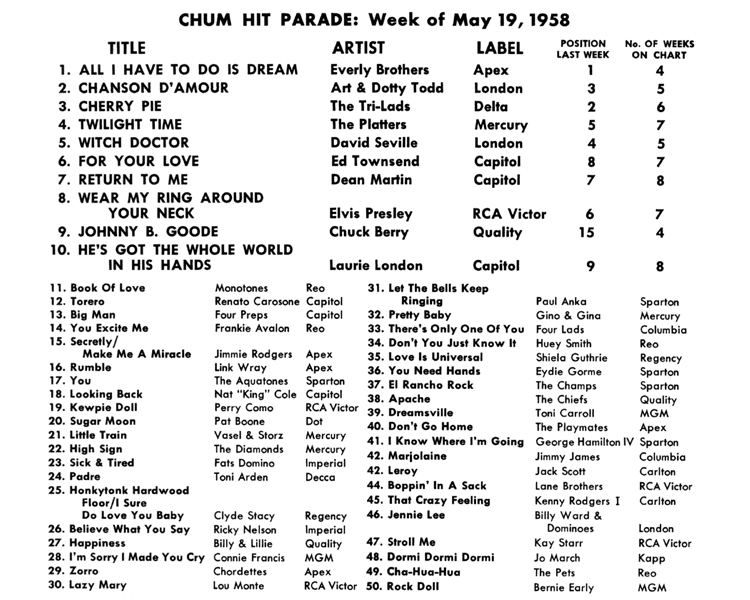
"Rumble" was a hit in the United States, where it climbed to number 16 on the pop charts and number 11 on the R&B chart in the summer of 1958.[16] In Canada the record also reached number 16.[17]
Shortly after the record's release, The Morning-Advocate of Baton Rouge, Louisiana, wrote: "Rumble is teen slanguage for a street brawl...Ploddingly slow, this tune is much like 'Big Guitar' in feeling. Wray's Ray Men produce some weird sounds. This is blues, 1958."[18] The Press-Telegram of Long Beach, California, published a positive review, commenting on its menacing nature: "In line with its title, the tune features a rather sinister-sounding rock 'n' roll tempo evoking all sorts of frightful pictures of tattooed teenagers in leather jackets."[19] Rolling Stone, writing retrospectively, said "its ragged, ominous chords, overdriven and dragged to a crawl, sounded like an invitation to a knife fight."[20]
Legacy
Wray is often credited with introducing the power chord to popular music with "Rumble."[12][21] Pete Townshend of the Who, whose playing features power chords prominently, said of Wray: "He is the king. If it hadn't been for Link Wray and 'Rumble,' I would have never picked up a guitar."[22]
Bob Dylan, who had seen Wray in concert at age sixteen, called "Rumble" the "best instrumental ever," and has performed it on occasion with his own band.[23] Iggy Pop said that he "left school emotionally" when he heard "Rumble," leading him to pursue a career in music.[24]
In the 2008 documentary It Might Get Loud, Jimmy Page of Led Zeppelin plays "Rumble" on his turntable, praising its "profound attitude."[25] Page performed it live at Wray's 2023 induction ceremony at the Rock and Roll Hall of Fame.[26]
References
- ↑ Richard Aquila (1989). That Old-time Rock & Roll: A Chronicle of an Era, 1954–1963. University of Illinois Press. p. 21. ISBN 978-0-252-06919-2.
- ↑ Markesich, Mike (2012). Teenbeat Mayhem (1st ed.). Branford, Connecticut: Priceless Info Press. pp. 10, 12. ISBN 978-0-9856482-5-1.
- ↑ Shaw, Greg (September 15, 1998). Nuggets: Original Artyfacts from the First Psychedelic Era, 1965–1968 (4-CD Box Set) – Sic Transit Gloria: The Story of Punk Rock in the '60s (liner notes). ISBN 978-1-56826-804-0. R2756466.
- ↑ "The 200 Best Albums of the 1960s". Pitchfork. August 22, 2017. Retrieved April 15, 2023.
...since his first and most famous garage-rock single, "Rumble"...
- ↑ "Rock and Roll Hall of Fame Inducts Songs for the First Time, Including 'Born to Be Wild' & 'Louie Louie'". Billboard. Retrieved April 15, 2018.
- ↑ McDonough, Jimmy (2006). "Be Wild, Not Evil: The Link Wray Story". Perfect Sound Forever. Retrieved March 4, 2023.
- ↑ Harrington, Richard (January 13, 2006). "Wray's 'Rumble' Still Reverberating". The Washington Post. ISSN 0190-8286. Retrieved July 27, 2026.
- ↑ Molenda, Michael (November 2007). "Blast from the Past: Link Wray's 'Rumble'". EQ. p. 51. ProQuest 199510916.
- ↑ Miller, Stephen (May 9, 2007). "Milt Grant, 83, Legendary Sock Hop Host". The New York Sun.
- ↑ Bacas, Harry (June 1, 1958). "Milt Grant Plugs a Hit—His Own". www.loc.gov. Washington Evening Star. Retrieved July 21, 2026.
- ↑ Sisario, Ben (November 22, 2005). "Link Wray, 76, a Guitarist With Raw Rockabilly Sound, Dies". The New York Times. Retrieved April 27, 2021.
- 1 2 3 4 Sullivan, James (November 21, 2005). "Guitarist Link Wray Dies: Father of the power chord was seventy-six". Rolling Stone. Archived from the original on April 2, 2019.
- ↑ Doyle, Jack (May 10, 2010). "Rumble Riles Censors, 1958–59". PopHistoryDig.com. Retrieved April 5, 2016.
- ↑ Rodriguez, Robert A. (2005). The 1950s' Most Wanted: The Top 10 Book of Rock & Roll Rebels, Cold War Crises, and All-American Oddities. Potomac Books. p. 94. ISBN 978-1-57488-715-0. LCCN 2004013424.
'Rumble' has the distinction of being the only instrumental single banned from the radio airwaves. ... a song with such a provocative name and such menace to its power chords, could only spell trouble for impressionable listeners.
- ↑ Tushnet, Mark V.; Chen, Alan K.; Blocher, Joseph (2017). "Instrumental Music and the First Amendment". Free Speech Beyond Words: The Surprising Reach of the First Amendment. NYU Press. p. 30. ISBN 978-1-4798-8028-7. LCCN 2016590840. OCLC 946161367.
Nongovernmental institutions that control forums for musical expression have also played a censoring role. For example, in 1959, federally licensed American radio stations refused to broadcast the purely instrumental Link Wray song 'Rumble' on the basis of its title's association with street violence.
- ↑ Whitburn, Joel (2004). Top R&B/Hip-Hop Singles: 1942-2004. Record Research. p. 637.
- ↑ "CHUM Hit Parade - May 19, 1958".
- ↑ Schreiber, Charles J. (April 27, 1958). "'Witch Doctor' Has Prescription for Success, Hexes Other Sides". The Morning-Advocate. p. 8-E. Retrieved July 31, 2026.
- ↑ Kouns, Terry (May 1, 1958). "Platter Matter". Press-Telegram. p. B-13. Retrieved July 31, 2026.
- ↑ O'Dell, Cary (2008). "'Rumble'—Link Wray (1958)" (PDF). Library of Congress. Retrieved July 31, 2026.
- ↑ Noris, Michelle (November 21, 2005). "Link Wray: Father of the Power Chord". NPR. Retrieved July 31, 2026.
- ↑ Koda, Cub. "Link Wray". AllMusic. Retrieved July 31, 2026.
- ↑ Harrington, Richard (January 13, 2006). "Wray's 'Rumble' Still Reverberating". The Washington Post. Archived from the original on December 1, 2017.
Bob Dylan ... who once called 'Rumble' 'the best instrumental ever', visited with [Link] Wray and [Robert] Gordon backstage after a 1978 London show.
- ↑ "Fuse". Fuse.tv. Retrieved April 27, 2021.
- ↑ "Jimmy Page Listening to Rumble". YouTube. September 2, 2010. Archived from the original on December 14, 2021. Retrieved April 11, 2020.
- ↑ "Jimmy Page reflects on his surprise performance at the Rock And Roll Hall Of Fame". Loudersound.com. November 6, 2023. Retrieved August 6, 2026.