Rulers of Circassia
The Rulers of Circassia refers to the figures who held supreme authority over Circassia. This role evolved from a symbolic feudal title into a formal executive office established to coordinate national defense during the Russo-Circassian War.
History
Pre-Inalid princes
The influential tribes of Circassia regularly met to elect a Grand Prince (Пщышхо) among them. The existence of such an institute is confirmed by foreign sources. In the eyes of foreign observers, the Grand Prince was considered the king of the Circassians. However, the individual tribes were greatly autonomous and the title was mostly symbolic.[1] In 1237, the Dominican monks Richard and Julian, as part of the Hungarian embassy, visited Circassia and the main city of this country Matrega, located on the Taman Peninsula. In Matrega, the embassy received a good reception from the Grand Prince.[2]
In the 14th and 15th centuries Italian documents concerning the relationship between the consul of Kafa and Circassia clearly indicate the absolutely special status of the ruler of Circassia. This status allowed the senior prince of Circassia to correspond with the Pope. The letter of Pope John XXII, addressed to the Grand Prince Verzacht of Zichia (Circassia), dates back to 1333, in which the Roman pontiff thanked the ruler for his diligence in introducing the Catholic faith among his subjects. Verzacht's power status was so high that following his example some other Circassian princes adopted Catholicism.[3]
List
| Name | Circassian name | Reign | Description |
|---|---|---|---|
| Rededya | Ридадэ | ?–1022 | Prince of Kassogia, leader of Circassians who fought Mstislav the Brave |
| Tuqar | Tукъар | ?–1237 | Leader of Circassians who died fighting the Mongols |
| Tuqbash | Tукъбаш | 1237–1239 | Leader of Circassians who died fighting the Mongols |
Inalid Prince of Princes
Grand Princes of the Principality of Chemguy were considered as the "true owners" of most of West Circassia.[4] This is because in Circassian oral history, Inal the Blind managed to unite all Circassians and declared himself the "Princes of Princes",[5][4] and the title has passed to Inal's eldest son Chemrug. Chemrug's son Boletuqo founded the House of Boletuqo, which was the princely dynasty of the Principality of Chemguy. In some versions, Boletuqo's brothers, along with their subjects, broke away from the principality and formed their own principalities.[4] This separation process resulted in the formation of the Hatuqay, Jane, and Hegayk tribes.[6] The Chemguy Grand Prince held a nominal vassal authority over all the principalities believed to be descended from the Inal; including Kabardians and Besleney.[4]
In the first half of the 16th century, the Bzhedug people migrated from the Black Sea coast to settle in the Chemguy lands in the Kuban region. According to legend, the Chemguy prince agreed to allow the Bzhedug people to settle in his lands on the condition that the Bzhedug princes become his vassal nobles. The Bzhedug princes wanted to preserve their princely rank and independence. The Bzhedug won the ensuing war and acquired vast territories around the Psekups basin.[7] Makhosh tribe, who broke away from the Bzhedug tribe, also went east and settled in the Chemguy lands.[8] In the late 16th century, the Abzakh and Shapsug-Natukhaj tribes appeared, in that order, in central West Circassia and along the Black Sea coast.[9]
According to historian F. A. Shcherbina, during the Russo-Circassian War, when General Zass suggested defining borders with the Principality of Chemguy, Grand Prince Jembulat Boletuqo replied:[10]
"What has this Russian general, born of a woman without trousers, devised? What border could I have? I am a son of the sun and the moon, meaning I descend from parental blood so pure that my parents can only be likened to the sun and the moon, and my ancestors' domains stretched along the Kuban, from the Laba River to the Black Sea. There is but one border for these lands: the Kuban. On one side are my lands, on the other are the Russians. Everyone should know this."
By the early 19th century, the confederative structure of the Principality of Chemguy included the territories of Makhosh, Yejeruqay, Ademiy and Mamkhegh.[11] They had previously established dominance over the Abazin regions as well.[12]
List
| Name | Circassian name | Reign | Description |
|---|---|---|---|
| Inal "the Blind" | Хъурышъолъей икъо Инал "Нэшъу" | See Dating of Inal | Ancestor of Circassian princes in tradition. |
| Chemrug | Инал икъо Кӏэмрыгу | Early 14th c. | Eldest son of Inal in tradition. He gave his name to the principality (the land of Chemrug, Chemrugoy, Chemirgoy, Chemguy).[13][14] |
| Boletuqo | Кӏэмрыгу икъо Болэтыкъо | Early 14th c. | Eldest son of Chemrug in tradition. He was the founder of the dynasty. Dated to the early 14th century by Samir Khotko.[15] |
| Chertibiy
(Kerti Bey / Kurtibay) |
Болэтыкъо Чэртыбий | Before 1452 | Father of Biberd, Ashaba and Tokhtamish.[15][16] In the anonymous Arabic chronicle titled 'al-‘Uqūd al-Jawhariyya fī al-Mahāsin al-Dawla al-Ashrafiyya al-Ghawiyya', Kurtibay, the ruler of Karamuk (namely Chemguy), and Kerti Bey, the ruler of Kremuk mentioned by Josaphat Barbaro, are the same person.[16] This ruler had sons named Biberd, mentioned by Barbaro, and Tokhtamish (Taktamysh) and Ashaba (Ishbai), mentioned by the Arabic chronicle.[16] |
| Biberd | Болэтыкъо Чэртыбий икъо Биберд | c. 1452 | Son of Chertibiy. Mentioned by Giosafat Barbaro, a representative of a Venetian noble family in Tana, as the ruler of Chemguy (Kremuk) in 1452.[15] He was also mentioned in a Genoese document from 1471.[15] |
| Tomenish | Болэтыкъо Томэныш | Early 16th c. | Mentioned in oral sources as the ruler of Chemguy and killed during the battle against Bzhedugs.[17] The place where Tomenish died severely wounded was turned into a mound by the Bzhedugs after the battle. This mound is called the Tomenish mound (Томанышы иIуашъхь).[17] In some versions; Bzhedugs had allied with the fugitive relatives of the Crimean Khan,[18] Tomenish was also recorded as Bezruqo[18] and fought alongside Hatuqay prince Aledjuqo during the battle.[19] |
| Qanshau
(Kansu) |
Болэтыкъо Къаншъау | c. 1581 | Mentioned in Ottoman documents in 1581 as the Christian ruler of Chemguy (Kemürgüy).[20] The name Kansu in Ottoman documents may be Qanshau.[21] Circassian folk songs about the 1578 Derbent campaign during the Ottoman-Safavid War of 1578–1590 instead name Asran (Болэтыкъо Асран).[22] |
| Qanshauqo
(Kanşuk / Kansutrak) |
Болэтыкъо Къаншъау икъо | c. 1583 | Mentioned in Ottoman documents from 1583 as the ruler of Chemguy.[20] He was mentioned among the Circassian princes with their detachments who were part of the Ottoman expeditionary force.[21] He is mentioned as Kansutrak in another document.[23] A document from 1586 mentions two Chemguy princes named Subuh and Survez.[24] |
| Mehmed | Болэтыкъо Мыхьэмэд | Until 1590 | Mehmed was the ruler of Chemguy until he was appointed by Ottomans as the Sanjak-bey of Kefe and the Emir of the Circassian lands in 1590. Mehmed and his brother Husrev had converted to Islam.[21] |
| Husrev | Болэтыкъо Хьусрэу | c. 1590 | After his older brother Mehmed was appointed as Emir, Husrev was appointed as the ruler of Chemguy after Mehmed.[21] |
| Unnamed ruler | c. 1629 | Mentioned by Dominican friar Giovanni Luca in 1629 as the ruler of Chemguy (Bolette-koy). He welcomed the missionaries sent by Pope Urban VIII, hosting them in his residence and facilitating the mass baptism of 250 children in his domain. He was around 60 years old in 1629 and had sons and at least a daughter. His wife had recently died.[25] | |
| Mirzabek | Болэтыкъо Мырзэбек | c. 1643 | Mentioned by Russians in 1643 as the ruler of Chemguy (Kumurgey), son of Qanmirza and older brother of Bezruqo which was sent to Terek city as a delegate.[26] |
| Sihatuqo
(Sihadok) |
Болэтыкъо Сыхьатыкъо | c. 1666 | Mentioned by Evliya Çelebi in 1666 as the eldest brother among the 7 ruling prince brothers of Chemguy (Bolatkay). He listed 5 brothers from eldest to youngest as: Sihatuqo (Sihadok), Yelbezdi (El-Bozdı), Yelmirza (El-mirza), Bezruqo (Bazruk), Bateqo (Batok).[27] |
| Unnamed ruler | c. 1724 | Mentioned by Xavier de Glavany in his 1724 report as the ruler of Chemguy (Gemirgia) and Makhosh (Mokosigilan).[12] According to Glavany, the principality had 2,000 dwellings under his administration, and the Abazin tribe Barakay (Karabay) with 600 dwellings was also listed as his dependency.[12] | |
| Shumaf | Болэтыкъо Айтэч икъо Шумафэ | Mid 18th c. | Son of Aytech. Mentioned in traditional songs and legends.[28][29] He had 2 sons named Aslanbech and Hatughuzhuqo.[14] |
| Aslanbech
|
Болэтыкъо Шумафэ икъо Аслъэнбэч | c. 1782 | Son of Shumaf. Mentioned in 1782 as the ruler of Chemguy, who signed his letter to the commandant of Suzhuq-Kale, reporting on frontier conditions and requesting military support from the Ottoman authorities.[30] Later that, he is mentioned in 1789, 1790, 1791, 1792 and 1797.[31][32][33][34][35] |
| Bezruqo | Болэтыкъо Хьатыгъужъыкъо икъо Бэзрыкъо | Until 1808 | Son of Hatughuzhuqo.[36][37] He was killed during a battle against the Abzakhs.[14] |
| Mishawost | Болэтыкъо Хьатыгъужъыкъо икъо Мышъэост | 1808–1827 | Son of Hatughuzhuqo, older brother of Bezruqo.[37][14] |
| Jembulat
|
Болэтыкъо Хьатыгъужъыкъо икъо Джанболэт | 1827–1836/1837 | Son of Hatughuzhuqo.[38] He opposed Russia and was killed by Russian general Grigory Zass in an assassination.[14] |


De-facto Confederation Leaders

Circassia traditionally consisted of more than a dozen principalities. Some of these principalities were divided into large feudal estates, characterized by the stability of political status. Within these territories there were numerous feudal possessions of princes (pshi). The Circassian state was a federal state consisting of four levels of government: Village council (чылэ хасэ, made up of village elders and nobles), district council (made up of representatives from 7 neighbouring village councils), regional council (шъолъыр хасэ, made up from neighbouring district councils), people's council (лъэпкъ зэфэс, where every council had a representative). A central government emerged during the mid to late 1800s. Prior to that, the institute of grand prince was mostly symbolic. The confederation of free tribes emerged as rival power structure to the princes.
In 1807, Qalebatuqo Hatuqay Shupako self-proclaimed himself as the leader of the Circassian confederation, and divided Circassia into 12 major regions.[39][40][41] In 1827, Ismail Berzeg officially declared the military confederation of the Circassian tribes and by 1839 united a significant part of Circassia under his control.[42][43] In 1839, the Circassians declared Bighurqal (Anapa) as their new capital and Hawduqo Mansur was declared the new leader of the Circassian Confederation. He kept this title until his death.[44][45][43] In 1848, Muhammad Amin was the leader of Circassia.[46][47][48] After learning that a warriorly scholar has arrived, thousands of families moved to the Abdzakh region to accept his rule.[49] Seferbiy Zaneqo assumed power after Amin's departure, but died the next year.
In June 1860, at a congress of representatives of Circassians, a parliament was formed as the highest legislative body of Circassia. Being a political resistance council and the legislature of Circassia,[50][51][52] the parliament was established in the capital of Sochi (Adyghe: Шъачэ, romanized: Ş̂açə) on June 13, 1860, and Gerandiqo Berzeg was elected as the head of the parliament and the nation.[53][54]
List
| Portrait | Name | Circassian name | Term of office | Tribe of origin | Profession | Notes |
|---|---|---|---|---|---|---|
 |
Sheikh Mansur | Шыихъ Мансур | 1787–1791 | Military commander, Islamic preacher | Managed to gain the loyalty of most Circassians, uniting them in the name of Islam.[55] Considered a hero in Circassian folklore despite being of Chechen origin.[56] Was recognized by the Ottoman Caliph as the leader of all Caucasian Muslims.[57] | |
| Shupako Hatuqay Qalebatuqo | Къалэбатыкъо Хьатыкъуай Шупаго | 1807–1827 | Soldier, nobleman, politician | A member of the House of Shupako. He held possession of Gelendzhik.[58] In 1807, having acquired some wealth and power, he attempted to unite Circassians under a "national oath" and declared himself the leader of the Circassian confederation and divided Circassia into 12 major regions.[39] But his authority was mostly limited, though British adventurer in Circassia, James Bell, said he was "admired".[59] | ||
 |
Ismail Berzeg | Бэрзэдж Дэгумыкъо Исмахьил | 1827–1839 | Military commander, nobleman, politician | A member of the House of Berzeg. From 1827, he engaged in organizing a military confederation of the tribes living on the Black Sea coast. By the end of 1839, he had united most of the population and other Circassians accepted his authority. James Bell called him "Circassian Washington".[59] | |
| Hawduqo Mansur | Хьаудыкъо Мансур Шупаго | 1839–1846 | Military commander, nobleman, politician | A member of the House of Shupako.[39] On May 6, 1837, he presided over the All-Circassian tribal assembly, which was attended by 1,000 Circassian representatives, as well as British adventurers James Bell and John Augustus Longworth.[60] In December 1838, he was also elected as the leader of the assembly held by the Shapsugs and Natukhais.[61] He rose to the position of a leader of the Circassians.[62] After this date, in Circassian meetings mentioned in Russian sources, Mansur was referred to as the leader.[58] Longworth mentioned Mansur's popularity, Longworth states that the Circassians loved him enough to make him "king of the country." He also mentions that Mansur spoke Turkish very well.[60] | ||
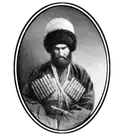 |
Muhammad Amin | Наиб Мыхьэмэд Амин | 1848–September 1859 | Islamic preacher | Appointed by Imam Shamil to lead the Circassians,[48] his title was "Naib" (representative). Amin used harsh methods to impose his rule, and many Circassians recognized his authority willingly or unwillingly. His era was marked with various reforms in industry, diplomacy, military, administration, religious issues and more. He gradually established stricter Islamic laws, removed slavery, banned social classes, built schools and small factories.[39] He was recognized by the Ottoman Caliph as the Governor of Circassia.[63] | |
 |
Seferbiy Zaneqo | Занэкъо Сэфэрбий | September 1859–1 January 1860 | Diplomat, Military commander, nobleman, politician | Designer of the Circassian flag. An Ottoman and Russian citizen, Zaneqo mostly worked as a diplomat of Circassia, acting as an intermediary between Circassians and Ottomans, Russians, and British.[64] Was elected by Circassians as representative of Circassia.[65][66] Initially recognized as the envoy of Circassia to Ottomans by Mahmud II,[65] he later acquired the title Governor of Circassia.[64][67] However, he could not establish authority due to the naibate of Muhammad Amin, and a civil war between the two ensued. Amin lost the war, however Zaneqo passed soon after. | |
 |
Gerandiqo Berzeg | Бэрзэдж Дэгумыкъо Джэрандыкъо | 13 June 1860 – 21 May 1864 | Military commander, nobleman, politician | A member of the House of Berzeg. In 1861, the Parliament of Independence was established in Sochi, declaring Circassia as a unitary state. Gerandiqo Berzeg was elected as the chairman and continued this role until the annexation of Circassia.[68] |


References
- ↑ "Черкесия: черты социо-культурной идентичности". Archived from the original on 17 October 2013. Retrieved 20 August 2013.
- ↑ De facto Ungariae Magnae a fretre Riccardo invento tempori domini Gregorii Noni. // Исторический архив. 1940. Т. 3. С. 96.)
- ↑ Atti della Societa Ligure di storia patria. T. VII, f. 2. 737; Колли Л. Кафа в период владения ею банком св. Георгия (1454-1475) // Известия Таврической Ученой Архивной комиссии. № 47. Симферополь, 1912. С. 86.)
- 1 2 3 4 Кагазежев, Жираслан Валерьевич. "Позднесредневековое адыгское княжество Кемиргой (Кремук)". История И Археология.
- ↑ Кожев, Заурбек Анзорович. КЫЗБУРУНСКОЕ СРАЖЕНИЕ (КЪЫЗБРУН ЗАУЭ) ПО ЧЕРКЕССКИМ ПРЕДАНИЯМ В ИЗЛОЖЕНИИ Ш.Б. НОГМОВА (PDF).
- ↑ Кагазежев, Ж. В. (2013). Черкесия в эпоху князя Инала и его ближайших потомков: XIV--первая половина XVI века (in Russian). OOO "Pechatnyĭ dvor". ISBN 978-5-906002-46-4.
- ↑ ЕМЫКI, Н. (2020). "БЖЪЭДЫГЪУХЭР КЪУШЪХЬЭМ КЪЫЗЭРЭЧIЭКIЫГЪЭХЭР" [HOW THE BZHEDUGS CAME OUT OF THE MOUNTAINS TO THE PLAIN]. ПСАЛЪ (in Adyghe). 16-17 (19-20): 244–251.
- ↑ Хан-Гирей, Султан. Записки о Черкесии [Notes on Circassia] (in Russian). pp. 114, 130–134, 583.
- ↑ Люлье, Л.Я. (1857). ЧЕРКЕССИЯ: историко-этнографические статьи (PDF) (in Russian).
- ↑ Скиба, К.В. (2016). "ГИБЕЛЬ «СТАРШЕГО ТЕМИРГОЕВСКОГО КНЯЗЯ» ДЖАМБУЛАТА БОЛОТОКОВА ВОЗЛЕ КРЕПОСТИ ПРОЧНЫЙ ОКОП В ОКТЯБРЕ 1836 ГОДА" (PDF). Российский Фронтир: 58.
- ↑ Скиба, К.В. "ИСТОРИЯ «КНЯЖЕСТВА ТЕМИРГОЙ» И РОДА КНЯЗЕЙ БОЛОТОКОВЫХ В XV- XVIII ВВ" (PDF). Российская Государственность В Судьбах Народов Кавказа - IX. Материалы Региональной Научно-практической Конференции.
- 1 2 3 Главани, Ксаверио. ОПИСАНИЕ ЧЕРКЕССИИ, составленное Ксаверио Главани, французским консулом в Крыму и первым врачом хана в Бахчисарае, 20 января 1724 г. (in Russian).
- ↑ ШЕУДЖЕН, А.Х. (2022). АДЫГИ В двух томах Том II (PDF) (in Russian). Майкоп. p. 35. ISBN 978-5-7992-1034-2.
{{cite book}}: CS1 maint: location missing publisher (link) - 1 2 3 4 5 Викторович, Скиба Константин (2015). "Род темиргоевских князей Болотоковых в военно-политических событиях на Кубани в конце XVIII начале xix вв". Политематический Сетевой Электронный Научный Журнал Кубанского Государственного Аграрного Университета (109): 1102–1128. ISSN 1990-4665.
- 1 2 3 4 Хотко, С. Х (2017). Черкесия: генезис, этнополитические связи со странами Восточной Европы и Ближнего Востока (XIII–XVI вв.) (in Russian). Адыгейское республиканское книжное издательство. ISBN 978-5-7608-0861-5.
- 1 2 3 Druzhinina, Inga A.; Александровна, Дружинина Инга; Iliushina, Milana Yu; Юрьевна, Илюшина Милана; Kabardov, Inal B.; Бесланович, Кабардов Инал (2024-12-23). "NOBILITY AND POWER IN 15TH-CENTURY KABARDA ACCORDING TO THE SOURCE "PRECIOUS NECKLACES CONCERNING MERITS OF THE STATE OF AL-ASHRAF AL-GHAWRI"". History, Archeology and Ethnography of the Caucasus (in Russian). 20 (4): 772–782. doi:10.32653/CH204772-782. ISSN 2618-849X.
- 1 2 ЕМЫКI, Н. (2020). "БЖЪЭДЫГЪУХЭР КЪУШЪХЬЭМ КЪЫЗЭРЭЧIЭКIЫГЪЭХЭР" [HOW THE BZHEDUGS CAME OUT OF THE MOUNTAINS TO THE PLAIN]. ПСАЛЪ (in Adyghe). 16-17 (19-20): 244–251.
- 1 2 ШЕУДЖЕН, А.Х. (2022). АДЫГИ В двух томах Том I (PDF) (in Russian). Майкоп. p. 458. ISBN 978-5-7992-1033-5.
{{cite book}}: CS1 maint: location missing publisher (link) - ↑ Кадырбаев, А.Ш.; Трепавлов, В.В.; Zaytsev, Ilya (2019). История и родословная черкесов : издание рукописи тюркского исторического сочинения XVIII в. (in Russian). Российское историческое общество; Институт научной информации по общественным наукам РАН; Институт стран Азии и Африки МГУ им. М.В. Ломоносова, Изд-во восточной литературы. pp. 28–29. ISBN 978-5-6041860-3-9.
- 1 2 KIRZIOGLU, Prof. Dr. M. Fahrettin KIRZIOGLU (1993). OSMANLILAR'IN KAFKAS ELLERİ'Nİ FETHİ (1451-1590). pp. 441–442.
- 1 2 3 4 Samir, Khotko (2017). ЧЕРКЕСИЯ: ГЕНЕЗИС, ЭТНОПОЛИТИЧЕСКИЕ СВЯЗИ СО СТРАНАМИ ВОСТОЧНОЙ ЕВРОПЫ И БЛИЖНЕГО ВОСТОКА (XIII-XVI ВВ.) (in Russian). Maykop: Адыгейское республиканское книжное издательство. p. 358.
- ↑ ЕМЫКОВА, Н.Х. (2012). "ПЕСНЯ О ВЗЯТИИ ТЕМИРКАПЫ". ПСАЛЪ. 9.
- ↑ Yasar, Murat (2011). The North Caucasus in the Second Half of the Sixteenth Century: Imperial Entanglements and Shifting Loyalties (PhD). University of Toronto. p. 128.
- ↑ İnci, Abidin (November 2019). "16. Yüzyıl'da Osmanlı Devleti'nin Çerkesya ile İlişkileri ve Osmanlı-Çerkes Sınırı" [Relations of the Ottoman State with Circassia in the 16th Century and the Ottoman-Circassian Border]. Kafkasya Çalışmaları - Sosyal Bilimler Dergisi (Journal of Caucasian Studies) (in Turkish). 5 (9): 1–28. eISSN 2149-9101. ISSN 2149-9527.
- ↑ "ДОКУМЕНТЫ->КРЫМ->ДЖИОВАННИ ДЕ ЛУККА (ЖАН ДЕ ЛЮК)->ОПИСАНИЕ ПЕРЕКОПСКИХ И НОГАЙСКИХ ТАТАР (1633?)->ПУБЛИКАЦИЯ 2010 Г.->ТЕКСТ". www.vostlit.info. Retrieved 2026-01-19.
- ↑ Глава III. АДЫГИ В СИСТЕМЕ ГЕОПОЛИТИЧЕСКИХ И ЭТНОПОЛИТИЧЕСКИХ ВЗАИМООТНОШЕНИЙ НА КАВКАЗЕ (СЕРЕДИНА XVI – НАЧАЛО 1770-х гг.) "Отдельные западно-адыгские народности стремились восстановить отношения с Россией. В августе 1643 г. верховный темиргоевский («кумургейский») князь Мурзабек Канмурзин прислал в Терский город своего младшего брата Базруку, который принес шерть..." Архив ИГИ КБНЦ, ф. 1, оп. 1, ед. хр. 12, л. 91-92.
- ↑ Hotko, Samir. Открытие Черкесии (PDF) (in Russian). pp. 22–26. Archived from the original (PDF) on 2024-11-16.
- ↑ НАГАРОКОВ, К.Р. (2018). "О ПРОБЛЕМАХ РЕКОНСТРУКЦИИ АДЫГСКИХ НАРОДНЫХ ПЕСЕН ИЗ ГОСУДАРСТВЕННОГО АРХИВА ФРАНЦИИ". ПСАЛЪ (in Russian). 15 (18). Адыгейский государственный университет: 125–134.
- ↑ Дьячков-Тарасов, А. Н. (1902). "Абадзехи (Историко-этнографический очерк)" [Abadzekhs (Historical and Ethnographic Essay)] (PDF). Записки Кавказского Отдела Русского Географического Общества (in Russian). 22 (4): 437.
- ↑ Шаов, Ибрагим Капланович. "Юридические формы политики Османского государства на Северо-Западном Кавказе: на примере Анапского наместничества (1782–1828)" (PDF). Вопросы Российского И Международного Права. 13 (9A): 41.
- ↑ Directorate of State Archives (BOA), Ali Emiri - Sabık I (AE.SABH.I), 19-1626, H-10-07-1203 (6 April 1789). "Imperial Order regarding the intelligence report on Russian fortifications in Kabarda and Dagestan."
- ↑ Бутков, Петр Григорьевич (1869). Материалы для новой истории Кавказа, с 1722 по 1803 год. Части III (in Russian). p. 230.
- ↑ Directorate of State Archives (BOA), Cevdet - Hariciye (C.HR), 33-1621, H-29-09-1205 (31 May 1791). "Decree regarding the mobilization of Circassian tribes against Russia."
- ↑ Mattei, Jean-Louis (1994). Kırım ve Kafkasya'da Osmanlı Nüfuzunun Gerilemesi ve Ruslara Karşı Kafkas Kabilelerinin Direniş Girişimleri (1792) (in Turkish).
- ↑ Directorate of State Archives (BOA), Cevdet - Maliye (C.ML), 57-2608, H-23-05-1212 (13 November 1797). "Report submitted by the Anapa Warden regarding the allocation of the remaining 200 kurus from the salary of the deceased Apetek's son to his three children."
- ↑ Данильченко, А. Е.; Теучеж, Б. А. (2023). Кикова, Б. А. (ed.). Памятные даты по Республике Адыгея на 2024 год : библиографический указатель (PDF) (in Russian). Майкоп: Национальная библиотека Республики Адыгея, Отдел краеведческой и национальной литературы, Качество. pp. 106–107. ISBN 978-5-9703-0760-1.
- 1 2 VON KLAPROTH, JULIUS (1814). TRAVELS IN THE CAUCASUS AND GEORGIA, PERFORMED IN THE YEARS 1807 AND 1808 (PDF) (in Russian). London. pp. 126–127.
- ↑ Лавров, Л.И. (1968). Эпиграфические памятники Северного Кавказа на арабском, персидском и турецком языках Памятники письменности Востока (in Russian). Vol. Часть 3. Moscow. p. 199.
{{cite book}}: CS1 maint: location missing publisher (link) - 1 2 3 4 İsmail Hakkı Berkok (1958). Tarihte Kafkasya [Caucasus in History] (in Turkish). İstanbul Matbaası. Archived from the original on 12 March 2023. Retrieved 12 March 2023.
- ↑ KAFFED, Çerkes Özgürlük Meclisi
- ↑ These regions were Shapsugo-Natukhaj, Abdzakh, Chemguy, Barakay, Bzhedug, Kabardo-Besleney, Hatuqway, Makhosh, Bashilbey, Taberda, Abkhazia and Ubykh.
- ↑ Hatajuqua, Ali. "Hadji-Ismail Dagomuqua Berzeg, Circassian Warrior and Diplomat". Eurasia Daily Monitor. 7 (38).
- 1 2 D, S. Kronolojik Savaş Tarihi
- ↑ Хункаров, Д. Урыс-Адыгэ зауэ
- ↑ A.Ü. Arşivi, XII.V, Çerkez tarihi liderleri
- ↑ Казиев Ш.М. Имам Шамиль / Изд. 2-е испр. — М.: Молодая гвардия, 2003. — 378 с.
- ↑ AKAK, Vol. X, p.590, document No. 544, Vorontsov to Chernyshev (secret), 8 [20] November 1847, No. 117
- 1 2 Карлгоф Н. Магомет-Амин II // Кавказский календарь на 1861 год. — Тф.: Тип. Гл. управ. намес. кавказского, 1860. — С. 77—102 (отд. 4).
- ↑ NA, F.O. 195/443, “Report of Mehmed Emin…”, 15 August 1854
- ↑ Фадеев А.В. Указ. соч.
- ↑ Фадеев А.В. Убыхи в освободительном движении на Западном Кавказе //Исторический сборник. – М.; Л., 1935. – № 4.
- ↑ Блиев М.М., Дегоев В.В. Кавказская война. – М., 1994.
- ↑ Черкесия: черты социо-культурной идентичности
- ↑ Ruslan, Yemij (August 2011). Soçi Meclisi ve Çar II. Aleksandr ile Buluşma.
- ↑ "ŞEYH MANSÛR". TDV İslâm Ansiklopedisi (in Turkish). Retrieved 2025-12-10.
- ↑ Askerov, Ali (2015). Historical Dictionary of the Chechen Conflict. Rowman & Littlefield. p. 3.
- ↑ Oztas, Ahmet (2013). A Page from the History of the North Caucasus: Imam Mansur Ushurma. EHESS. pp. 1–14.
- 1 2 Khotko, Samir (2014). КАВКАЗСКАЯ ВОЙНА: УРОКИ ИСТОРИИ И СОВРЕМЕННОСТЬ [The Caucasian War: Lessons of History and Modernity]. Материалы научной конференции, посвященной 150-летию окончания Кавказской войны [Materials of the scientific conference dedicated to the 150th anniversary of the end of the Caucasian War] (in Russian). Maykop: Izdatelstvo "Magarin Oleg Grigorievich" (Maikop). ISBN 9785916922455. Retrieved 14 December 2025.
- 1 2 Bell, James Stanislaus (1840). Journal of a Residence in Circassia: During the Years 1837, 1838 and 1839. pp. 344–346. Archived from the original on 5 July 2023. Retrieved 12 March 2023.
- 1 2 Longworth, J. A. (1840). A Year Among the Circassians. H. Colburn.
- ↑ ИнфоРост, Н. П. "ГПИБ | Т. 3 : [Письма 1839-1841 гг.]. - 1910". elib.shpl.ru. Archived from the original on 11 August 2020. Retrieved 2025-12-10.
- ↑ Hotko, Samir (2015). "ГЛАВА 5. ЧЕРКЕССКИЙ ЛИМЕС". Adyghe Republican Institute of Humanitarian Studies.
- ↑ BOA, İrade Dahiliye [İ.DH.], 305/19355, 5 Zilkâde 1270 [30 July 1854]
- 1 2 Yağcı, Zübeyde Güneş (2016-06-01). "The International Leader of North Caucasus: Sefer Zaniko". Bilig (76): 59–86. ISSN 1301-0549.
- 1 2 Arslan, Nebahat; Wakizaka, Keisuke; Topçu (Papşu), Murat; Kyriakidis, Theodosios; Güneş, Sadriye; Has, Yaprak; Liy, Ergün Özgür; Hacisalihoglu, Mehmet (12 January 2021). 1864 Kafkas Tehciri: Kafkasya'da Rus Kolonizasyonu, Savaş ve Sürgün [Caucasian Exodus of 1864: Russian Colonization of Caucasia, War and Exodus].
- ↑ Bell, James Stanislaus (1840). Journal of a Residence in Circassia: During the Years 1837, 1838 and 1839. pp. 344–346. Archived from the original on 5 July 2023. Retrieved 12 March 2023.
- ↑ BOA, İrade Dahiliye [İ.DH.], 25156, 9 Zilkâde 1273 [1 July 1857]; NA, F.O. 195/458, Misk to Stratford, Damascus, 30 September 1857, No.21.
- ↑ Владимировна, Чунтыжева Рима (2014). "Сочинский меджлис: опыт общественно-политического творчества адыгов в XIX веке". Вестник Майкопского Государственного Технологического Университета (4): 15–19. ISSN 2078-1024.