Rostriamynodon
| Rostriamynodon | |
|---|---|
 | |
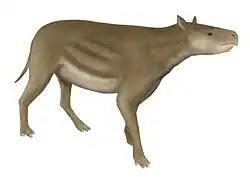
| Life restoration of R. grangeri | |
Scientific classification  | |
| Kingdom: | Animalia |
| Phylum: | Chordata |
| Class: | Mammalia |
| Infraclass: | Placentalia |
| Order: | Perissodactyla |
| Superfamily: | Rhinocerotoidea |
| Family: | †Amynodontidae |
| Genus: | †Rostriamynodon Wall & Manning, 1986[2] |
| Species: | †R. grangeri |
| Binomial name | |
| †Rostriamynodon grangeri Wall & Manning, 1986[2] | |
Rostriamynodon is an extinct genus of primitive amynodont that lived in East Asia during the Middle Eocene. The genus contains a single species, R. grangeri, known from from the Irdin Manha Formation in Inner Mongolia, China. Rostriamynodon is known from better fossil material than other primitive amynodonts, and its status as a intermediate form is important for the study of rhinocerotoid evolution.
Research history
Rostriamynodon grangeri was described by William P. Wall and Early Manning in 1986, based on a complete skull and mandible (AMNH 107635), found in the Irdin Manha Formation in Inner Mongolia, China.[2][3] The provenance of AMNH 107635 is sometimes incorrectly given as the Arshan Formation.[3] AMNH 107635 is slightly crushed. The lower dentition is relatively complete, but the upper dentition is more poorly preserved.[2] Wall and Manning recognized Rostriamynodon as an important fossil for the study of rhinocerotoid evolution, as a geologically early and primitive amynodont, and thus an early intermediate form.[2]
The name Rostriamynodon is derived from the Latin rostrum ("snout"), after the long preorbital (in front of the eyes) part of the skull, and the related genus Amynodon.[2] The species name grangeri is in honor of the paleontologist Walter W. Granger.[2]
Description
Rostriamynodon was a small amynodont,[4] with an estimated weight of 449 kilograms (990 lb)[5] to 536.5 kilograms (1,183 lb).[6] Rostriamynodon had the dental formula 3.1.3.33.1.3.3.[2] The canines were much larger than the incisors, and within the size range seen in Amynodon.[2]
Rostriamynodon had all of the major diagnostic features of amynodonts, such as a third upper molar with a quadratic outline, preorbital fossae (grooves in front of the eye orbits), and lacking both the lower and upper first premolar.[2] In all other features, Rostriamynodon is more primitive than other amynodonts.[2] The preorbital part of the skull of Rostriamynodon takes up about 42 % of the total length of the skull, longer than in any other known amynodont.[7]
Classification
Rostriamynodon is the earliest and most primitive well-defined amynodont.[8] Other genera recognized as primitive amynodonts, Caenolophus and Teilhardia, are based on much more fragmentary fossils.[2] Wall and Manning erected a new amynodont subfamily to contain Rostriamynodon, Rostriamynodontinae, and placed all more derived amynodonts in another subfamily, Amynodontinae.[2] Rostriamynodontinae has since been considered a redundant taxon and is no longer in use.[4]
Phylogenetic analyses consistently recover Rostriamynodon as a basal amynodont.[4][9][10] The cladogram below follows an analysis by Veine-Tonizzo et al. (2023):[10]
| Amynodontidae |
| ||||||||||||||||||||||||||||||||||||||||||||||||||||||||||||||||||||||||||||||||||||||||||||||||||||||||||||
References
- ↑ Bai, Bin; Meng, Jin; Janis, Christine M.; Zhang, Zhao-Qun; Wang, Yuan-Qing (2020). "Perissodactyl diversities and responses to climate changes as reflected by dental homogeneity during the Cenozoic in Asia". Ecology and Evolution. 10 (13): 6333–6355. Bibcode:2020EcoEv..10.6333B. doi:10.1002/ece3.6363. ISSN 2045-7758. PMC 7381588. PMID 32724516.
- 1 2 3 4 5 6 7 8 9 10 11 12 13 Wall, William P.; Manning, Earl (July 1986). "Rostriamynodon grangeri n. gen., n. sp. of amynodontid (Perissodactyla, Rhinocerotoidea) with comments on the phylogenetic history of Eocene Amynodontidae". Journal of Paleontology. 60 (4): 911–919. Bibcode:1986JPal...60..911W. doi:10.1017/S0022336000043079. ISSN 0022-3360.
- 1 2 Bai, Bin; Wang, Yuan-Qing; Li, Qian; Wang, Hai-Bing; Mao, Fang-Yuan; Gong, Yan-Xin; Meng, Jin (2018). "Biostratigraphy and Diversity of Paleogene Perissodactyls from the Erlian Basin of Inner Mongolia, China". American Museum Novitates (3914): 1–60. doi:10.1206/3914.1. ISSN 0003-0082.
- 1 2 3 Averianov, Alexander; Danilov, Igor; Jin, Jianhua; Wang, Yingyong (2017). "A new amynodontid from the Eocene of South China and phylogeny of Amynodontidae (Perissodactyla: Rhinocerotoidea)". Journal of Systematic Palaeontology. 15 (11): 927–945. Bibcode:2017JSPal..15..927A. doi:10.1080/14772019.2016.1256914. ISSN 1477-2019.
- ↑ Sanisidro, Oscar; Mihlbachler, Matthew C.; Cantalapiedra, Juan L. (2023). "A macroevolutionary pathway to megaherbivory". Science. 380 (6645): 616–618. Bibcode:2023Sci...380..616S. doi:10.1126/science.ade1833. PMID 37167399. Supplemental Material (Data S1, Sheet 8)
- ↑ Averianov, Alexander; Danilov, Igor; Jin, Jianhua; Wang, Yingyong (2017). "A new amynodontid from the Eocene of South China and phylogeny of Amynodontidae (Perissodactyla: Rhinocerotoidea)". Journal of Systematic Palaeontology. 15 (11): 927–945. Bibcode:2017JSPal..15..927A. doi:10.1080/14772019.2016.1256914. ISSN 1477-2019. Supplemental material.
- ↑ Wall, William P. (1982). "The Genus Amynodon and Its Relationship to Other Members of the Amynodontidae (Perissodactyla, Rhinocerotoidea)". Journal of Paleontology. 56 (2): 434–443. ISSN 0022-3360. JSTOR 1304471.
- ↑ Wall, William P. (1998). "Amynodontidae". Evolution of Tertiary Mammals of North America: Volume 1: Terrestrial Carnivores, Ungulates, and Ungulate Like Mammals. Cambridge University Press. pp. 583–588. ISBN 978-0-521-35519-3.
- ↑ Tissier, Jérémy; Becker, Damien; Codrea, Vlad; Costeur, Loïc; Fărcaş, Cristina; Solomon, Alexandru; Venczel, Marton; Maridet, Olivier (2018). "New data on Amynodontidae (Mammalia, Perissodactyla) from Eastern Europe: Phylogenetic and palaeobiogeographic implications around the Eocene-Oligocene transition". PLOS ONE. 13 (4) e0193774. Bibcode:2018PLoSO..1393774T. doi:10.1371/journal.pone.0193774. ISSN 1932-6203. PMC 5905962. PMID 29668673.
- 1 2 Veine-Tonizzo, Lea; Tissier, Jérémy; Bukhsianidze, Maia; Vasilyan, Davit; Becker, Damien (2023). "Cranial morphology and phylogenetic relationships of Amynodontidae Scott and Osborn, 1883 (Perissodactyla, Rhinocerotoidea)". Comptes Rendus. Palevol. 22 (8): 109–142. doi:10.5852/cr-palevol2023v22a8.
| |||||||||||||||||||||||||||||||||||||||||
| |||||||||||||||||||||||||||||||||||||||||
| |||||||||||||||||||||||||||||||||||||||||
| |||||||||||||||||||||||||||||||||||||||||
| |||||||||||||||||||||||||||||||||||||||||