Ross Masood
Ross Masood | |
|---|---|
 | |
| Born | 15 February 1889 |
| Died | 30 July 1937 (aged 48) |
| Father | Syed Mahmood |
| Relatives | Syed Ahmed Khan (grandfather) |
| Part of a series on |
| Aligarh Movement |
|---|
 |
Sir Ross Masood (15 February 1889 – 30 July 1937) was the Vice-Chancellor of Aligarh Muslim University starting in 1929.[1][2]
Early life and career
Ross Masood was the son of Syed Mahmood. His grandfather was Sir Syed Ahmed Khan.[2] He had three children: one daughter, Nadira Begum, and two sons, Anwar Masood and Akbar Masood (1917–1971). Ross Masood was educated at Aligarh Muslim University and the University of Oxford.[3]
On his return from England, Masood was elected a trustee of Muhammadan Anglo-Oriental College and started his own legal practice in Patna. He then entered the Indian Education Service as headmaster of the Patna High School, a professor of history at Ravenshaw College, Cuttack (Orissa), and one of the founders of Osmania University.[3]
From 1916 to 1928, he was Director of Public Instruction in Hyderabad Deccan. In 1922, he travelled to Japan to assess its educational system as a possible model for Hyderabad. In his publication, Japan and its Educational System (1923), Masood recommended that Hyderabad follow a Japanese model of modernization and educational reform by focusing on the imperial tradition, patriotic nationalism, and freedom from foreign control.[4]
He became the Vice-Chancellor of Aligarh Muslim University in 1929. He was knighted by the British Government in the 1933 Birthday Honours list.[1] Here, he introduced new courses, upgraded the syllabi and established laboratories for various science subjects.[5]
Masood was the president of Anjuman Taraqqi-i-Urdu.[6]
Masood was friends with the English novelist E. M. Forster, who dedicated his 1924 novel A Passage to India to Masood.[7][8][9] Forster would later write of Masood: "He woke me up out of my suburban and academic life, showed me new horizons and a new civilisation and helped me towards the understanding of a continent".[7]
Legacy
Anjuman Taraqqi-i-Urdu published a biography of Masood in 2011.[10]
A residential hall constructed in the year 1969 in Aligarh Muslim University is named after him.
References
- 1 2 Ross Masood on The London Gazette Published 6 June 1933, Retrieved 9 October 2019
- 1 2 Peerzada Salman (28 April 2014). "This week 50 years ago: Tributes paid to Ross Masood". Dawn (newspaper). Retrieved 9 October 2019.
- 1 2 Syed Ross Masood - Pursuit of Excellence in Higher Education on aligarhmovement.com website Retrieved 11 October 2019
- ↑ Hanaoka, Mimi (November 2022). "Syed Ross Masood and a Japanese Model for Education, Nationalism, and Modernity in Hyderabad". History of Education Quarterly. 62 (4): 418–446. doi:10.1017/heq.2022.29. S2CID 253447706.
- ↑ Matai-e Garan Baha Masood by Hakim Syed Zillur Rahman, Souvenir Federation of Aligarh Muslim University Alumni Association of North America, USA, 2003
- ↑ "Ross Masud – Bahaisiyat Sadr-e Anjuman Tarraqi-e-Urdu" by Hakim Syed Zillur Rahman, Hundredth Anniversary of Anjuman Tarraqi-e-Urdu Hind, New Delhi, 28 February – 2 March 2003
- 1 2 Alim, Scheherazade (9 April 2001). "Forster Chacha: A Personal Reminiscence". Outlook magazine. Archived from the original on 9 October 2019. Retrieved 9 October 2019.
- ↑ Singh, Amardeep (ed.). "A Passage To India (1924) Glossary: Syed Ross Masood". Retrieved 2 June 2026.
- ↑ Forster-Masood letters / edited by Jalil Ahmad Kidwai. Karachi, Pakistan : Ross Masood Education and Culture Society of Pakistan, 1984.
- ↑ Hakim Syed Zillur Rahman (2011), Rās Masʻūd, Naʼī Dihlī: Anjuman Taraqqī-yi Urdū (Hind), ISBN 978-8171601608, OL 25056019M, 817160160X
External links
| History | 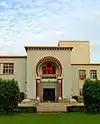 | |
|---|---|---|
| Faculty & departments | ||
| Colleges & schools | ||
| Libraries | ||
| Clubs & societies | ||
| Arts & culture | ||
| Halls | ||
| Campuses | ||
| People | ||