Richard Scolyer
Richard Scolyer | |
|---|---|
 | |
| Born | Richard Anthony Scolyer 16 December 1966 Launceston, Tasmania, Australia |
| Died | 7 June 2026 (aged 59) Sydney, New South Wales, Australia |
| Education | University of Tasmania University of Sydney |
| Occupations | Pathologist and translational researcher |
| Organization | Melanoma Institute Australia |
| Spouse | Katie Nicoll[1] |
| Children | 3[2] |
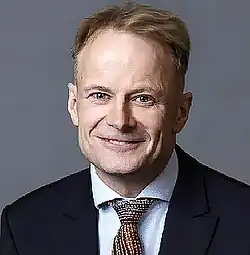
Richard Anthony Scolyer (16 December 1966 – 7 June 2026) was an Australian pathologist. He was a senior staff specialist in tissue pathology and diagnostic oncology at Royal Prince Alfred Hospital,[3][4] and Conjoint Professor, Sydney Medical School, Faculty of Medicine and Health, The University of Sydney.[5] He and Professor Georgina Long were honoured as 2024 Australians of the Year.
Career
Scolyer provided a clinical consultation service for the diagnosis of difficult pigmented lesions and received more than 2,000 cases for opinion from Australasia and beyond annually. He integrated his clinical practice with co-leading a melanoma translational research laboratory.[6]
In February 2019, he was ranked the world's 10th leading publisher on the topic of melanoma and the world's leading publisher in melanoma pathology.[7] Scolyer had co-authored more than 700 publications and book-chapters on the subject until his death in 2026,[3][6] and was an editor of the fourth edition of the WHO classification of tumours of the central nervous system.[8]
Cancer diagnosis and treatment
In June 2023, Scolyer was diagnosed with a grade 4 glioblastoma IDH wild-type brain tumour.[9][1] With treatment for glioblastoma mostly unchanged for the last 20 years, Georgina Long worked to develop a world-first treatment for Scolyer's brain tumour based on breakthroughs in melanoma research. Scolyer underwent experimental combination immunotherapy before and after surgical excision of the tumour, delaying his surgery to do so. Scolyer was also administered a cancer vaccine personalised to the tumour genetic markers, in order to help the immunotherapy detect the cancer cells. His treatment was documented in the journal Nature Medicine,[10] paving the way for future clinical trials. While medical oncologists have applied these techniques successfully to melanoma, this treatment is non-standard for brain cancer due to concerns about toxicity, whether drugs will reach the brain, and speed of tumour development.[11]
In February 2024, eight months after surgery, Scolyer's cancer had not returned. This was an encouraging result with potentially broader implications due to the pioneering approach taken, with the normal prognosis for this glioblastoma being six to nine months, though oncologists warned that it was too early to judge the effectiveness of the treatment, compared to standard protocols.[12] On 10 March 2025, Scolyer announced the cancer had returned, and he was given a prognosis of three months.[13][14] In January 2026, Scolyer expressed surprise that he had lived for two and a half years since his diagnosis, much longer than the average 12 months.[15]
Personal life and death
Richard Anthony Scolyer was born on 16 December 1966 in Launceston, Tasmania.[16] After attending Riverside High School and Launceston Community College, he completed his medical training at the University of Tasmania, undertook pathology training in Canberra and Sydney, and subsequently became a clinical professor at the University of Sydney.[16]
Scolyer was married to a fellow pathologist, Katie Nicoll; they had three children.[17][18]
Scolyer died from brain cancer on 7 June 2026, at the age of 59, three years after his first diagnosis. A state funeral was held in memory of Scolyer at the Sydney Opera House on 13 July.[19][15][16][17][18]
Awards and recognition
As of 2020 Scolyer had received ten New South Wales Premier's Awards for Outstanding Cancer Research in 2009, 2012, 2013, 2014, 2016, 2017, 2018 and 2020.[20]
He was appointed an Officer of the Order of Australia for "distinguished service to medicine, particularly in the field of melanoma and skin cancer, and to national and international professional organisations" in the 2021 Queen's Birthday Honours.[3]
Scolyer was named 2024 Australian of the Year alongside Georgina Long by the National Australia Day Council, a not-for-profit Australian Government-owned social enterprise.[21]
He won Social Impact Book of the Year at the 2025 Australian Book Industry Awards[22] for his book Brainstorm.[23][24]
References
- 1 2 MacLennan, Leah (20 September 2023). "Cancer expert given experimental treatments for incurable brain tumour describes 'phenomenal' results". ABC News. Retrieved 20 September 2023.
- ↑ Burns, Brielle (4 December 2023). "Doctor facing 'certain death' does unthinkable". news.com.au. Retrieved 2 January 2024.
- 1 2 3 "Professor Richard Anthony Scolyer". It's an Honour. Retrieved 13 June 2021.
- ↑ "Tissue Pathology at RPA". www.tissuepathologyatrpa.com.au. Retrieved 6 February 2021.
- ↑ "Staff Profile". The University of Sydney. Retrieved 13 August 2020.
- 1 2 "Our team". Melanoma Institute Australia. Retrieved 13 August 2020.
- ↑ "Melanoma: Worldwide - Expertscape.com". expertscape.com. Retrieved 13 August 2020.
- ↑ DE, Elder; D, Massi; RA, Scolyer; R, Willemze (11 September 2018). WHO Classification of Skin Tumours. World Health Organization. ISBN 978-92-832-2440-2.
- ↑ "World Leading Pathologist Documents His Own Cancer Journey". NSW Health Pathology. 23 June 2023. Retrieved 10 March 2025.
- ↑ Long, Georgina V.; Shklovskaya, Elena; Satgunaseelan, Laveniya; Mao, Yizhe; da Silva, Inês Pires; Perry, Kristen A.; Diefenbach, Russell J.; Gide, Tuba N.; Shivalingam, Brindha; Buckland, Michael E.; Gonzalez, Maria; Caixeiro, Nicole; Vergara, Ismael A.; Bai, Xinyu; Rawson, Robert V. (27 February 2025). "Neoadjuvant triplet immune checkpoint blockade in newly diagnosed glioblastoma". Nature Medicine. 31 (5): 1557–1566. doi:10.1038/s41591-025-03512-1. ISSN 1546-170X. PMC 12092302. PMID 40016450.
- ↑ "Professor Richard Scolyer 'patient zero' in new frontier of brain cancer treatment". The Royal College of Pathologists of Australia. 22 February 2024. Archived from the original on 10 March 2025. Retrieved 11 March 2025.
- ↑ Turnbull, Tiffany (3 February 2024). "Richard Scolyer: Melanoma doctor's high-stakes gamble to treat his brain cancer". BBC News. Retrieved 3 February 2024.
- ↑ Langdon, Ally (10 March 2025). "Professor Richard Scolyer reveals brain cancer has returned, given just months to live". A Current Affair (Australian TV program). Nine News. Archived from the original on 10 March 2025. Retrieved 11 March 2025.
- ↑ "'I'm not ready to die': Professor Richard Scolyer reveals heartbreaking prognosis". ABC News. 10 March 2025. Retrieved 10 March 2025.
- 1 2 Megan Mackander; Vanessa Gorman (7 June 2026). "Professor Richard Scolyer dies aged 59 leaving behind legacy of revolutionary brain cancer research". ABC News. Retrieved 7 June 2026.
- 1 2 3 King, Jennifer (7 June 2026). "Richard Scolyer, acclaimed melanoma researcher who tried experimental treatment on his own brain cancer – obituary". The Guardian. Retrieved 12 June 2026.
- 1 2 "Richard Scolyer's 'final goodbye', an open letter to all Australians". WAtoday. 7 June 2026. Retrieved 7 June 2026.
- 1 2 Turnbull, Tiffanie (8 June 2026). "Australian doctor who underwent world-first brain tumour treatment dies". BBC News. Retrieved 8 June 2026.
- ↑ Gladstone, Nigel (28 June 2026). "State funeral date announced for Professor Richard Scolyer". The Sydney Morning Herald. Retrieved 29 June 2026.
- ↑ "NSW Premier's Awards for Outstanding Cancer Research". NSW Cancer.
- ↑ "Who are Georgina Long and Richard Scolyer, the 2024 Australians of the Year?". SBS News. 25 January 2024. Retrieved 25 January 2024.
- ↑ "Australian Book Industry Award Winners 2025". 7 May 2025.
- ↑ "'We really want to make a difference': Professor Richard Scolyer's hope for the future of cancer research – ABC listen". www.abc.net.au. 8 May 2025. Retrieved 14 August 2025.
- ↑ Scolyer, Richard (2024). Brainstorm (1st ed.). Sydney: Allen & Unwin. ISBN 9781761471490. OL 57759207M.