Ribulokinase
| Ribulokinase | |||||||||
|---|---|---|---|---|---|---|---|---|---|
 Ribulokinase dimer, Bacillus halodurans | |||||||||
| Identifiers | |||||||||
| EC no. | 2.7.1.16 | ||||||||
| CAS no. | 9030-57-3 | ||||||||
| Databases | |||||||||
| BRENDA | enzyme data | ||||||||
| ExPASy | NiceZyme view | ||||||||
| KEGG | enzyme entry | ||||||||
| MetaCyc | metabolic pathway | ||||||||
| Rhea | reactions | ||||||||
| PDB structures | RCSB PDB PDBe PDBsum | ||||||||
| Gene Ontology | AmiGO / QuickGO | ||||||||
| |||||||||
Ribulokinase (EC 2.7.1.16) is an enzyme that catalyzes two chemical reactions


The enzyme characterised from Aerobacter aerogenes and Escherichia coli converts the pentose sugar, L-ribulose, to L-ribulose 5-phosphate by transferring a phosphate group from the cofactor, adenosine triphosphate (ATP), which is converted to adenosine diphosphate (ADP). This reaction is part of a pathway that allows these bacteria to metabolise L-arabinose.[1][2]
The enzyme from Lactobacillus plantarum can also act on D-rubulose:[3]
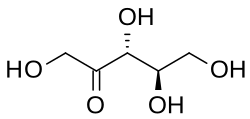

This enzyme is a transferase, specifically one transferring phosphorus-containing groups (phosphotransferases) with an alcohol group as acceptor. The systematic name of this enzyme class is ATP:L(or D)-ribulose 5-phosphotransferase. Other names in common use include ribulokinase (phosphorylating), and L-ribulokinase.[4]
References
- ↑ Simpson, F.J.; Wolin, M.J.; Wood, W.A. (1958). "Degradation of L-arabinose by Aerobacter aerogenes. I: A pathway involving phosphorylated intermediates". Journal of Biological Chemistry. 230: 457–472. doi:10.1016/S0021-9258(18)70580-2.
- ↑ Lee, Nancy; Bendet, Irwin (1967). "Crystalline l-Ribulokinase from Escherichia coli". Journal of Biological Chemistry. 242 (9): 2043–2050. doi:10.1016/S0021-9258(18)96014-X. PMID 5336963.
- ↑ Burma, D.P.; Horecker, B.L. (1958). "Pentose Fermentation by Lactobacillus plantarum". Journal of Biological Chemistry. 231 (2): 1039–1051. doi:10.1016/S0021-9258(18)70465-1.
- ↑ Enzyme 2.7.1.16 at KEGG Pathway Database.
Categories: