Ramadan in Nigeria
Ramadan is a significant religious and cultural observance in Nigeria, which has a large Muslim population. It is marked by fasting, prayer, charity, and community gatherings, with influences from Nigeria's varying ethnic groups and local traditions. The observance is particularly prominent in the northern regions, where Islam has deep historical roots, but it is also practiced widely across other parts of the country.[1][2][3]
History
Ramadan came to Nigeria through Muslim traders from North Africa between the 11th and 15th century. During British colonial rule, Muslims continued observing Ramadan more. After Nigeria’s independence in 1960, it remained a major religious tradition.[4]
Commencement and religious authority
The beginning of Ramadan in Nigeria is determined by the sighting of the crescent moon. The Nigerian Supreme Council for Islamic Affairs (NSCIA), led by the Sultan of Sokoto, announces the official start and end of the month. This announcement is broadcast nationwide through radio, television, and social media.[5][6]
Fasting and daily practices
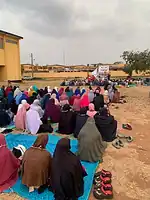
Muslims in Nigeria fast from dawn (suhoor) until sunset (iftar), abstaining from food, drink, and other physical needs during daylight hours. The fast is typically broken with dates and water, followed by meals that often include rice, soups, and meat dishes. Suhoor, the pre-dawn meal, enables those observing to have energy through the day. Daily life during Ramadan is reshaped, with work schedules, school hours, and public activities often adjusted to accommodate fasting and prayer.[7][8][9][10]
Prayers and worship
Mosques across Nigeria see increased attendance during Ramadan, particularly for the nightly Tarawih prayers. Special sermons and Qur’an recitations are common, and many Muslims aim to complete the reading of the entire Qur’an during the month. Spiritual reflection and devotion are emphasized, with Ramadan serving as a period of heightened religious consciousness.
Charity and community

Charity (Zakat and Sadaqah) is a central aspect of Ramadan in Nigeria. Wealthier individuals and organizations often provide food and financial assistance to the less privileged. Community iftar gatherings are widespread, fostering unity and social cohesion.[11]
Cultural traditions
While Ramadan is observed according to Islamic principles, Nigerian Muslims incorporate local customs into the month's practices. One notable tradition is Tashe, a cultural performance in Northern Nigeria where children dress in costumes, sing, and perform in the evenings during Ramadan. Tashe is both entertainment and a way of reinforcing communal bonds.[12][13]
Geographic and ethnic diversity
Nigeria's Muslim population is concentrated in the northern states, particularly among the Hausa-Fulani, Kanuri, and Nupe ethnic groups. However, significant Muslim communities also exist in southwestern Nigeria among the Yoruba, and in smaller numbers across other regions. This diversity influences the foods, languages, and cultural expressions associated with Ramadan, making the observance a reflection of Nigeria's pluralistic society.[8]
Eid al-Fitr
The end of Ramadan is marked by the festival of Eid al-Fitr. In Nigeria, large communal prayers are held in open fields and mosques, followed by feasts, family visits, and cultural festivities. Traditional clothing is worn, and gifts are exchanged. Eid celebrations highlight both religious devotion and Nigeria's cultural diversity, with regional variations in food and customs.[14]
See also
References
- ↑ "Ramadan in Nigeria: A Journey Through Tradition, Spirituality, and Community". Intalks Africa. 25 February 2026. Retrieved 3 March 2026.
- ↑ Lukman, Adeshina (29 December 2021). "Historical Overview of the Socio-Religious Activities during the Month of Ramadan in Ilorin in the 20th Century". Lapai Journal of Nigeria History. 13 (3): 51–61. ISSN 2006-2818.
- ↑ "TGM Ramadan Consumer Insights Statistics | Data in Nigeria". TGM Research. Retrieved 3 March 2026.
- ↑ Amos, Kobor (1 March 2025). "Sultan declares Saturday, March 1, as commencement of Ramadan in Nigeria". The Guardian. Lagos, Nigeria. Retrieved 30 April 2026.
- ↑ Aravindan (1 August 2025). "Ramadan in Nigeria 2026: Daily Life, Traditions, and What to Expect". Wego Travel Blog. Retrieved 3 March 2026.
- ↑ "Matakan da ake bi don duban watan azumi a Najeriya". BBC News Hausa (in Hausa). Retrieved 3 March 2026.
- ↑ Garba, Mahdi (14 April 2021). "9 Ways Ramadan is Celebrated in Nigeria". Retrieved 3 March 2026.
- 1 2 "Fasting Across Africa: Unique Ramadan Traditions in African Communities". NKENNE. Retrieved 3 March 2026.
- ↑ "Ramadan Lantern – Unique Iftars in Nigeria… What is Plantain?". Profile News. 14 March 2025. Retrieved 3 March 2026.
- ↑ Lawal, Shola (7 June 2018). "The Taste of Ramadan in Nigeria (Plus a Recipe)". Roads & Kingdoms. Retrieved 3 March 2026.
- ↑ Atta, Aisha. "RAMADAN ETIQUETTE IN NORTHERN NIGERIA – Aisha Atta". Leadership.
- ↑ "Amsoshin Takardunku: Asalin Tashe da yadda ake yin sa". BBC News Hausa (in Hausa). 17 April 2022. Retrieved 3 March 2026.
- ↑ "Rayuwata - Yadda al'adar tashe ke neman gushewa a kasar Hausa". RFI (in Hausa). 5 April 2024. Retrieved 3 March 2026.
- ↑ "Eid festivities in north Nigeria make UNESCO heritage list". France 24. 5 December 2024. Retrieved 3 March 2026.
| Obligations |  | ||||||||||
|---|---|---|---|---|---|---|---|---|---|---|---|
| Meals | |||||||||||
| Prayers and observances | |||||||||||
| Ramadan culture | |||||||||||
| Ramadan by country |
| ||||||||||