Quaid-e-Azam Residency
| Quaid-e-Azam Residency | |
|---|---|
| قائدِ اعظم ریزیڈنسی (Urdu) | |
 Quaid e Azam Residency, Ziarat, Pakistan | |
Interactive map of Quaid-e-Azam Residency | |
| Location | Ziarat, Balochistan, Pakistan |
| History | |
| Built | 1892 |
| Site notes | |
Architectural style | Wooden structure |
Quaid-e-Azam Residency (Urdu: قائدِ اعظم ریزیڈنسی), also known as the Ziarat Residency, is a 19th-century wooden building located in the hill station of Ziarat in Balochistan, Pakistan. Constructed in 1892 during the British India, the two-storey structure is best known as the place where the founder of Pakistan, Muhammad Ali Jinnah, spent the last months of his life in 1948. The building is a wooden structure, originally designed as a sanatorium before being converted into the summer residence of the agent of the Governor General. It is declared a heritage site and is of great architectural importance.
History
Construction and colonial use
The Residency was built by the British in 1892 as part of the development of Ziarat, an alpine hamlet in Balochistan situated at an elevation of about 2,400 metres above sea level and surrounded by ancient juniper forests.[1][2] Originally intended as a sanatorium, the building's arid and dry mountain setting was considered suitable for the treatment of pulmonary ailments.[2][3] It was subsequently adapted as the summer residence of the Agent to the Governor-General of Balochistan and used by British officers seeking respite from the summer heat of Quetta and Sibi.[4][3]
Jinnah's stay in 1948
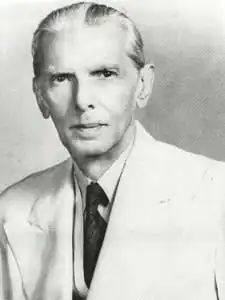
Following the creation of Pakistan in 1947, Muhammad Ali Jinnah assumed office as the country's first Governor-General. In mid-1948, his long-concealed tuberculosis had progressed sharply, and on the advice of his doctors he was moved from Karachi to Quetta on 6 July 1948 and shortly afterwards to the higher retreat of Ziarat.[1][5] He resided at the Residency alongside his sister and companion Fatima Jinnah, who occupied the room facing his own on the upper floor.[1] During his stay, tests carried out by Colonel Ilahi Bakhsh and other physicians confirmed a diagnosis of tuberculosis and advanced lung cancer.[1][5]
Jinnah continued to conduct official business from Ziarat, receiving despatch boxes marked "M.A.J." from Karachi and holding meetings in the sitting room and on the front lawn.[2] His visitors during this period included the first Prime Minister Liaquat Ali Khan and Cabinet Secretary Chaudhry Muhammad Ali.[5] On 13 August 1948, on the eve of the first anniversary of Pakistan's independence, Jinnah was moved to the lower altitude of Quetta and thereafter flown to Karachi on 11 September 1948, where he died the same evening.[1]
After partition, the Residency was converted into a museum and declared a national monument.[4] The building has appeared on Pakistan's 100-rupee note since 2006.[1]
Property damage
On 29 October 2008, at around 4 am, Ziarat and surrounding areas were struck by an earthquake doublet. The first tremor, 6.2 magnitude, lasted a couple of seconds, and was followed by a magnitude-6.4 tremor that lasted almost 30 seconds, destroying many mud houses, several government buildings and neighbouring houses. The residency was also damaged during the 2008 earthquake.[6]
On 15 June 2013, the Residency was targeted with rockets. The wooden parts of the building were badly affected as a result of the attack. Militants belonging to BLA claimed responsibility. It was badly damaged as a result of the intense attack.[7] However, the government of Pakistan vowed to restore the site. However, despite the wooden structure being badly damaged in the 2013 attack, the concrete structure was standing and the photographs along with the other artifacts were safe and sound.[8]
Rehabilitation
The reconstruction work completed by builder Nayyer Ali Dada and the rehabilitated Ziarat Residency opened on August 14, 2014, by then Prime Minister Nawaz Sharif.[9] The building is now open for all to visit it.
Depictions
The Quaid-e-Azam Residency has appeared on the 100-rupee note since 2006.
See also
References
- 1 2 3 4 5 6 "Summer home where Pakistani founder spent final days lives on as monument to his memory". Arab News. August 14, 2022.
- 1 2 3 Shuaib, Haroon (August 24, 2015). "Ziarat Residency: the Quaid's Last Abode". Youlin Magazine.
- 1 2 "Revisiting Ziarat Residency". The Nation. December 25, 2016.
- 1 2 "BLA destroys Jinnah's Residency in Ziarat". The Express Tribune. June 16, 2013.
- 1 2 3 "Burning down the Quaid's house". Dawn. June 25, 2013.
- ↑ "Pakistan quake kills 160". The Telegraph. Retrieved 2023-02-17.
- ↑ "BLA claims attack on Jinnah residency in Ziarat". Express Tribune. 15 June 2013. Retrieved 15 June 2013.
- ↑ "Nisar presents preliminary report on Ziarat attack in NA". Archived from the original on 2013-06-17. Retrieved 2013-06-21.
- ↑ "Rehabilitated Ziarat Residency to be inaugurated on August 14th". 14 May 2014.
External links

- Quaid's Residency - VT
- A picture of the Quaid-e-Azam residency - offroadpakistan.com Archived 2019-08-14 at the Wayback Machine
- Rockets kill one, gut historic building in Baluchistan


- Cultural heritage sites in Balochistan, Pakistan
- 1892 establishments in British India
- Ziarat District
- Monuments and memorials in Pakistan
- Buildings and structures in Ziarat District
- Burned buildings and structures in Pakistan
- Houses completed in 1892
- Archaeological sites in Balochistan, Pakistan
- Memorials to Muhammad Ali Jinnah