Propofol hemisuccinate
 | |
| Clinical data | |
|---|---|
| Other names | EP-102; EP102; EP-103; EP102 |
| Routes of administration | Oral, inhalation[1] |
| Drug class | GABAA receptor positive allosteric modulator; Anesthetic |
| Identifiers | |
| |
| CAS Number | |
| PubChem CID | |
| DrugBank | |
| ChemSpider | |
| UNII | |
| Chemical and physical data | |
| Formula | C16H22O4 |
| Molar mass | 278.348 g·mol−1 |
| 3D model (JSmol) | |
| |
| |
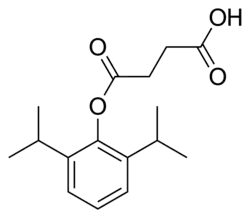
Propofol hemisuccinate (developmental code names EP-102 and EP-103) is an anesthetic drug which is an ester substituted prodrug of propofol.[1] Propofol itself is a viscous, oily liquid which does not dissolve in water and has to be formulated as an oil-in-water emulsion. Propofol hemisuccinate is a modified form of propofol which can be made into a water-soluble salt, and can be administered by routes such as by inhalation which are impossible with the unmodified propofol parent compound. It has improved neuroprotective properties compared to propofol.[2][3][4] The drug is under development for the treatment of migraine and epilepsy.[1]
See also
References
- 1 2 3 "Propofol hemisuccinate". AdisInsight. 28 June 2023. Retrieved 7 June 2026.
- ↑ Sagara Y, Hendler S, Khoh-Reiter S, Gillenwater G, Carlo D, Schubert D, et al. (December 1999). "Propofol hemisuccinate protects neuronal cells from oxidative injury". Journal of Neurochemistry. 73 (6): 2524–2530. doi:10.1046/j.1471-4159.1999.0732524.x. PMID 10582614.
- ↑ Vansant G, Trauger RJ, Cameron A, Vendemelio M, Kreitschitz S, Carlo AT, et al. (May 2007). "Propofol hemisuccinate suppression of experimental autoimmune encephalomyelitis". Autoimmunity. 40 (3): 180–186. doi:10.1080/08916930701204467. PMID 17453716.
- ↑ Dhir A, Zolkowska D, Murphy RB, Rogawski MA (January 2011). "Seizure protection by intrapulmonary delivery of propofol hemisuccinate". The Journal of Pharmacology and Experimental Therapeutics. 336 (1): 215–222. doi:10.1124/jpet.110.173591. PMID 20837991.