Production of peaches in California
California is the largest grower of peaches in the United States, producing about 70% of the total.[1]


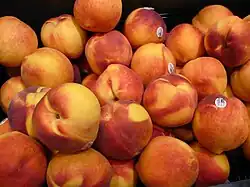


The California Freestone Peach Association (CFPA)[2] and California Canning Peach Association/California Cling Peach Board (CCPA)[2][3] represent the industry.[4] (The CFPA is a separate incorporation that is operated by the CCPA's staff.) The majority of the country's peaches are grown here, in 2020 468,000 short tons (425,000 t) for sales of $308.3 million.[5] Since 1980 the total value of the harvest has been slightly increasing.[5] Peach acreage has been declining however, down to 73,000 acres (30,000 ha) as of 2020.[5]
In April 2026, Del Monte shut down its major warehouses in California. As of May 2026, California farmers plan on cutting down 420,000 peach trees following Del Monte's bankruptcy with $9 million of assistance from the United States Department of Agriculture.[6]
Economics
In 2014, California led US peach production, followed by South Carolina, then Georgia.[7]
As of 2021 cling deliveries for processing purposes have been on a downward trend for years.[8] From 430,000 short tons (390,000 t) in 2010, delivered tonnage declined to 225,000 short tons (204,000 t) in 2021.[8] Cling yield shows no clear trend over the same time, bouncing between 18.1 short tons per acre (41 t/ha) and 15.3 short tons per acre (34 t/ha).[8] As of 2022, prices of clingstone peaches had been trending mostly upward for several years, from $317 per short ton ($349/t) in 2012 to $518 per short ton ($571/t). In 2022, CCPA (California Canning Peach Association) expected deliveries of clingstone peaches to be between 214,200–232,400 short tons (194,300–210,800 t) from a yield of 15.3–16.6 short tons per acre (34–37 t/ha).[8]
Breeding
UCD hosts one of the major breeding programs in the country.[9] Most of the private breeding programs for peach in the country are found in California, with a significant amount of the public breeding also being performed here but also elsewhere in the country.[9]
Cultivars
Pests
See Cal ag § Colletotrichum acutatum for the cause of Peach Anthracnose here.[15]
Arthropod
Some arthropod pests of peach in California are:[16]
- Black Peach Aphid (Brachycaudus persicae)
- Brown Mite (Bryobia rubrioculus)
- European Fruit Lecanium (Parthenolecanium corni)
- European Red Mite (Panonychus ulmi)
- Fruit Tree Leafroller (Archips argyrospila)
- Katydids (Tettigoniidae)
- Oblique Banded Leaf Roller (Choristoneura rosaceana)
- Omnivorous Leafroller (Platynota stultana)
- Oriental Fruit Moth (Grapholita molesta)
- Pacific Flatheaded Borer (Chrysobothris mali)
- Peach Silver Mite (Aculus cornutus)
- Peach Twig Borer (Anarsia lineatella)
- Peachtree Borer (Synanthedon exitiosa)
- Plant Bugs/Lygus Bugs (Miridae) including:
- The Prune Limb Borer (Bondia comonana) and the American Plum Borer (Euzophera semifuneralis)
- San Jose Scale (Quadraspidiotus perniciosus)
- Shothole Borer (Scolytus rugulosus)
- Stink Bugs (Pentatomidae)
- Webspinning Spider Mites:
- Western Flower Thrips (Frankliniella occidentalis), see Cal ag § Western Flower Thrips
Diseases
Some diseases of peach in California include:[16][17]
- Armillaria Root Rot – see Cal ag § Armillaria Root Rot.
- Bacterial Canker (Pseudomonas syringae)
- Brown Rot Blossom and Twig Blight (Cal ag § Monilinia fructicola, occasionally Cal ag § Monilinia laxa)
- Crown Gall (Agrobacterium tumefaciens)
- Jacket Rot (Cal ag § Botrytis cinerea, M. fructicola, M. laxa, Sclerotinia sclerotiorum)
- Peach Leaf Curl (Taphrina deformans)
- Phytophthora Root and Crown Rot (Phytophthora spp.)
- Powdery Mildew (Podosphaera cunningtonii)
- Ripe Fruit Rot (B. cinerea, M. fructicola, Rhizopus spp.)
- Rust (Tranzschelia discolor)
- Scab (Cladosporium carpophilum)
- Shot Hole Disease of Peach (Wilsonomyces carpophilus)
- Verticillium Wilt (Verticillium dahliae)
UC IPM provides information about commonly used fungicides[18] and fungicide efficacy. (See also Cal ag § Fungicides.)
Peach Yellow Leaf Roll was first discovered in the Sacramento Valley in 1948, but remained uncommon until an epidemic in the late 1970s and early 1980s.[19] For the causative organism see Cal ag § Candidatus Phytoplasma pyri.
Nematode diseases
Some nematode diseases of peach in California are:[20]
- Dagger nematode (Xiphinema americanum)
- Ring nematode (Mesocriconema xenoplax syn. Criconemella xenoplax)
- Root Lesion Nematode (Pratylenchus vulnus and other Pratylenchus spp.)
- Root-Knot Nematode (Meloidogyne arenaria, Cal ag § Meloidogyne hapla, Cal ag § Meloidogyne incognita, and Cal ag § Meloidogyne javanica)
Integrated pest management
Regional Integrated Pest Management Centers (Regional IPM Centers) hosts a suggested IPM plan for peach.[21] UC IPM provides even more detailed integrated pest management information.[16]
Fungal disease IPM
UC IPM recommends treatment timings[22] and resistance management practices[23] specifically for peach IPM.
References
- ↑ "FE1016/FE1016: Establishment and Production Costs for Peach Orchards in Florida: Enterprise Budget and Profitability Analysis". Electronic Data Information Source. Institute of Food and Agricultural Sciences. February 26, 2021. Retrieved June 8, 2022.
- 1 2 "Cal Peach". California Canning Peach Association. December 15, 2015. Retrieved July 6, 2022.
- ↑ "California Cling Peaches". California Cling Peach Board. Retrieved July 6, 2022.
- ↑ California Department of Food and Agriculture (2006). "California Agricultural Directory" (PDF).
- 1 2 3 "Peaches". Agricultural Marketing Resource Center, USDA. July 11, 2022. Retrieved July 11, 2022.
- ↑ Thompson, Anthony (May 6, 2026). "Del Monte bankruptcy prompts massive peach tree removal in California". USA TODAY.
- ↑ Kathryn C. Taylor (August 15, 2003). "Peaches". New Georgia Encyclopedia. Georgia Humanities Council and the University of Georgia Press. Archived from the original on July 5, 2015. Retrieved August 3, 2015.
- 1 2 3 4 "Research – Cal Peach". Cal Peach. December 15, 2015. Retrieved July 6, 2022.
- 1 2 Iezzoni, Amy F.; McFerson, Jim; Luby, James; Gasic, Ksenija; Whitaker, Vance; Bassil, Nahla; Yue, Chengyan; Gallardo, Karina; McCracken, Vicki; Coe, Michael; Hardner, Craig; Zurn, Jason D.; Hokanson, Stan; van de Weg, Eric; Jung, Sook; Main, Dorrie; da Silva Linge, Cassia; Vanderzande, Stijn; Davis, Thomas M.; Mahoney, Lise L.; Finn, Chad; Peace, Cameron (November 1, 2020). "RosBREED: bridging the chasm between discovery and application to enable DNA-informed breeding in rosaceous crops". Horticulture Research. 7 (1). Nature + Nanjing Agricultural University: 177. doi:10.1038/s41438-020-00398-7. ISSN 2662-6810. PMC 7603521. PMID 33328430. S2CID 226217178.
- ↑ Agriculture, University of California; Resources, Natural. "California Varieties – Fruit Report". Division of Agriculture and Natural Resources. Retrieved July 6, 2022.
- ↑ "Last Bite—A peach with longevity". Good Fruit Grower. Retrieved June 8, 2022.
- ↑ Stone, Jenny (January 7, 2020). "The O'Henry Peach" (PDF). Garden Club of Palo Alto.
- ↑ Karp, David (May 23, 2001). "Gems Among the Stones". Los Angeles Times. Retrieved June 8, 2022.
- ↑ "Prunus Cultivar: O'Henry". Foundation Plant Services. Retrieved June 8, 2022.
- ↑ Dowling, Madeline; Peres, Natalia; Villani, Sara; Schnabel, Guido (2020). "Managing Colletotrichum on Fruit Crops: A "Complex" Challenge". Plant Disease. 104 (9). American Phytopathological Society: 2301–2316. doi:10.1094/pdis-11-19-2378-fe. ISSN 0191-2917. PMID 32689886. S2CID 219479598.
- 1 2 3 "Peach / Agriculture: Pest Management". UC Integrated Pest Management. UC Agriculture.
- ↑ Smith, Reannon L.; May, Tom W.; Kaur, Jatinder; Sawbridge, Tim I.; Mann, Ross C.; Pascoe, Ian G.; Edwards, Jacqueline (February 26, 2021). "Re-Evaluation of the Podosphaera tridactyla Species Complex in Australia". Journal of Fungi. 7 (3): 171. doi:10.3390/jof7030171. ISSN 2309-608X. PMC 8025908. PMID 33652636.
- ↑ "General Properties of Fungicides Used in Peaches / Peach / Agriculture: Pest Management". UC Integrated Pest Management. UC Agriculture.
- ↑ Bragard, Claude; Dehnen‐Schmutz, Katharina; Gonthier, Paolo; Jaques, Josep; Justesen, Annemarie; MacLeod, Alan; Magnusson, Christer; Milonas, Panagiotis; Navas‐Cortes, Juan; Parnell, Stephen; Potting, Roel; Reignault, Philippe Lucien; Thulke, Hans; Van der Werf, Wopke; Civera, Antonio; Yuen, Jonathan; Zappalà, Lucia; Bosco, Domenico; Chiumenti, Michela; Di Serio, Francesco; Galetto, Luciana; Marzachì, Cristina; Pautasso, Marco; Jacques, Marie (2020). "Pest categorisation of the non‐EU phytoplasmas of Cydonia Mill., Fragaria L., Malus Mill., Prunus L., Pyrus L., Ribes L., Rubus L. and Vitis L." EFSA Journal. 18 (1). John Wiley and Sons Ltd (European Food Safety Authority): e05929. doi:10.2903/j.efsa.2020.5929. ISSN 1831-4732. PMC 7008834. PMID 32626484. S2CID 214229451.
{{cite journal}}: CS1 maint: unflagged free DOI (link) - ↑ "Nematodes Agriculture: Peach Pest Management Guidelines". UC Integrated Pest Management. UC Agriculture.
- ↑ "2008 PMSP for Peach Production in California". Regional Integrated Pest Management Centers Database. California Tree Fruit Agreement, California Canning Peach Association, California Minor Crops Council. May 4, 2022. Retrieved June 29, 2022.
- ↑ "Treatment Timing for Key Diseases / Peach / Agriculture: Pest Management". UC Integrated Pest Management. UC Agriculture.
- ↑ "Fungicide Resistance Management / Peach / Agriculture: Pest Management". UC Integrated Pest Management. UC Agriculture.
