President of the South Australian Legislative Council
 President of the Legislative Council Parliament of South Australia | |
|---|---|
 Crest of the South Australian Legislative Council | |
| Style | Madam/Mr President (informal and within the house) The Honourable (within the Commonwealth) |
| Member of | Legislative Council Joint Parliamentary Services Committee |
| Appointer | Elected by the South Australian Legislative Council |
| Term length | At His Majesty's pleasure with the confidence of the House or until resignation |
| Constituting instrument | Constitution Act 1934 (Sections 23-25) |
| Precursor | Governor (1836-1851) Speaker (1851-1857) |
| Inaugural holder | James Hurtle Fisher |
| Formation | 22 April 1857 |
| Salary | $326,550 (including $186,600 MP salary + 75%) |
| Website | Official website |
The president of the South Australian Legislative Council is the presiding officer of the South Australian Legislative Council, the upper house of the Parliament of South Australia. The other presiding officer is the speaker of the South Australian House of Assembly.[1]
The current president of the Legislative Council is Labor Party member, Reggie Martin, who has served since 2026.[2]
Function and election
The president of the Legislative Council is elected by all members of the Council to chair over the proceedings of the council, must be seen as impartial and authoritative in maintaining order and enforcement of the standing orders (or rules and procedures of the council) of the council.[3]
The President, along with the Speaker of the House of Assembly are both members of the Joint Parliamentary Service Committee, which regulates the functions and operations of the Parliament, and its staff.[4]
Election of President
The election of the Office of President is governed by Chapter III of the standing orders. If an election of the president is required, members of the council are asked to submit nominations, which must be seconded by another member. If at the time of the election, there are no other nominations for the position, the nominee is deemed elected unopposed; however, if more than two members have been nominated, then a secret ballot is held, with the nominee with the majority of the votes of the members present becoming president; but if no candidate has a majority, then a process whereby the name of the member who has the smallest number of votes is removed and another ballot held. This continues until the number of nominees is reduced to two, and then the nominee of those final two with the majority of votes is elected president.[3]
2020 deadlocked ballot
In 2020, the election of president saw an unusual deadlock contest between Liberal Party nominee Jing Lee and John Dawkins, a former Liberal member nominated by the Labor Party and the cross-bench. After two consecutive ballots, which resulted in an 11–11 deadlock, the tie-break procedure under Section 20 of the standing orders was triggered. Per the rules, both names were placed in a box; the clerk of the Legislative Council drew John Dawkins' name first, officially electing him president.[3][5]
Absence of president
Unlike the House of Assembly's deputy speaker, the Legislative Council has no formal deputy to the president. If the president needs to leave the chair during a sitting period, the president may select another member of the council to act in their place; and in the absence of the president in any other occasion, the standing orders direct that the council shall select another member to fill the office until the next meeting of the council.[3]
History
Between 1836 and 1851, the Legislative Council was established with members wholly nominated by the Crown, the governor of South Australia appointed as the presiding officer, firstly by letters patent and then by the subsequent passage of the South Australia Act 1842.[6][7] After a series of reforms in 1850 and 1851, the governance of South Australia created a partially representative Legislative Council, with the role of presiding officer of the council fulfilled by a speaker elected by the members of the council.[8][9]
Since the passage of the Constitution Act 1856, establishing true democratic self-governance, and subsequent reforms to the Constitution of South Australia, the Legislative Council has been presided over by the president.[10][11]
Presidents of the Legislative Council
Governor as presiding officer (1836-1851)
From the establishment of the Council in 1836 until the reforms in 1851, the covernor of South Australia presided over the Legislative Council. [12]
| Order | Presiding Officer | Portrait | Office | Term commenced | Term ended | Term in office |
|---|---|---|---|---|---|---|
| 1 | John Hindmarsh |  |
Governor | 28 December 1836 | 16 July 1838 | 1 year, 200 days |
| 2 | George Gawler |  |
Governor | 17 October 1838 | 15 May 1941 | 2 years, 210 days |
| 3 | George Grey |  |
Governor | 15 May 1841 | 25 October 1845 | 4 years, 163 days |
| 4 | Frederick Holt Robe |  |
Governor | 25 October 1845 | 2 August 1848 | 2 years, 282 days |
| 5 | Henry Fox Young |  |
Governor | 2 August 1848 | 21 February 1851 | 2 years, 282 days |
Speaker as presiding officer (1851-1857)
Between 1851 and 1857, the speaker was the presiding officer of the Legislative Council.[12]
| Order | Presiding Officer | Portrait | Term commenced | Term ended | Term in office |
|---|---|---|---|---|---|
| 1 | John Morphett |  |
20 August 1851 | 15 August 1855 | 3 years, 360 days |
| 2 | James Hurtle Fisher |  |
1 November 1855 | 2 February 1857 | 1 year, 93 days |
Presidents as presiding officers (Since 1857)
In 1857, following constitutional reforms, the presiding officer of the Legislative Council was called the president.[1] [10]
| Order | President | Portrait | Party | Term commenced | Term ended | Term in office |
|---|---|---|---|---|---|---|
| 1 | James Hurtle Fisher | |
22 April 1857 | 2 February 1865 | 7 years, 286 days | |
| 2 | John Morphett | |
31 March 1865 | 2 April 1873 | 8 years, 2 days | |
| 3 | William Milne |  |
25 July 1873 | 19 April 1881 | 8 years, 0 days | |
| 4 | Henry Ayers | 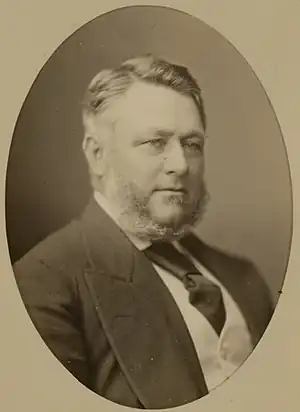 |
2 June 1881 | 19 December 1893 | 12 years, 200 days | |
| 5 | Richard Baker |  |
19 December 1893 | 9 May 1901 | 7 years, 141 days | |
| 6 | Lancelot Stirling |  |
18 July 1901 | 24 May 1932 | 30 years, 311 days | |
| 7 | David Gordon | 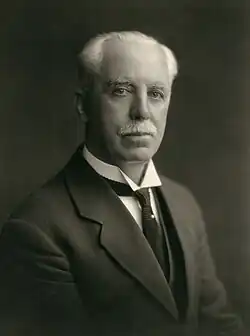 |
Liberal and Country League | 7 July 1932 | 29 February 1944 | 11 years, 206 days |
| 8 | Walter Gordon Duncan | 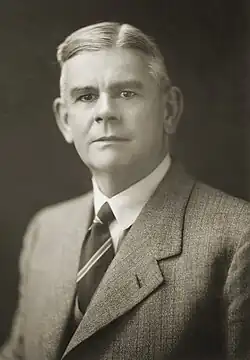 |
Liberal and Country League | 20 July 1944 | 3 March 1962 | 17 years, 226 days |
| 9 | Les Densley | Liberal and Country League | 12 April 1962 | 7 March 1967 | 4 years, 329 days | |
| 10 | Lyell McEwin | 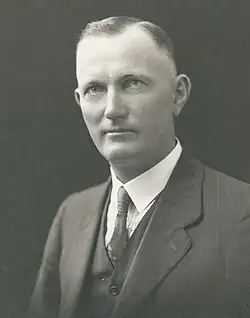 |
Liberal and Country League / Liberal Party | 8 March 1967 | 11 July 1975 | 8 years, 125 days |
| 11 | Frank Potter | Liberal Party | 5 August 1975 | 26 February 1978 | 2 years, 205 days | |
| 12 | Arthur Whyte | Liberal Party of Australia | 28 February 1978 | 7 December 1985 | 7 years, 282 days | |
| 13 | Anne Levy |  |
Labor Party | 11 February 1986 | 13 April 1989 | 3 years, 61 days |
| 14 | Gordon Bruce | Labor Party | 13 April 1989 | 11 December 1993 | 4 years, 242 days | |
| 15 | Peter Dunn | Liberal Party | 10 February 1994 | 10 October 1997 | 3 years, 242 days | |
| 15 | Jamie Irwin | Liberal Party | 2 December 1997 | 8 February 2002 | 4 years, 69 days | |
| 16 | Ron Roberts |  |
Labor Party | 5 March 2002 | 17 March 2006 | 4 years, 12 days |
| 17 | Bob Sneath |  |
Labor Party | 27 April 2006 | 5 October 2012 | 6 years, 161 days |
| 18 | John Gazzola | Labor Party | 16 October 2012 | 5 May 2014 | 1 year, 201 days | |
| 19 | Russell Wortley | Labor Party | 6 May 2014 | 2 May 2018 | 3 years, 361 days | |
| 20 | Andrew McLachlan |  |
Liberal Party | 3 May 2018 | 6 February 2020 | 1 year, 279 days |
| 21 | Terry Stephens | 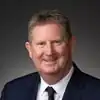 |
Liberal Party | 5 February 2020 | 8 September 2020 | 216 days (1st Term) |
| 22 | John Dawkins |  |
Independent | 8 September 2020 | 19 March 2022 | 1 year, 192 days |
| 23 | Terry Stephens | |
Liberal Party | 3 May 2022 | 20 March 2026 | 3 years, 321 days (2nd Term) |
| 24 | Reggie Martin |  |
Labor Party | 5 May 2026 | Present | 116 days |
References
- 1 2 "Presiding Officer". Parliament of South Australia - Legislative Council. Parliament of South Australia. Retrieved 28 March 2026.
- ↑ "'Not my state': Pauline Hanson promises hands-off approach as SA parliament resumes". ABC News Online. 5 May 2026. Retrieved 6 May 2026.
- 1 2 3 4 The Standing Orders of the Legislative Council Relating to the Public Business Together with the Joint Standing Orders Agreed by Both Houses (1 August 2024 ed.). Adelaide: Parliament of South Australia. 6 October 1903. Retrieved 28 March 2026.
- ↑ Parliament (Joint Services) Act 1985 (SA). Adelaide: Parliament of South Australia. 1985. Retrieved 28 March 2026.
- ↑ "Election of President". Hansard - Legislative Council. 8 September 2020. Retrieved 28 March 2026.
- ↑ Letters Patent establishing the Province of South Australia 19 February 1836 (UK). London: King in Council (UK). 19 February 1836. Retrieved 27 March 2026.
- ↑ "An Act to provide for the better Government of South Australia [30th July 1842]: Anno 5o et 6o Victoriae" (PDF). Founding Documents. Retrieved 13 November 2019.
- ↑ An Act for the better Government of Her Majesty's Australian Colonies (PDF). London: Parliament of the United Kingdom. 5 August 1850. Retrieved 27 March 2026.
- ↑ Ordinance No1 of 1851 - To Establish the Legislative Council of South Australia, and provide for the election of Members to serve in the same (PDF). Adelaide: Governor of South Australia. 21 February 1851. Retrieved 27 March 2026.
- 1 2 Constitution Act 1856 (SA). Adelaide: Parliament of South Australia. 24 June 1856.
- ↑ Constitution Act 1934 (SA). Adelaide: Parliament of South Australia. 1934.
- 1 2 Statistical Record of the Legislature 1836-2007 (PDF). Adelaide: Parliament of South Australia. 24 April 2007. p. 3. Archived from the original (PDF) on 12 March 2011. Retrieved 10 May 2020.

Presiding officers of Australian legislatures | |
|---|---|
Federal, States and territories | |


