Potassium periodate
 | |
 | |
| Names | |
|---|---|
| IUPAC name
Potassium periodate | |
| Other names
potassium metaperiodate | |
| Identifiers | |
3D model (JSmol) |
|
| ChemSpider | |
| ECHA InfoCard | 100.029.269 |
| EC Number |
|
PubChem CID |
|
| UNII | |
| UN number | 3085 |
CompTox Dashboard (EPA) |
|
| |
| |
| Properties[1] | |
| KIO4 | |
| Molar mass | 229.999 g·mol−1 |
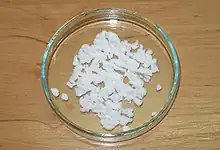
| Appearance | colorless tetrahedral crystals |
| Density | 3.618 g/cm3 |
| Melting point | 582 °C (1,080 °F; 855 K) |
| Boiling point | explodes |
| 0.51 g/100g | |
Solubility product (Ksp) |
3.71×10⁻⁴ |
| Band gap | 2.433 eV[2] |
Refractive index (nD) |
1.63[2] |
| Structure[2] | |
| tetragonal | |
| I41/a | |
| 4/m | |
a = 7.669 Å, b = 7.669 Å, c = 7.669 Å α = 135.102°, β = 135.102°, γ = 65.371° | |
Lattice volume (V) |
221.443 Å3 |
Formula units (Z) |
2 |
| Thermochemistry[1] | |
Std molar entropy (S⦵298) |
175.7 J⋅mol−1·K-1 |
Std enthalpy of formation (ΔfH⦵298) |
−467.2 kJ⋅mol−1 |
Gibbs free energy (ΔfG⦵) |
−361.4 kJ⋅mol−1 |
| Hazards | |
| GHS labelling:[3] | |
    | |
| Danger | |
| H271, H314, H372, H400 | |
| P210, P220, P221, P260, P264, P270, P273, P280, P283, P301+P330+P331, P303+P361+P353, P304+P340+P310, P305+P351+P338+P310, P306+P360, P314, P363, P370+P378, P371+P380+P375, P391, P405, P501 | |
| NFPA 704 (fire diamond) | |
| Related compounds | |
Other anions |
|
Other cations |
Sodium periodate |
Related compounds |
Periodic acid |
Except where otherwise noted, data are given for materials in their standard state (at 25 °C [77 °F], 100 kPa).
Infobox references | |


Potassium periodate is an inorganic salt with the molecular formula KIO4. It is composed of a potassium cation and a periodate anion and may also be regarded as the potassium salt of periodic acid. Note that the pronunciation is per-iodate, not period-ate.
Unlike other common periodates, such as sodium periodate and periodic acid, it is only available in the meta-periodate form; the corresponding potassium ortho-periodate (K5IO6) has never been reported.
Preparation
Potassium periodate can be prepared by the oxidation of an aqueous solution of potassium iodate by chlorine and potassium hydroxide.[5]
- KIO3 + Cl2 + 2 KOH → KIO4 + 2 KCl + H2O
It can also be generated by the electrochemical oxidation of potassium iodate, however the low solubility of KIO3 makes this approach of limited use.
Chemical properties
Potassium periodate decomposes at 582 °C (1,080 °F) to form potassium iodate and oxygen.
The low solubility of KIO4 makes it useful for the determination of potassium and cerium.[6]
On heating (especially with manganese(IV) oxide as catalyst), it decomposes to form potassium iodate, releasing oxygen gas.
References
- 1 2 Haynes, William M., ed. (2016). CRC Handbook of Chemistry and Physics (97th ed.). Boca Raton, Florida: CRC Press. pp. 4–80, 5–33, 5–178. ISBN 9781498754293.
- 1 2 3 "Potassium iodate(VII) - KIO4". legacy.materialsproject.org. Materials Project. doi:10.17188/1199594. Retrieved 14 May 2026.
- ↑ Sigma-Aldrich Co., Potassium periodate.
- ↑ "SDS - Potassium periodate". www.fishersci.com. ThermoFisher Scientific. 19 December 2025. Retrieved 14 May 2026.
- ↑ Schmeisser, M. Brauer, Georg (ed.). Handbook of preparative inorganic chemistry. Volume 1. Translated by Riley, Reed F. (2nd ed.). New York, N.Y.: Academic Press. p. 325. ISBN 978-0121266011.
- ↑ Venugopalan, M.; George, K. J. (1956). "Determination of cerium by potassium periodate". Die Naturwissenschaften. 43 (15): 348–349. doi:10.1007/BF00755157.