Portal:Wine/Selected article
 | This page is currently inactive and is retained for historical reference. Either the page is no longer relevant or consensus on its purpose has become unclear. To revive discussion, seek broader input via a forum such as the village pump. |
 | Note: Article entries are now located at Portal:Wine/Selected articles, from where they are transcluded directly on the main portal page. |
Usage
The template for used to configure these sub-pages is located at {{Selected article}}.
- Add a new Selected article to the next available subpage.
- Update "max=" to new total for its {{Random portal component}} on the main page.
Selected article 1
Portal:Wine/Selected article/1

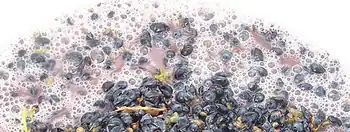
The yeast species Saccharomyces cerevisiae has been used in baking and fermenting alcoholic beverages for thousands of years. It is also extremely important as a model organism in modern cell biology research, and is the most thoroughly researched eukaryotic microorganism. Researchers have used it to gather information into the biology of the eukaryotic cell and ultimately human biology. Other species of yeast, such as Candida albicans, are opportunistic pathogens and can cause infection in humans. Yeasts have recently been used to generate electricity in microbial fuel cells, and produce ethanol for the biofuel industry.
Yeasts do not form a specific taxonomic or phylogenetic grouping. At present it is estimated that only 1% of all yeast species have been described. The term "yeast" is often taken as a synonym for S. cerevisiae, but the phylogenetic diversity of yeasts is shown by their placement in both divisions Ascomycota and Basidiomycota. The budding yeasts ("true yeasts") are classified in the order Saccharomycetales. (Full article...)
Selected article 2
Portal:Wine/Selected article/2

On the whole, biblical literature displays an ambivalence toward intoxicating drinks, considering them both a blessing from God that brings joy and merriment and potentially dangerous beverages that can be unwisely and sinfully abused The relationships between Judaism and alcohol and Christianity and alcohol have generally followed this same pattern, with some dissenters particularly among Christians around the time of Prohibition. (Full article...)
Selected article 3
Portal:Wine/Selected article/3

Ethanol is a straight-chain alcohol, and its molecular formula is C2H5OH. Its empirical formula is C2H6O. An alternative notation is CH3-CH2-OH, which indicates that the carbon of a methyl group (CH3-) is attached to the carbon of a methylene group (-CH2-), which is attached to the oxygen of a hydroxyl group (-OH). It is a constitutional isomer of dimethyl ether. Ethanol is often abbreviated as EtOH, using the common organic chemistry notation of representing the ethyl group (C2H5) with Et.
The fermentation of sugar into ethanol is one of the earliest organic reactions employed by humanity. The intoxicating effects of ethanol consumption have been known since ancient times. In modern times, ethanol intended for industrial use is also produced from by-products of petroleum refining. (Full article...)
Selected article 4
Portal:Wine/Selected article/4

Selected article 5
Portal:Wine/Selected article/5

How the Phylloxera aphid was introduced to Europe remains debated: American vines had been taken to Europe many times before, for reasons including experimentation and trials in grafting, without consideration of the possibility of the introduction of pestilence. While the Phylloxera was thought to have arrived sometime around 1858, it was first recorded in France in 1863, near the former province of Languedoc. It is argued by some that the introduction of such pests as phylloxera was only a problem after the invention of steamships, which allowed a faster journey across the ocean, and consequently allowed durable pests, such as the Phylloxera, to survive.
Eventually, following Jules-Emile Planchon's discovery of the Phylloxera as the cause of the blight, and Charles Valentine Riley's confirmation of Planchon's theory, Leo Laliman and Gaston Bazille, two French wine growers, proposed that the European vines be grafted to the resistant American rootstock that were not susceptible to the Phylloxera. While many of the French wine growers disliked this idea, many found themselves with no other option. The method proved to be an effective remedy. The following "Reconstitution" (as it was termed) of the many vineyards that had been lost was a slow process, but eventually the wine industry in France was able to return to relative normality. (Full article...)
Selected article 6
Portal:Wine/Selected article/6

A wine fault or defect is an unpleasant characteristic of a wine often resulting from poor winemaking practices or storage conditions, and leading to wine spoilage. Many of the compounds that cause wine faults are already naturally present in wine but at insufficient concentrations to adversely affect it. In fact, depending on perception, these concentrations may impart positive characters to the wine. However when the concentration of these compounds greatly exceeds the sensory threshold, they replace or obscure the flavours and aromas that the wine should be expressing. Ultimately the quality of the wine is reduced, making it less appealing and sometimes undrinkable. (Full article...)
Selected article 7
Portal:Wine/Selected article/7
Selected article 8
Portal:Wine/Selected article/8

American Viticultural Areas entirely within the state include the Willamette Valley, Southern Oregon, Umpqua Valley, and Rogue Valley AVAs. Parts of the Columbia Gorge, Walla Walla Valley, and Snake River Valley AVAs lie within Oregon. Pinot Noir and Pinot Gris are the top two grapes grown, with over 16,000 tons (14,515 metric tons) harvested in 2005. As of 2005, Oregon wine makers produced over 1.5 million cases combined.
With 303 wineries in Oregon, a tourism industry has developed around wine tasting. Much of the tourism focuses on the wineries and tasting rooms in and around the Yamhill Valley southwest of Portland. In 2004, it was estimated that wine tourism contributed USD $92 million to the state economy, excluding winery and tasting room sales. (Full article...)
Selected article 9
Portal:Wine/Selected article/9

Selected article 10
Portal:Wine/Selected article/10
Selected article 11
Portal:Wine/Selected article/11

Located at the northern edges of the wine growing world, the history of the Champagne wine region has had a significant role in the development of this unique terroir. The area's close proximity to Paris promoted the regions economic success in its wine trade but also put the villages and vineyards in the path of marching armies on their way to the French capital. Despite the frequency of these military conflict, the regions developed a reputation for quality wine production in the early Middle Ages and was able to continue that reputation as the region's producers began making sparkling wine with the advent of the great Champagne houses in the 17th & 18th century.
The principal grapes grown in the region include Chardonnay, Pinot Noir, and Pinot Meunier. Pinot Noir is the most widely planted grape in the Aube region and grows very well in Montagne de Reims. Pinot Meunier is the dominant grape in the Vallée de la Marne region. The Côte des Blancs is dedicated almost exclusively to Chardonnay. (Full article...)
Selected article 12
Portal:Wine/Selected article/12

The wine has a rich history, said to date back to the time of the ancient Greeks, where it was a popular drink at festivals celebrating the goddess Aphrodite. A dried grape wine from Cyprus was first known to be described in 800 BC by the Greek poet Hesiod and was known as the Cypriot Manna. (Full article...)
Selected article 13
Portal:Wine/Selected article/13

Konrad T. Howitz and Robert Zipkin of BIOMOL International discovered that resveratrol increases the activity of an enzyme called SIRT1. They then contacted David Sinclair of the Harvard Medical School, and cofounder of Sirtris Pharmaceuticals, in order to initiate a collaboration. Sinclair found that resveratrol significantly increases the lifespan of yeast and mice. There is hope that it could do the same for humans.
The four stilbenoids cis- and trans-resveratrol, and cis- and trans-piceid are similar and related, and sometimes analyzed together as a group. (Full article...)
Selected article 14
Portal:Wine/Selected article/14

Selected article 15
Portal:Wine/Selected article/15

Following a wine renaissance in the mid-20th century, Californian wine entered the international stage at the 1976 Judgment of Paris wine competition when Californian wines beat out French wines in both red and white wine categories. Today there are more than 1,200 wineries in the state, ranging from small boutique wineries to large corporations like E & J Gallo Winery with distribution across the globe. (Full article...)
Selected article 16
Portal:Wine/Selected article/16

Wine is a popular drink in Italy. Grapes are grown in almost every part of Italy, with more than 1 million vineyards under cultivation. In some places the vines are trained along low supports. In others they climb as slender saplings.
Most wine-making in Italy is done in modern wineries. However, villagers who make wine for their own use sometimes still tread the grapes with their bare feet, until the juice is squeezed out. They believe this ancient method still makes the best wine. (Full article...)