Portal:University of Oxford

| Main page | Indices | Projects |
The University of Oxford portal

The University of Oxford is a collegiate research university in Oxford, England. There is evidence of teaching as early as 1096, making it the oldest university in the English-speaking world and the world’s second-oldest university in continuous operation. It grew rapidly from 1167, when Henry II prohibited English students from attending the University of Paris. After escalating conflict between students and the Oxford townspeople, some Oxford academics fled northeast to Cambridge, where they established the University of Cambridge in 1209. The two universities share many common features and are jointly referred to as Oxbridge.
The University of Oxford is made up of 43 colleges – of which 36 are chartered colleges (independent bodies), 4 are permanent private halls (owned by religious organisations), and 3 are societies (controlled by the university) – and a range of academic departments that are organised into four divisions. Colleges control their own membership and activities. Typically social life for students is centred around fellow college members. All students are members of a college. Oxford does not have a main campus. Its buildings and facilities are scattered throughout the city centre and around the town. Undergraduate teaching at the university consists of lectures, small-group tutorials at the colleges and halls, seminars, laboratory work and tutorials provided by the central university faculties and departments. Postgraduate teaching is provided in a predominantly centralised fashion.
Oxford operates the Ashmolean Museum, the world's oldest university museum; Oxford University Press, the largest university press in the world; and the largest academic library system nationwide. In the fiscal year ending 31 July 2025, the university had a total consolidated income of £3.02 billion, of which £801.3 million was from research grants and contracts.
Oxford has educated a wide range of notable alumni, including 31 prime ministers of the United Kingdom and many heads of state and government around the world. As of October 2025, 76 Nobel Prize laureates, four Fields Medalists, and six Turing Award winners have matriculated, worked, or held visiting fellowships at the University of Oxford. Its alumni have won 160 Olympic medals. Oxford is home to a number of scholarships, including the Rhodes Scholarship, one of the oldest international graduate scholarship programmes in the world. (Full article...)
Selected article

The university's position of Savilian Professor of Astronomy was established in 1619. It was founded (at the same time as the Savilian Professorship of Geometry) by Sir Henry Savile, a mathematician and classical scholar who was Warden of Merton College and Provost of Eton College. He appointed John Bainbridge as the first professor. There have been 21 astronomy professors in all; Steven Balbus, the current professor, was appointed in September 2012. Past professors include Christopher Wren (1661–73) (pictured), architect of St Paul's Cathedral in London and the Sheldonian Theatre in Oxford; he held the professorship at the time of his commission to rebuild the cathedral after it was destroyed by the Great Fire of London in 1666. Three professors have been awarded the Gold Medal of the Royal Astronomical Society: Charles Pritchard (1870–93), Harry Plaskett (1932–60) and Joseph Silk (1999–2012). The two Savilian chairs have been linked with professorial fellowships at New College since the late 19th century. The astronomy professor is a member of the Sub-Department of Astrophysics at Oxford. (Full article...)
Selected biography

Selected college or hall

University College, founded by William of Durham in 1249, is one of the oldest of the Oxford colleges. Claims that it was founded by King Alfred the Great in 872 are no longer taken seriously by historians. It is one of the largest colleges in terms of student numbers, with about 420 undergraduates and 150 postgraduates. Univ, as it is generally known, has its main entrance on High Street, between Merton Street and Magpie Lane. The medieval buildings were replaced by the main quadrangle in the 17th century, after delays caused by the English Civil War. The Radcliffe Quadrangle was added in 1719. Women have been admitted as students since 1979. The poet Percy Bysshe Shelley studied at the college but was expelled for writing The Necessity of Atheism; he is now commemorated by the Shelley Memorial. Two British prime ministers, Clement Attlee (student) and Harold Wilson (fellow) were members of the college, as were the American president Bill Clinton and the Australian prime minister Bob Hawke. Other alumni include the scientist Stephen Hawking, the writer C. S. Lewis and the poet Andrew Motion. (Full article...)
Selected image

Did you know
Articles from Wikipedia's "Did You Know" archives about the university and people associated with it:
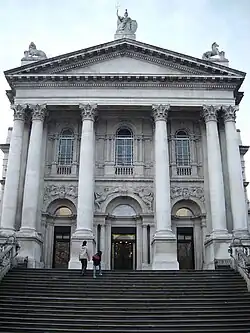
- ... that before Charles Aitken installed electric lighting, the Tate Gallery (pictured) was cleared of visitors on dark and foggy days?
- ... that in 1964 J. N. L. Baker, Bursar of Jesus College, became the first member of the university to hold the post of Lord Mayor of Oxford?
- ... that although George Bernard Shaw called fellow Edwardian playwright St John Hankin's death "a public calamity," his work was largely neglected until the 1990s?
- ... that "many-sided" priest Father Patrick McLaughlin promoted links between the church and the world of literature by staging plays, and by commissioning lectures from T. S. Eliot and Dorothy L. Sayers?
- ... that in 1612 Jewish teacher Jacob Barnet was arrested and imprisoned by officials of the university for changing his mind about being baptized?
Selected quotation
Selected panorama

On this day
Events for 31 August relating to the university, its colleges, academics and alumni. College affiliations are marked in brackets.
|
Births
Other events
|
Deaths
|
Wikimedia
The following Wikimedia Foundation sister projects provide more on this subject:
-
 Commons
Free media repository -
 Wikidata
Free knowledge base -
 Wikiquote
Collection of quotations -
 Wikisource
Free-content library -
 Wikiversity
Free learning tools -
 Wikivoyage
Free travel guide -
 Wiktionary
Dictionary and thesaurus