Portal:United States/Selected location
Selected location
Usage
The layout design for these subpages is at Portal:United States/Selected location/Layout.
- Add a new Selected location to the next available subpage.
- Update "max=" to new total for its {{Random portal component}} on the main page.
Selected locations list
1-20
Portal:United States/Selected location/1

The city's economy is currently dominated by education, high tech, and biotechnology. Average home prices and property taxes are well above the state and national medians. The city is also known for its political liberalism and its large number of restaurants and performance venues.
Ann Arbor was founded in January 1824 by John Allen and Elisha Rumsey, both of whom were land speculators. There are various accounts concerning the origin of the settlement's name; one states that Allen and Rumsey decided to name it "Annarbour" for their spouses, both named Ann, and for the stands of burr oak in the 640 acres (260 ha) of land they had purchased for $800 from the federal government. The regional Native Americans named the settlement Kaw-goosh-kaw-nick, after the sound of Allen's saw mill.
The Ann Arbor Land Company, a group of speculators, set aside 40 acres (16 ha) of undeveloped land and offered it to the State of Michigan as the site of the state capital, but lost the bid to Lansing. In 1837, the property was accepted instead as the site of the University of Michigan, forever linking Ann Arbor and its history with the university.
Portal:United States/Selected location/2

In 1630, Puritan colonists from England founded the city on the Shawmut Peninsula. During the American Revolution the Boston Massacre, the Boston Tea Party, the Battle of Bunker Hill and the Siege of Boston all occurred within the city and surrounding areas. After American independence was attained Boston became a major shipping port and manufacturing center, and its rich history now attracts 16.3 million visitors annually. The city was the site of America's first public school, Boston Latin School (1635), and first college, Harvard College (1636), in neighboring Cambridge. Boston was also home to the first subway system in the United States.
Through land reclamation and municipal annexation, Boston has expanded beyond the peninsula. With many colleges and universities within the city and surrounding area, Boston is a center of higher education and a center for health care. The city's economy is also based on research, finance, and technology — principally biotechnology.
Portal:United States/Selected location/3
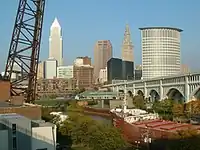
As of the 2000 census, the city proper had a total population of 478,403 and is the center of Greater Cleveland, the largest metropolitan area in Ohio.
In studies conducted by The Economist in 2005, Cleveland and Pittsburgh were ranked as the most livable cities in the United States, and the city was ranked as the best city for business meetings in the continental U.S. The city faces continuing challenges, in particular from concentrated poverty in some neighborhoods and difficulties in the funding and delivery of high-quality public education.
Portal:United States/Selected location/4
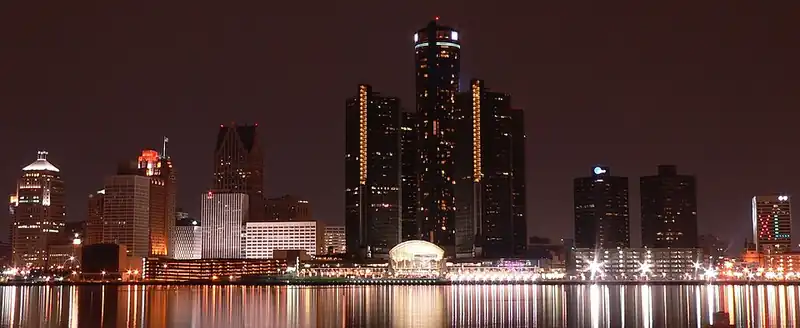
It is known as the world's traditional automotive center — "Detroit" is a metonym for the American automobile industry — and an important source of popular music, legacies celebrated by the city's two familiar nicknames, Motor City and Motown. Other nicknames emerged in the twentieth century, including Rock City, Arsenal of Democracy (during World War II), The D, D-Town, and The 3-1-3 (its area code). The metropolitan area is an important center for research and development; its broad based economy includes advanced manufacturing, robotics, biotechnology, information technology, and finance. Metro Detroit attracts about 15.9 million visitors annually.
In 2008, Detroit ranked as the United States' eleventh most populous city, with 910,920 residents. A population shift to the suburbs began in the 1950s and continued as the metropolitan area grew to one of the nation's largest. The name Detroit sometimes refers to the Metro Detroit area, a sprawling region with a population of 4,425,110 for the Metropolitan Statistical Area, and 5,354,225 for the Combined Statistical Area, making it the nation's eleventh-largest as of the 2008 Census Bureau estimates. The Windsor-Detroit area, a critical commercial link straddling the Canada-U.S. border, has a total population of about 5,800,000.
Portal:United States/Selected location/5
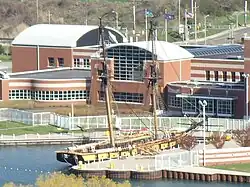
Erie is in proximity to Cleveland, Ohio; Buffalo, New York; and Pittsburgh, Pennsylvania. Once teeming with heavy industry, Erie's heavy manufacturing sector now consists mainly of plastics and locomotive building. Known for its lake-effect snow, Erie is in the heart of the Rust Belt and has begun to focus on tourism as a driving force in its economy. More than four million people each year visit Presque Isle State Park, for water recreation, and a new casino named for the state park is growing in popularity.
Erie is known as the Flagship City because of the presence of Oliver Hazard Perry's flagship USS Niagara.
Portal:United States/Selected location/6

Located on the western banks of the Red River of the North in an extremely flat region known as the Red River Valley, the city is prone to flooding and was struck by the devastating Red River Flood of 1997. Grand Forks was founded in 1870 by steamboat captain Alexander Griggs and incorporated on February 22, 1881. Its location at the fork of the Red River and the Red Lake River gives the city its name.
Historically dependent on local agriculture, the city's economy now encompasses higher education, defense, health care, manufacturing, food processing, and scientific research. Grand Forks is served by Grand Forks International Airport and Grand Forks Air Force Base, while the city's University of North Dakota is the largest and oldest institution of higher education in the state. The Alerus Center host athletic and other events, while the North Dakota Museum of Art and Chester Fritz Auditorium are the city's largest cultural venues.
Portal:United States/Selected location/7
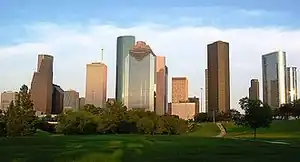
The city was incorporated on June 5, 1837 and named after then-President of the Republic of Texas—former General Sam Houston. The burgeoning port and railroad industry, combined with oil discovery in 1901, has induced continual surges in the city's population. In the mid-twentieth century, Houston became the home of the Texas Medical Center and NASA's Johnson Space Center, where Mission Control Center is located.
Houston's economy has a broad industrial base in the energy, manufacturing, aeronautics, and technology; only New York City is home to more Fortune 500 headquarters. The Port of Houston ranks first in the United States in international waterborne tonnage handled. It is home to many cultural institutions and exhibits—attracting more than 7 million visitors a year to the Houston Museum District. Houston has an active visual and performing arts scene in the Theater District and is one of five U.S. cities that offer year-round resident companies in all major performing arts.
Portal:United States/Selected location/8

Louisville is situated in north-central Kentucky on the Kentucky-Indiana border at the only natural obstacle in the Ohio River, the Falls of the Ohio. Although situated in a Southern state, Louisville is influenced by both Midwestern and Southern culture, and is commonly referred to as either the northernmost Southern city or the southernmost Northern city in the United States.
Louisville has been the site of many important innovations through history. Notable residents have included inventor Thomas Edison, the first Jewish Supreme Court Justice Louis Brandeis, boxing legend Muhammad Ali, newscaster Diane Sawyer, writer Hunter S. Thompson, and actor Tom Cruise. Notable events occurring in the city include the first public viewing place of Edison's light bulb, the first library open to African Americans in the South, and medical advances including the first human hand transplant, the first self-contained artificial heart transplant and the development site of the first cervical cancer vaccine.
Portal:United States/Selected location/9

Abundantly rich in water, the city has twenty lakes and wetlands, the Mississippi riverfront, creeks and waterfalls, many connected by parkways in the Chain of Lakes and the Grand Rounds Scenic Byway. Minneapolis was once the world's flour milling capital and a hub for timber. The community's diverse population has a long tradition of charitable support through progressive public social programs and through private and corporate philanthropy.
The name Minneapolis is attributed to the city's first schoolmaster, who combined mni, the Dakota word for water, and polis, the Greek word for city. Minneapolis is nicknamed the City of Lakes and the Mill City.
Portal:United States/Selected location/10
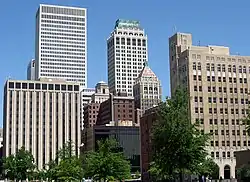
Tulsa was first settled in the 1830s by the Creek Native American tribe. In 1921, it was the site of the infamous Tulsa race massacre, one of the largest and most destructive acts of racial violence in the history of the United States. For most of the 20th century, the city held the nickname "Oil Capital of the World" and played a major role as one of the most important hubs for the American oil industry. Tulsa has been credited as the birthplace of U.S. Route 66 and the home of Western Swing music.
Once heavily dependent on the oil industry, economic downturn and subsequent diversification efforts created an economic base in the energy, finance, aviation, telecommunications and technology sectors. The Tulsa Port of Catoosa, at the head of the McClellan-Kerr Arkansas River Navigation System, is the most inland riverport in the U.S. with access to international waterways. Two institutions of higher education within the city operate at the NCAA Division I level, Oral Roberts University and the University of Tulsa.
Portal:United States/Selected location/11
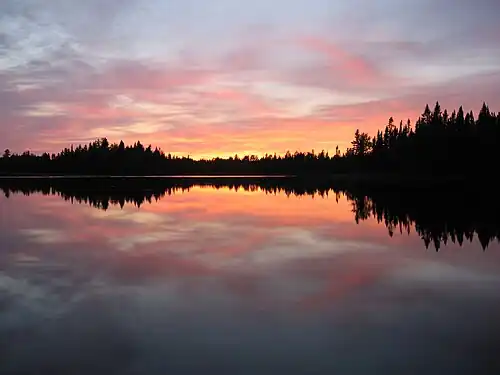
Nearly 60% of Minnesota's residents live in the Minneapolis–Saint Paul metropolitan area known as the Twin Cities. The remainder of the state consists of western prairies now given over to intensive agriculture; eastern deciduous forests, also heavily farmed and settled; and the less populated northern boreal forest. The state's image of being populated by whites of Nordic and German descent has some truth, but diversity is increasing; substantial influxes of African, Asian, and Latin American immigrants have joined the descendants of European immigrants and of the original Native American inhabitants.
The extremes of the climate contrast with the moderation of Minnesota’s people. The state is known for its moderate-to-progressive politics and social policies, its civic involvement, and high voter turnout. It ranks among the healthiest states by a number of measures, and has one of the most highly educated and literate populations.
Portal:United States/Selected location/12

The comprises five boroughs: The Bronx, Brooklyn, Manhattan, Queens and Staten Island. With over 8.2 million residents within an area of 322 square miles (830 km²), it's the most densely populated major city in the United States.
Many of the city's neighborhoods and landmarks are known around the world. The Statue of Liberty greeted millions of immigrants as they arrived at Ellis Island in the late 19th and early 20th centuries. Wall Street is home to the New York Stock Exchange. The city has had several of the tallest buildings in the world, including the Empire State Building and the World Trade Center.
New York is the birthplace of many cultural movements, including the Harlem Renaissance in literature and visual art, abstract expressionism in painting, and hip hop, salsa and Tin Pan Alley in music. In 2005, nearly 170 languages were spoken in the city and 36% of its population was born outside the United States. With its 24-hour subway and constant bustling of traffic and people, New York is known as "The City That Never Sleeps."
Portal:United States/Selected location/13

A major producer of natural gas, oil and food, Oklahoma relies on an economic base of aviation, energy, telecommunications, and biotechnology. Oklahoma City and Tulsa serve as Oklahoma's primary economic anchors, with nearly 60 percent of Oklahomans living in their metropolitan statistical areas.
With small mountain ranges, prairie, and eastern forests, most of Oklahoma lies in the Great Plains and the U.S. Interior Highlands—a region especially prone to severe weather. With a prevalence of residents with Native American ancestry, more than 25 Native American languages are spoken in Oklahoma, the most of any state. It is located on a confluence of three major American cultural regions and historically served as a route for cattle drives, a destination for southern settlers, and a government-sanctioned territory for Native Americans.
Portal:United States/Selected location/14
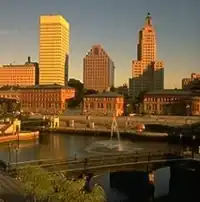
Providence was founded in 1636 by Roger Williams, a religious exile from the Massachusetts Bay Colony. He named the area in honor of "God's merciful Providence" which he believed was responsible for his finding such a haven to settle. After being one of the first cities in the country to industrialize, Providence became noted for its jewelry and silverware industry. Today, Providence city proper alone is home to eight hospitals and seven institutions of higher learning, which has shifted the city's economy into service industries, though it still retains significant manufacturing work. The city was once nicknamed the "Beehive of Industry", while today "The Renaissance City" is more common, though as of 2000 census, its poverty rate was still among the ten highest for cities over 100,000.
Portal:United States/Selected location/15

In 1776, the Spanish settled the tip of the peninsula, establishing a fort at the Golden Gate and a mission named for Francis of Assisi. The California Gold Rush in 1848 propelled the city into a period of rapid growth. After being devastated by the 1906 earthquake and fire, San Francisco was quickly rebuilt.
San Francisco is a popular international tourist destination renowned for its steep rolling hills, an eclectic mix of Victorian and modern architecture, and famous landmarks, including the Golden Gate Bridge, Alcatraz Island, the cable cars, Coit Tower, and Chinatown. The city is also known for its diverse, cosmopolitan population, including large and long-established Asian American and LGBT communities. While the climate includes chilly summer fog, the winters are mild.
Portal:United States/Selected location/16

The first permanent white settlers—Arthur A. Denny and those subsequently known as the Denny party—arrived November 13, 1851. Early settlements in the area were called "New York-Alki" ("Alki" meaning "bye and bye" in the local Chinook Jargon) and "Duwamps". In 1853, Doc Maynard suggested that the main settlement be renamed "Seattle", an anglicized rendition of the name of Sealth, the chief of the two local tribes.
Seattle is often regarded as the birthplace of grunge music, and has a reputation for heavy coffee consumption; coffee companies founded or based in Seattle include Starbucks and Tully's. Analysis conducted in 2004 by the United States Census Bureau indicated that Seattle was the most educated large city in the U.S. with 48.8 percent of residents 25 and older having at least bachelor degrees.
Portal:United States/Selected location/17

The city was named for John Young, an early settler from Whitestown, New York, who established the community's first sawmill and gristmill. Youngstown is located in a region of the United States that is often referred to as the Rust Belt. Traditionally known as a center of steel production, Youngstown was forced to redefine itself when the U.S. steel industry fell into decline in the 1970s, leaving communities throughout the region without major industry.
Portal:United States/Selected location/18
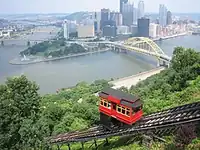
The city was named for British Prime Minister William Pitt the Elder almost twenty years before the Revolutionary War, in honor of his unique support for the frontiers people crossing into the American interior. The city is a leader in the medical, academic, technology, finance, metals and energy industries. It is the home to the world's largest concentration of bridges, America's most steps, and seven major universities including top ranked University of Pittsburgh and Carnegie Mellon University.
Portal:United States/Selected location/19

The centers of all three branches of the U.S. federal government are located in the District, as are many of the nation's monuments and museums. Washington, D.C., is governed by a mayor and a 13-member city council. However, the United States Congress has supreme authority over the city and may overturn local laws. Residents of the District therefore have less self-governance than residents of the states.
Portal:United States/Selected location/20

Historically a manufacturing center, education is the city's largest economic sector with Kent State University the city's, and one of the region's, largest employers. The city is governed by a council-manager system with a city manager, a nine-member city council, and a mayor. Kent has nearly 20 parks and preserves and hosts a number of annual festivals including ones related to Earth Day, folk music, and the U.S. Independence Day. In addition to the Kent State athletic teams, the city also hosts a number of amateur and local sporting events at various times during the year. Kent is part of the Cleveland-Akron media market and is the city of license for three local radio stations and three television stations and includes the regional affiliates for National Public Radio (NPR) and the Public Broadcasting Service (PBS).
21-40
Portal:United States/Selected location/21

There have been several major planned road projects that would affect the freeway's corridor, including a plan to extend I-68 to Moundsville, West Virginia (which, due to major funding issues, is unlikely to be completed As of 2010) and the plan to construct the Mon-Fayette Expressway, a toll highway which, when completed, will meet I-68 east of Morgantown.
Portal:United States/Selected location/22
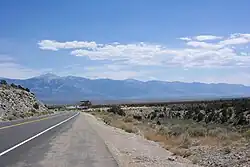
The route was constructed over a historic corridor, first used for the Pony Express and later for the Central Overland Route and Lincoln Highway. Before the formation of the U.S. Highway System, most of US 50 in Nevada was designated State Route 2. The routing east of Ely has changed significantly from the original plans. The route change resulted from a rivalry between Nevada and Utah over which transcontinental route was better to serve California bound traffic, the Lincoln Highway or the Victory Highway.
Portal:United States/Selected location/23

The southernmost section of the road was known as the White Plains Post Road in the eighteenth and nineteenth centuries, a major highway connecting New York City to White Plains, the Westchester county seat. Route 22 in its modern form was established in 1930 as one of the principal routes from New York City to Canada.
Portal:United States/Selected location/24

Brockway Mountain was named for David D. Brockway, one of the pioneer residents of the area. The road was constructed by the county road commission with funding through Depression-era work programs in 1933. It was briefly used as a connection for the parallel state highway after it opened. Since it opened, Brockway Mountain Drive has been recognized in several publications and other venues for its scenic nature, dating back to the mid-20th century. Newspaper profiles of Keweenaw County or the Upper Peninsula have discussed the scenic value of the roadway and its environment.
Portal:United States/Selected location/25

Portal:United States/Selected location/26
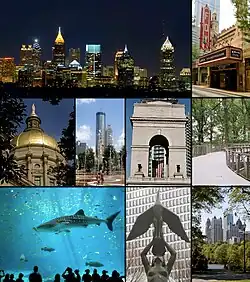
Atlanta was established in 1847 at the intersection of two railroad lines, and the city rose from the ashes of the Civil War to become a national center of commerce. In the decades following the civil rights movement, during which the city earned a reputation as "too busy to hate" for the progressive views of its citizens and leaders, Atlanta attained international prominence. Atlanta is the primary transportation hub of the Southeastern United States via highway, railroad, and air, with Hartsfield–Jackson Atlanta International Airport being the world's busiest airport since 1998. Atlanta is considered an "alpha(-) world city," and, with a gross domestic product of US$270 billion, Atlanta’s economy ranks 15th among world cities and sixth in the nation. Although Atlanta’s economy is considered diverse, dominant sectors include logistics, professional and business services, media operations, government administration, and higher education. Geographically, Atlanta is marked by rolling hills and dense tree coverage. Revitalization of Atlanta's neighborhoods, initially spurred by the 1996 Olympics, has intensified in the 21st century, altering the city's demographics, politics, and culture.
Portal:United States/Selected location/27
Portal:United States/Selected location/28

Portal:United States/Selected location/29

The city bills itself as The Entertainment Capital of the World, and is famous for its mega casino–hotels and associated entertainment. A growing retirement and family city, Las Vegas is the 24th-most populous city in the United States, with a population of 660,929 at the 2023 United States Census Estimates. The 2013 population of the Las Vegas metropolitan area was 2,027,828. The city is one of the top three leading destinations in the United States for conventions, business, and meetings.
Portal:United States/Selected location/30
Portal:United States/Selected location/31
Portal:United States/Selected location/32
Portal:United States/Selected location/33
Portal:United States/Selected location/34
Portal:United States/Selected location/35
Portal:United States/Selected location/36
Portal:United States/Selected location/37
Portal:United States/Selected location/38
Portal:United States/Selected location/39
Nominations
Feel free to add FA-Class United States articles and A-Class United States articles, particularly of Top-, High- and Mid-Importance to the above list. GA-Class United States articles of Top- and High-Importance also may be preferred. Other United States-related articles may be nominated here.
United States popular pages by WikiProject
The following United States WikiProjects include lists of popular pages - the top pages ordered by number of views in the scope of each WikiProject.
| National | United States | Roads | Superfunds |
| States | Alabama | Alaska | Arizona | Arkansas | California | Colorado | Connecticut | Delaware | Florida | Georgia | Hawaii | Idaho | Illinois | Indiana | Iowa | Kansas | Kentucky | Louisiana | Maine | Maryland | Massachusetts | Michigan | Minnesota | Mississippi | Missouri | Montana | Nebraska | Nevada | New Hampshire | New Jersey | New Mexico | New York | North Carolina | North Dakota | Ohio | Oklahoma | Oregon | Pennsylvania | Rhode Island | South Carolina | South Dakota | Tennessee | Texas | Utah | Vermont | Virginia | Washington | West Virginia | Wisconsin | Wyoming |
| Borders | Canada | Mexico |
| Government | Government | Congress | Supreme Court cases |
| Culture | Military history | National Register of Historic Places |
| Society | African diaspora | Asian Americans | Indigenous peoples of North America |
Preferred locations
Municipality and state ratings are from the U.S. project. Roads are rated by the U.S. Roads project.
| United States articles by quality and importance Preferred to showcase at U.S. Portal - Selected location: | |||||||
|---|---|---|---|---|---|---|---|
| Quality | Importance | ||||||
| Top | High | Mid | |||||
 FA |
FA-Top list | FA-High list | FA-Mid list | ||||
 A |
A-Top list
|
A-High list
|
A-Mid list | ||||
 GA |
GA-Top list
|
GA-High list | |||||
