Portal:Tornadoes

The Tornadoes Portal

Tornadoes are violently rotating columns of air that are in contact with the Earth and either a cumulonimbus or a cumulus cloud. Tornadoes are often called twisters, whirlwinds, or cyclones. While most tornadoes contain winds of less than 110 miles per hour (180 km/h), are about 250 feet (80 m) across, and travel a few miles (several kilometers), the wind speeds in the most intense tornadoes can reach 300 miles per hour (480 km/h), are more than two miles (3 km) in diameter, and stay on the ground for dozens of miles (more than 100 km). Various types of tornadoes include the multiple vortex tornado, landspout, and waterspout. Other tornado-like phenomenons that exist in nature include the gustnado, dust devil, fire whirl, and steam devil. Most tornadoes occur in North America (in the United States and Canada), concentrated in a region nicknamed Tornado Alley. Tornadoes also occur in South America, South Africa, Europe, Asia, and Oceania.
Selected tornado article -
The 1899 New Richmond tornado was an estimated F5 tornado that formed in the early evening of Monday, June 12, 1899, leaving a 45-mile-long (72 km) path of destruction through St. Croix, Polk, and Barron counties in west-central Wisconsin. There were a total of 117 fatalities and 150 injuries, with hundreds more reported as displaced. The worst devastation occurred in the city of New Richmond, which took a direct hit from the storm. Over half of New Richmond was left in ruins due to the tornado, which also caused minor damage to surrounding communities. The damage was reported to be over $300,000 (USD) ($11,610,000 in 2025). As of 2019, it is ranked as the ninth deadliest tornado in United States history, as well as the deadliest tornado ever recorded in Wisconsin. (Full article...)
Selected tornado list -

This is a list of tornadoes and tornado outbreaks that have occurred in Canada since the year 2000. Due to increasing detection, particularly in the US and southern Canada, numbers of counted tornadoes have increased markedly in recent decades although number of actual tornadoes and counted significant tornadoes has not. In older events, the number of tornadoes officially counted is likely underestimated.
On average, there are around 80 confirmed and unconfirmed tornadoes that touch down in Canada each year, with most occurring in the southern Canadian Prairies, Southern Ontario and southern Quebec. Canada ranks second in the world for the most tornadoes per year, after the United States. The most common types are F0 to F2 in damage intensity level and usually result in minor structural damage to barns, wood fences, roof shingles, chimneys, uprooted or snapped tree limbs and downed power lines. Fewer than 5% of tornadoes in Canada are rated F3 or higher in intensity, where wind speeds are in excess of 225 km/h (140 mph). Prior to April 1, 2013, Canada used a slightly modified Fujita scale, and as of that date the Enhanced Fujita scale, again slightly modified, was put into use to rate tornado intensity, based on the damage to buildings and vegetation. (Full article...)
Selected image -

Selected tornado year -

This page documents the tornadoes and tornado outbreaks of 1951, primarily in the United States. Most tornadoes form in the U.S., although some events may take place internationally. Tornado statistics for older years like this often appear significantly lower than modern years due to fewer reports or confirmed tornadoes.
The total count of tornadoes and ratings differs from various agencies accordingly. The article, therefore, documents information from the most contemporary official sources alongside assessments from tornado historian Thomas P. Grazulis. (Full article...)
Related portals
2026 tornado activity
In the evening hours of January 7, a strong tornado tracked through Kalpaki, Greece, significantly damaging numerous structures. A large poultry farm was destroyed, killing 30,000–40,000 chickens inside. A church and a military camp were also damaged. The tornado was rated IF2 on the International Fujita Scale.
(Full article...)List of 2026 tornado articles |
|---|
Tornado anniversaries
August 29
- 1910 – An F2 (possibly F3) tornado destroyed a large portion of Heaton, North Dakota, killing two people. A house was reported carried 300 feet (90 m) while ten people inside were uninjured.
- 1992 – An F3 tornado struck Wautoma, Wisconsin, destroying 48 homes and damaging about 400. with damage costing $10 million. One person was killed when here trailer home was thrown several hundred feet, and 30 others were injured.
- 2005 – Hurricane Katrina made landfall on the United States Gulf Coast, resulting in the most active phase of its associated tornado outbreak as 39 tornadoes touched down. An F2 tornado killed one person and approximately one million chickens, along with other livestock, near Glenloch, Georgia.
August 30
- 1971 – An F2 tornado hit Tempe and Mesa, Arizona in the Phoenix Metropolitan Area, destroying several homes and causing significant damage to others. Forty-one people were injured, mostly from flying glass.
- 1974 – A series of tornadoes touched down in the vicinity of Great Bend, Kansas, which mostly remained over open country. One large tornado was captured on film near Ash Valley in some of the best-known tornado footage of the twentieth century. While this tornado only produced F1 damage, analysis of the film indicated winds in the F2 range near the ground and in the F3 range aloft.
August 31
- 1977 – An F4 tornado moved across the Wausau Metropolitan Area in Wisconsin, injuring 10 people. It moved at treetop level in Wausau and caused its worst damage in Rib Mountain, where 15 homes were destroyed. There was damage to 60 farms.
Did you know…
- ...that the 12-year gap between the 2013 Moore tornado and the 2025 Enderlin tornado, both of which were rated EF5, was the longest EF5 drought in recorded history?
- ...that the 2021 South Moravia tornado, an IF4 tornado with winds between 207–260 mph (333–418 km/h), was the strongest tornado to hit the Czech Republic in modern history?
- ...that five of the six people killed in the 2011 Cullman–Arab tornado were members of the same family?
- ...that Picher, Oklahoma, was hit so hard by a tornado in 2008 that it became a ghost town in 2015?
- ...that the 2022 Andover tornado injured only three people, despite damaging more than 1,000 buildings?
- ...that after the 1991 Andover tornado a horse was found swimming in a pool after the tornado passed?
- ...that after the 2003 Manchester tornado, the town of Manchester became a ghost town?
General images -
 Map of 2003 United States tornado paths. (from Tornadoes of 2003)
 A mobile home that was obliterated by an EF3 tornado in Waxia, Louisiana. (from Tornadoes of 2021)
 EF3 damage to metal-truss electrical-transmission towers in Deer Park, Texas. (from Tornadoes of 2023)
 Map of tornadoes across Southeast Texas and southern Louisiana from January 1–2. (from Tornadoes of 1999)
 The windows of Cabalantian Church in Bacolor, Pampanga that were damaged by a tornado. (from Tornadoes of 2023)
 EF2 damage to a home northeast of Jonesboro, Louisiana. (from Tornadoes of 2023)
 EF4 damage to a construction company in Northwood, North Dakota. (from Tornadoes of 2007)
 A large barn completely destroyed at EF2 intensity. (from Tornadoes of 2025)
 Damage to a hunting lodge near Taylor Landing, Texas from an EF3 tornado. (from Tornadoes of 2024)
 EF3 damage to a home in Fultondale, Alabama. (from Tornadoes of 2021)
 A landspout tornado over Rusty Point, Alaska. (from Tornadoes of 2024)
 EF3 damage to a house near Columbia, Tennessee. (from Tornadoes of 2024)
 EF3 tornado in Bennington, Nebraska. (from Tornadoes of 2025)
 A large metal outbuilding that was destroyed at high-end EF2 intensity near Evansville, Wisconsin. (from Tornadoes of 2024)
 A deadly EF5 tornado exiting Phil Campbell, Alabama shortly after causing devastating damage on April 27. (from Tornadoes of 2011)
 EF3 damage to the Precision Materials manufacturing facility near Ohatchee, Alabama. (from Tornadoes of 2021)

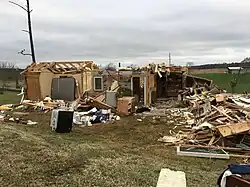 EF3 damage to a house near Mize, Mississippi. (from Tornadoes of 2019)
 High-end EF2 damage to a home near McDonough, Georgia. (from Tornadoes of 2025)
 Funnel cloud that later produced the F5 tornado near Elie, Manitoba on June 22, 2007. (from Tornadoes of 2007)
 EF4 damage to the Rolling Fork, Mississippi, water tower. (from Tornadoes of 2023)
 A large EF4 tornado approaching Barnsdall, Oklahoma on May 6. (from Tornadoes of 2024)
 An EF3 tornado near Yuma, Colorado on August 8. (from Tornadoes of 2023)
 One of the many tornadoes to impact north-central Colorado on June 4th (from Tornadoes of 2015)
 A home that was heavily damaged at EF2 intensity in Selma, Indiana. (from Tornadoes of 2024)
 EF2 damage in Movico, Alabama. (from Tornadoes of 2023)
 A house that was completely destroyed at EF4 intensity in the suburbs of St. Louis, Missouri. (from Tornadoes of 2011)
 Damage from one of the tornadoes near Tampa. (from Tornadoes of 2011)
 An EF4 tornado near Cayce, Kentucky. (from Tornadoes of 2021)
 EF2 damage and ground scouring on the west side of Frazeysburg, Ohio. (from Tornadoes of 2024)
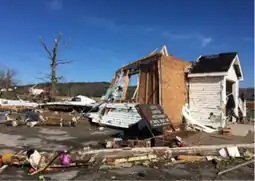 EF3 damage to a church in Lutts, Tennessee. (from Tornadoes of 2015)
 A poorly-anchored house that was leveled by a low-end EF3 tornado on the southeast side of Naperville, Illinois. (from Tornadoes of 2021)
 Remains of a home that was ripped from its raised pier foundation and leveled at low-end EF3 intensity in Lower Grand Lagoon, Florida. (from Tornadoes of 2024)
 A mobile home that was destroyed at high-end EF2 intensity near Deer Lodge, Tennessee, resulting in two fatalities. (from Tornadoes of 2025)
 EF2 damage to a home that was shifted off its foundation and sustained partial roof loss southwest of Douglas, Georgia. (from Tornadoes of 2021)
 Damage to homes and power lines being repaired in Norman, Oklahoma after a high-end EF2 tornado struck the area. (from Tornadoes of 2023)
 Toppled trees and electrical poles from a tornado in Daet, Camarines Norte. (from Tornadoes of 2025)
 EF3 damage to a grocery store in Columbus, Mississippi. One person was killed at this location. (from Tornadoes of 2019)
 President of Chile Gabriel Boric surveys EF1 tornado damage in Puerto Varas. (from Tornadoes of 2025)
 High-end EF2 damage to the First Presbyterian Church in Wetumpka, Alabama. (from Tornadoes of 2019)
 A farm outbuilding swept away by an EF4 tornado west of Pocahontas, Iowa on April 9. (from Tornadoes of 2011)
 EF2 damage to electrical transmission towers west of Ripley, Mississippi. (from Tornadoes of 2023)
 The Dortches tornado captured by a dash-cam near Battleboro. (from Tornadoes of 2023)
 EF4 damage at a research station near Tipton, Oklahoma. (from Tornadoes of 2011)
 EF2 damage to a home and trees on the southwest side of Jasper, Texas. (from Tornadoes of 2024)
 A nocturnal EF3 tornado seen from Sanger, Texas. (from Tornadoes of 2024)
 Cleanup after the tornado in Dumas, Arkansas. (from Tornadoes of 2007)
 Photograph of the Rogers–Little Flock, Arkansas EF2 tornado on November 4. (from Tornadoes of 2024)
 An F3/IF1.5 tornado left a large scar through the Siberian forest. (from Tornadoes of 2025)
 3D NEXRAD velocity scans showing the tornadogenesis of an EF1 tornado near Hollister, Oklahoma. (from Tornadoes of 2024)
 Featured Article or List -
(Full article...)
Topics
Subcategories

Related WikiProjects
The scope of WikiProject Severe weather is to write articles about severe weather, namely thunderstorms and tornadoes. Their talk page is located here.
WikiProject Weather is the main hub for all articles that are weather-related. WikiProject Weather strives to improve articles in a variety of weather topics, including Tropical Cyclones, Severe Weather, General meteorology, Non-tropical Storms, Climate, Floods, Droughts and wildfires, Meteorological instruments and data, Meteorological Biographies, and Space Weather. If you would like to help, please visit the project talk page.
WikiProject Meteorology is a collaborative effort by dozens of Wikipedians to improve the quality of meteorology- and weather-related articles. If you would like to help, visit the project talk page, and see what needs doing. The project is currently being merged into WikiProject Weather.
WikiProject Tropical cyclones is a daughter project of WikiProject meteorology. The dozens of semi-active members and several full-time members focus on improving Wikipedia's coverage of tropical cyclones.
Wikipedia is a fully collaborative effort by volunteers. So if you see something you think you can improve, be bold and get to editing! We appreciate any help you can provide!
Things you can do
 |
Here are some tasks awaiting attention:
|
Wikimedia
The following Wikimedia Foundation sister projects provide more on this subject:
-
 Commons
Free media repository -
 Wikidata
Free knowledge base -
 Wikiquote
Collection of quotations -
 Wikisource
Free-content library -
 Wikiversity
Free learning tools -
 Wikivoyage
Free travel guide -
 Wiktionary
Dictionary and thesaurus

