Portal:Tennessee

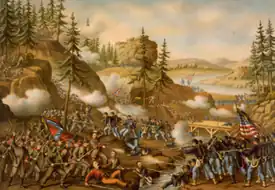
The Tennessee Portal Tennessee (/ˌtɛnɪˈsiː/ ⓘ, locally /ˈtɛnɪsi/), officially the State of Tennessee, is a landlocked state in the Southeastern region of the United States. It borders Kentucky to the north, Virginia to the northeast, North Carolina to the east, Georgia, Alabama, and Mississippi to the south, Arkansas to the southwest, and Missouri to the northwest. Tennessee is the 36th-largest by area and the 15th-most populous of the 50 states. According to the United States Census Bureau, the state's estimated population as of 2024 is 7.22 million. Tennessee is geographically, culturally, and legally divided into three Grand Divisions of East, Middle, and West Tennessee. Nashville is the state's capital and most populous city, and anchors its largest metropolitan area. Tennessee has diverse terrain and landforms, and from east to west, contains a mix of cultural features characteristic of Appalachia, the Upland South, and the Deep South. The Blue Ridge Mountains along the eastern border reach some of the highest elevations in eastern North America, and the Cumberland Plateau contains many scenic valleys and waterfalls. The central part of the state is marked by cavernous bedrock and irregular rolling hills, and level, fertile plains define West Tennessee. The state is twice bisected by the Tennessee River, and the Mississippi River forms its western border. The Great Smoky Mountains National Park, the nation's most visited national park, is in eastern Tennessee. Tennessee is rooted in the Watauga Association, a 1772 frontier pact generally regarded as the first constitutional government west of the Appalachian Mountains. Its name derives from Tanasi (ᏔᎾᏏ), a Cherokee town preceding the first European American settlement. Tennessee was initially part of North Carolina, and later the Southwest Territory, before its admission to the Union as the 16th state on June 1, 1796. It earned the nickname "The Volunteer State" due to a strong tradition of military service. A slave state until the American Civil War, Tennessee was politically divided, with most of its western and middle parts supporting the Confederacy, and most of the eastern region harboring pro-Union sentiment. As a result, Tennessee was the last state to officially secede from the Union and join the Confederacy, and the first former Confederate state readmitted to the Union after the war had ended during the Reconstruction era. (Full article...)
|







Non-Hispanic White 50–60% 60–70% 70–80% 80–90% 90%+ |
Black or African American 50–60% |


Non-Hispanic White50–60%60–70%70–80%80–90%90%+
Black or African American50–60%




Did you know -
- ... that the construction of Tennessee State Route 155 in Nashville facilitated the development of an entertainment district anchored by the relocated Grand Ole Opry in the 1970s?
- ... that Interstate 155 is the only piece of surface transportation infrastructure that directly connects the U.S. states of Missouri and Tennessee?
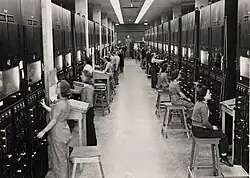
- ... that a library of religion and science in Tennessee never opened to the public?
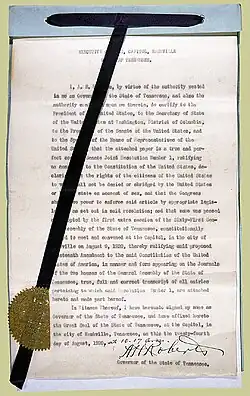
- ... that the Tennessee State Capitol was one of the first buildings in the United States to use structural iron?
- ... that the tombs of U.S. President James K. Polk and First Lady Sarah Childress Polk are some of the many memorials and monuments at the Tennessee State Capitol?
- ... that one candidate in the 1990 United States Senate election in Tennessee began the campaign with $3,000 in campaign funds, while the other began with $1 million?
Topics

Categories

New articles
Rules | Match log | Results page (for watching) | Deleted articles| Last updated: 2026-08-25 21:32 (UTC)
Note: The list display can now be customized by each user. See List display personalization for details.
- 1998 Lawrence County, Tennessee tornado (edit | talk | history | links | watch | logs | tools | Portal:Tennessee (Q14616265) ) by Kbbt12fais11 (talk · contribs · new pages (6)) started on 2026-08-25, score: 52
- Tennessee Bicentennial Rap (edit | talk | history | links | watch | logs | tools | Portal:Tennessee (Q14616265) ) by Dclemens1971 (talk · contribs · new pages (11)) started on 2026-08-24, score: 45
- 2002 United States House of Representatives elections in Connecticut (edit | talk | history | links | watch | logs | tools | Portal:Tennessee (Q14616265) ) by Colonelmash4077 (talk · contribs · new pages (9)) started on 2026-08-24, score: 20
- Tennessee House of Representatives 50th district (edit | talk | history | links | watch | logs | tools | Portal:Tennessee (Q14616265) ) by Basileus121 (talk · contribs · new pages (6)) started on 2026-08-22, score: 54
- Bryant Winn (edit | talk | history | links | watch | logs | tools | Bryant Winn (Q108053127) ) by WikiOriginal-9 (talk · contribs · new pages (104)) started on 2026-08-24, score: 34
- Barry Coburn (edit | talk | history | links | watch | logs | tools | Barry Coburn (Q141168882) ) by Nil NZ (talk · contribs · new pages (38)) started on 2026-08-24, score: 34
- Radiant Nuclear (edit | talk | history | links | watch | logs | tools | Portal:Tennessee (Q14616265) ) by H2so4aq (talk · contribs · new pages (3)) started on 2026-08-23, score: 20
- Paradise (Brandon Flowers song) (edit | talk | history | links | watch | logs | tools | Portal:Tennessee (Q14616265) ) by Dan arndt (talk · contribs · new pages (11)) started on 2026-08-23, score: 34
- Choice Lanes (edit | talk | history | links | watch | logs | tools | Portal:Tennessee (Q14616265) ) by Bneu2013 (talk · contribs · new pages (11)) started on 2026-08-22, score: 59
- Thrasher (album) (edit | talk | history | links | watch | logs | tools | Portal:Tennessee (Q14616265) ) by Sulfurboy (talk · contribs · new pages (289)) started on 2026-08-23, score: 34
- 2026–27 Tennessee Volunteers basketball team (edit | talk | history | links | watch | logs | tools | Portal:Tennessee (Q14616265) ) by Butters.From.SouthPark (talk · contribs · new pages (38)) started on 2026-08-23, score: 38
- Harry Alonzo Winne (edit | talk | history | links | watch | logs | tools | Harry Alonzo Winne (Q115943826) ) by DMVHistorian (talk · contribs · new pages (36)) started on 2026-08-22, score: 20
- Amari McNeill (edit | talk | history | links | watch | logs | tools | Amari McNeill (Q141149631) ) by WiZDumB87 (talk · contribs · new pages (3)) started on 2026-08-22, score: 34
- Tennessee House of Representatives 9th district (edit | talk | history | links | watch | logs | tools | Portal:Tennessee (Q14616265) ) by Basileus121 (talk · contribs · new pages (6)) started on 2026-08-22, score: 40
- White Pass and Yukon Route 71 (edit | talk | history | links | watch | logs | tools | Portal:Tennessee (Q14616265) ) by Sulfurboy (talk · contribs · new pages (289)) started on 2026-08-22, score: 20
- Fiona Cauley (edit | talk | history | links | watch | logs | tools | Fiona Cauley (Q141148467) ) by Strange Orange (talk · contribs · new pages (3)) started on 2026-08-22, score: 34
- Tulsa Bus Plant (edit | talk | history | links | watch | logs | tools | Portal:Tennessee (Q14616265) ) by Thomasfan1916 (talk · contribs · new pages (12)) started on 2026-08-22, score: 20
- Kayin Lee (edit | talk | history | links | watch | logs | tools | Kayin Lee (Q141146125) ) by Yankees10 (talk · contribs · new pages (16)) started on 2026-08-22, score: 36
- Bibliography of James K. Polk (edit | talk | history | links | watch | logs | tools | bibliography of James K. Polk (Q141148572) ) by TimothyBlue (talk · contribs · new pages (55)) started on 2026-08-18, score: 20
- Johnson v. Avery (edit | talk | history | links | watch | logs | tools | Portal:Tennessee (Q14616265) ) by Prezbo (talk · contribs · new pages (3)) started on 2026-08-21, score: 40
- Zaay Green (edit | talk | history | links | watch | logs | tools | Zaay Green (Q119558350) ) by SwedishDrachma (talk · contribs · new pages (15)) started on 2026-08-21, score: 36
- Junior Sherrill (edit | talk | history | links | watch | logs | tools | Junior Sherrill (Q141138305) ) by Yankees10 (talk · contribs · new pages (16)) started on 2026-08-21, score: 34
- Tennessee House of Representatives 7th district (edit | talk | history | links | watch | logs | tools | Portal:Tennessee (Q14616265) ) by Basileus121 (talk · contribs · new pages (6)) started on 2026-08-20, score: 40
- Bert Prentice (edit | talk | history | links | watch | logs | tools | Bert Prentice (Q141131670) ) by Kingzwest (talk · contribs · new pages (2)) started on 2026-08-19, score: 47
- Kenny J. Williams (edit | talk | history | links | watch | logs | tools | Kenny Williams (Q6391256) ) by Astaire (talk · contribs · new pages (4)) started on 2026-08-19, score: 36
- Gary Tucker (edit | talk | history | links | watch | logs | tools | Gary Tucker (Q108055232) ) by WikiOriginal-9 (talk · contribs · new pages (104)) started on 2026-08-19, score: 40
- Marico Portis (edit | talk | history | links | watch | logs | tools | Marico Portis (Q108053566) ) by WikiOriginal-9 (talk · contribs · new pages (104)) started on 2026-08-19, score: 36
- Senator McNally (edit | talk | history | links | watch | logs | tools | Senator McNally (Q141128384) ) by PA Uploader (talk · contribs · new pages (366)) started on 2026-08-19, score: 20
- Ted Leland (edit | talk | history | links | watch | logs | tools | Ted Leland (Q141124433) ) by S0091 (talk · contribs · new pages (17)) started on 2026-08-18, score: 40
- Lawrence Smith (American football) (edit | talk | history | links | watch | logs | tools | Lawrence Smith (Q141137185) ) by WikiOriginal-9 (talk · contribs · new pages (104)) started on 2026-08-18, score: 36
- Domestic violence register (edit | talk | history | links | watch | logs | tools | domestic violence register (Q141119340) ) by Sjö (talk · contribs · new pages (1)) started on 2026-08-18, score: 20
- Omari Kelly (edit | talk | history | links | watch | logs | tools | Omari Kelly (Q141114666) ) by Jordano53 (talk · contribs · new pages (2)) started on 2026-08-18, score: 30
- Ryan Terry (edit | talk | history | links | watch | logs | tools | Ryan Terry (Q108051732) ) by KerbHopper (talk · contribs · new pages (78)) started on 2026-08-18, score: 36
- The Confuser (edit | talk | history | links | watch | logs | tools | The Confuser (Q141112699) ) by Fundgy (talk · contribs · new pages (4)) started on 2026-08-18, score: 34
- Javin Gordon (edit | talk | history | links | watch | logs | tools | Javin Gordon (Q141100280) ) by BullDawg2021 (talk · contribs · new pages (7)) started on 2026-08-16, score: 36
- SMCA (edit | talk | history | links | watch | logs | tools | MOMus–Museum of Modern Art–Costakis Collection (Q247518) ) by Thomasfan1916 (talk · contribs · new pages (12)) started on 2026-08-15, score: 34
- Sharp Manufacturing Company of America (edit | talk | history | links | watch | logs | tools | Portal:Tennessee (Q14616265) ) by Thomasfan1916 (talk · contribs · new pages (12)) started on 2026-08-15, score: 54
- Toshiba Lebanon plant (edit | talk | history | links | watch | logs | tools | Portal:Tennessee (Q14616265) ) by Thomasfan1916 (talk · contribs · new pages (12)) started on 2026-08-15, score: 40
- 1870 Tennessee gubernatorial election (edit | talk | history | links | watch | logs | tools | Portal:Tennessee (Q14616265) ) by Afton2466 (talk · contribs · new pages (1)) started on 2026-08-14, score: 38
- Pick-up basketball (edit | talk | history | links | watch | logs | tools | Portal:Tennessee (Q14616265) ) by SwaggyboyTN (talk · contribs · new pages (1)) started on 2026-08-14, score: 34
- Alice Culler Cobb (edit | talk | history | links | watch | logs | tools | Alice Culler Cobb (Q141066261) ) by Rosiestep (talk · contribs · new pages (10)) started on 2026-08-14, score: 28
- David Earl Miller (edit | talk | history | links | watch | logs | tools | David Earl Miller (Q137427729) ) by BytesDAL (talk · contribs · new pages (1)) started on 2026-08-14, score: 34
- McKenzie Siroky (edit | talk | history | links | watch | logs | tools | McKenzie Siroky (Q140796549) ) by DetroitFan7 (talk · contribs · new pages (44)) started on 2026-08-14, score: 40
- Joseph Louw (edit | talk | history | links | watch | logs | tools | Joseph Louw (Q141065086) ) by CherryPie94 (talk · contribs · new pages (36)) started on 2026-08-14, score: 34
- Britt Nicole (album) (edit | talk | history | links | watch | logs | tools | Portal:Tennessee (Q14616265) ) by Loveclubxo (talk · contribs · new pages (6)) started on 2026-08-14, score: 34
- Tennessee House of Representatives 5th district (edit | talk | history | links | watch | logs | tools | Portal:Tennessee (Q14616265) ) by Basileus121 (talk · contribs · new pages (6)) started on 2026-08-13, score: 40
- Keith Miller (American football) (edit | talk | history | links | watch | logs | tools | Keith Miller (Q141065513) ) by WikiOriginal-9 (talk · contribs · new pages (104)) started on 2026-08-13, score: 40
- Tennessee House of Representatives 4th district (edit | talk | history | links | watch | logs | tools | Portal:Tennessee (Q14616265) ) by Basileus121 (talk · contribs · new pages (6)) started on 2026-08-13, score: 40
- Self Goes Shopping (edit | talk | history | links | watch | logs | tools | Self Goes Shopping (Q7448266) ) by KmartEmployeeTor (talk · contribs · new pages (2)) started on 2026-08-13, score: 20
- Carey A. Harris (edit | talk | history | links | watch | logs | tools | Carey A. Harris (Q141039323) ) by Jengod (talk · contribs · new pages (33)) started on 2026-08-13, score: 57
- 2007 Little League Softball World Series (edit | talk | history | links | watch | logs | tools | Portal:Tennessee (Q14616265) ) by Masonpatriot (talk · contribs · new pages (19)) started on 2026-08-13, score: 20
- Tennessee House of Representatives 60th district (edit | talk | history | links | watch | logs | tools | Portal:Tennessee (Q14616265) ) by Basileus121 (talk · contribs · new pages (6)) started on 2026-08-13, score: 60
- Kai Sun (edit | talk | history | links | watch | logs | tools | Portal:Tennessee (Q14616265) ) by Sunkai76 (talk · contribs · new pages (2)) started on 2026-08-11, score: 20
- Yoshi Mobility (edit | talk | history | links | watch | logs | tools | Portal:Tennessee (Q14616265) ) by Absurdum4242 (talk · contribs · new pages (49)) started on 2026-08-12, score: 34
- Panda Fest (edit | talk | history | links | watch | logs | tools | Portal:Tennessee (Q14616265) ) by Another Believer (talk · contribs · new pages (99)) started on 2026-08-12, score: 30
- Liberty Tower (Chattanooga, Tennessee) (edit | talk | history | links | watch | logs | tools | Portal:Tennessee (Q14616265) ) by Wobbanight (talk · contribs · new pages (5)) started on 2026-08-11, score: 40
- The Maclellan (edit | talk | history | links | watch | logs | tools | Portal:Tennessee (Q14616265) ) by Wobbanight (talk · contribs · new pages (5)) started on 2026-08-10, score: 54
- List of tallest buildings in Chattanooga (edit | talk | history | links | watch | logs | tools | Portal:Tennessee (Q14616265) ) by Wobbanight (talk · contribs · new pages (5)) started on 2026-08-09, score: 74
Related portals
WikiProjects

- WikiProject Tennessee
- WikiProject United States
Associated Wikimedia
The following Wikimedia Foundation sister projects provide more on this subject:
-
 Commons
Free media repository -
 Wikidata
Free knowledge base -
 Wikiquote
Collection of quotations -
 Wikisource
Free-content library -
 Wikiversity
Free learning tools -
 Wikivoyage
Free travel guide -
 Wiktionary
Dictionary and thesaurus