Selected articles list
Selected article 1
Portal:Taiwan/Selected article/1
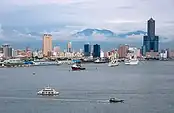
Kaohsiung
Kaohsiung City (
Chinese: 高雄市;
Hanyu Pinyin: Gāoxióng;
Tongyong Pinyin: Gaosyóng;
Wade–Giles: Kao-hsiung;
Pe̍h-ōe-jī: Ko-hiông; old name:
Takao,
Takow,
Takau) is a city located in southern
Taiwan. Kaohsiung City is also the most
dense and the second largest city in Taiwan, with a population around 1.51 million. As one of two
central municipalities under the administration of the Republic of China (
Taiwan), Kaohsiung City is a second-level political division, with the same status as a
province. The city is further divided into eleven districts, each with a district office that handles day-to-day businesses between the Kaohsiung City government and its citizens.
Kaohsiung is a major center for manufacturing, refining, and transportation. Kaohsiung is the major port through which most of Taiwan's oil is imported, which accounts for the large amount of heavy industry. It is an export processing zone—producing aluminium, wood and paper products, fertilizers, cement, metals, machinery, and ships. With its harbor one of the four largest in the world, Kaohsiung is the center of Taiwan's shipbuilding industry, as well as home to a large Republic of China Navy base. (Full article...)
Selected article 2
Portal:Taiwan/Selected article/2
The
Japanese colonial period in Taiwan refers to the period between 1895 and 1945 during which
Taiwan was a Japanese
colony. Due to differing perceptions of history, it may also be referred to by some as the period of "
Japanese occupation". The expansion into Taiwan was a part of Japan's general policy of southward expansion during the late 19th century. Japanese rule in Taiwan was markedly different from in
Korea. As Taiwan was Japan's first overseas colony, Japanese intentions were to turn the island into a showpiece "model colony". As a result, much effort was made to improve the island's economy, industry, public works, and culture. The relative failures of the early years of post-World War II rule by the
Kuomintang ("KMT") led to a certain degree of nostalgia amongst the older generation of Taiwanese who experienced both. This has affected, to some degree, issues such as
national identity,
ethnic identity, and the
Taiwan independence movement. The comparative lack of
anti-Japanese sentiment amongst Taiwanese society has also led to misunderstandings with
overseas Chinese communities and
mainland Chinese.
(Full article...)
Selected article 3
Portal:Taiwan/Selected article/3
Taiwanese (pe̍h-oē-jī: Tâi-oân-oē or Tâi-gí; Chinese: 台語, 台灣話; pinyin: Táiyǔ, Táiwānhuà) is a dialect of Min Nan Chinese spoken by about 70% of Taiwan's population. The sub-ethnic group in Taiwan for which Taiwanese is considered a native language is known as Hoklo (the correspondence between language and ethnicity is generally true though not absolute, as some Hoklo speak Taiwanese poorly while some non-Hoklo speak Taiwanese fluently). Pe̍h-oē-jī (POJ) is a popular orthography for this language, and Min Nan in general. (Full article...)
Selected article 4
Portal:Taiwan/Selected article/4

THSR train on a test run in June 2006
The
Taiwan High Speed Rail (台灣高速鐵路; THSR) is a
high-speed rail network that runs along the west coast of
Taiwan. It is approximately 335.50 kilometers (208
mi), and runs from
Taipei City to
Kaohsiung City. It began operation on January 5, 2007. Adopting
Japan's
Shinkansen technology for the core system, the THSR uses the
Taiwan High Speed 700T train, which was manufactured by a consortium of Japanese companies, most notably
Kawasaki Heavy Industries. The total cost of the project is currently estimated to be
US$15 billion, and is one of the largest privately funded transport schemes to date. Express trains capable of traveling at up to 300
km/h (186
mph) travel from
Taipei City to
Kaohsiung City in roughly 90 minutes as opposed to 4.5 hours by conventional rail, although local service THSR trains take approximately two hours when stopping at all stations en route.
(Full article...)
Selected article 5
Portal:Taiwan/Selected article/5

People gathered in front of the Tobacco Monopoly Bureau on February 28, 1947
The
228 Incident (
Chinese: 二二八事件;
pinyin: èr èr bā shìjiàn;
Pe̍h-ōe-jī: Jī-jī-pat sū-kiāⁿ) or
228 Massacre was an uprising in Taiwan that began on February 28, 1947 and was suppressed by the
Kuomintang (
KMT) government, resulting in between ten thousand to twenty thousand civilians killed. The number "228" refers to the day of the incident,
February 28 (28th day of the 2nd month, 2/28). This event is now commemorated in the Taiwan as
Peace Memorial Day. Official government policy had repressed the education of the events until recently, for various reasons. Many of the details of the incident are still highly controversial and hotly debated in Taiwan today, as the largely conservative-controlled government often tries to stifle discussion on the topic. Some people point to Communist involvement as a "justification" for the
KMT's action.
(Full article...)
Selected article 6
Portal:Taiwan/Selected article/6

Shin Kong Life Tower
Shin Kong Life Tower (
Chinese: 新光人壽保險摩天大樓) is the third tallest building in
Taiwan at 51 stories. The rose-coloured skyscraper topped by a pyramid is a landmark in
Taipei. Its first twelve floors and two underground floors house a Shin Kong Mitsukoshi Department Store. The remaining floors provide office space and serve as headquarters for the Shin Kong Life Insurance Company. The structure stands across Chunghsiao Road from
Taipei Main Station near the Asiaworld Department Store. The Shin Kong Life Tower was Taiwan's tallest building when it opened in December 1993. In 1997 the building was surpassed as Taiwan's tallest by the
Tuntex Sky Tower in the city of
Kaohsiung. Both were surpassed in height by
Taipei 101 in 2004.
(Full article...)
Selected article 7
Portal:Taiwan/Selected article/7
EVA Airways Corporation is an airline based at Taiwan Taoyuan International Airport near Taipei, Taiwan, operating passenger and dedicated cargo services to over 40 international destinations in Asia, Australia, Europe and North America. EVA Air is largely privately owned and flies a fully international route network. It is the second largest Taiwanese airline. EVA Air is headquartered in Luzhu, Taoyuan City. Since its founding in 1989 as an affiliate of shipping conglomerate Evergreen Group, EVA Air has expanded to include air cargo, airline catering, ground handling, and aviation engineering services. Its cargo arm, EVA Air Cargo, links with the Evergreen worldwide shipping network on sea and land. Its domestic and regional subsidiary, UNI Air, operates a medium and short-haul network based in Kaohsiung, Taiwan. EVA Air is the 6th safest international airline in the world, with no hull losses or fatalities since its establishment. EVA Air operates a mixed fleet of Airbus, Boeing, and McDonnell Douglas aircraft, with Airbus A330, Boeing 747, and Boeing 777 airliners primarily used on passenger routes, along with Boeing 747 and MD-11 freighters used on cargo routes. The airline was one of the first carriers to introduce the premium economy class, which it debuted in 1991. EVA Air's slogan is "Sharing the World, Flying Together." (Full article...)
Selected article 8
Portal:Taiwan/Selected article/8

S.H.E
S.H.E is a
Taiwanese girl group whose members are
Selina Jen,
Hebe Tien, and
Ella Chen. The name of the group is derived from the first letter of each member's name. Since releasing their first album
Girls' Dorm (2001), S.H.E has recorded 10 albums with sales totalling over 4.5 million, and set ticketing records in each of their two concert tours. The group has acted in seven
drama series, hosted two variety shows, and contributed 10 songs to six drama soundtracks. S.H.E has endorsed more than 30 companies and products, including
Coca-Cola and
World of Warcraft. In 2000, Ren, Tian and Chen signed up for a singing contest, and the winner, Ren, was awarded a record contract. Tian and Chen, who were both finalists, joined Ren to form S.H.E. The trio frequently
covers songs by other artists, and performs original compositions. The group produces albums under the
HIM International Music label.
Avex Asia distributed S.H.E's music in
Hong Kong, but transferred this role to
WOW Music in 2007.
EMI Music China is the distributor in
Singapore and the
People's Republic of China.
(Full article...)
Selected article 9
Portal:Taiwan/Selected article/9

A Rukai Chief, 1896
Taiwanese aborigines are the
indigenous peoples of
Taiwan. Although each group holds a variety of creation stories, contemporary research suggests their ancestors may have been living on the islands for approximately 8,000 years before major
Han Chinese immigration began in the
1600s. The Taiwanese Aborigines are
Austronesian peoples, with linguistic and genetic ties to other Austronesian ethnic groups, such as peoples of the
Philippines,
Malaysia,
Indonesia, and
Oceania. For centuries Taiwan's Aboriginal peoples experienced economic competition and military conflict with a series of conquering peoples. Centralized government policies designed to foster
language shift and
cultural assimilation, as well as continued contact with the colonizers through trade, intermarriage and other dispassionate intercultural processes, have resulted in varying degrees of
language death and loss of original
cultural identity. The bulk of contemporary Taiwanese Aborigines reside in the mountains and the cities. Many Aboriginal groups are actively seeking a higher degree of political self-determination and economic development since the early 1980s.
(Full article...)
Selected article 10
Portal:Taiwan/Selected article/10

Amis people in Taiwan
The
Amis (
Chinese: 阿美族;
pinyin: āměi-zú; also
Ami or
Pangcah) are an indigenous people of
Taiwan. They speak
Amis, an
Austronesian language, and are one of the sixteen officially recognized peoples of
Taiwanese aborigines. The traditional territory of the Amis includes the long, narrow valley between the Central Mountains and the Coastal Mountains (
Huatung Valley), the Pacific coastal plain eastern to the Coastal Mountains and the
Hengchun Peninsula.
(Full article...)
Selected article 11


