Featured articles list
Featured article 1
Portal:Society/Featured article/1
The
Liberty Bell is an iconic symbol of American independence. It was commissioned from the London firm of Lester and Pack (today the
Whitechapel Bell Foundry) in 1752, and was inscribed with part of a verse from the
Book of Leviticus: "Proclaim LIBERTY throughout all the land unto all the inhabitants thereof." It originally cracked when first rung after arrival in
Philadelphia, and was twice recast by local workmen. The bell hung for years in the steeple of the Pennsylvania State House (today known as
Independence Hall), and was used to summon lawmakers to legislative sessions and to alert citizens to public meetings and proclamations. Bells were rung to mark the reading of the
American Declaration of Independence on
July 8, 1776, and while there is no contemporary account of the Liberty Bell ringing, most historians believe it was one of the bells rung. It acquired its distinctive large crack sometime in the early 19th century—a widespread story claims it cracked while ringing after the death of
Chief Justice John Marshall in 1835. The bell was moved from its longstanding home in Independence Hall to a nearby glass pavilion on
Independence Mall in 1976, and then to the larger Liberty Bell Center adjacent to the pavilion in 2003.
Featured article 2
Portal:Society/Featured article/2
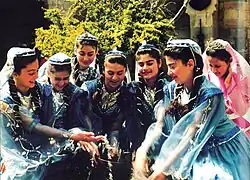
The
Azerbaijani people are an
ethnic group largely found in northwestern
Iran and the
Republic of Azerbaijan. The Azerbaijanis, commonly referred to as Azeris, live in a wider area from the
Caucasus to the
Iranian plateau. The Azeris are normally at least nominally
Muslim and have a mixed cultural heritage of
Turkic,
Iranian, and
Caucasian elements. Despite living on both sides of an international border, the Azeris form a single group. However, northerners and southerners differ due to nearly two centuries of separate social evolution in
Russian/
Soviet-influenced Azerbaijan and
Iranian Azarbaijan. The
Azerbaijani language unifies Azeris and is mutually intelligible with
Turkmen and
Turkish. As a result of this separate existence, the Azeris are mainly secularists in Azerbaijan and religious Muslims in Iranian Azarbaijan. Since Azerbaijan's independence from the
Soviet Union in 1991, there has been renewed interest in religion and cross-border ethnic ties.
Featured article 3
Portal:Society/Featured article/3
The
Belarusian Republican Youth Union is an organized
youth group in the
Eastern European country of
Belarus. The goals of the BRSM are to promote
patriotism and to instill individual
moral values into the youth of Belarus, using activities such as camping, sporting events and visiting memorials. The organization, which was created by a merger of other youth groups in 2002, is the successor of the
Leninist Communist Youth League of the
Belorussian SSR. While it is only one of a few youth groups inside Belarus, it is the largest and receives much backing from the
Belarusian government. The BRSM has been accused of using methods of coercion and empty promises to recruit members and of being used as a
propaganda tool by the
Lukashenko Government.
Featured article 4
Portal:Society/Featured article/4
"
The Bus Uncle" is a
Cantonese video clip of an argument between two men aboard a bus in
Hong Kong on
April 27,
2006. While the older man, nicknamed the Bus Uncle, scolded the person behind him, a nearby passenger used his camera phone to record the entire incident to provide evidence for the police in the event of a fight. However, the resulting six-minute video was uploaded to the
HK Golden Forum,
YouTube, and
Google Video. The clip became YouTube's most viewed video in May 2006, attracting viewers with its rhetorical outbursts and copious use of
profanity by the older man, receiving 1.7 million hits in the first 3 weeks of that month. The video became a cultural sensation in Hong Kong, inspiring vigorous debate and discussion on lifestyle, etiquette, civic awareness and media ethics within the city, eventually attracting the attention of the media around the world.
Featured article 5
Portal:Society/Featured article/5
The Chaser APEC pranks constituted a series of
comic stunts that targeted the
2007 Asia-Pacific Economic Cooperation (APEC) Leaders Summit, which occurred from 2–9 September, in
Sydney, Australia. They were coordinated and performed by the Australian
satire group
The Chaser for the television series
The Chaser's War on Everything. The most prominent prank was the breach of an APEC restricted zone in the heart of
Sydney's CBD on 6 September.
Julian Morrow directed a fake
Canadian motorcade, which was allowed through the restricted zone by police and not detected until
Chas Licciardello alighted, dressed as
Osama bin Laden. Although pranks that involved public locations, figures, and organisations were always a feature of the series, the APEC pranks yielded unprecedented local and international publicity, both positive and negative. Some team members faced
charges for breaching the APEC zone, but these were dropped because police had allowed their entry in the restricted zone. Other less controversial and less publicised stunts were also shown on
The Chaser's War on Everything, with ratings peaking at almost three million Australian viewers for the APEC wrap-up episode.
Featured article 6
Portal:Society/Featured article/6
Polish culture during World War II was suppressed by the
occupying powers of
Nazi Germany and the
Soviet Union, both of whom were hostile to Poland's
people and
culture. Policies aimed at
cultural genocide resulted in the deaths of thousands of scholars and artists, and the theft or destruction of innumerable cultural artifacts. British historian
Niall Ferguson writes that "the maltreatment of the Poles was one of many ways in which the Nazi and Soviet regimes had grown to resemble one another". The occupiers looted or destroyed much of Poland's cultural heritage, while persecuting and killing members of the Polish
cultural elite. Most
Polish schools were closed, and those that remained open saw their
curricula altered significantly. Nevertheless, underground organizations and individuals
—in particular the
Polish Underground State—saved much of Poland's most valuable cultural heritage, and worked to salvage as many cultural institutions and artifacts as possible. The
Catholic Church and wealthy individuals contributed to the survival of some artists and their works. Despite severe retribution by the Nazis and Soviets, Polish underground cultural activities, including publications, concerts, live theater, education, and academic research, continued throughout the war.
Featured article 7
Portal:Society/Featured article/7
The
definition of Macedonia is a major source of confusion due to the overlapping use of the term to describe geographical, political and historical areas, languages and peoples. Ethnic groups inhabiting the area use different terminology for the same entity, or the same terminology for different entities. Geographically, no single definition of its borders or the names of its subdivisions is accepted by all scholars and ethnic groups. Demographically, it is mainly inhabited by four ethnic groups, three of which self-identify as
Macedonians: One
Slavic group does so at a national level, while another,
Bulgarians, as well as a
Greek one do so at a regional level. Linguistically, the names and origins of the languages and dialects spoken in the region are a source of controversy. Politically, the use of the name Macedonia has led to a diplomatic dispute between
Greece and the
Republic of Macedonia. Despite intervention from the
United Nations, the dispute is still pending full resolution.
Featured article 8
Portal:Society/Featured article/8
Daylight saving time is the convention of advancing
clocks so that afternoons have more
daylight and mornings have less. Typically clocks are adjusted forward one hour near the start of
spring and are adjusted backward in
autumn; the ancients lengthened summer hours instead. Presaged by a 1784
satire, modern DST was first proposed in 1907 by
William Willett, and 1916 saw its first widespread use as a
wartime measure aimed at
conserving coal. Despite controversy, many countries have used it since then;
details vary by location and change occasionally. Adding daylight to afternoons benefits
retailing,
sports, and other activities that exploit
sunlight after working hours, but causes problems for
farmers and other workers whose hours depend on the sun. Extra afternoon daylight cuts
traffic fatalities; its effect on
health and
crime is less clear. DST is said to save
electricity by reducing the need for artificial evening
lighting, but the evidence for this is weak and DST can boomerang by boosting
peak demand, increasing overall electricity costs. DST's clock shifts complicate
timekeeping and can disrupt meetings, travel, billing, medical devices, and heavy equipment.
Featured article 9
Portal:Society/Featured article/9
A
fairy tale is a story featuring
folkloric characters such as
fairies,
goblins,
elves,
trolls,
giants, and
talking animals, and usually
enchantments. In cultures where
demons and
witches are perceived as real, fairy tales may merge into
legendary narratives, where the context is perceived by teller and hearers as having historical actuality. However, unlike
legends and
epics they usually do not contain more than superficial references to
religion and actual places, persons, and events; they take place
once upon a time rather than in actual times. Fairy tales are found in oral folktales and in literary form. The history of the fairy tale is particularly difficult to trace, because only the literary forms can survive. Still, the evidence of literary works at least indicates that fairy tales have existed for thousands of years, although not perhaps recognized as a genre; the name "fairy tale" was first ascribed to them by
Madame d'Aulnoy. Literary fairy tales are found over the centuries all over the world, and when they collected them, folklorists found fairy tales in every culture. Fairy tales, and works derived from fairy tales, are still written today.
Featured article 10
Portal:Society/Featured article/10
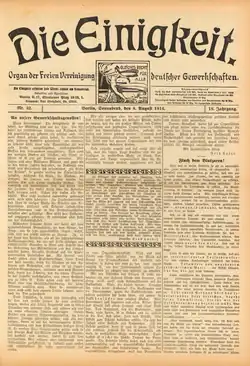
The
Free Association of German Trade Unions (FVdG) was a
trade union federation in
Imperial and early
Weimar Germany. It was founded in 1897 in
Halle as the national
umbrella organization of the
localist current of the
German labor movement. During the years following its formation, the FVdG began to adopt increasingly radical positions. During the German socialist movement's debate over the use of mass strikes, the FVdG advanced the view that the
general strike must be a weapon in the hands of the working class. The federation believed the mass strike was the last step before a socialist revolution and became increasingly critical of
parliamentary action. Disputes with the mainstream labor movement finally led to the expulsion of FVdG members from the
Social Democratic Party of Germany in 1908 and the complete severing of relations between the two organizations.
Anarchist and especially
syndicalist positions became increasingly popular within the FVdG. Immediately after the
November Revolution, the FVdG very quickly became a mass organization. It was particularly attractive to miners from the
Ruhr area opposed to the mainstream unions' reformist policies. In December 1919, the federation merged with several minor
left communist unions to become the
Free Workers' Union of Germany.
Featured article 11
Portal:Society/Featured article/11
The
Girl Scouts of the United States of America (GSUSA) is a
youth organization for girls in the
United States and American girls living abroad. The Girl Scout program developed from the concerns of the
progressive movement in the United States from people who sought to promote the
social welfare of young women and as a female counterpart to the
Boy Scouts of America. It was founded by
Juliette Gordon Low in 1912 and is based on the
Scouting principles developed by
Robert Baden-Powell. The GSUSA uses the
Scout method to build
self-esteem and to teach values such as honesty, fairness, courage, compassion, character, sisterhood, confidence, and
citizenship through activities including
camping,
community service, learning
first aid, and earning numerous badges that can teach lifelong skills. Girl Scouts are recognized for their achievements through rank advancement and various special awards. GSUSA has programs for girls with special interests, such as water-based activities. Membership is organized according to age levels with activities appropriate to each age group.
Featured article 12
Portal:Society/Featured article/12
The
Kylfings were a people of uncertain origin who were active in Northern Europe during the
Viking Age. They were active from roughly the late ninth century through the early twelfth century and could be found in areas of
Lapland, Russia, and the
Byzantine Empire that were frequented by
Scandinavian traders, raiders and mercenaries. Scholars differ on whether the Kylfings were ethnically
Finnic or
Norse. Their geographic origin is also disputed;
Denmark,
Sweden and the Eastern
Baltic are put forward as candidates. Whether the name Kylfing denotes a particular tribal, socio-political, or economic grouping is a matter of much debate. They are mentioned in
Old Norse runestone inscriptions,
sagas, and
poetry, as well as
Byzantine records and
Rus' law-codes, in which they were afforded significant economic and social privileges. According to the sagas, the Kylfings opposed the consolidation of
Norway under
Harald Fairhair and participated in the pivotal
Battle of Hafrsfjord. After Harald's victory in that battle, they are described in the sagas as having raided in
Finnmark and elsewhere in
northern Norway and having fought against Harald's lieutenants such as
Thorolf Kveldulfsson.
Featured article 13
Portal:Society/Featured article/13
Lesbian is a term most widely used in the English language to describe
sexual and
romantic desire between females. Lesbian, as a concept, is used to differentiate women with a shared
sexual orientation, and the concept is a 20th-century construct. Throughout history, women have not had the freedom or independence to pursue homosexual relationships where men have. However, they also have not met the same harsh punishment in some societies as homosexual men. In the past, lesbian relationships were sometimes regarded as harmless unless the participants attempted to pursue privileges traditionally enjoyed by their peers. As a result, little in history has been documented to give an accurate description of how female homosexuality has been expressed. When early
sexologists in the late 19th century began to categorize and describe homosexual behavior, hampered by a lack of knowledge about lesbianism or women's sexuality, they distinguished lesbians as women who did not adhere to female gender roles and designated them mentally ill. Women in homosexual relationships responded to this designation either by hiding their personal lives or accepting the label of outcast and creating a subculture and
identity that developed in Europe and the United States. Women exhibit sexual fluidity; some women who engage in homosexual behavior may reject identifying as lesbian or as
bisexual. Greater understanding of women's sexuality has led to three components to identifying lesbians:
sexual behavior,
sexual desire, or
sexual identity.
Featured article 14
Portal:Society/Featured article/14
Ketuanan Melayu is the
racialist belief that the
Malay people are the "tuan" (masters) of
Malaysia or
Malaya;
Malaysian Chinese and
Indian Malaysians are considered beholden to the Malays, who have granted them citizenship in return for the Malays' special privileges as set out in
Article 153 of the
Constitution of Malaysia. This
quid pro quo arrangement is usually referred to as the
social contract, not to be confused with the usual idea of a
social contract between the government and the people. The most vocal opposition towards the concept has come from non-Malay-based parties, such as the
Democratic Action Party. However, the portions of the Constitution related to
ketuanan Melayu were "
entrenched" after the
racial riots of
May 13 1969, which followed an election campaign focused on the issue of non-Malay rights. The riots caused a major change in the government's approach to racial issues, and led to the introduction of an aggressive
affirmative action policy strongly favouring the Malays, the
New Economic Policy. The
National Culture Policy, also introduced in 1970, emphasised an assimilation of the non-Malays into the Malay ethnic group. However, during the 1990s Prime Minister
Mahathir Mohamad rejected this approach, with his
Bangsa Malaysia policy emphasising a Malaysian instead of Malay identity for the state.
Featured article 15
Portal:Society/Featured article/15
The
Commonwealth of Australia is a country in the
Southern Hemisphere comprising the world's smallest continent and a number of islands, the largest of which is
Tasmania. Australia has been inhabited for about 50,000 years by
Aboriginal and
Torres Strait Islander peoples. Eastern Australia was claimed by the
British in 1770, and officially settled as a British
penal colony on 26 January 1788. As the population grew and new areas were explored, six largely self-governing
Crown colonies were established within Australia over the course of the 19th century. On 1 January 1901 the six colonies
federated and the Commonwealth of Australia was formed. Since federation, Australia has had a stable
liberal democratic political system and remains a
Commonwealth realm. Australia currently has a population of about 20 million, concentrated mainly in the coastal cities of
Sydney,
Melbourne,
Brisbane,
Adelaide and
Perth.
Featured article 16
Portal:Society/Featured article/16
Belarus is a
landlocked country in
Eastern Europe. Its capital is
Minsk. Other major cities include
Brest,
Grodno (Hrodna),
Gomel (Homiel),
Mogilev (Mahilyow) and
Vitebsk (Viciebsk). Forty percent of its 207,600
km
2 (80,200
sq
mi) is forested, and its strongest economic sectors are
agriculture and
manufacturing. Until the 20th century, the lands of modern day Belarus belonged to several countries.
The parliament of the republic declared the sovereignty of Belarus on 27 July 1990, and following the collapse of the Soviet Union, Belarus declared independence on 25 August 1991. Alexander Lukashenko has been the country's president since 1994. Under his lead and despite objections from Western governments, Soviet-era policies, such as state ownership of the economy, have been implemented. Most of Belarus's population of 9.85 million reside in the urban areas surrounding Minsk and other voblast (regional) capitals. More than 80% of the population are ethnic Belarusians, with sizable minorities of Russians, Poles and Ukrainians. Since a controversial 1995 referendum, Russian has been an official language alongside Belarusian.
Featured article 17
Portal:Society/Featured article/17
Belgrade is the
capital and largest city of
Serbia. It is one of the oldest cities in Europe, first emerging as prehistoric
Vinča in
4800 BC. It was settled in the
3rd century BC by the
Celts, before becoming the
Roman settlement of
Singidunum. It first became the capital of
Serbia in
1403, and was the capital of various
South Slav states from
1918 until
2003, as well as
Serbia and Montenegro from
2003 until
2006. The city lies at the confluence of the
Sava and
Danube Rivers in north central Serbia, where the
Pannonian Plain meets the
Balkan Peninsula. The population of Belgrade, according to the Serbian census of 2002, is 1,576,124. Belgrade has the status of a separate territorial unit in Serbia, with its own autonomous city government. Its territory is divided into
17 municipalities, each of which has its own local council. It is the central
economic hub of Serbia, and the capital of
Serbian culture,
education and science.
Featured article 18
Portal:Society/Featured article/18
Boston is the
capital city and most populous city of the
Commonwealth of Massachusetts, a state in the
United States. The largest city in
New England, it is considered the unofficial capital of the New England region. The city-proper had an estimated population of 596,638 in 2005, and lies at the center of America's
eleventh-largest metropolitan area,
Greater Boston, which is home to 4.4 million people. Founded in 1630, Boston was the location of several major events during the
American Revolution, including the
Boston Massacre and the
Boston Tea Party. With many colleges and universities within the city and surrounding area, Boston is a center of higher education and a center for health care. The city's economy is also based on research, finance, and technology
— principally
biotechnology. Boston is struggling with
gentrification issues, and has one of the highest
costs of living in the United States.
Featured article 19
Portal:Society/Featured article/19
The
indigenous people of the Everglades region arrived in the
Florida peninsula approximately 15,000
years ago, probably following large game. The
Paleo-Indians found an
arid landscape that supported plants and animals adapted to desert conditions.
Climate changes 6,500
years ago brought a wetter landscape, and the Paleo-Indians slowly adapted to the new conditions. Archaeologists call the cultures that resulted from the adaptations
Archaic peoples, from whom two major tribes emerged in the area: the
Calusa and the
Tequesta. The earliest written descriptions of these people come from Spanish explorers who sought to convert and conquer them. After more than 200
years of relations with the Spanish, both indigenous societies lost cohesiveness. Official records indicate that survivors of war and disease were transported to
Havana in the late 18th century. Isolated groups may have been assimilated into the
Seminole nation, which formed in northern Florida when a band of
Creeks consolidated surviving members of pre-Columbian societies in Florida into their own to become a distinct tribe. Seminoles were forced into the Everglades by the U.S. military during the
Seminole Wars from 1835 to 1842. The U.S. military pursued the Seminoles into the region, which resulted in some of the first recorded explorations of much of the area. Seminoles continue to live in the Everglades region, and support themselves with
casino gaming on six reservations located throughout the state.
Featured article 20
Portal:Society/Featured article/20
The
Tamil people are an
ethnic group from
South Asia with a recorded history going back almost two millennia. The oldest Tamil communities are those of southern
India and north-eastern
Sri Lanka. Unlike many
ethnic groups, the Tamils have at no time been governed by a single political entity;
Tamil̲akam, the traditional name for the Tamil lands, has always been under the rule of more than one kingdom or state. Despite this, the Tamil
cultural identity has always been strong. Historically, this identity has been primarily
linguistic, with Tamils being those whose
first language was
Tamil. In recent times, however, the definition has been broadened to also include emigrants of Tamil descent who maintain Tamil traditions, even when they no longer speak the language. Tamils are ethnically, linguistically and culturally related to the other
Dravidian peoples of
South Asia. There are an estimated 74 million Tamils around the world.
Featured article 21
Portal:Society/Featured article/21
To the People of Texas & All Americans in the World is an
open letter written on
February 24, 1836, by
William B. Travis, commander of the
Texian forces at the
Battle of the Alamo, to settlers in
Mexican Texas. On
February 23, the
Alamo Mission in
San Antonio, Texas, had been besieged by Mexican forces led by General
Antonio López de Santa Anna. Fearing that his small group of men could not withstand an assault, Travis wrote this letter seeking reinforcements and supplies from supporters. The letter was initially entrusted to courier Albert Martin, who carried it to
Gonzales and then handed the letter to Launcelot Smithers. Partially in response to the letter, men from throughout Texas and the United States began to gather in Gonzales. Between 32 and 90 of them reached the Alamo before it fell; the remainder formed the nucleus of the army which eventually defeated Santa Anna at the
Battle of San Jacinto. After the
Texas Revolution, the original letter was delivered to Travis's family in Alabama, and in 1893, one of his descendants sold it to the
State of Texas. For many decades it was displayed at the
Texas State Library; the original letter is now protected and a copy is on display under a portrait of Travis.
Featured article 22
Portal:Society/Featured article/22
The
ANAK Society is the oldest known
secret society and
honor society based at the
Georgia Institute of Technology (Georgia Tech) in
Atlanta,
Georgia,
US. Founded in 1908, ANAK's purpose is "to honor outstanding juniors and seniors who have shown both exemplary leadership and a true love for Georgia Tech". The society's name refers to
Anak, a
biblical figure said to be the forefather of a
race of giants. Although not originally founded as a secret society, ANAK has kept its activities and membership rosters confidential since 1961. Membership is made public upon a student's graduation or a faculty member's retirement. The ANAK Society's membership comprises at least 1,100
Georgia Tech graduates, faculty members, and honorary members. Notable members include
Jimmy Carter,
Bobby Dodd,
Ivan Allen Jr., and most of Georgia Tech's presidents. Membership in the ANAK Society has long been considered the highest honor a Georgia Tech student can receive, although the society's activities have been the object of suspicion and controversy in recent years.
Featured article 23
Portal:Society/Featured article/23
Chinese society during the Song Dynasty was marked by political and legal reforms, a philosophical revival of
Confucianism, and the development of cities beyond administrative purposes into centers of trade, industry, and
maritime commerce. The inhabitants of rural areas were mostly farmers, although some were also hunters, fishers, or government employees working in mines or the salt marshes. Contrarily, shopkeepers, artisans, city guards, entertainers, laborers, and wealthy merchants lived in the county and provincial centers along with the
Chinese gentry—a small, elite community of educated scholars and
scholar-officials. The military also provided a means for advancement in Song society for those who became officers, even though soldiers were not highly-respected members of society. Although certain domestic and familial duties were expected of women in Song society, they nonetheless enjoyed a wide range of social and legal rights in an otherwise
patriarchal society. Women's improved rights to property came gradually with the increasing value of
dowries offered by brides' families.
Daoism and
Buddhism were the dominant religions of China in the Song era, the latter deeply impacting many beliefs and principles of
Neo-Confucianism throughout the dynasty. The Song justice system was maintained by policing sheriffs, investigators, official coroners, and exam-drafted officials who acted as
magistrates.
Featured article 24
Portal:Society/Featured article/24
The
American Livestock Breeds Conservancy is a
nonprofit organization focused on preserving and promoting
rare breeds of
livestock. Founded in 1977 through the efforts of livestock breed enthusiasts concerned about the disappearance of many of the US's heritage livestock breeds, the ALBC was the pioneer livestock preservation organization in the United States, and remains a leading organization in that field. It has initiated programs that have saved multiple breeds from extinction, and works closely with similar organizations in other countries, including
Rare Breeds Canada. The ALBC maintains a conservation priority list that divides endangered breeds of horses, asses, sheep, goats, cattle, rabbits, pigs and poultry into five categories based on population numbers and historical interest. The organization has published several books, and works with
breed registries and other groups on several aspects of breed preservation, including genetic testing, historical documentation, animal rescue and marketing. Preservation of genetic material is of special interest to the ALBC, and for a period of time it maintained a
gene bank that was later transferred to the
United States Department of Agriculture. It has also developed and published several heritage definitions, including parameters for heritage breeds of cattle and poultry.
Featured article 25
Portal:Society/Featured article/25
Sustainability is the capacity to endure through renewal, maintenance, and sustenance, or nourishment, in contrast to durability, the capacity to endure through unchanging resistance to change. For humans in social systems or ecosystems, sustainability is the long-term maintenance of responsibility, which has environmental, economic, and social dimensions, and encompasses the concept of
stewardship, the responsible management of
resource use. In
ecology, sustainability describes how biological systems remain
diverse, robust, and productive over time, a necessary precondition for the well-being of humans and other
organisms. Long-lived and healthy
wetlands and
forests are examples of sustainable biological systems. Robust, diverse, productive
ecosystems and environments provide vital resources and processes (known as "
ecosystem services"). There are two major ways of managing human impact on ecosystem services. One approach is
environmental management; this approach is based largely on information gained from educated professionals in
earth science,
environmental science, and
conservation biology. Another approach is management of
consumption of resources, which is based largely on information gained from educated professionals in
economics.
Featured article 26
Portal:Society/Featured article/26
Same-sex marriage in Spain was legalized in 2005. In 2004, the new
Socialist government, led by
President José Luis Rodríguez Zapatero, began a campaign for its legalization, which would include
adoption by same-sex couples. After much debate, a law permitting
same-sex marriage was passed by the
Cortes Generales (Spain's
bicameral parliament composed of the Senate and the Congress of Deputies). Same-sex marriage officially became legal in Spain on Sunday,
3 July,
2005. The ratification of this law has not been devoid of conflict, despite support from 66% of Spaniards.
Catholic authorities in particular were adamantly opposed to it, fearing the weakening of the meaning of marriage. After its approval, the
conservative People's Party challenged the law in
Constitutional Court. Approximately 4,500 same-sex couples have married in Spain during the first year of the law.
Featured article 27
Portal:Society/Featured article/27
Scouting is a worldwide
youth movement aiming to develop young people physically, mentally and spiritually, so that they can play constructive roles within the society. Scouting began in 1907 when
R.S.S. Baden-Powell,
Lieutenant General in the
British Army, held the first Scouting encampment at
Brownsea Island,
England. Baden-Powell wrote the principles of Scouting in
Scouting for Boys, based on his earlier military books, with influence and support of
Seton of the Woodcraft Indians,
Smith of the
Boys' Brigade, and his publisher
Pearson. During the first half of the
20th century, the movement grew to encompass three major age groups for boys (
Cub Scout,
Boy Scout,
Rover Scout) and for girls (
Brownie Guide,
Girl Guide and Girl Scout,
Ranger Guide). The movement employs the
Scout method, a program of non-formal education with emphasis on practical outdoor activities, including
camping,
woodcraft,
aquatics,
hiking,
backpacking, and
sports.
Featured article 28
Portal:Society/Featured article/28
The Stonewall riots were a series of spontaneous, violent demonstrations against a police raid that took place in the early morning hours of June 28, 1969, at the Stonewall Inn, in the Greenwich Village neighborhood of New York City. They are frequently cited as the first instance in American history when gays and lesbians fought back against a government-sponsored system that persecuted homosexuals, and they have become the defining event that marked the start of the gay rights movement in the United States and around the world. The Stonewall Inn, at the time, was owned by the Mafia. It catered to an assortment of patrons, but it was known to be popular with the most marginalized people in the gay community: transvestites, effeminate young men, hustlers, and homeless youth. Police raids on gay bars were routine in the 1960s, but officers quickly lost control of the situation at the Stonewall Inn, and attracted a crowd that was incited to riot. Tensions between New York City police and gay residents of Greenwich Village erupted into more protests the next evening, and again several nights later. Within six months, two gay activist organizations were formed in New York, concentrating on confrontational tactics, and three newspapers were established to promote rights for gays and lesbians. Within a few years, gay rights organizations were founded across the U.S. and the world. Today Gay Pride events are held annually throughout the world toward the end of June to mark the Stonewall riots.
Featured article 29
Portal:Society/Featured article/29
Taiwanese aborigines are the
indigenous peoples of
Taiwan. Although each group holds a variety of creation stories, contemporary research suggests their ancestors may have been living on the islands for approximately 8,000 years before major
Han Chinese immigration began in the 1600s. The Taiwanese Aborigines are
Austronesian peoples, with linguistic and genetic ties to other Austronesian ethnic groups, such as peoples of the
Philippines,
Malaysia,
Indonesia, and
Oceania. For centuries Taiwan's Aboriginal peoples experienced economic competition and military conflict with a series of conquering peoples. Centralized government policies designed to foster
language shift and
cultural assimilation, as well as continued contact with the colonizers through trade, intermarriage and other dispassionate intercultural processes, have resulted in varying degrees of
language death and loss of original
cultural identity. The bulk of contemporary Taiwanese Aborigines reside in the mountains and the cities. Many Aboriginal groups are actively seeking a higher degree of political self-determination and economic development since the early 1980s.
Featured article 30
Portal:Society/Featured article/30
The
Toraja are an
ethnic group indigenous to a mountainous region of
South Sulawesi,
Indonesia. Their population is approximately 650,000, of which 450,000 still live in the
regency of
Tana Toraja. Most of the population is
Christian, and others are
Muslim or have local
animist beliefs known as
aluk ("the way"). Torajans are renowned for their elaborate funeral rites, burial sites carved into rocky cliffs, massive peaked-roof traditional houses known as
tongkonan, and colorful
wood carvings. Toraja funeral rites are important social events, usually attended by hundreds of people and lasting for several days. Before the twentieth century, Torajans lived in
autonomous villages, where they practised animism and were relatively untouched by the outside world. In the early 1900s, Dutch missionaries first worked to convert Torajan highlanders to Christianity. When the Tana Toraja regency was further opened to the outside world in the 1970s, it became an icon of
tourism in Indonesia: it was exploited by tourism developers and studied by
anthropologists. By the 1990s, when tourism peaked, Toraja society had
evolved significantly, from its agricultural beginnings into a largely Christian society.
Featured article 31
Portal:Society/Featured article/31
Feminism is a collection of movements and ideologies aimed at defining, establishing, and defending
equal political, economic, and social rights for women. In addition, feminism seeks to establish equal opportunities for women in education and employment. A
Feminist is "an advocate or supporter of the rights and equality of women".
Feminist theory, which emerged from these feminist movements, aims to understand the nature of gender inequality by examining women's social roles and lived experience; it has developed theories in a variety of disciplines in order to respond to issues such as the social construction of sex and gender. Some of the earlier forms of feminism have been
criticized for taking into account only white, middle-class, educated perspectives. This led to the creation of ethnically specific or multiculturalist forms of feminism. Feminist activists campaign for
women's rights – such as in contract law, property, and
voting – while also promoting bodily integrity, autonomy, and
reproductive rights for women. Feminist campaigns have changed societies, particularly in the West, by achieving
women's suffrage,
gender neutrality in English,
equal pay for women, reproductive rights for women (including access to
contraceptives and
abortion), and the right to enter into contracts and own property. Feminists have worked to protect women and girls from
domestic violence,
sexual harassment, and
sexual assault. They have also advocated for workplace rights, including
maternity leave, and against forms of
discrimination against women. Feminism is mainly focused on women's issues, but because feminism seeks gender equality, some feminists argue that
men's liberation is a necessary part of feminism, and that men are also harmed by sexism and gender roles.In Muslim countries feminism is the name of gaining equality in specific departments of life i.e. workplace, home decision making, protection laws etc.
Featured article 32
Portal:Society/Featured article/32
Polyethnicity refers to the close proximity of people from different ethnic backgrounds within a
country or other specific geographic region. It also relates to the ability and willingness of individuals to identify themselves with multiple
ethnicities. It occurs when multiple
ethnicities inhabit a given area, specifically through means of
immigration,
intermarriage,
trade,
conquest, and post-war land-divisions.
Professor William H. McNeill states in his series of lectures on polyethnicity that it is the societal norm for cultures to be made up of many ethnic groups. This has had many political and social implications on countries and regions. Many, if not all, countries have some level of polyethnicity, with countries like the
United States and
Canada having large levels and countries like
Japan and
Poland having relatively small levels (and more specifically, a sense of homogeneity). The amount of polyethnicity prevalent in current society has spurred some arguments against it, which include a belief that it leads to the weakening of each societies strengths, and also a belief that political-ethnic issues in countries with polyethnic populations are better handled with different laws for certain ethnicities.
Featured article 33
Portal:Society/Featured article/33
The
Greeks, also known as the
Hellenes (
Greek:
Ἕλληνες,
[ˈelines]), are an
ethnic group native to
Greece,
Cyprus and other regions. They also form a significant
diaspora, with Greek communities established around the world. Greek colonies and communities have been historically established in most corners of the
Mediterranean, but Greeks have always been centered around the
Aegean Sea, where the
Greek language has been spoken since antiquity. Until the early 20th century, Greeks were uniformly distributed between the Greek peninsula, the western coast of
Asia Minor,
Pontus,
Egypt, Cyprus and
Constantinople; many of these regions coincided to a large extent with the borders of the
Byzantine Empire of the late 11th century and the Eastern Mediterranean areas of the ancient
Greek colonization. In the aftermath of the
Greco-Turkish War (1919–1922), a large-scale
population exchange between Greece and Turkey transferred and confined Christians from
Turkey, except
Constantinople (effectively ethnic Greeks) into the borders of the
modern Greek state and
Cyprus. Other ethnic Greek populations can be found from
southern Italy to the
Caucasus and in diaspora communities in a number of other countries. Today, most Greeks are officially registered as members of the
Greek Orthodox Church.
Featured article 34
Portal:Society/Featured article/34
Sociology is the study of
society. It is a
social science which uses various methods of empirical investigation and critical analysis to develop a body of knowledge about human social activity. For many sociologists the goal is to conduct research which may be applied directly to
social policy and welfare, while others focus primarily on refining the theoretical understanding of social processes. Subject matter ranges from the
micro level of individual
agency and interaction to the
macro level of systems and the
social structure. The traditional focuses of sociology have included
social stratification,
social class,
culture,
social mobility,
religion,
secularization,
law, and
deviance. As all spheres of human activity are affected by the interplay between
social structure and individual agency, sociology has gradually expanded its focus to further subjects, such as
health,
medical,
military and
penal institutions,
the Internet, and the role of social activity in the development of
scientific knowledge. The range of social scientific methods has also expanded.
Social researchers draw upon a variety of
qualitative and
quantitative techniques. The
linguistic and
cultural turns of the mid-twentieth century led to increasingly
interpretative,
hermeneutic, and
philosophic approaches to the analysis of society. Conversely, recent decades have seen the rise of new
analytically,
mathematically and
computationally rigorous techniques, such as
agent-based modelling and
social network analysis. Sociology should not be confused with various general
social studies courses which bear little relation to sociological theory or social science research methodology.
Featured article 35
Portal:Society/Featured article/35
Anarchism is generally defined as a
political philosophy which holds the
state to be undesirable, unnecessary, or harmful, or, alternatively, as opposing
authority or
hierarchical organization in the conduct of human relations. Proponents of anarchism, known as "anarchists", advocate
stateless societies based on non-
hierarchical voluntary associations. There are many types and traditions of anarchism, not all of which are mutually exclusive.
Anarchist schools of thought can differ fundamentally, supporting anything from extreme individualism to complete collectivism. Strains of anarchism have been divided into the categories of
social and
individualist anarchism or similar dual classifications. Anarchism is often considered a radical
left-wing ideology, and much of
anarchist economics and
anarchist legal philosophy reflect
anti-statist interpretations of
communism,
collectivism,
syndicalism, or
participatory economics. However, anarchism has always included an
individualist strain,
egoist strain, and
free market strain. Some individualist anarchists are also
socialists or
communists, while some anarcho-communists are also individualists. Anarchism as a mass
social movement has regularly endured fluctuations in popularity. The central tendency of anarchism as a social movement has been represented by
anarcho-communism and
anarcho-syndicalism, with
individualist anarchism being primarily a literary phenomenon which nevertheless did have an impact on the bigger currents and individualists have also participated in large anarchist organizations. Most anarchists
oppose all forms of aggression, supporting
self-defense or
non-violence (
anarcho-pacifism), while others have supported the use of some
coercive measures, including violent
revolution and
propaganda of the deed, on the path to an anarchist society.
Featured article 36
Portal:Society/Featured article/36
Birth control, also known as
contraception and
fertility control, refers to methods or devices used to prevent
pregnancy. Planning and provision of birth control is called
family planning.
Safe sex, such as the use of male or
female condoms, can also help prevent transmission of
sexually transmitted diseases. Contraceptive use in
developing countries has cut the number of
maternal deaths by 44% (about 270,000 deaths averted in 2008) but could prevent 73% if the full demand for birth control were met. Because
teenage pregnancies are at greater risk of adverse outcomes such as
preterm birth,
low birth weight and
infant mortality, adolescents need comprehensive
sex education and access to
reproductive health services, including contraception. By lengthening the time between pregnancies, birth control can also improve adult women's delivery outcomes and the survival of their children. Effective birth control methods include
barriers such as
condoms,
diaphragms, and the
contraceptive sponge;
hormonal contraception including
oral pills,
patches,
vaginal rings, and
injectable contraceptives; and
intrauterine devices (IUDs).
Emergency contraception can prevent pregnancy after unprotected sex.
Long-acting reversible contraception such as implants, IUDs, or vaginal rings are recommended to reduce
teenage pregnancy.
Sterilization by means such as
vasectomy and
tubal ligation is permanent contraception. Some people regard
sexual abstinence as birth control, but
abstinence-only sex education often increases teen pregnancies when offered without contraceptive education. Birth control methods have been used since ancient times, but effective and safe methods only became available in the 20th century. For some people, contraception involves moral issues, and many cultures limit access to birth control due to the moral and political issues involved. About 222 million women who want to avoid pregnancy in developing countries are not using a modern contraception method. Birth control increases
economic growth because of fewer dependent children, more women participating in the
workforce, and less consumption of scarce resources. Women's earnings, assets,
body mass index, and their children's schooling and body mass index all substantially improve with greater access to contraception.
Featured article 37
Portal:Society/Featured article/37
In
Western culture,
the finger (as in
giving someone the finger or
the bird), also known as
the finger wave,
the middle finger,
flipping someone off, or
the one finger salute is an obscene hand
gesture, often meaning the phrases "fuck off" or "fuck you". It is performed by showing the back of a closed fist that has only the
middle finger extended upwards, though in some locales the thumb is also extended. Extending the finger is considered a universal symbol of contempt. The gesture dates back to
Ancient Greece and was also used in
Ancient Rome. Historically, it represented the
phallus. In recent times, the gesture has gained increased acceptance, and has been used increasingly by musical artists, athletes, and politicians. However, many still view the gesture as obscene. Many cultures use similar gestures to display their disrespect towards others of a different culture.
Featured article 38
Portal:Society/Featured article/38
The concept of the
First World first originated during the
Cold War, when it was used to describe countries with whom the
United States was aligned. These countries were
democratic and
capitalistic. Since its original definition, the term
First World has come to be largely synonymous with that of
developed countries, or
highly developed countries (depending on which definition is being used). In general, First World countries have very advanced economies and very high
Human Development Indexes. The
United Nations defines the First World on the basis of its wealth: its
gross national product (GNP). This being said, the definition of
First World is now less concrete than it was during the
Cold War.
Global dynamics between the First World and the rest of the world were essentially split into two. Relationships with the Second World were competitive, ideological and hostile. Relationships with Third World countries were normally positive in theory, while some were quite negative in practice (such as with the practice of proxy war). Present inter-world relationships are not so rigid, although there is a disparity in terms of the First World having more influence, wealth, information and advancements than the other worlds. Globalization is an increasingly important phenomenon which has been fueled largely by the First World and its connections with the other worlds. An example of globalization within the First World is the European Union which has brought much cooperation and integration to the region. Multinational corporations also provide examples of the First World's impact on globalization, as they have brought economic, political and social integration in many countries. With the rise of the multinational corporation, the problem of outsourcing has risen in many First World countries.
Featured article 39
Portal:Society/Featured article/39
Disco Demolition Night was a Major League Baseball (MLB) promotion on Thursday, July 12, 1979, at Comiskey Park in Chicago, Illinois, that ended in a riot.
In the late 1970s, dance-oriented disco was the most popular music genre in the United States, particularly after being featured in hit films such as Saturday Night Fever (1977). However, disco sparked a major backlash from rock music fans—an opposition prominent enough that the White Sox, seeking to fill seats at Comiskey Park during a lackluster season, engaged Chicago shock jock and anti-disco campaigner Steve Dahl for the promotion at the July 12 doubleheader. Dahl's sponsoring radio station was WLUP (97.9 FM, now WCKL), so admission was discounted to 98 cents for attendees who turned in a disco record; between games, Dahl was to destroy the collected vinyl in an explosion.
Featured article 40