Portal:Science/Featured article
 | This page is currently inactive and is retained for historical reference. Article selection on the page Portal:Science has been automated via WP:RECOG. See Portal:Science/Recognized content. |
Usage
The layout design for these subpages is at Portal:Science/Featured article/Layout.
- Add a new Featured article to the next available subpage.
- Update "max=" to new total for its {{Random portal component}} on the main page.
Featured articles list
Featured article 1
Portal:Science/Featured article/1

Featured article 2
Portal:Science/Featured article/2

Featured article 3
Portal:Science/Featured article/3

The primary scientific objectives are to characterize the global geology and morphology and map the surface composition of Pluto and Charon, and study the neutral atmosphere of Pluto and its escape rate. Other objectives include studying time variability of Pluto's surface and atmosphere; imaging and mapping areas of Pluto and Charon at high-resolution; characterizing Pluto's upper atmosphere, ionosphere, and energetic particle environment; searching for an atmosphere around Charon; refining bulk parameters of Pluto and Charon; and searching for additional satellites and rings.
Featured article 4
Portal:Science/Featured article/4

Experiments have already been carried out in which quantum computational operations were executed on a very small number of qubits. Research in practical areas continues at a frantic pace; see Quantum Information Science and Technology Roadmap for a sense of where the research is heading. Many national government and military funding agencies support quantum computing research, to develop quantum computers for both civilian and national security purposes, such as cryptanalysis.
Featured article 5
Portal:Science/Featured article/5

Because the quantum dot has discrete energy levels, much like an atom, they are sometimes called artificial atoms. The energy levels can be controlled by changing the size and shape of the quantum dot, and the depth of the potential. Like in atoms, the energy levels of small quantum dots can be probed by optical spectroscopy techniques. In contrast to atoms it is relatively easy to connect quantum dots by tunnel barriers to conducting leads, which allows the application of the techniques of tunneling spectroscopy for their investigation.
Featured article 6
Portal:Science/Featured article/6
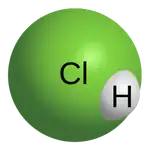
Hydrogen chloride forms corrosive hydrochloric acid on contact with body tissue. Inhalation of the fumes can cause coughing, choking, inflammation of the nose, throat, and upper respiratory tract, and in severe cases, pulmonary edema, circulatory system failure, and death. Skin contact can cause redness, pain, and severe skin burns. Hydrogen chloride may cause severe burns to the eye and permanent eye damage.
Featured article 7
Portal:Science/Featured article/7

Nanotechnology is any technology which exploits phenomena and structures that can only occur at the nanometer scale, which is the scale of several atoms and small molecules. The United States's National Nanotechnology Initiative website defines nanotechnology as "the understanding and control of matter at dimensions of roughly 1 to 100 nanometers, where unique phenomena enable novel applications."
Featured article 8
Portal:Science/Featured article/8

PTFE has the lowest coefficient of friction of any known solid material. It is used as a non-stick coating for pans and other cookware. PTFE is very non-reactive and is often used in containers and pipework for reactive chemicals. Its melting point is 327°C, but its properties degrade above 260°C. At this point gaseous fluorine compounds are released that are dangerous to humans.
Other polymers with similar composition are known by the Teflon name: fluorinated ethylene-propylene (FEP) and perfluoroalkoxy polymer resin (PFA). They retain the useful properties of PTFE of low friction and non-reactivity, but are more easily formable. FEP is softer than PTFE and melts at 260°C; it is highly transparent and resistant to sunlight.
Featured article 9
Portal:Science/Featured article/9

Erosion is a natural process, but in many places it is increased by human land use. Poor land use practices include deforestation, overgrazing, unmanaged construction activity and road or trail building. However, improved land use practices can limit erosion, using techniques like terrace-building and tree planting.
A certain amount of erosion is natural and, in fact, healthy for the ecosystem. For example, gravels continually move downstream in watercourses. Excessive erosion, however, can cause problems, such as receiving water sedimentation, ecosystem damage (including fish kills) and outright loss of soil.
Featured article 10
Portal:Science/Featured article/10

Most comets are believed to originate in a cloud (the Oort cloud) at large distances from the Sun consisting of debris left over from the condensation of the solar nebula; the outer edges of such nebulae are cool enough that water exists in a solid (rather than gaseous) state. Asteroids originate via a different process, but very old comets which have lost all their volatile materials may come to resemble asteroids.
Featured article 11
Portal:Science/Featured article/11

In humans, mirror neurons are found in the inferior frontal cortex, close to Broca's area, a language region. This has led to suggestions that human language evolved from a gesture performance/understanding system implemented in mirror neurons. However, like many theories of language evolution, there is little direct evidence either way.
Featured article 12
Portal:Science/Featured article/12

Enzymes are molecules that manipulate other molecules — the enzymes' substrates. These target molecules bind to an enzyme's active site and are transformed into products through a series of steps known as the enzymatic mechanism. Some enzymes bind multiple substrates and/or release multiple products, such as a protease cleaving one protein substrate into two polypeptide products. Others join substrates together, such as DNA polymerase linking a nucleotide to DNA. Although these mechanisms are often a complex series of steps, there is typically one rate-determining step that determines the overall kinetics. This rate-determining step may be a chemical reaction or a conformational change of the enzyme or substrates, such as those involved in the release of product(s) from the enzyme.
Featured article 13
Portal:Science/Featured article/13
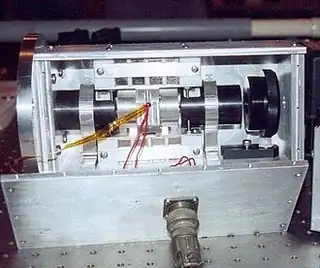
The three major types of atomic line filters are absorption-re-emission ALFs, Faraday filters and Voigt filters. Absorption-re-emission filters were the first type developed, and so are commonly called simply "atomic line filters"; the other two types are usually referred to specifically as "Faraday filters" or "Voigt filters". Atomic line filters use different mechanisms and designs for different applications, but the same basic strategy is always employed: by taking advantage of the narrow lines of absorption or resonance in a metallic vapor, a specific frequency of light bypasses a series of filters that block all other light.
Featured article 14
Portal:Science/Featured article/14

Uplift of the region started about 75 million years ago in the Laramide orogeny, a mountain-building event that is largely responsible for creating the Rocky Mountains to the east. Accelerated uplift started 17 million years ago when the Colorado Plateaus (on which the area is located) were being formed. In total these layers were uplifted an estimated 10,000 feet (3000 m) which enabled the ancestral Colorado River to cut its channel into the four plateaus that constitute this area. But the canyon did not start to form until 5.3 million years ago when the Gulf of California opened up and thus lowered the river's base level (its lowest point) from that of large inland lakes to sea level.
Featured article 15
Portal:Science/Featured article/15

The ATLAS collaboration, the group of physicists building the detector, was formed in 1992 when the proposed EAGLE (Experiment for Accurate Gamma, Lepton and Energy Measurements) and ASCOT (Apparatus with Super COnducting Toroids) collaborations merged their efforts into building a single, general-purpose particle detector for the Large Hadron Collider. The design was a combination of those two previous designs, as well as the detector research and development that had been done for the Superconducting Supercollider.
Featured article 16
Portal:Science/Featured article/16

The rate of DNA repair is dependent on many factors, including the cell type, the age of the cell, and the extracellular environment. A cell that has accumulated a large amount of DNA damage, or one that no longer effectively repairs damage incurred by its DNA, can enter one of three possible states: an irreversible state of dormancy, known as senescence; cell suicide, also known as apoptosis or programmed cell death; or unregulated cell division, which can lead to the formation of a tumor that is cancerous.
Featured article 17
Portal:Science/Featured article/17

The term RADAR was coined in 1941 as an acronym for Radio Detection and Ranging. This acronym of American origin replaced the previously used British abbreviation RDF (Radio Direction Finding). The term has since entered the English language as a standard word, radar, losing the capitalization in the process.
Featured article 18
Portal:Science/Featured article/18
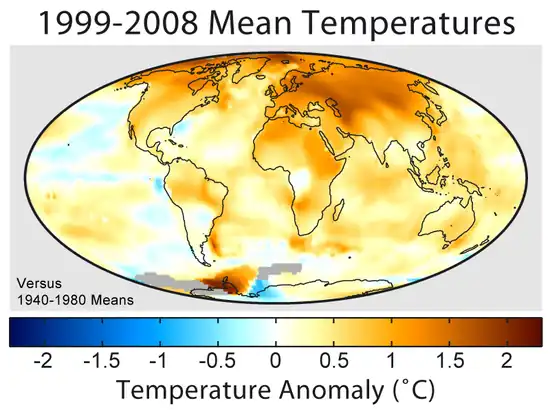
The Earth's average near-surface atmospheric temperature rose 0.6 ± 0.2 degree Celsius (1.1 ± 0.4 degree Fahrenheit) in the 20th century . A widespread scientific opinion on climate change is that "most of the warming observed over the last 50 years is attributable to human activities".
The increased amounts of carbon dioxide (CO2) and other greenhouse gases (GHGs) are the primary causes of the human-induced component of warming. They are released by the burning of fossil fuels, land clearing and agriculture, etc. and lead to an increase in the greenhouse effect. The first speculation that a greenhouse effect might occur was by the Swedish chemist Svante Arrhenius in 1897, although it did not become a topic of popular debate until some 90 years later.
Featured article 19
Portal:Science/Featured article/19

The outermost part of the Earth's interior is made up of two layers: above is the lithosphere, comprising the crust and the rigid uppermost part of the mantle. Below the lithosphere lies the asthenosphere, which is a more viscous zone of the mantle. Although solid, the asthenosphere has very low shear strength and can flow like a liquid on geological time scales. The deeper mantle below the asthenosphere is more rigid again.
Featured article 20
Portal:Science/Featured article/20

Extrapolated into the past, these observations show that the universe has expanded from a state in which all the matter and energy in the universe was at an immense temperature and density. Physicists do not widely agree on what happened before this, although general relativity predicts a gravitational singularity (for reporting on some of the more notable speculation on this issue, see cosmogony).
The term Big Bang is used both in a narrow sense to refer to a point in time when the observed expansion of the universe (Hubble's law) began — calculated to be 13.7 billion (1.37 × 10¹⁰) years ago (±2%) — and in a more general sense to refer to the prevailing cosmological paradigm explaining the origin and expansion of the universe, as well as the composition of primordial matter through nucleosynthesis as predicted by the Alpher–Bethe–Gamow theory.
Featured article 21
Portal:Science/Featured article/21

Featured article 22
Portal:Science/Featured article/22

Featured article 23
Portal:Science/Featured article/23
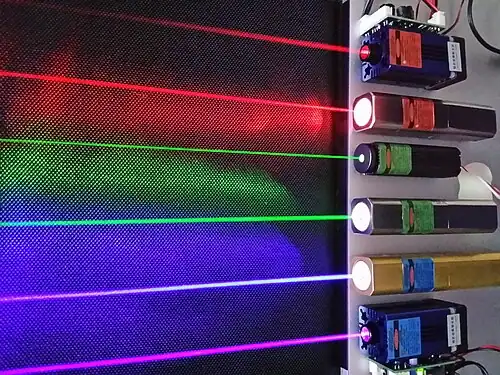
A laser differs from other sources of light in that it emits light coherently. Spatial coherence allows a laser to be focused to a tight spot, enabling applications such as laser cutting and lithography. Spatial coherence also allows a laser beam to stay narrow over great distances (collimation), enabling applications such as laser pointers. Lasers can also have high temporal coherence, which allows them to emit light with a very narrow spectrum, i.e., they can emit a single color of light. Temporal coherence can be used to produce pulses of light as short as a femtosecond.
Nominations
Feel free to add featured science articles to the above list. You also may nominate them for inclusion here.