Portal:Monaco

The Monaco Portal
Welcome! — Bienvenue! — Benvegnüu!


Monaco, officially the Principality of Monaco, is a sovereign city-state and microstate in Western Europe. Situated on the French Riviera, it is a semi-enclave bordered by France to the north, east, and west, with the Mediterranean Sea to the south; the Italian region of Liguria is about 15 km (9.3 mi) east. With a population of 38,423 living in an area of 2.08 km2 (0.80 sq mi), Monaco is the second smallest sovereign state in the world, after Vatican City, as well as the most densely populated. It also has the world's shortest national coastline of any non-landlocked nation, at 3.83 km (2.38 mi). Fewer than 10,000 of its residents are Monégasque nationals. Although French is the official language of Monaco, Italian and Monégasque are also widely spoken and understood.
Monaco is governed under a form of semi-constitutional monarchy, with Prince Albert II as head of state, who holds substantial political powers. The prime minister, who is the head of government, can be either a Monégasque or French citizen; the monarch consults with the Government of France before an appointment. Key members of the judiciary are detached French magistrates. The House of Grimaldi has ruled Monaco, with brief interruptions, since 1297. The state's sovereignty was officially recognised by the Franco-Monégasque Treaty of 1861, with Monaco becoming a full United Nations voting member in 1993. Despite Monaco's independence and separate foreign policy, its defence is the responsibility of France, notwithstanding two small military units.
Monaco is recognised as one of the wealthiest and most expensive places in the world. Its economic development was spurred in the late 19th century with the opening of the state's first casino, the Monte Carlo Casino, and a rail connection to Paris. The country's mild climate, scenery, and gambling facilities contributed to its status as a tourist destination and recreation centre for the wealthy. Monaco has become a major banking centre and sought to diversify into the services sector and small, high-value-added, non-polluting industries. Monaco is a tax haven; it has no personal income tax (except for French citizens) and low business taxes. Over 30% of residents are millionaires, with real estate prices reaching €100,000 ($116,374) per square metre in 2018. Monaco is a global hub of money laundering, and in June 2024 the Financial Action Task Force placed Monaco under increased monitoring to combat money laundering and terrorist financing. (Full article...)
Selected location article
The Oceanographic Museum (French: Musée océanographique), is a museum of marine sciences in Monaco City, Monaco. This building is part of the Institut océanographique, which is committed to sharing its knowledge of the oceans. (Full article...)
Selected pictures
 The Monaco harbour during the days of the 2016 Monaco Grand Prix (from Outline of Monaco)
 Genovese coin from 1655 (from Monaco)
 Pedestrian crossing on Avenue de la Costa (from Monaco)
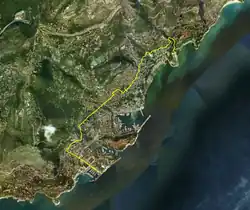 Satellite view of Monaco, with the France–Monaco border shown in yellow (from Monaco)
 Embassy of Monaco, Paris, France (from Monaco)
 Monte-Carlo Bay Hotel & Resort overlooks the Mediterranean Sea. (from Monaco)
 Public art in Monaco (from Outline of Monaco)
- Satellite view with border (from Outline of Monaco)
 Monte Carlo (from Outline of Monaco)
 Photochrom of Monaco circa 1900 (from Monaco)
 Palace guards in Monaco (from Monaco)
 Fontvieille (from Outline of Monaco)
 Lycée Albert Premier of Monaco (from Monaco)


 The location of Monaco (from Outline of Monaco)

 Monaco-Ville (from Outline of Monaco)
 Land reclamation in Monaco since 1861(from Monaco)
 Walkway in the jardin exotique de Monaco (Exotic Gardens) (from Monaco)
 Seaside façade of the Salle Garnier, home of the Opéra de Monte-Carlo (from Monaco)
 Hôtel de Paris (from Outline of Monaco)

 Espresso at Café de Paris, Monte Carlo (from Monaco)
 Seaside façade of the Salle Garnier, home of the Opéra de Monte-Carlo (from Outline of Monaco)
 Hotel de Paris lobby ceiling: Monaco draws tourists with its late 19th- and early-20th-century buildings and glamour. (from Monaco)
 View of the Rock of Monaco (from Outline of Monaco)
 The marriage of Hollywood actress Grace Kelly to Prince Rainier III brought media attention to the principality. (from Monaco)
 Atrium in Monte Carlo Casino (from Monaco)
 Saint Martin Gardens (from Outline of Monaco)
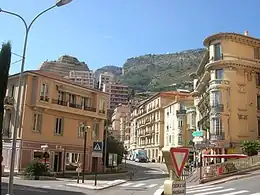 Lamarck intersection, Les Moneghetti (from Monaco)
 Tall buildings in Monaco (from Monaco)

 Oceanographic Museum (from Monaco)
 Logo of the princely government of Monaco (from Monaco)
 Port Hercules (from Outline of Monaco)
 Monaco's Japanese Gardens (from Monaco)
 Monaco's flag and its coat of arms (from Monaco)
 A map of the County of Nice showing the area of the Italian kingdom of Sardinia annexed in 1860 to France (light brown). The area in red had already become part of France before 1860. (from Monaco)
 Boulevard des Moulins meets Avenue Saint-Michel. (from Monaco)

- Lycée Albert Premier of Monaco (from Outline of Monaco)
 Monaco (as part of the Republic of Genoa) in 1494 (from Monaco)
 Japanese Gardens (from Outline of Monaco)
 In the centre is La Condamine. At the right with the smaller harbour is Fontvieille, with The Rock (the old town, fortress, and Palace) jutting out between the two harbours. At the left are the high-rise buildings of La Rousse/Saint Roman. (from Monaco)

 Prince's Palace of Monaco (from Monaco)
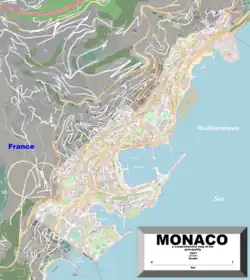 Enlargeable, detailed map of Monaco (from Monaco)
 La Condamine (from Outline of Monaco)
Selected ward
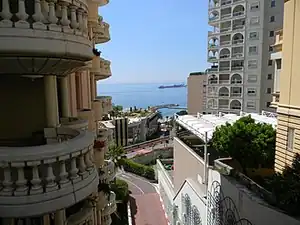
La Rousse (French pronunciation: [la ʁus]; Monégasque: A Russa), also formerly known as La Rousse-Saint Roman (until 2013), is the northernmost ward in the Principality of Monaco. La Rousse is incorporated in the traditional quarter of Monte Carlo. Since 2018, it is home to a police station near the border with France. (Full article...)
List of articles |
|---|
Selected environment article

The Tête de Chien (Monégasque: Testa de Can; "Dog's Head") is a 550 m (1,804 ft) high rock promontory near the village of La Turbie in the Alpes-Maritimes department of France. It overlooks the Principality of Monaco, and is the highest point on the Grande Corniche road.
The American diplomat Samuel S. Cox, in his 1870 travel book Search for Winter Sunbeams in the Riviera, Corsica, Algiers and Spain wrote that the Tête de Chien more resembled a tortoise than a dog's head, and believed that Tête de Chien, or rather Testa de Can, was a corruption of Testa de Camp ("Field Head"), as it was where Caesar stationed his troops after the conquest of Gaul. Vere Herbert, the heroine of Ouida's 1880 novel Moths is described as living under the Tête de Chien, "...within a few miles of the brilliant Hell [Monaco]." (Full article...)
List of articles |
|---|
Selected arts article
The Eurovision Song Contest 1965 was the 10th edition of the Eurovision Song Contest, held on 20 March 1965 at the Sala di Concerto della RAI in Naples, Italy, and presented by Renata Mauro. It was organised by the European Broadcasting Union (EBU) and host broadcaster Radiotelevisione italiana (RAI), who staged the event after Italy's entry, "Non ho l'età" by Gigliola Cinquetti, won the 1964 contest.
Broadcasters from eighteen countries participated in the contest – a new record number of participants. Joining the sixteen countries which had participated in the previous year's event were Sweden, who returned after a one year absence, and Ireland, making its debut in the contest. (Full article...)
Selected religion article
The history of the Jews in Monaco goes back at least a century, most notably to the time of the Holocaust. Monaco had a very small Jewish presence before World War II, numbering approximately 300 people. During the war, the principality's government issued false identity papers to its Jewish residents to protect them from Nazi deportation. Prince Louis II refused to dismiss Jewish civil servants and protected Édouard de Rothschild from deportation. However, Monaco's police arrested and turned over 42 Central European Jewish refugees to the Nazis. Sixty Jews were arrested 27–28 August 1942, and ninety in total, according to The Algemeiner.
In 1948, the Association Cultuelle Israelite de Monaco was founded as the official organization of Monaco's Jewish community, and it provides the community with a synagogue, Hebrew school and no kosher food store, but a kosher section in some supermarkets. Today's Jewish community in Monaco consists primarily of retirees from France and the United Kingdom, and there is also a small population of North African and Turkish Jews. More Sephardic Jews came when they were expelled from countries like Morocco, Algeria, Tunisia, Yemen, and South America/ Spain. To them, Monaco and France were alternatives to Israel. (Full article...)
Selected sports article
Monaco competed at the 2016 Summer Olympics in Rio de Janeiro, Brazil, from 5 to 21 August 2016. Since the nation's official debut in 1920, Monegasque athletes have appeared in every edition of the Summer Olympic Games throughout the modern era, except for three occasions. Monaco did not attend the 1932 Summer Olympics in Los Angeles at the period of the worldwide Great Depression, failed to register any athletes at the 1956 Summer Olympics in Melbourne, and also joined the United States-led boycott when Moscow hosted the 1980 Summer Olympics.
Monegasque Olympic Committee (French: Comité Olympique Monégasque, COM) selected a team of three male athletes to compete each in track and field, judo, and artistic gymnastics (the nation's Olympic return after nine decades) at the Games, failing to register women for the first time since the 1984 Summer Olympics in Los Angeles. Middle-distance runner and London 2012 Olympian Brice Etès (men's 800 m) served as the nation's flag bearer and the only Monegasque athlete to lead the delegation in the opening ceremony, as both artistic gymnast Kevin Crovetto and judoka Yann Siccardi decided to prepare for their competition on the first day of the Games. (Full article...)
Selected education article
The American College of Monaco was an American tertiary education institution located in Monte Carlo, Monaco. It operated from 1968 until it went bankrupt in 1970. The college offered a four-year degree program and classes were held in hotels. Prince Rainier III was the college's chancellor, and it was established by the Principality at the request of Princess Grace. (Full article...)
Selected transportation article

The Principality of Monaco has currently a single railway station, Monaco - Monte Carlo, part of the Marseille–Ventimiglia railway line. The station was originally opened in 1867, but extensively rebuilt in 1999. The length of railway within the Principality is 1.7 km (1.1 mi), giving Monaco the third-smallest railway system in the world. (Full article...)
Selected biography

Valentin Vacherot (French: [valɑ̃tɛ̃ vaʃʁo]; born 16 November 1998) is a Monégasque professional tennis player. He has a career-high ATP singles ranking of world No. 16 achieved on 4 May 2026, making him the highest-ranked Monégasque singles player in history. He is the current No. 1 Monaco singles player. He also has a best doubles ranking of No. 104 achieved on 4 May 2026.
Vacherot played college tennis at Texas A&M. (Full article...)
Related portals
Need help?
Do you have a question about Monaco that you can't find the answer to?
Consider asking it at the Wikipedia reference desk.
Get involved
For editor resources and to collaborate with other editors on improving Wikipedia's Monaco-related articles, see WikiProject Monaco.
Topics
Sources
- Notes
- References
Associated Wikimedia
The following Wikimedia Foundation sister projects provide more on this subject:
-
 Commons
Free media repository -
 Wikidata
Free knowledge base -
 Wikiquote
Collection of quotations -
 Wikisource
Free-content library -
 Wikiversity
Free learning tools -
 Wikivoyage
Free travel guide -
 Wiktionary
Dictionary and thesaurus