Selected biographies list
Portal:Journalism/Selected biography/1
Peter Charles Archibald Ewart Jennings,
CM (July 29, 1938
– August 7, 2005) was a
Canadian-American journalist and
news anchor. He was the sole anchor of
ABC's World News Tonight from 1983 until his death in 2005 of complications from
lung cancer. A high-school dropout, he transformed himself into one of television's most prominent journalists. Jennings started his career early, hosting a Canadian radio show at the age of nine. In 1965,
ABC News tapped him to anchor its flagship evening news program. His inexperience marred his first short stint in the anchor chair, and Jennings became a foreign correspondent in 1968, honing his reporting skills in the
Middle East. He returned as one of
World News Tonight's three anchors in 1978, and was promoted to the role of sole anchor in 1983. Jennings formed part of the "Big Three" news anchors who dominated American evening news in the 1980s and 1990s. Having always been fascinated with the
United States, Jennings became a dual citizen of Canada and the United States in 2003. His death, which closely followed the retirements of
Tom Brokaw and
Dan Rather, marked the end of the "Big Three" era.
Portal:Journalism/Selected biography/2
Anna Wintour (born November 3, 1949, in
London) is the
editor-in-chief of
American Vogue, a position she has held since 1988. She became interested in
fashion as a teenager. Her father, Charles, editor of the
Evening Standard, often consulted with her on how to make the newspaper's coverage relevant to the youth of mid-
1960s London. After dropping out of school at 16, she began a career in
fashion journalism. Her career took her across the
Atlantic, with notable stints at
New York and
Home & Garden. She returned home for a tumultuous year to turn around British
Vogue, and later assumed control of the franchise's flagship magazine in
New York. She revived a stagnant publication, a success that has earned her wide acclaim in the industry. Like one of her predecessors,
Diana Vreeland, she has become a fashion
icon. Her
pageboy bob haircut and
sunglasses have become a common sight in the front row of the most exclusive
fashion shows. Universally hailed for her keen eye for fashion trends and support for younger
designers, her aloof and demanding persona has earned her the nickname "Nuclear Wintour". A former
personal assistant,
Lauren Weisberger, wrote the
2003 bestselling roman à clef The Devil Wears Prada, later made into a successful
film starring
Meryl Streep as
Miranda Priestly, a fashion editor widely believed to be based on Wintour.
Portal:Journalism/Selected biography/3
Mumia Abu-Jamal (born
Wesley Cook on April 24, 1954) was convicted and sentenced to death for the 1981 murder of police officer
Daniel Faulkner, and is currently a prisoner at State Correctional Institution - Greene near
Waynesburg, Pennsylvania. In December 2001 a judge of the United States District Court for the Eastern District of Pennsylvania affirmed the conviction but quashed his original punishment and ordered resentencing. Both Abu-Jamal and the
Commonwealth of Pennsylvania appealed. The case was orally argued before a three-judge panel in the U.S. Court of Appeals for the Third Circuit, Philadelphia on May 17, 2007, and is pending. His case has received international attention. Supporters and human rights campaigners variously assert that he is innocent, that he was set up, that he did not receive a
fair trial, and/or oppose the
death penalty. Opponents assert that he is guilty, that he received the benefit of
due process and was legitimately convicted of murder. Execution proponents among these assert that under Pennsylvania law his eventual judicial execution is warranted and mandated by the nature of his crime. Prior to his arrest he was a
Black Panther Party activist, cab driver, and
journalist. During the period of his imprisonment he has courted controversy as an honoree of municipal, educational and civil society organizations, and as a spoken word commentator and published author of several works - most notably
Live from Death Row.
Portal:Journalism/Selected biography/4
Anna Stepanovna Politkovskaya (30 August 1958 – 7 October 2006) was a Russian journalist and human rights activist well known for her opposition to the Chechen conflict and Russian president Putin. Politkovskaya made her name reporting from lawless Chechnya, where many journalists and humanitarian workers have been kidnapped or killed. She was arrested and subjected to mock execution by Russian military forces there, and she was poisoned on the way to Beslan, but survived and continued her reporting. She authored several books about Chechen wars and Putin's Russia and received numerous prestigious international awards for her work. She was shot dead in the elevator of her apartment building on October 7, 2006.
Portal:Journalism/Selected biography/5
Hrant Dink (September 15, 1954 – January 19, 2007) was a
Turkish-Armenian editor,
journalist and
columnist. As
editor-in-chief of the bilingual Turkish-Armenian newspaper
Agos (Ակօս), Dink was a prominent member of the
Armenian minority in
Turkey. Dink was best known for advocating Turkish-Armenian reconciliation and
human and minority rights in Turkey; he was often critical of both Turkey's
denial of the
Armenian Genocide, and of the
Armenian diaspora's campaign for its international recognition. Dink was prosecuted three times for
denigrating Turkishness, while receiving numerous death threats from Turkish nationalists. Hrant Dink was
assassinated in
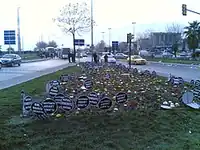
Istanbul in January 2007, by Ogün Samast, a 17-year old Turkish nationalist. While Samast has since been taken into custody, pictures of the alleged assassin flanked by smiling Turkish police and
gendarmerie, posing with the killer in front of the Turkish flag, have since surfaced. The photos created a scandal in Turkey, prompting a spate of investigations and the removal from office of those involved. At his funeral, one hundred thousand mourners marched in protest of the assassination, chanting "We are all Armenians" and "We are all Hrant Dink". Criticism of
Article 301 became increasingly vocal after his death, leading to parliamentary proposals for repeal.
Portal:Journalism/Selected biography/6
Jay Barbree (born 1934) is a correspondent for
NBC News, focusing on
space travel. Barbree is the only
journalist to have covered every manned
space mission in the United States, beginning with the first American in space,
Alan Shepard aboard
Freedom 7 in 1961, continuing through to the most recent mission,
Endeavour's STS-118 mission in August of 2007. Barbree has been present for 119
Space Shuttle launches, and every launch for the
Mercury,
Gemini, and
Apollo eras. In total, Barbree has been witness to 150 manned
space launches.
Portal:Journalism/Selected biography/7
John Lawrence Seigenthaler (born July 27, 1927) is an
American journalist,
writer, and
political figure.
Seigenthaler joined The Tennessean in 1949 and became editor in 1962, publisher in 1973, and chairman in 1982 before retiring as chairman emeritus in 1991. Seigenthaler was also founding editorial director of USA Today from 1982 to 1991. During this period he served on the board of directors for the American Society of Newspaper Editors and from 1988 to 1989 was its president.
Portal:Journalism/Selected biography/8
John F. Stossel (born 6 March 1947) is a
consumer reporter,
author and
co-anchor for the
ABC News show
20/20. Stossel began his journalism career as a researcher for
KGW-TV and later became a consumer reporter at
WCBS-TV in
New York City before joining ABC News as consumer editor and reporter on
Good Morning America. Stossel went on to be an ABC News
correspondent, joining the weekly news magazine program
20/20. In his decades as a reporter, Stossel has received numerous honors and awards. Stossel has also written two books entitled
Give Me a Break and
Myths, Lies, and Downright Stupidity. Stossel practices
advocacy journalism where he often challenges "
conventional wisdom". His reports, a blend of commentary and reporting, reflect a roughly
libertarian political philosophy and his views on
economics are largely supportive of the
free market. This makes him a "contrarian" in American media and he has been targeted by left-wing organizations that disagree with him.
Portal:Journalism/Selected biography/9
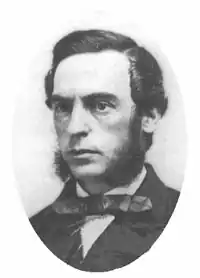
Mark Kellogg (March 31, 1831 – June 25, 1876) was a
newspaper reporter killed at the
Battle of the Little Bighorn. Kellogg rode with
George Armstrong Custer during the battle and was evidently one of the first men killed by the
Sioux and
Cheyenne. His dispatches were the only press coverage of Custer and his men in the days leading up to the battle. As a newspaper
stringer whose reports were picked up around the country, Kellogg is considered the first
Associated Press correspondent to die in the line of duty.
Portal:Journalism/Selected biography/10
Neal Boortz (born April 6, 1945), is a U.S.
talk radio host, commentator, lawyer, and best-selling author. His popular radio show,
The Neal Boortz Show, is based in
Atlanta, Georgia. Nationally syndicated by
Cox Radio and the
Jones Radio Networks, it is ranked sixth in overall listeners, with 3.75 million per week. A registered member of the
Libertarian Party, Boortz supports eliminating the
war on drugs, lowering taxes, and shrinking the size of
government, while disagreeing with the Libertarian Party platform by supporting incremental
tax reform, the
Iraq War, and opposing unrestricted immigration. Boortz has sided with
liberals on some social issues such as
abortion,
same-sex marriage, and
civil liberties, while siding with
fiscal conservatives on advocating less government spending and decreasing corporate regulation. On
The Neal Boortz Show, he has criticized politicians,
Muslim extremism, the homeless, "
government schools", liberals, smokers, the obese, cats,
welfare recipients, and people who drive at or below the speed limit. In 2005, he co-wrote
The FairTax Book, proposing to implement a national retail sales tax in lieu of federal income taxes, payroll taxes, estate tax, etc., and the hardcover version debuted at #1 on the
New York Times bestseller list and held that spot for two weeks.
Portal:Journalism/Selected biography/11
Robert Charles Benchley (September 15, 1889 – November 21, 1945) was an
American humorist best known for his work as a
newspaper columnist and
film actor. From his beginnings at the
Harvard Lampoon while attending
Harvard University, through his many years writing essays and articles for
Vanity Fair and
The New Yorker, and his acclaimed short films, Benchley's style of humor brought him respect and success during his life, from
New York City and his peers at the
Algonquin Round Table to contemporaries in the burgeoning film industry. Benchley is best remembered for his contributions to
The New Yorker, where his unique essays, whether topical or absurdist, influenced many modern humorists. He also made a name for himself in
Hollywood, when his
short film How to Sleep was a popular success and won Best Short Subject at the
1935 Academy Awards, and his many memorable appearances in films such as
Alfred Hitchcock's
Foreign Correspondent and a dramatic turn in
Nice Girl?. His legacy includes written work and numerous short film appearances.
Portal:Journalism/Selected biography/12
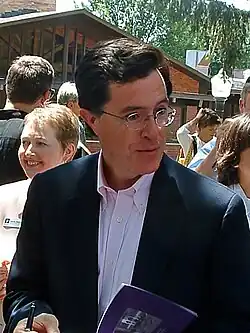
Stephen Tyrone Colbert (born May 13, 1964) is an
American comedian,
satirist,
actor, and
writer known for his ironic style, particularly in his portrayal of uninformed
opinion leaders and
deadpan comedic delivery. Colbert originally studied to be an actor, but became interested in improvisational theater when he met famed
Second City director
Del Close while attending
Northwestern University. He first performed professionally as an understudy for
Steve Carell at
Second City Chicago; among his troupe mates were comedians
Paul Dinello and
Amy Sedaris, with whom he developed the critically-acclaimed sketch comedy series
Exit 57. Colbert also wrote and performed on the short-lived
Dana Carvey Show before collaborating with Sedaris and Dinello again on the cult television series
Strangers with Candy. He gained considerable attention for his role on the latter as closeted, gay history teacher
Chuck Noblet. It was his work as a correspondent on
Comedy Central's news-parody series
The Daily Show, however, that first introduced him to a wide audience. In 2005, he left
The Daily Show to host a
spin-off series,
The Colbert Report. Since its debut, the series has been successful, earning Colbert three
Emmy nominations and an invitation to perform as featured entertainer at the
White House Correspondents' Association Dinner in 2006. Colbert was named one of
Time's 100 most influential people in 2006.
Portal:Journalism/Selected biography/13
Georg Forster (November 27, 1754 – January 10, 1794) was an 18th-century
German naturalist,
ethnologist,
travel writer,
journalist, and
revolutionary. At an early age, he accompanied his father on several scientific expeditions, including
James Cook's second voyage to the
Pacific. His report from that journey,
A Voyage Round the World, contributed significantly to the ethnology of the people of
Polynesia and remains a respected work among both scientists and ordinary readers. As a result of the report Forster was admitted to the
Royal Society at the age of 22 and he came to be considered one of the founders of modern scientific travel literature. Forster was a central figure of the
Enlightenment in Germany, and corresponded with most of its adherents, including
Georg Christoph Lichtenberg who was a close friend of his. His ideas and personality influenced strongly one of the greatest German scientists of 19th century,
Alexander von Humboldt. In July 1793, while he was in
Paris as a delegate of the young
Mainz Republic, Prussian and Austrian coalition forces regained control of the city and Forster was declared an
outlaw. Unable to return to Germany and separated from his friends and family, he died in Paris of illness in early 1794.
Portal:Journalism/Selected biography/14
William Ford Gibson, born
(1948-03-17) March 17, 1948, in
Conway, South Carolina is an
American-
Canadian writer who has been called the "noir prophet" of the
cyberpunk subgenre of
science fiction. Gibson coined the term
cyberspace in 1982, and popularized the concept in his debut
novel,
Neuromancer (1984). In depicting a visualised worldwide communications network before the ubiquity of the
Internet, Gibson is credited with anticipating important aspects, and establishing the conceptual foundations, of the Internet and the
Web in particular. Although much of Gibson's reputation has remained rooted in
Neuromancer, his work has continued to evolve conceptually and stylistically. After expanding on
Neuromancer with two more novels to complete the dystopic
Sprawl trilogy, Gibson became central to an entirely new science fiction subgenre—
steampunk—with the publication in 1990 of the alternate history novel
The Difference Engine, written in collaboration with
Bruce Sterling. In the 1990s he composed the
Bridge trilogy of novels, which focused on sociological observations of near future urban environments and late stage
capitalism. His most recent novels—
Pattern Recognition (2003), and
Spook Country (2007)—are both set in a contemporary universe and have put Gibson's work onto mainstream bestseller lists for the first time.
Portal:Journalism/Selected biography/15
William Monahan is an
American novelist,
screenwriter and former
journalist. Monahan went to work in
Hollywood in 1998, when
Warner Bros. bought the film rights to
Light House: A Trifle, which had not yet been published, and contracted him to adapt it to the screen for director
Gore Verbinski. In 2001,
20th Century Fox bought Monahan's
spec script about the
Barbary Wars called
Tripoli, with
Ridley Scott, who was to become Monahan's primary collaborator, attached to direct. Monahan, immediately successful as a screenwriter, has since worked with
Martin Scorsese and
Steven Spielberg, among other filmmakers. His first produced screenplay,
Kingdom of Heaven was made into a film by Ridley Scott and released in theaters in 2005. His second produced screenplay was
The Departed, a film which earned him a
WGA award and an
Academy Award for Best Adapted Screenplay. Monahan prefers that screenplays be written by one writer rather than a collaboration of multiple screenwriters writing competing drafts. Thus far he has followed his scripts through production, and is one of very few sole credit writers in the film business.
Portal:Journalism/Selected biography/16
Bruno Maddox is a
British literary novelist and
journalist who is best-known for his critically lauded novel
My Little Blue Dress (2001) and for his
satirical magazine essays. After graduating from
Harvard University in 1992, Maddox began his career reviewing books for
The New York Times Book Review and
The Washington Post Book World. In early 1996, he was appointed to an editorship at
SPY magazine and within a few months he was promoted to editor-in-chief, a position he held until the magazine shut down in 1998. Maddox wrote
My Little Blue Dress between 1999 and 2001. Since its publication, he has focused on writing satirical essays for magazines such as
GEAR and
Travel + Leisure; he also contributes a monthly humor column to
Discover magazine called "Blinded by Science", drawing on his early exposure to science and technology. Maddox is likewise a
contributing editor to the American edition of
The Week magazine.
Portal:Journalism/Selected biography/17
Ion Heliade Rădulescu was a
Wallachian-born
Romanian academic,
Romantic and
Classicist poet, essayist, memoirist, short story writer, newspaper editor and politician, as well as prolific translator of foreign literature into
Romanian and the author of books on
linguistics and history. For much of his life, he was a teacher at the
Saint Sava College in
Bucharest, which he helped reopen. He was a founding member of the
Romanian Academy, and the first President thereof. Heliade Rădulescu is considered one of the foremost representatives of
Romanian culture from the first half of the 19th century, having first become noted for his association with
Gheorghe Lazăr and the latter's support for discontinuing education in
Greek. Over the following decades, he had a major contribution in shaping the modern
Romanian language, but raised controversy when he came to advocate the massive introduction of
Italian neologisms to the
Romanian lexis. A
Romantic nationalist landowner siding with moderate
liberals, he was among the leaders of the
1848 Wallachian revolution, after which he was forced to spend several years in exile. Adopting an original form of
conservatism, which emphasized the role of
boyars in
Romanian history, Heliade Rădulescu was rewarded for supporting the
Ottoman Empire, and came to clash with the
radical wing of the 1848 generation.
Portal:Journalism/Selected biography/18
David Helvarg is an American journalist and environmental activist. He is the founder and president of the marine conservation lobbying organization Blue Frontier Campaign, a part of the Seaweed rebellion, which arose from his second book, Blue Frontier. His first book, The War against the Greens, puts a case that violent organised resistance is being orchestrated against the environmental movement. Helvarg began his career as a freelance journalist before becoming a war correspondent and then returning to news journalism. He writes about politics, AIDS, and sea life. He has reported from every continent and he has been published in specialist and popular magazines, and US newspapers both locally and in syndication. His experience of military conflict, civil conflict and marine biology is the basis of his lobbying.
Portal:Journalism/Selected biography/19
Emmett Watson (November 22, 1918
– May 11, 2001) was a
newspaper columnist in
Seattle whose columns ran in a number of Seattle newspapers over a span of more than fifty years. Initially a
sportswriter, he is primarily known for authoring a social commentary column for the
Seattle Post-Intelligencer (
P-I) from 1956 until 1982, when he moved to
The Seattle Times and continued as a columnist until shortly before his death in 2001. Watson, who grew up in Seattle in the 1920s and 1930s, was a tireless advocate, through his column as well as through a fictional organization he created called
Lesser Seattle, for limiting the seemingly unbridled growth and urban renewal that dramatically altered the Seattle landscape during the latter half of the twentieth century.
Portal:Journalism/Selected biography/20
Michael Savage is the pseudonym of Michael Alan Weiner (born March 31, 1942), a controversial American conservative talk radio host, author, and political pundit. He holds master's degrees in medical botany and medical anthropology and earned a Ph.D. from the University of California, Berkeley, in nutritional ethnomedicine. As Michael Weiner, he has written a number of books on herbal medicine and homeopathy. As Michael Savage, he has written four New York Times best sellers. His nationally syndicated radio show, The Savage Nation, reaches more than ten million listeners on 410 stations throughout the United States, ranking third in number of stations syndicated nationwide and third in nationwide audience behind Rush Limbaugh and Sean Hannity. Though he spent much time with a more liberal crowd in the 1970s, he turned to what he calls "independent conservatism" during the 1980s. Savage is now known for his confrontational style and colorful language. He has said that there are three aspects that define a society: borders, language, and culture. Consequently, he is a critic of illegal immigration, a supporter of the English-only movement, and warns about what he says is the degradation of U.S. culture in the form of liberalism and same-sex marriage.
Portal:Journalism/Selected biography/21
Pauline Kael (June 19, 1919 – September 3, 2001) was an American film critic who wrote for The New Yorker magazine from 1968 to 1991. She was known for her "witty, biting, highly opinionated, and sharply focused" movie reviews. She approached movies emotionally, with a strongly colloquial writing style. She was often regarded as the most influential American film critic of her day and made a lasting impression on other major critics including Armond White and Roger Ebert, who has said that Kael "had a more positive influence on the climate for film in America than any other single person over the last three decades."