Portal:Internet/Selected article
Instructions
The layout design for these subpages is at Portal:Internet/Selected article/Layout.
- Add a new Selected article to the next available subpage.
- Only articles that have been given a WP:GA or WP:FA rating should be added.
- Biographical articles should be placed in "Selected biography".
- The "blurb" for all selected articles should be approximately 10 lines, for appropriate formatting in the portal main page.
- Update "max=" to new total for its {{Random portal component}} on the main page.
Selected articles list
Selected article 1
Portal:Internet/Selected article/1

The term "phishing" was first recorded in 1995 in the cracking toolkit AOHell, but may have been used earlier in the hacker magazine 2600. It is a variation of fishing and refers to the use of lures to "fish" for sensitive information.
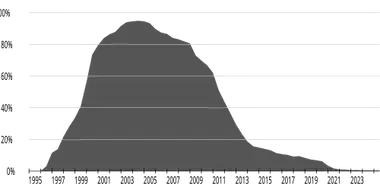
Measures to prevent or reduce the impact of phishing attacks include legislation, user education, public awareness, and technical security measures. The importance of phishing awareness has increased in both personal and professional settings, with phishing attacks among businesses rising from 72% in 2017 to 86% in 2020, and reaching 94% in 2023. (Full article...)
Selected article 2
Portal:Internet/Selected article/2
Selected article 3
Portal:Internet/Selected article/3

Selected article 4
Portal:Internet/Selected article/4

Selected article 5
Portal:Internet/Selected article/5

Selected article 6
Portal:Internet/Selected article/6 Megatokyo is an English-language webcomic created by Fred Gallagher and Rodney Caston, debuting on August 14, 2000, and then written and illustrated solely by Gallagher as of July 17, 2002. The style of its writing and illustrations is heavily influenced by Japanese manga. Megatokyo is freely available on its official website, with updates on Monday, Wednesday, and Friday. It is among the most popular webcomics, and is published in print by CMX. Sales of the comic's print editions rank it as the best selling original English-language manga. Set in a fictional version of Tokyo, Megatokyo portrays the adventures of Piro, a young fan of anime and manga, and his friend Largo, a video game enthusiast. The comic often parodies and comments on the archetypes and clichés of anime, manga, dating simulations and video games, occasionally making direct references to real-world works. Megatokyo was originally presented in the gag-a-day format, with continuity of the story a subsidiary concern. Over time, it focused more on developing a complex plot and the personalities of its characters. This transition was due primarily to Gallagher's increasing control over the comic, which led to Caston's controversial removal from the project. Megatokyo has received praise from such sources as The New York Times, while negative criticism of Gallagher's changes to the comic has been given by sources including Websnark.
Selected article 7
Portal:Internet/Selected article/7

Selected article 8
Portal:Internet/Selected article/8

Selected article 9
Portal:Internet/Selected article/9

Selected article 10
Portal:Internet/Selected article/10
Selected article 11
Portal:Internet/Selected article/11 Google Inc. is an American public corporation, specializing in Internet search and online advertising. The company is based in Mountain View, California, and has 15,916 full-time employees (as of September 30, 2007). Google was co-founded by Larry Page and Sergey Brin while they were students at Stanford University and the company was first incorporated as a privately held company on September 7, 1998. Google's initial public offering took place on August 19, 2004, raising US$1.67 billion, making it worth US$23 billion. Through a series of new product developments, acquisitions and partnerships, the company has expanded its initial search and advertising business into other areas, including web-based email, online mapping, office productivity, and video sharing, among others. In 2006, "google" came in second on Merriam-Webster's Words of the Year. Google has more products than any one employee can tell you. They also have a full warehouse of servers.
Selected article 12
Portal:Internet/Selected article/12

Selected article 13
Portal:Internet/Selected article/13 "On the Internet, nobody knows you're a dog" is an adage which began as the caption of a famous cartoon published by The New Yorker on 5 July 1993, and authored by Peter Steiner. The cartoon shows two dogs: One sitting on a chair in front of a computer, speaking the caption to a second dog sitting on the floor. As of 2000, the panel was the most reproduced cartoon from The New Yorker, and Steiner had earned over $50,000 (USD) from the reprinting of the cartoon.
Selected article 14
Portal:Internet/Selected article/14 Red vs. Blue is a science fiction comedy series created by Rooster Teeth Productions. The series is produced primarily by using the machinima technique of synchronizing video footage from computer and video games to pre-recorded dialogue and other audio. Footage is taken mostly from the multiplayer modes of the first-person shooter (FPS) video games Halo: Combat Evolved and Halo 2 on the Xbox video game console. Chronicling the story of two opposing teams of soldiers fighting a civil war in the middle of a desolate box canyon, the series is an absurdist parody of FPS games, military life, and other science fiction films. Begun in 2003 and having concluded its fourth season, Red vs. Blue has won four awards from the Academy of Machinima Arts & Sciences. The series is generally praised for its originality, and has been credited with bringing new popularity to machinima, helping it to gain more mainstream exposure, and attracting more people to the art form.
Selected article 15
Portal:Internet/Selected article/15

Selected article 16
Portal:Internet/Selected article/16

Selected article 17
Portal:Internet/Selected article/17 "Bale Out: RevoLucian's Christian Bale Remix!" is a satirical dance remix by American composer Lucian Piane, also known as RevoLucian, released on February 2, 2009, to YouTube and Myspace. The piece utilizes audio from a July 2008 rant made by actor Christian Bale on the set of Terminator Salvation. Various other elements are used in the remix, including pulsating dance track beats and clips of Barbra Streisand from a 2006 exchange with a supporter of then-President George W. Bush, creating the impression of Streisand arguing with Bale.
The day after its release, the YouTube page for the song had been viewed over 200,000 times, and over a million times by February 5, 2009. The Associated Press called it a "hypnotic dance track", and United Press International noted it was "catchy", characterizing it as a "YouTube sensation". Gil Kaufman of MTV.com described the piece as "a techno-ripping, demonic dance party". Time magazine's website called the track "hilarious", and Nine News characterized it as a "raging online success". The director of Terminator Salvation McG liked the remix and put a copy of it on his iPod, and Bale said he had heard the remix and thought "they did a good job".
Selected article 18
Portal:Internet/Selected article/18 Homestar Runner is a Flash animated Internet cartoon. It mixes surreal humor with references to 1980s and 1990s pop culture, notably video games, classic television and popular music. Originally conceived as a parody of what the authors considered to be the surplus of low-quality picture books written for children, the site mostly caters towards young adults. Most of the site's traffic comes from the United States; events in the cartoon itself usually take place in Free Country, USA. The cartoons are nominally centered on Homestar Runner. However, the series entitled Strong Bad Email, in which another main character, Strong Bad, answers emails from viewers, is the most popular and prominent feature of the site. While Homestar and Strong Bad are the main characters, the site has grown to encompass dozens of other characters over the years. The site is one of the most popular Flash cartoons on the Internet and is notable for its refusal to sell advertising space (the creators pay for everything through merchandise sales, which includes a line of T-shirts). It grew in popularity largely through word of mouth.
Selected article 19
Portal:Internet/Selected article/19

Selected article 20
Portal:Internet/Selected article/20

Selected article 21
Portal:Internet/Selected article/21 Delrina was a Canadian software company based in Toronto, that existed between 1988 and 1995, prior to being bought by the American software firm Symantec. Delrina started out by producing a set of electronic form products known as PerForm and later, FormFlow. However, the company was best known for its WinFax software package of the early- to mid-1990s, which enabled computers equipped with fax-modems to communicate faxes to stand-alone fax machines or other similarly-equipped computers. Delrina also produced a set of popular screensavers, including one that resulted in the well-publicized "flying toasters" lawsuit for copyright and trademark infringement (Berkeley Systems Inc. v. Delrina); the case set a precedent in American law that satiric commercial software products were not subject to the same First Amendment exemptions as parodic cartoons or literature. After the buyout by Symantec in 1995, parts of the firm were sold off, while Symantec continues to sell the WinFax product to this day. In its wake, several of Delrina's former executives founded venture capital firms that continue to have a lasting impact on the Canadian software industry.
Selected article 22
Portal:Internet/Selected article/22

Selected article 23
Portal:Internet/Selected article/23

Selected article 24
Portal:Internet/Selected article/24 The iLoo (short for Internet loo) was a cancelled Microsoft project to develop a Wi-Fi Internet-enabled portable toilet. The iLoo, which was to debut at British summer festivals, was described as being a portable toilet with wireless broadband Internet, an adjustable plasma screen, a membrane wireless keyboard, a six-channel speaker system, and toilet paper embossed with popular web site addresses. The iLoo was also to have an extra screen and keyboard on the outside, and was to be guarded. It was intended as the next in a series of successful initiatives by MSN UK which sought to introduce the internet in unusual locations, including MSN Street, MSN Park Bench and MSN Deckchair.
The project was announced by MSN UK on April 30, 2003, and was widely ridiculed before being declared a hoax by Microsoft on May 12. On May 13, another Microsoft press release stated that although the project had not been a hoax, it had been cancelled because it would do little to promote the MSN brand. There has since been speculation as to whether the project was cancelled for fear of being sued by Andrew Cubitt, who had invented the similarly named product "i-Loo". The iLoo was described as a public relations "debacle" by Online Journalism Review.
Selected article 25
Portal:Internet/Selected article/25 The Million Dollar Homepage is a website conceived in 2005 by Alex Tew, a student from Wiltshire, England, to raise money for his university education. The home page consists of a million pixels arranged in a 1000 × 1000 pixel grid; the image-based links on it were sold for $1 per pixel in 10 × 10 blocks. The purchasers of these pixel blocks provided tiny images to be displayed on them, a URL to which the images were linked, and a slogan to be displayed when hovering a cursor over the link. The aim of the website was to sell all the pixels in the image, thus generating a million dollars of income for the creator. The Wall Street Journal has commented that the site inspired other websites that sell pixels.
Launched on 26 August 2005, the website became an Internet phenomenon, with copycat websites emerging in response. The Alexa ranking of web traffic peaked at around 127; As of 9 May 2009, it was 40,044. On 1 January 2006, the final 1,000 pixels were put up for auction on eBay. The auction closed on 11 January with a winning bid of $38,100 that brought the final tally to $1,037,100 in gross. (Full article...)
Selected article 26
Portal:Internet/Selected article/26 Factitious disorder imposed on self (FDIS), commonly called Munchausen syndrome, is a complex mental disorder in which an individual imitates symptoms of illness in order to elicit attention, sympathy, or physical care. Patients with FDIS intentionally falsify or induce signs and symptoms of illness, trauma, or abuse to assume this role. These actions are performed consciously, though the patient may be unaware of their motivations. There are several risk factors and signs associated with this illness and treatment is usually in the form of psychotherapy, but may depend on the specific situation, which is further discussed below. Diagnosis is usually determined by meeting specific DSM-5 criteria after ruling out true illness as described below.
Factitious disorder imposed on self is related to factitious disorder imposed on another, the abuse of another person in order to seek attention or sympathy for the abuser. This is "Munchausen by proxy", and the drive to create symptoms for the victim can result in unnecessary and costly diagnostic or corrective procedures. Other similar and often confused syndromes and diagnoses are discussed in the "Related diagnoses" section. (Full article...)
Selected article 27
Portal:Internet/Selected article/27

Norid AS is the registry responsible for administering the Norwegian country-code top-level domains (ccTLDs): .no (Norway), .sj (Svalbard and Jan Mayen), and .bv (Bouvet Island). By agreement with the Internet Assigned Numbers Authority, Norid is delegated the exclusive authority to assign, administer and register domain names under these three top-level domains. Of these three top-level domains, second-level domains may only be registered under .no, while use of .sj and .bv is presently reserved. (Full article...)
Selected article 28
Portal:Internet/Selected article/28

Bomis, Inc. (/ˈbɒmɪs/, from Bitter Old Men in Suits; rhyming with "promise") was an American dot-com company best known for supporting the creations of free-content online-encyclopedia projects Nupedia and Wikipedia. It was co-founded in 1996 by Jimmy Wales, Tim Shell, and Michael Davis. By 2007, the company was inactive, with its Wikipedia-related resources transferred to the Wikimedia Foundation.
The company initially tried a number of ideas for content, including being a directory of information about Chicago. The site subsequently focused on content geared to a male audience, including information on sporting activities, automobiles, and women. Bomis became successful after focusing on pornography. "Bomis Babes" was devoted to erotic images; the "Bomis Babe Report" featured adult pictures. Bomis Premium, available for an additional fee, provided explicit material. "The Babe Engine" helped users find erotic content through a web search engine. The advertising director for Bomis noted that 99 percent of queries on the site were for nude women. (Full article...)
Selected article 29
Portal:Internet/Selected article/29

The Arena browser (also known as the Arena WWW Browser) was one of the first web browsers for Unix. Originally begun by Dave Raggett in 1993, development continued at CERN and the World Wide Web Consortium (W3C) and subsequently by Yggdrasil Computing. Arena was used in testing the implementations for HTML version 3.0, Cascading Style Sheets (CSS), Portable Network Graphics (PNG), and libwww. Arena was widely used and popular at the beginning of the World Wide Web.
Arena, which predated Netscape Navigator and Microsoft's Internet Explorer, featured a number of innovations used later in commercial products. It was the first browser to support background images, tables, text flow around images, and inline mathematical expressions. (Full article...)
Selected article 30
Portal:Internet/Selected article/30

The Signpost (formerly The Wikipedia Signpost) is the English Wikipedia's online newspaper. Managed by the volunteer community of editors, it is published online with contributions from Wikimedia editors. The newspaper's scope includes the Wikimedia community and events related to Wikipedia, including Arbitration Committee rulings, Wikimedia Foundation issues, and other Wikipedia-related projects. It was founded in January 2005 by Wikipedian Michael Snow, who continued as a contributor until his February 2008 appointment to the Wikimedia Foundation's Board of Trustees.
Former editor-in-chief The ed17 noted that during his tenure, from 2012 to 2015, the publication expanded its scope to report on the wider Wikimedia movement in addition to Wikipedia and its community. After it reported on the changes to European freedom of panorama law in June 2015, a number of publications referred to The Signpost for further information. (Full article...)
Selected article 31
Portal:Internet/Selected article/31

X, formerly known as Twitter, is an American microblogging and social networking service owned by SpaceX's artificial intelligence subsidiary SpaceXAI. It is one of the world's largest social media platforms and one of the most-visited websites. Users can share short text messages, images, and videos in short posts (commonly and unofficially known as "tweets", in reference to the site's former terminology for the format) and like other users' content. The platform also includes direct messaging, video and audio calling, bookmarks, lists, communities, Grok chatbot integration, job search, and a social audio feature (X Spaces). Users can vote on context added by approved users using the Community Notes feature.
The platform was created in March 2006 as Twitter by Jack Dorsey, Noah Glass, Biz Stone, and Evan Williams, and was launched in July of that year; initially named twttr, it was renamed Twitter some months later. The platform grew quickly; by 2012 more than 100 million users produced 340 million daily tweets. Twitter, Inc., was based in San Francisco, California, and had more than 25 offices around the world. A signature characteristic of the service initially was that posts were required to be brief. Posts were initially limited to 140 characters, which was changed to 280 characters in 2017. The limitation was removed for subscribed accounts in 2023. 10% of users produce over 80% of tweets. In 2020, it was estimated that approximately 48 million accounts (15% of all accounts) were run by Internet bots rather than humans. (Full article...)
Selected article 32
Portal:Internet/Selected article/32 Cyber Rights: Defending Free Speech in the Digital Age is a non-fiction book about cyberlaw, written by free speech lawyer Mike Godwin. It was first published in 1998 by Times Books. It was republished in 2003 as a revised edition by The MIT Press. Godwin graduated from the University of Texas School of Law in 1990 and was the first staff counsel for the Electronic Frontier Foundation. Written with a first-person perspective, Cyber Rights offers a background in the legal issues and history pertaining to free speech on the Internet. It documents the author's experiences in defending free speech online, and puts forth the thesis that "the remedy for the abuse of free speech is more speech". Godwin emphasizes that decisions made about the expression of ideas on the Internet affect freedom of speech in other media as well, as granted by the First Amendment to the United States Constitution.
The book was received favorably by Library Journal, where it was "Recommended for anyone concerned about expression on the Internet and democratic society." Publishers Weekly noted Godwin's "unusually broad view of free speech", and criticized the author for viewing issues "filtered through rose-colored screens". The Philadelphia Inquirer highlighted Cyber Rights among "1998's Best Reading". (Full article...)
Selected article 33
Portal:Internet/Selected article/33

Acid2 is a webpage that tests web browsers' functionality in displaying aspects of HTML markup, CSS 2.1 styling, PNG images, and data URIs. The test page was released on 13 April 2005 by the Web Standards Project. The Acid2 test page will be displayed correctly in any application that follows the World Wide Web Consortium and Internet Engineering Task Force specifications for these technologies. These specifications are known as web standards because they describe how technologies used on the web are expected to function.
Acid2 tests rendering flaws in web browsers and other applications that render HTML. Named after the acid test for gold, it was developed in the spirit of Acid1, a relatively narrow test of compliance with the Cascading Style Sheets 1.0 (CSS1) standard. As with Acid1, an application passes the test if the way it displays the test page matches a reference image. (Full article...)
Selected article 34
Portal:Internet/Selected article/34 A Uniform Resource Identifier (URI), formerly Universal Resource Identifier, is a unique sequence of characters that identifies an abstract or physical resource,[1]: 1 such as resources on a webpage, email address, phone number,[1]: 7 books, real-world objects such as people and places, and concepts. In particular, the resource need not be retrievable via the Internet, or any computer network.[1]: 5
URIs that provide a means of locating and retrieving information resources on a network (like the Internet, an Intranet or a computer file system) are called Uniform Resource Locators (URLs). URLs are therefore a subset of URIs.[1]: 7 Other URIs provide only a unique name, without a means of locating or retrieving the resource or information about it; these are Uniform Resource Names (URNs). The web technologies that use URIs are not limited to web browsers. (Full article...)
Selected article 35
Portal:Internet/Selected article/35

The city of Minneapolis, Minnesota, is covered by a citywide broadband wireless internet network, sometimes called Wireless Minneapolis. The network was first proposed in 2003, at which point only a few other cities nationwide had such systems in place. Local firm US Internet beat out EarthLink to build and operate the network, with a guaranteed ten-year, multimillion-dollar contract from the city itself as the network's anchor tenant. Construction began on the project in 2006, but encountered several delays. Most of the city was covered by the network by 2010, and USI Wireless, the subsidiary of US Internet responsible for the system, set up numerous free internet access points at public locations around Minneapolis.
The network, which offers speeds of one to six megabits per second at a rate of about $20 per month, had about 20,000 residential subscribers by the end of 2010. Municipally, the network is used by city inspectors and employees, with plans in place for the police and fire departments to use it in the future. In 2007, when the I-35W Mississippi River bridge collapsed, the wireless system helped coordinate rescuers and emergency services. The city and USI Wireless have won praise for the network, which has been singled out for being one of the few successful municipal wireless ventures nationwide among a number of stalled or failed projects. (Full article...)
Selected article 36
Portal:Internet/Selected article/36 Portal:Internet/Selected article/36
Selected article 37
Portal:Internet/Selected article/37 Portal:Internet/Selected article/37
Selected article 38
Portal:Internet/Selected article/38 Portal:Internet/Selected article/38
Selected article 39
Portal:Internet/Selected article/39 Portal:Internet/Selected article/39
Selected article 40
Portal:Internet/Selected article/40 Portal:Internet/Selected article/40
Selected article 41
Portal:Internet/Selected article/41 Portal:Internet/Selected article/41
Selected article 42
Portal:Internet/Selected article/42 Portal:Internet/Selected article/42
Selected article 43
Portal:Internet/Selected article/43 Portal:Internet/Selected article/43
Selected article 44
Portal:Internet/Selected article/44 Portal:Internet/Selected article/44
Selected article 45
Portal:Internet/Selected article/45 Portal:Internet/Selected article/45
Selected article 46
Portal:Internet/Selected article/46 Portal:Internet/Selected article/46
Selected article 47
Portal:Internet/Selected article/47 Portal:Internet/Selected article/47
Selected article 48
Portal:Internet/Selected article/48 Portal:Internet/Selected article/48
Selected article 49
Portal:Internet/Selected article/49 Portal:Internet/Selected article/49
Selected article 50
Portal:Internet/Selected article/50 Portal:Internet/Selected article/50
Nominations
- Adding articles
- Feel free to add Featured or Good quality Internet articles to the above list.
- You can also ask for help at Portal talk:Internet.