Portal:Games/Selected article
 | This Wikipedia page has been superseded by Portal:Games and is retained primarily for historical reference. |
Selected article 1
Portal:Games/Selected article/1
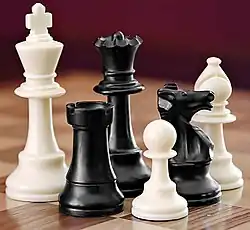
Each player begins the game with 16 pieces: one king, one queen, two rooks, two knights, two bishops, and eight pawns. Each of the six piece types moves differently. Pieces are used to attack and capture the opponent's pieces, with the objective to 'checkmate' the opponent's king by placing it under an inescapable threat of capture. In addition to checkmate, the game can be won by the voluntary resignation of the opponent, which typically occurs when too much material is lost, or if checkmate appears unavoidable. A game may also result in a draw in several ways, where neither player wins. The course of the game is divided into three phases: opening, middlegame, and endgame.
The first official World Chess Champion, Wilhelm Steinitz, claimed his title in 1886. In addition to the World Championship, there are the Women's World Championship, the Junior World Championship, the World Senior Championship, the Correspondence Chess World Championship, the World Computer Chess Championship, and Blitz and Rapid World Championships. The Chess Olympiad is a popular competition among teams from different nations. Online chess has opened amateur and professional competition to a wide and varied group of players. Chess is a recognized sport of the International Olympic Committee and international chess competition is sanctioned by the World Chess Federation (FIDE), which adopted the now-standard Staunton chess set in 1924 for use in all official games. There are also many chess variants, with different rules, different pieces, and different boards.
Selected article 2
Portal:Games/Selected article/2

The Turk was in fact a mechanical illusion that allowed a human chess master hiding inside to operate the machine. With a skilled operator, the Turk won most of the games played during its demonstrations around Europe and the Americas for nearly 84 years, playing and defeating many challengers including statesmen such as Napoleon Bonaparte and Benjamin Franklin. Although many had suspected the hidden human operator, the hoax was revealed only in the 1820s by the Londoner Robert Willis.[2] The operator(s) within the mechanism during Kempelen's original tour remains a mystery. When the device was later purchased in 1804 and exhibited by Johann Nepomuk Mälzel, the chess masters who secretly operated it included Johann Allgaier, Boncourt, Aaron Alexandre, William Lewis, Jacques Mouret, and William Schlumberger.
Owing to the Turk's popularity and mystery, its construction inspired a number of inventions and imitations, including Ajeeb, or "The Egyptian", an American imitation built by Charles Hopper that President Grover Cleveland played in 1885, and Mephisto, the self-described "most famous" machine, of which little is known.
Selected article 3
Portal:Games/Selected article/3
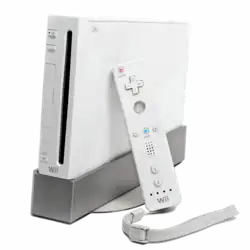
The Wii has many advanced features compared to previous Nintendo consoles. For example, the primary wireless controller (the Wii Remote) can be used as a handheld pointing device and detects movement in three dimensions. Another notable feature of the console is WiiConnect24, which enables it to receive messages and updates over the Internet while in standby mode. Furthermore, it is the first console to offer the Virtual Console service, with which select emulated games from past systems can be downloaded.
It succeeds the Nintendo GameCube, with early models being fully backward-compatible with all GameCube games and most accessories. Nintendo first spoke of the console at the 2004 E3 press conference and later unveiled it at the 2005 E3. Nintendo CEO Satoru Iwata revealed a prototype of the controller at the September 2005 Tokyo Game Show. By December 8, 2006, it had completed its launch in the four key markets.
In late 2011 Nintendo released a reconfigured model, the "Wii Family Edition", which removed Nintendo GameCube compatibility; this model was not released in Japan. Its successor, the Wii U, was released during the fourth quarter of 2012. The Wii Mini, Nintendo's first major console redesign since the compact SNES, succeeded the standard Wii model on December 7, 2012 in Canada.
Selected article 4
Portal:Games/Selected article/4
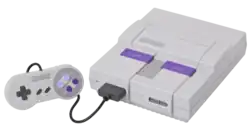
The Super Nintendo Entertainment System is Nintendo's second home console, following the Nintendo Entertainment System (NES). The console introduced advanced graphics and sound capabilities compared with other consoles at the time. Additionally, development of a variety of enhancement chips (which were integrated on game circuit boards) helped to keep it competitive in the marketplace.
The Super NES and Super Famicom launched with only a few games, but these games were well received in the marketplace. In Japan, only two games were initially available: Super Mario World and F-Zero. In North America, Super Mario World shipped with the console, and other initial titles included F-Zero, Pilotwings (both of which demonstrated the console's "Mode 7" pseudo-3D rendering capability), SimCity, and Gradius III.
The SNES was a global success, becoming the best-selling console of the 16-bit era despite its relatively late start and the fierce competition it faced in North America and Europe from Sega's Genesis console. 49.10 million Super NES units were sold worldwide, with 23.35 million of those units sold in the Americas and 17.17 million in Japan. The SNES remained popular well into the 32-bit era, and continues to be popular among fans, collectors, retro gamers, and emulation enthusiasts, some of whom are still making homebrew ROM images.
Selected article 5
Portal:Games/Selected article/5

By the 1970s, the idea that the game had been created solely by Charles Darrow had become popular folklore; it was printed in the game's instructions for many years, in a 1974 book devoted to Monopoly, and was cited in a general book about toys even as recently as 2007. Even a guide to family games published for Reader's Digest in 2003 only gave credit to Darrow and Elizabeth Magie, erroneously stating that Magie's original game was created in the 1800s, and not acknowledging any of the game's development between Magie's creation of the game, and the eventual publication by Parker Brothers.
In the 1970s, Professor Ralph Anspach, who had himself published a board game intended to illustrate the principles of both monopolies and trust busting, fought Parker Brothers and its then parent company, General Mills, over the copyright and trademarks of the Monopoly board game. Through the research of Anspach and others, much of the early history of the game was "rediscovered" and entered into official United States court records. The game's name remains a registered trademark of Parker Brothers, as do its specific design elements.