Portal:Environment/Selected biography
 | This Wikipedia page has been superseded by Portal:Environment and is retained primarily for historical reference. |
 | Note: Article entries are now being transcluded directly on the main portal page. However, this page should be retained for historical reference. |
Usage
The layout design for these subpages is at Portal:Environment/Selected biography/Layout.
- Add a new Selected biography to the next available subpage.
- Update "max=" to new total for its {{Random portal component}} on the main page.
Selected biographies list
Selected biography/1 view - talk - edit - history
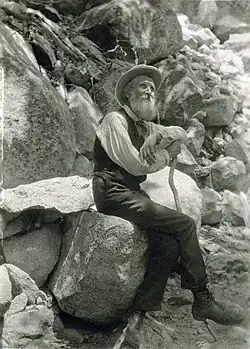
Selected biography/2 view - talk - edit - history

Selected biography/3 view - talk - edit - history

Selected biography/4 view - talk - edit - history
Selected biography/5 view - talk - edit - history

Selected biography/6 view - talk - edit - history

Selected biography/7 view - talk - edit - history

In the 1970s, Porritt was the driving force behind the Ecology Party. As chairman of the UK Ecology Party (now the Green Party) from 1978 to 1984, he presided over changes that made the party much more prominent in elections. Under his stewardship, membership grew from a few hundred to around 3,000. In 1984 his first book, Seeing Green, was published. In this year he also gave up teaching to become Director of Friends of the Earth in Britain, a post he held until 1990.
Selected biography/8 view - talk - edit - history Francisco Alves Mendes Filho (December 15, 1944 – December 22, 1988), also known as Chico Mendes, was a Brazilian rubber tapper, unionist and environmental activist. He fought to stop the logging of the Amazon Rainforest to clear land for cattle ranching, and founded a national union of rubber tappers in an attempt to preserve their profession and the rainforest that it relied upon. He was murdered in 1988 by ranchers opposed to his activism.
| “ | At first I thought I was fighting to save rubber trees, then I thought I was fighting to save the Amazon rainforest. Now I realise I am fighting for humanity. | ” |
On 22 December 1988, Mendes was assassinated by gunshot at his Xapuri home. In December, 1990 rancher Darcy Alves Pereira and his son Darli Alves were sentenced to 19 years in prison for their part in Mendes' assassination.
Selected biography/9 view - talk - edit - history
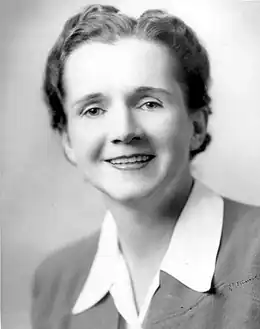
Selected biography/10 view - talk - edit - history

She was most associated with battles to save the Florida Everglades from draining and over development, during which times she organized benefits and various marches. Her book The Everglades: River of Grass, written in 1947, has gone through numerous editions. It galvanized people to protect the Everglades. At the age of 78, she founded Friends of the Everglades, an organization which is still at the forefront of Florida conservation.
Selected biography/11 view - talk - edit - history

She is most famous for chairing the World Commission on Environment and Development (WCED), widely referred to as the Brundtland Commission, developing the broad political concept of sustainable development in the course of extensive public hearings that were distinguished by their inclusiveness and published its report Our Common Future in April 1987. The Brundtland Commission provided the momentum for the 1992 Earth Summit/UNCED, that was headed by Maurice Strong, who had been a prominent member of the Brundtland Commission. The Brundtland Commission also provided momentum for Agenda 21.
Selected biography/12 view - talk - edit - history

Selected biography/13 view - talk - edit - history

Selected biography/14 view - talk - edit - history

Næss had been a minor political candidate for the Norwegian Green Party and in 1939 he was the youngest person to be appointed full professor at the University of Oslo and the only professor of philosophy in the country at the time. In 1996, he won the Swedish Academy Nordic Prize, known as the 'little Nobel'. In 2005 he was decorated as a Commander with Star of the Royal Norwegian Order of St. Olav for socially useful work.
Selected biography/15 view - talk - edit - history

Selected biography/16 view - talk - edit - history Donella "Dana" Meadows (March 13, 1941 Elgin, Illinois, USA - February 20, 2001, New Hampshire) was a pioneering American environmental scientist, teacher and writer. She is known as lead author of Limits to Growth, a 1972 book modelling the consequences of a rapidly growing world population and finite resource supplies.
Selected biography/17 view - talk - edit - history

Throughout his life, Fuller was concerned with the question "Does humanity have a chance to survive lastingly and successfully on planet Earth, and if so, how?" Considering himself an average individual without special monetary means or academic degree, he chose to devote his life to this question, trying to find out what an individual like him could do to improve humanity's condition that large organizations, governments, or private enterprises inherently could not do.
Fuller published more than 30 books, inventing and popularizing terms such as "Spaceship Earth", ephemeralization, and synergetic. He also developed numerous inventions, mainly architectural designs, the best known of which is the geodesic dome. Carbon molecules known as fullerenes were later named by scientists for their resemblance to geodesic spheres.
Selected biography/18 view - talk - edit - history

Lovins has worked professionally as an environmentalist and an advocate for a "soft energy path" for the United States and other nations. He has promoted energy-use and energy-production concepts based on conservation, efficiency, the use of renewable sources of energy, and on generation of energy at or near the site where the energy is actually used.
Lovins has provided expert testimony in eight countries and more than 20 US states, briefed 19 heads of state, and published 29 books (including Winning the Oil Endgame, Factor Four with Hunter Lovins and Ernst Ulrich von Weizsäcker, and Natural Capitalism with Hunter Lovins and Paul Hawken).
Selected biography/19 view - talk - edit - history

Brown is the author or co-author of over 50 books on global environmental issues and his works have been translated into more than forty languages. His most recent book is World on the Edge: How to Prevent Environmental and Economic Collapse (2011). Brown emphasizes the geopolitical effects of fast-rising grain prices noting that "the biggest threat to global stability is the potential for food crises in poor countries," and one that could "bring down civilization".
The recipient of 26 honorary degrees and a MacArthur Fellowship, Brown has been described by the Washington Post as "one of the world's most influential thinkers". As early as 1978, in his book The Twenty-Ninth Day, he was already warning of "the various dangers arising out of our manhandling of nature... by overfishing the oceans, stripping the forests, turning land into desert." In 1986, the Library of Congress requested his personal papers noting that his writings "have already strongly affected thinking about problems of world population and resources," while president Bill Clinton has suggested that "we should all heed his advice."
Selected biography/20 view - talk - edit - history James B. Harkin, also known as the Father of National Parks, was a Canadian-born journalist turned bureaucrat with a passion for conservation but also widely renowned for his commodification of the Canadian landscape. Harkin was able to acquire an appointment to be the first commissioner of the Dominion Parks Branch in 1911. During his career, Harkin oversaw the establishment of national parks that include Elk Island, Mount Revelstoke, Point Pelee, Kootenay, Wood Buffalo, Prince Albert, Riding Mountain, Georgian Bay Islands and Cape Breton Highlands. The creation of the Wood Buffalo National Park sparked huge debate with local indigenous groups and the rippling effects of that debate are still being dealt with today.
Selected biography/21 view - talk - edit - history

In 1973, she co-founded the Workshop in Political Theory and Policy Analysis at Indiana University. Examining the use of collective action, trust, and cooperation in the management of common pool resources, her approach to public policy, known as the institutional analysis and development (IAD) framework, has been considered sufficiently distinct to be thought of as a separate school of public choice theory.
Her most famous research focuses on how humans interact with ecosystems to maintain long-term sustainable resource yields. She conducted her field studies on the management of pasture by locals in Africa and irrigation systems management in villages of western Nepal. Her work has considered how societies have developed diverse institutional arrangements for managing natural resources and avoiding ecosystem collapse in many cases, even though some arrangements have failed to prevent resource exhaustion. Her work emphasized the multifaceted nature of human–ecosystem interaction and argues against any singular "panacea" for individual social-ecological system problems.
Selected biography/22 view - talk - edit - history

Nominations
Feel free to add top or high importance Environment-related biographies to the above list. Other Environment-related biographies may be nominated here.
- I would like to nominate Amory Lovins please... Johnfos (talk) 21:13, 19 November 2007 (UTC)
 Done Suggestion taken. OhanaUnitedTalk page 06:25, 20 December 2008 (UTC)