Cricket is a bat-and-ball game that is played between two teams of eleven players on a field, at the centre of which is a 22-yard (20-metre; 66-foot) pitch with a wicket at each end, each comprising two bails (small sticks) balanced on three stumps. Two players from the batting team, the striker and nonstriker, stand in front of either wicket holding bats, while one player from the fielding team, the bowler, bowls the ball toward the striker's wicket from the opposite end of the pitch. The striker's goal is to hit the bowled ball with the bat and then switch places with the nonstriker, with the batting team scoring one run for each of these swaps. Runs are also scored when the ball reaches the boundary of the field or when the ball is bowled illegally.
Both teams were unbeaten in the first group stage. In the second round, known as the Super Sixes, New Zealand and England finished first and second to qualify directly for the final; New Zealand had only lost to England, while England had already guaranteed their place in the final when they lost their last match to Australia, who were the defending champions. England were considered the favourites for the final. The New Zealand captain, Haidee Tiffen, won the toss, and opted to bat first. Her side were bowled out for 166 runs. The all-rounderLucy Doolan, batting at number nine, was the highest scorer for New Zealand with 48. Nicky Shaw, one of England's bowlers, took a career-best four wickets for 34 runs. In their response, England built an opening partnership of 74 runs and continued to score steadily. Despite regularly losing wickets, they reached the winning total with 23 balls to spare, earning England their first World Cup title for 16 years. Shaw, who had initially not been in the England starting lineup, was named player of the match, having replaced the injured Jenny Gunn minutes before the game started.
James Faulkner is one of the only four bowlers to take multiple five-wicket hauls and the only to take multiple five-wicket hauls in the same season.
In cricket, a five-wicket haul (also known as a "five-for" or "fifer") refers to a bowler taking five or more wickets in a single innings. This is regarded as a notable achievement, especially in T20 cricket where a bowler can bowl a maximum of only 24 balls (4 overs). The Indian Premier League (IPL) is a professional Twenty20 cricket league in India, which has been held annually since its first season in 2008. So far, 38 five-wicket hauls have been taken by different bowlers, of which only two five-wicket hauls have been taken outside India. Players from twelve of the thirteen teams have taken five-wicket hauls; Kochi Tuskers Kerala is the only franchise for which a player has not taken a five-wicket haul. The first five-wicket haul was taken by Sohail Tanvir of the Rajasthan Royals against the Chennai Super Kings on 4 May 2008. He finished the game with 6 wickets. The most economical five-wicket haul was taken by Akash Madhwal of the Mumbai Indians, who claimed five wickets with an economy rate of 1.43 in the 2023 season. Yuzvendra Chahal of the Rajasthan Royals took the least economical five-wicket haul, 5/40 bowling with an economy rate of 10.00 in 2021. Anil Kumble is the oldest bowler to take a five-wicket haul, achieving the feat at the age of 38, while Jaydev Unadkat is the youngest, he was 21 when he took his first five-for in 2013. (Full article...)
Image 2
The Trans-Tasman Trophy is awarded to the winner of the Australia–New ZealandTest match series in cricket. The trophy is awarded to the team that wins a Test series, or one-off Test match, between the two nations. If the series is a draw, the holder retains the trophy. It was first competed for in the 1985–86 season, although six Test series between the nations were contested before the trophy's instigation. As of March2024, Australia hold the trophy following their 2–0 series win in the 2023–24 series in New Zealand. Australia also lead in overall wins, winning 12 of the 19 series, while New Zealand (nicknamed the Black Caps) have won 3, the remaining 4 ending in draws. Australia's Allan Border is the most successful batsman in the history of the trophy, scoring 1,356 runs in 25 innings at an average of 61.63. New Zealand's Ross Taylor holds the record for the highest score in the trophy's history, with 290 in the second innings of the second Test of the 2015–16 series in Australia. Taylor's score surpassed the previous record set in the same Test; Australian David Warner struck 253 in the first innings. Australian spin bowlerShane Warne has taken the most wickets in the trophy, with 103 in 20 matches at an average of 24.37, while New Zealand's Richard Hadlee has the best bowling figures with 9 wickets for 52 runs which he took in the first innings of the inaugural Test. Former Australian captainMark Taylor has taken the most catches, with 25 in 11 matches, while fellow countryman Ian Healy is the most successful wicket-keeper, making 42 dismissals in 11 matches. (Full article...)
Image 3
Shaun Pollock, top run scorer in the history of the Afro-Asia Cup A One Day International, or an ODI, is an international cricket match between two representative teams, each having ODI status, as determined by the International Cricket Council. An ODI differs from Test matches in that the number of overs per team is limited, and that each team has only one innings.
Designed as a fund-raiser for the African Cricket Association and the Asian Cricket Council, the Afro-Asia Cup debuted in 2005 and a second series was played in 2007. The list is arranged in the order in which each player won his first ODI cap for the African XI. Where more than one player won his first ODI cap in the same match, those players are listed alphabetically by surname. All the players have represented their respective member teams of the ICC at either Test or ODI level, but only the records of their games for the ACA African XI are listed. (Full article...)
In cricket, a five-wicket haul (also known as a "five–for" or "fifer") refers to a bowler taking five or more wickets in a single innings. This is regarded as a notable achievement, as of October2024 only 54 bowlers have taken 15 or more five-wicket hauls at an international level in their cricketing careers. Anil Kumble is a former Test and One Day International (ODI) cricketer who represented India. He is a right-arm leg spin (legbreakgoogly) bowler. Kumble has taken 619 wickets in Test cricket and 337 wickets in ODI cricket. With 37 five-wicket hauls, Kumble has the highest number of Test and combined international five-wicket hauls among Indian cricketers and fourth highest among all players, after Muttiah Muralitharan, Richard Hadlee, and Shane Warne.
Kumble made his ODI debut against Sri Lanka and his Test debut against England, both in 1990. His first five-wicket haul was against South Africa at Johannesburg (November 1992) in the second Test of India's tour. He has claimed the most of his five-wicket hauls against Australia, ten of them, all in Test matches. His best performance was against Pakistan at the Feroz Shah Kotla in 1999; Kumble took all ten wickets during the second innings, just the second person to do so, after Jim Laker, and in the process ensured India of their first Test victory against Pakistan in twenty years. The feat also ranks as the second-best bowling figure in Test history. Twenty of Kumble's Test cricket five-wicket hauls have come in victory for India, while five have been in defeats. Kumble has also taken two five-wicket hauls in ODIs. His first ODI five-wicket haul was against the West Indies during the final of the 1993 Hero Cup at Eden Gardens, Calcutta when he took six wickets for twelve runs, a record for India in One Day Internationals. The performance ensured India's victory and Kumble was adjudged man of the match. His other ODI five-wicket haul was against New Zealand at the Basin Reserve in 1994. (Full article...)
Image 5
The Pakistan national cricket team against New Zealand during the 2009 ICC World Twenty20 at The Oval. The Pakistan national cricket team represents Pakistan in international cricket and is a full member of the International Cricket Council (ICC) with Test and One Day International (ODI) status. Pakistan first competed in international cricket in 1952, when they played against India in a four-day Test match; India won the match by an innings and 70 runs at the Feroz Shah Kotla Ground, Delhi. In the same series, Pakistan recorded their first Test win, the second match by an innings and 43 runs at the University Ground, Lucknow. As of August 2026, Pakistan have played 472 Test matches; they have won 153 matches, lost 153 matches, and 166 matches have ended in a draw. They have also won the 1998–99 Asian Test Championship, defeating Sri Lanka in the final by an innings and 175 runs. Pakistan played their first ODI match against New Zealand in February 1973 at the Lancaster Park, Christchurch, but registered their first win against England at Trent Bridge, Nottingham, in August 1974. As of June 2026, Pakistan have played 1003 ODI matches, winning 529 matches and losing 443; they also tied 9 matches, whilst 22 had no result. They also won the 1992 Cricket World Cup, the 2000 and 2012 Asia Cups, and the 2017 ICC Champions Trophy. Pakistan played their first Twenty20 International (T20I) match at the County Cricket Ground, Bristol, on 28 August 2006, against England, winning the match by five wickets. In 2009, they won the 2009 ICC World Twenty20, defeating Sri Lanka by eight wickets. As of February 2026, Pakistan have played 299 T20I matches and won 172 of them; 114 were lost and 4 were tied whilst 9 ended in no result. As of August 2026, Pakistan have faced ten teams in Test cricket, with their most frequent opponent being England, playing 93 matches against them. Pakistan have registered more wins against New Zealand than any other team, with 25. In ODI matches, Pakistan have played against 19 teams; they have played against Sri Lanka most frequently, with a winning percentage of 60 in 160 matches. Pakistan have defeated Sri Lanka on 96 occasions, which is their best record in ODIs. The team have competed against 20 different teams (including World XI) in T20Is, and have played 50 matches against New Zealand and 31 against Sri Lanka. Pakistan have defeated New Zealand on 24 occasions and Sri Lanka on 18 occasions in T20Is. They have lost to New Zealand 23 times in this format of the game. (Full article...)
Image 6
Botham batting for England at Trent Bridge in 1983 Sir Ian Botham is a former international cricketer and captain of the England cricket team. He has claimed five-wicket hauls (taken five or more wickets in an innings) in Test cricket on 27 occasions, second only to James Anderson among English cricketers. A five-wicket haul is regarded as a notable achievement, and as of October2024, only 54 bowlers have taken 15 or more five-wicket hauls at international level in their cricketing careers. Botham is generally considered one of the greatest all-rounders of all time. He was named as a Wisden Cricketer of the Year in 1978, and Indian Cricket Cricketer of the Year four years later. In 1992 he was awarded an Order of the British Empire (OBE), and he was knighted for his services to cricket and charity work in 2007. Two years later, he was honoured by the International Cricket Council, who named him as one of 55 initial inductees into the ICC Cricket Hall of Fame. He is ninth overall in all-time Test five-wicket haul takers.
He made his international debut for England on 26 August 1976 in a One Day International (ODI) against the West Indies. He made his Test cricket debut just under a year later against Australia, and it was during the first innings of this match that he claimed his first international five-wicket haul. It is against Australia that he has claimed the most five-wicket hauls, doing so on nine occasions. Three of these came during the 1981 Ashes series and, along with the two centuries he scored, saw the series dubbed "Botham's Ashes". He twice claimed eight wickets in an innings, playing at Lord's on each occasion, against Pakistan in 1978 and the West Indies in 1984. Including these performances, Botham has collected a five-wicket haul at Lord's eight times, more so than on any other ground. (Full article...)
The 16 competing teams were initially divided into four groups, with the two best-performing teams from each group moving on to a Super 8 format. Every team played a total of 6 matches in the Super 8 round; they didn't play with teams of their own group. They played a total of 6 teams from another three groups (the top 2 teams of all three groups). From this, Australia, New Zealand, Sri Lanka, and South Africa won through to the semi-finals, with Australia defeating Sri Lanka in the final to win their third consecutive World Cup and their fourth overall. Australia's unbeaten record in the tournament increased their total to 29 consecutive World Cup matches without a loss, a streak dating back to 23 May 1999, during the group stage of the 1999 World Cup. The tournament also saw upsets and surprise results, with pre-tournament favourites India and Pakistan failing to make it past the group stage, while Bangladesh, the second-lowest ranked ICC Full Member at the time, and World Cup debutant Ireland, which was an ICC Associate Member at the time, made it to the "Super 8", beating India and Pakistan respectively en route. Ireland became only the second associate nation to make it past the first round of a Cricket World Cup, the first being Kenya in 2003. (Full article...)
Image 8
Don Bradman (pictured), widely acknowledged as the greatest batsman of all time, still holds several records. Test cricket is the oldest form of cricket played at international level. A Test match is scheduled to take place over a period of five days, and is played by teams representing full member nations of the International Cricket Council (ICC). Australia was a founding member of the ICC having played the first Test match against England in March 1877 at the Melbourne Cricket Ground. They have played a total of 884 matches, second only to England who have played just over 1,000. As of August2026, Australia is the most successful team in Test cricket with an overall winning percentage of 48.41, ahead of their nearest rival South Africa on 39.87.
Top order batsman and former captainDon Bradman holds several batting records. Considered to be the greatest batsman of all time, he played 52 Tests between 1928 and 1948. He holds the record for the highest Test average of 99.94, has scored the most Test double centuries with 12, the equal most Test triple centuries with 2 and the most runs scored in a series with 974 during the 1930 Ashes series. He also holds the highest fifth-wicket partnership with Sid Barnes with 405 runs, set during the 1946–47 Ashes series, the oldest of the wicket partnerships records. A further two Australian partnership records for the second and the sixth wickets set by Bradman still stand. (Full article...)
Grace Road in the city of Leicester has staged well over half the county's first-class games and almost every game in List A and Twenty20 cricket. Leicestershire County Cricket Club is one of the 18 member clubs of the English County Championship, representing the historic county of Leicestershire. The club was established on 25 March 1879. It has since played first-class cricket from 1894, List A cricket from 1963 and Twenty20 cricket from 2003.[A] Unlike most professional sports, in which a team usually has a single fixed home ground, county cricket clubs have traditionally used different grounds in various towns and cities within the county for home matches, although the use of minor "out grounds" has diminished since the 1980s. Leicestershire's first XI have played home matches at fifteen different grounds.
The club's debut home match in first-class cricket was played at Grace Road in Leicester. After the 1900 season, the club ceased using Grace Road, as it was felt that it was located too far from the centre of the city. Instead, Aylestone Road became the club's headquarters, and staged nearly 400 first-class matches between 1901 and the outbreak of the Second World War. Due to a combination of wartime damage and industrial development, however, the club was forced to discontinue using Aylestone Road after the war, and Grace Road once again became the club's main venue. In the years after the war, the county also utilised grounds in other towns including Hinckley, Melton Mowbray, Barwell and Loughborough. (Full article...)
Image 11
Saqlain Mushtaq, a former Pakistanicricketer, took 19 five-wicket hauls during his career in international cricket. A five-wicket haul (also known as a "five–for" or "fifer") refers to a bowler taking five or more wickets in a single innings. This is regarded by cricket critics as a notable achievement, and as of October2024, only 54 bowlers have taken 15 or more five-wicket hauls at international level in their cricketing careers. A right-arm off break bowler who represented his country between 1995 and 2004, Saqlain was described by the BBC as "a revolution in the art of attacking off-spin bowling". Saqlain was named by Wisden as one of their Cricketers of the Year in 2000.
South Africa women at Taunton, 2009 ICC Women's World Twenty20 A women's Test match is an international four-innings cricket match held over a maximum of four days between two of the leading cricketing nations. Women's cricket was played in South Africa fairly regularly throughout the beginning of the 20th century, but died out during the Second World War. It was revived in 1949 by a group of enthusiasts, and in 1951 Netta Rheinberg, on behalf of the Women's Cricket Association, suggested that a South Africa Women's Cricket Association be formed, and encouraged the possibility that a series of matches could be played between the two associations. The South Africa & Rhodesian Women's Cricket Association (SA&RWCA) was officially formed in 1952. At their annual general meeting in January 1955, the SA&RWCA accepted an invitation from the Women's Cricket Association to join an International Women's Cricket Council that, in addition to South Africa, included England, Australia and New Zealand. They also agreed that international matches would be played between the four nations. In 1959, arrangements were made for the first international women's cricket tour of South Africa, as they would play host to the English team in 1960.
The first Test involving South Africa women was held at St George's Park, Port Elizabeth, the same venue as the one for first men's Test match in the country in 1889, and ended in a draw. South Africa then played a subsequent series against New Zealand in 1971–72. As part of the international campaign against apartheid, the Commonwealth of Nations signed the Gleneagles Agreement in 1977, excluding South Africa from competing in international sporting events. Because of this exclusion, they did not play another Test until hosting India in 2001–02, before facing England again in 2003, the Netherlands in 2007, India in 2014 and most recently England in 2022. (Full article...)
Image 13
The County Ground, Hove, which was first used in 1872, and has hosted the majority of Sussex's matches.
Sussex County Cricket Club is one of the 18 member clubs of the English County Championship, representing the historic county of Sussex. Although Sussex representative sides had been playing cricket since the mid-eighteenth century and had also played first-class cricket matches since 1815, the County Cricket Club was established on 1 March 1839. They have played first-class matches since 1839, List A matches since 1963, and Twenty20 matches since 2003.
Unlike most professional sports, in which a team usually has a single fixed home ground, county cricket clubs have traditionally used different grounds in various towns and cities within the county for home matches, although the use of minor "out grounds" away from the club's main headquarters has diminished since the 1980s. In total, Sussex have played first-class, List A and Twenty20 cricket at 17 different grounds across the county. (Full article...)
A triple century (an individual score of 300 runs or more) in Test cricket has been scored on 33 occasions by 29 batsmen from eight of the twelve Test-cricket playing nations. No player from Afghanistan, Bangladesh, Ireland or Zimbabwe has scored 300. A batsman scoring a Test triple century is slightly rarer than a bowler taking a Test hat-trick (33 triple centuries versus 46 hat-tricks as of October 2024).
Image 2A Game of Cricket at The Royal Academy Club in Marylebone Fields, now Regent's Park, depiction by unknown artist, c. 1790–1799 (from History of cricket)
Image 3 First Grand Match of Cricket Played by Members of the Royal Amateur Society on Hampton Court Green, August 3rd, 1836 (from History of cricket)
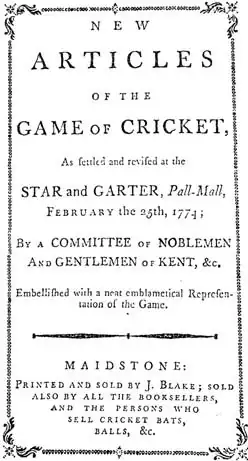
Image 4New articles of the game of cricket, 25 February 1774 (from Laws of Cricket)
Image 5The boundary can be marked in several ways, such as with a rope. (from Laws of Cricket)
Image 6Photograph of Miss Lily Poulett-Harris, founding mother of women's cricket in Australia. (from History of women's cricket)
Image 7A 1793 American depiction of "wicket" being played in front of Dartmouth College. Wicket likely came to North America in the late 17th century. (from History of cricket)
Image 8A wicket can be put down by throwing the ball at it and thereby dislodging the bails. (from Laws of Cricket)
Image 9A wicket consists of three stumps, upright wooden poles that are hammered into the ground, topped with two wooden crosspieces, known as the bails. (from Laws of Cricket)
Image 10In men's cricket the ball must weigh between 5.5 and 5.75 ounces (155.9 and 163 g) and measure between 8.81 and 9 in (22.4 and 22.9cm) in circumference. (from Laws of Cricket)
Image 15Plaquita, a Dominican street version of cricket. The Dominican Republic was first introduced to cricket through mid-18th century British contact, but switched to baseball after the 1916 American occupation. (from History of cricket)
Image 16Afghan soldiers playing cricket. Afghan refugees in Pakistan brought the sport back to Afghanistan, and it is now one of the most popular sports in the country. (from History of cricket)
Did you know
... that Michael Kettle received an award at the age of 80 for his work as a cricket groundskeeper?
... that Arthur Newnham was born in India, played first-class cricket in England, and served as a military attaché in Moscow?
... that the Kīlauea lava cricket disappears from a lava field as soon as any plants start to grow there?
The International Cricket Council (ICC) is the international governing body of cricket, and produces team rankings for the various forms of cricket played internationally.