Portal:Business/Selected economy/36
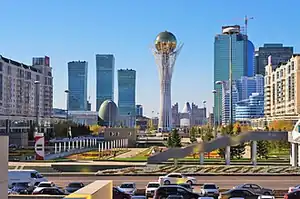
Kazakhstan has a developing economy that is considered upper-middle income. It is the largest in Central Asia in both absolute and per capita terms. As of 2023, the nation has attracted more than US$370 billion of foreign investments since becoming an independent republic after the dissolution of the former Soviet Union. It possesses oil reserves as well as minerals and metals. Almost every known element on the periodic table can be found in Kazakhstan. It also has considerable agricultural potential, with its vast steppe lands accommodating both livestock and grain production. The mountains in the south are important for apples and walnuts; both species grow wild there. Kazakhstan's industrial sector rests on the extraction and processing of these natural resources.
The dissolution of the Soviet Union and the collapse of demand for Kazakhstan's traditional heavy industry products have resulted in a sharp decline of the economy since 1991, with the steepest annual decline occurring in 1994. In 1995–97 the pace of the government program of economic reform and privatization quickened, resulting in a substantial shifting of assets into the private sector. Kazakhstan was granted "market economy country" status by the European Union and the United States, in 2000 and 2002 respectively. (Full article...)