Portal:Aviation

| Main page | Categories & Main topics |
|
Tasks and Projects |
The Aviation Portal

Aviation includes the activities surrounding mechanical flight and the aircraft industry. Aircraft include fixed-wing and rotary-wing types, morphable wings, wing-less lifting bodies, as well as lighter-than-air aircraft such as hot air balloons and airships.
Aviation began in the 18th century with the development of the hot air balloon, an apparatus capable of atmospheric displacement through buoyancy. Clément Ader built the "Ader Éole" in France and made an uncontrolled, powered hop in 1890. This was the first powered aircraft, although it did not achieve controlled flight. Some of the most significant advancements in aviation technology came with the controlled gliding flying of Otto Lilienthal in 1896. A major leap followed with the construction of the Wright Flyer, the first powered airplane by the Wright brothers in the early 1900s.
Since that time, aviation has been technologically revolutionized by the introduction of the jet engine which enabled aviation to become a major form of transport throughout the world. In 2024, there were 9.5 billion passengers worldwide according to the ICAO. As of 2018, estimates suggest that 11% of the world's population traveled by air, with up to 4% taking international flights. (Full article...)
Selected article

Selected image
Did you know
...that in 1943 British Overseas Airways Corporation Flight 777 was shot down by German Junkers Ju 88s, killing actor Leslie Howard and leading to speculation that it was an attempt to assassinate Winston Churchill? ...that during World War II, Marine Fighting Squadron 215 established four new U.S. Marine Corps records in the South Pacific including having the most ace pilots? ...that François Denhaut built the world's first flying boat, or seaplane with a hull?
General images -
 Map of record breaking flights of the 1920s (from History of aviation)
 The 14-bis, or Oiseau de proie (from History of aviation)


 The Aeroplane of Victor Tatin, 1879. (from History of aviation)
 Jean-Marie Le Bris and his flying machine, Albatros II, 1868 (from History of aviation)

 D.H. Comet, the world's first jet airliner. As in this picture, it also saw RAF service (from History of aviation)
 A Boeing 777X. It is under testing and will be the largest twinjet, with the widest and longest fuselage to enter production. (from Wide-body aircraft)
 "Governable parachute" design of 1852 (from History of aviation)
 Early Voisin biplane (from History of aviation)
 Nieuport IV, operated by most of the world's air forces before WW1 for reconnaissance and bombing, including during the Italian-Turkish war (from History of aviation)
 French reconnaissance balloon L'Intrépide of 1796, the oldest existing flying device, in the Heeresgeschichtliches Museum, Vienna (from History of aviation)
 La France flying in 1885 (from History of aviation)
 First failure of Langley's manned Aerodrome on the Potomac River, 7 October 1903 (from History of aviation)
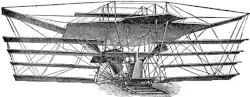 Maxim's flying machine (from History of aviation)
 Me 262, world first operational jet fighter (from History of aviation)
 Experimental helicopter by Enrico Forlanini (1877), exposed at the Museo nazionale della scienza e della tecnologia Leonardo da Vinci of Milan, Italy (from History of aviation)
 Apollo 11 lifts off on its mission to land a man on the Moon (from History of aviation)

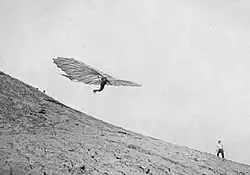 Otto Lilienthal, 29 May 1895 (from History of aviation)
 Qantas De Havilland biplane, c. 1930 (from History of aviation)
 One of Leonardo's sketches (from History of aviation)
 Clément Ader Avion III (1897 photograph) (from History of aviation)

 Alberto Santos-Dumont flying the Demoiselle over Paris (from History of aviation)
 An Airbus A321 of Vietravel Airlines parking next to a Vietnam Airlines Airbus A350-900 and a Cargolux Boeing 747-400 widebodies, highlighting their size differences. (from Wide-body aircraft)
 "Map of Air Routes and Landing Places in Great Britain, as temporarily arranged by the Air Ministry for civilian flying", published in 1919, showing Hounslow, near London, as the hub (from History of aviation)

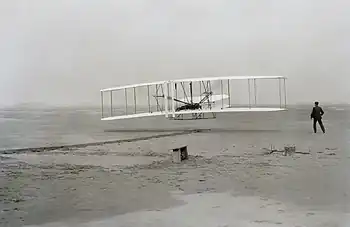 The Wright Flyer: the first sustained flight with a powered, controlled aircraft (from History of aviation)
 Concorde, G-BOAB, in storage at London Heathrow Airport following the end of all Concorde flying. This aircraft flew for 22,296 hours between its first flight in 1976 and final flight in 2000 (from History of aviation)


 Woodcut print of a kite from John Bate's 1635 book The Mysteryes of Nature and Art (from History of aviation)

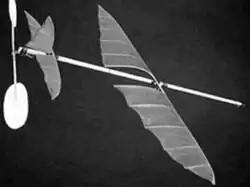 Planophore model aeroplane by Alphonse Pénaud, 1871 (from History of aviation)
 The Wright Military Flyer aboard a wagon in 1908 (from History of aviation)
 1843 artist's impression of John Stringfellow's plane Ariel flying over the Nile (from History of aviation)
 The Biot-Massia glider, restored and on display in the Musee de l'Air (from History of aviation)

 Often published as a photo of Santos-Dumont during the prize-winning flight, this is actually an earlier attempt using his "Number 5" (from History of aviation)


 1928 issue of Popular Aviation (now Flying magazine), which became the largest aviation magazine with a circulation of 100,000. (from History of aviation)
 Flagg biplane from 1933 (from History of aviation)
 An Airbus A380 of Qantas. The A380 is the world's largest passenger airliner. (from Wide-body aircraft)
Aviation news
- 30 August 2026 – 2026 state visit by Xi Jinping to Kyrgyzstan and Egypt
- Chinese President Xi Jinping and his wife Peng Liyuan arrive at Manas International Airport in Kyrgyzstan for the upcoming Shanghai Cooperation Organisation (SCO) summit in Bishkek and a state visit to the country. (Xinhua) (China Daily)
- 29 August 2026 – 2026 Nigerien coup attempt
- Nigerien television confirms that dissenting elements of the Niger Armed Forces attempted a coup in the nation's capital, Niamey. Attacks are reported on Diori Hamani International Airport and the Presidential Palace. (AP) (Reuters)
- 25 August 2026 – Russia–United States relations
- U.S. Central Intelligence Agency (CIA) director John Ratcliffe visits Moscow, Russia, on an unscheduled military flight to meet with Russian intelligence officials, marking the first known visit by a U.S. CIA director to Russia since 2021. (Al Jazeera) (BBC News)
- 24 August 2026 – Sudanese civil war
- Drone strikes by the Sudanese Armed Forces hits several Rapid Support Forces Paramilitary targets in Nyala, South Darfur, Sudan, hours after a cargo aircraft landed in the area. (Sudan Tribune)
- 21 August 2026 – 2026–27 Malaysia Super League
- In association football, Johor Darul Ta'zim claims a world record for the longest unbeaten run in top-flight league play, reaching 109 matches after defeating Kuching City 3–0 in Malaysia's Super League. (AFP via RFI)
Related portals
Associated Wikimedia
The following Wikimedia Foundation sister projects provide more on this subject:
-
 Commons
Free media repository -
 Wikidata
Free knowledge base -
 Wikiquote
Collection of quotations -
 Wikisource
Free-content library -
 Wikiversity
Free learning tools -
 Wikivoyage
Free travel guide -
 Wiktionary
Dictionary and thesaurus
Selected biography

Born in Mannheim, Wick joined the Luftwaffe in 1936 and was trained as a fighter pilot. He was assigned to Jagdgeschwader 2 "Richthofen" (JG 2—2nd Fighter Wing), and saw combat in the Battles of France and Britain. Promoted to Major in October 1940, he was given the position of Geschwaderkommodore (wing commander) of JG 2—the youngest in the Luftwaffe to hold this rank and position. He was shot down in the vicinity of the Isle of Wight on 28 November 1940 and posted as missing in action, presumed dead. By then he had been credited with destroying 56 enemy aircraft in aerial combat, making him the leading German fighter pilot at the time. Flying the Messerschmitt Bf 109, he claimed all of his victories against the Western Allies.
Selected Aircraft

The Antonov An-225 Mriya (Антонов Ан-225 Мрія, NATO reporting name: Cossack) was a strategic airlift transport aircraft built by Antonov, and was the world's largest powered aircraft before its destruction in February 2022. Mriya (Мрія) means "dream" (inspiration) in Ukrainian.
With a maximum gross weight of 640,000 kg (1,400,000 lb), the An-225 was the world's heaviest aircraft. Although its wingspan is less than that of the Hughes H-4 "Spruce Goose", the latter never went beyond a single short low-altitude test flight, making the An-225 the largest aircraft in the world to take off more than once. Both the An-124 and An-225 are larger than the C-5 Galaxy, the largest aircraft in the U.S. inventory. The An-225 was also larger than the Airbus A380.
- Span: 88.40 m (291 ft 2 in)
- Length: 75.30 m n(246 ft 11 in)
- Height: 18.1 m (59.3 ft)
- Engines: 6× ZMKB Progress D-18 turbofans, 229 kN (51,600 lbf) each
- Cruising Speed: 750 km/h (400 knots, 465 mph)
- First Flight: December 21, 1988
Today in Aviation
- 2012 – Two Indian Air Force Mil Mi-17s collide during a training flight 12 km from the Jamnagar airbase, all nine on board the two helicopters died.
- 2012 – Human Rights Watch alleges that in the previous three weeks Syrian government airstrikes and artillery fire have struck at least 10 bakeries in Aleppo as people lined up to collect bread, killing dozens, with one attack on 16 August alone killing 60 and injuring 70 people.[1]
- 2009 – A Belarusian Air Force Sukhoi Su-27 Flanker was lost during Radom Airshow 2009, Poland. The plane crashed near the Małęczyn village, outside the military air base the event took place on. No civilian was injured. There was no damage reported on the ground. The crew of two did not eject and were found dead by the rescue teams.
- 2008 – 2008 Conviasa Boeing 737 crash: A Conviasa Boeing 737-291 Advanced (registered as YV-102 T) ferry flight from Maiquetia, Venezuela to Latacunga, Ecuador crashed into Illiniza Volcano. The aircraft had been stored at Caracas and was being ferried to a new owner. There were 3 crew on board, none of whom survived.
- 2007 – Boeing B-52H Stratofortress, accidentally loaded with six W80-1 nuclear-armed AGM-129 advanced cruise missiles flies from Minot Air Force Base, North Dakota, to Barksdale AFB in Louisiana, where the unguarded aircraft sits on the tarmac for 10 hours undetected. Officers responsible for the security lapse at Minot are disciplined.
- 1995 – Operation Deliberate Force is launched by NATO against Bosnian Serb forces. Two hundred sorties are flown during the first 24 hours, including the first combat missions flown by the Luftwaffe since World War II. Raids continued until September 14.
- 1994 – Lockheed and Martin Marietta announce their intention to merge. They will form Lockheed-Martin the following year.
- 1985 – First flight of the Bell D-292
- 1984 – Cameroon Airlines Flight 786, a Boeing 737, with 109 passengers and 7 crew on board, suffers an uncontained engine failure during taxi for take-off at the Douala, Cameroon airport, starting a fire; two persons die as the plane burns to the ground.
- 1984 – Launch: Space Shuttle Discovery STS-41-D at 12:41:50 UTC. Mission highlights: Multiple comsat deployments; first flight of Discovery, test of OAST-1 Solar Array.
- 1984 – UA United States Navy North American T-2C Buckeye crashes into the Chesapeake Bay shortly after take-off from NAS Patuxent River, Maryland, killing the student and seriously injuring the instructor.
- 1983 – Launch: Space shuttle Challenger STS-8 at 06:32:00 UTC. Mission highlights: Comsat deployment, first flight of an African American in space, Guion Bluford; test of robot arm on heavy payloads with Payload Flight Test Article, First night landing.
- 1982 – First flight of the Northrop F-20 Tigershark 82-0062
- 1978 – In the LOT Flight 165 hijacking, two East German citizens hijack a Tupolev Tu-134, and force it to land at Tempelhof Airport; there are no casualties to the 63 passengers on board.
- 1975 – Wien Air Alaska Flight 99, a Fairchild F-27, crashes into Seuvokuk Mountain, Alaska while on approach to Iliamna Airport, killing 10 of 32 on board.
- 1974 – Maj Wendy Clay, a doctor, qualified as a pilot six years before the pilot classification is opened to all women.
- 1969 – First flight of the Tupolev Tu-22M
- 1967 – American aircraft bomb North Vietnamese road, railroad, and canal traffic in an attempt to isolate Haiphong.
- 1967 – The Spanish Navy acquires the second aviation ship and first true aircraft carrier in its history when the United States loans the light aircraft carrier USS Cabot (CVL-28) to Spain under the Mutual Defense Assistance Program; Spain will purchase the ship outright in 1973. Renamed Dédalo (R01), she will serve in the Spanish Navy until 1989.
- 1962 – First flight of the NAMC YS-11
- 1956 – Sabre Mk.VI fighter aircraft of the No. 1 Overseas Ferry Unit, Royal Canadian Air Force, based in St. Hubert, Quebec, set a new record for the flight from Vancouver, British Columbia, to Dartmouth, Nova Scotia.
- 1955 – Vought F7U-3 Cutlass, BuNo 129592, of VF-124, misses all the wires during a landing aboard USS Hancock, operating off of Hawaii, and hits the barrier. "Although reported to have suffered only slight damage, it was struck off charge and never flew again."
- 1953 – Second prototype SNCASO SO.9000 Trident I -002 makes first and last flight, crashing and being a total write-off.
- 1952 – First flight of the Avro Vulcan
- 1952 – As a pair of Northrop F-89 Scorpions perform a flypast, Northrop F-89C-30-NO, 51-5781, disintegrates in flight during a display at the International Aviation Exposition at Detroit, Michigan, killing the Scorpion pilot, Major Donald E. Adams, the radar intercept officer, Captain Ed F. Kelly, and one spectator.
- 1950 – The 1950 Mason-Dixon Line F-84 crash was an aircraft accident of a single Republic F-84 Thunderjet during a routine weather training mission of two jets. After passing southbound near Gettysburg, Pennsylvania, the F-84 C exploded in mid-air at tree height, left a large crater in a field, and scattered wreckage over 3 acres of the Hilbert cornfield near the Maryland intersection of the Harney and Bollinger School roads. Along with small parts of the aircraft, a few remains of the pilot were recovered; and the element leader in the lead F-84, 1st Lt. William L. Hall, reported “Alkire had not radioed of any difficulty before the explosion. ”
- 1943 – A Qantas Empire Airways PBY Catalina flying boat on the “Double Sunrise Route” from Ceylon to Perth, Australia, completes the longest non-stop scheduled airline flight in history. From mooring buoy to mooring buoy, the flight takes 31 hours 51 min.
- 1942 – One-off General Aircraft G.A.L.45 Owlet, DP240, ex-G-AGBK, a tandem, two-seat primary trainer with tricycle undercarriage, impressed by the RAF 1 May 1941 to train Douglas Boston pilots with tricycle techniques, of 605 Squadron at Ford, crashed this date near Arundel, Sussex.
- 1933 – Air France, France’s national airline, is formed.
- 1921 – Three Short aircraft of the naval aviation branch of the Chilean Army air corps carry out a successful mock raid from Valparaiso on Coquimbo. This will influence the eventual Chilean decision to separate naval aviation from army aviation.
- 1914 – Paris is bombed by a German aircraft for the first time – An Etrich Taube flown by Lt Ferdinand von Hiddessen.
- 1913 – American inventor Lawrence B. Sperry successfully demonstrates the first gyroscopic automatic stabilizing device for powered airplanes when Lt. Patrick N. L. Bellinger pilots a U. S. Navy flying boat designated C-2 and relinquishes full control to the autopilot.
References
- Shortcuts to this page: Portal:Airplanes • P:AVIA