Poppy of the Road
| Poppy of the Road | |
|---|---|
 | |
| Directed by | Juan Bustillo Oro Antonio Guzmán Aguilera |
| Written by | Juan Bustillo Oro Antonio Guzmán Aguilera |
| Produced by | Jesús Grovas |
| Starring | Tito Guízar Andrea Palma Margarita Mora |
| Cinematography | Jack Draper |
| Edited by | Juan Bustillo Oro |
| Music by | Manuel Castro Padilla |
Production company | |
| Distributed by | Cinexport Distributing |
Release date |
|
Running time | 107 minutes |
| Country | Mexico |
| Language | Spanish |
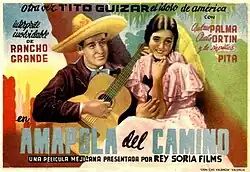
Poppy of the Road (Spanish: Amapola del camino) is a 1937 Mexican musical drama film directed by Juan Bustillo Oro and Antonio Guzmán Aguilera and starring Tito Guízar, Andrea Palma and Margarita Mora.[1][2] The film's sets were designed by the art directors José Rodríguez Granada, Ramón Rodríguez Granada and Carlos Toussaint. Future stars Pedro Armendáriz and Esther Fernández appeared in smaller roles.[3] [4][5]
Plot
María (Andrea Palma), a young woman living in a small Mexican village, faces immense domestic pressure from her parents to marry an elderly local pharmacist, Don Romualdo (Manuel Noriega). She actively resists the forced arrangement, as her true affection belongs to a young villager named Juan Padilla (Pedro Armendáriz). The household dynamic reaches a point of friction when Juan makes preparations to leave town, forcing María to confront her bleak matrimonial prospects.
The domestic landscape shifts drastically with the sudden arrival of Antonio Rosales (Tito Guízar), the handsome, charming son of the old pharmacist. Antonio's presence immediately captivates the local youth, and both María and her free-spirited sister, Amapola (Margarita Mora), find themselves falling in love with him. Ultimately, Antonio's romantic preferences lean toward Amapola. Despite her mutual attraction to Antonio, Amapola hesitates to accept his courtship out of deep sisterly loyalty and concern for María's emotional distress.
The romantic impasse is resolved when Juan returns unexpectedly to the village. Realizing her love for him remains steadfast, María breaks her ties to the pharmacist and chooses to elope with Juan. With the threat of the forced marriage removed and the misunderstandings between the sisters untangled, Amapola is freed from her guilt, allowing her and Antonio to happily formalize their relationship.
Cast
- Tito Guízar as Antonio Rosales
- Andrea Palma as María
- Leopoldo 'Chato' Ortín as Margarito
- Margarita Mora as Amapola
- Aurora Campuzano as Zoila
- Pedro Armendáriz as Juan Padilla
- Joaquín Coss as Mauricio
- Manuel Noriega as Romualdo
- Dolores Camarillo as Pancha
- Humberto Rodríguez as Tenógenes
- Paco Martínez as Lito
- Ricardo Mutio as Presidente municipal
- Honorato Bassoco as Secretario
- Conchita Gentil Arcos as Gerarda
- Valentín Asperó as Borracho
- Hernán Vera as Gendarme
- Esther Fernández as Extra
- Carolina Barret as Extra
References
- ↑ Amador p.204
- ↑ Avila p.80
- ↑ "Amapola del camino (1937)". FilmAffinity (in Spanish). Retrieved 30 July 2026.
- ↑ "Amapola del camino". JustWatch (in Spanish). Mexico. Retrieved 30 July 2026.
- ↑ "Amapola del camino (1937)". Letterboxd. Retrieved 30 July 2026.
Bibliography
- Amador, María Luisa. Cartelera cinematográfica, 1930-1939. Filmoteca, UNAM, 1980.
- Avila, Jacqueline. Cinesonidos: Film Music and National Identity During Mexico's Época de Oro. Oxford University Press, 2019.