Politics of Republika Srpska
 |
|---|
This article is about the politics of Republika Srpska, one of the two entities that together comprise the state of Bosnia and Herzegovina, the other being the Federation of Bosnia and Herzegovina.
Presidents of Republika Srpska


- Radovan Karadžić (7 April 1992 – 19 July 1996) (SDS)
- Biljana Plavšić (19 July 1996 – 4 November 1998) (SDS/SNS RS) (expelled from SDS in July 1997 and formed SNS RS)
- Nikola Poplašen (4 November 1998 – 26 January 2000) (SRS RS) (removed by High Representative on 5 March 1999; removal enforced on 2 September 1999)
- Mirko Šarović (26 January 2000 – 28 November 2002) (SDS) (not recognized as president by High Representative until 16 December 2000)
- Dragan Čavić (28 November 2002 – 9 November 2006) (SDS)
- Milan Jelić (9 November 2006 – 30 September 2007) (SNSD)
- Igor Radojičić (acting President) (1 October 2007 – 9 December 2007) (SNSD)
- Rajko Kuzmanović (9 December 2007 – 15 November 2010) (SNSD)
- Milorad Dodik (15 November 2010 – 19 November 2018) (SNSD)
- Željka Cvijanović (19 November 2018 – 15 November 2022) (SNSD)
- Milorad Dodik (15 November 2022 – 12 June 2025) (SNSD)
- Nenad Stevandić (acting President) (18 August 2025 - present)
National Assembly

The current National Assembly of the Republika Srpska (Народна Скупштина Републике Српске / Narodna Skupština Republike Srpske) is the ninth since the founding of the Republika Srpska.
- First Assembly (24 October 1991 – 14 September 1996)
- Second Assembly (19 October 1996 – 27 December 1997) (election of 4 September 1996)
- Third Assembly (27 December 1997 – 19 October 1998) (election of 22–23 November 1997)
- Fourth Assembly (19 October 1998 – 16 December 2000) (election of 13 September 1998)
- Fifth Assembly (16 December 2000 – 28 November 2002) (election of 11 September 2000)
- Sixth Assembly (28 November 2002 – 30 November 2006) (election of 5 October 2002)
- Seventh Assembly (30 November 2006 – 15 November 2010) (election of 1 October 2006)
- Eighth Assembly (15 November 2010 – 24 November 2014) (election of 3 October 2010)
- Ninth Assembly (24 November 2014 – 7 October 2018) (election of 12 October 2014)
- Tenth Assembly (7 October 2018 – present) (election of 7 October 2018)
The political composition of the Tenth Convocation of the National Assembly of Republika Srpska (and the change in number of seats from the Ninth Convocation):
- Alliance of Independent Social Democrats 28 (-1)
- Serb Democratic Party–SRS RS–SRS 16 (-8)
- Democratic People's Alliance 12 (+4)
- Party of Democratic Progress 9 (+2)
- Socialist Party 7 (+2)
- Together for BiH 4
- National Democratic Movement 4 (-1)
- United Srpska (US) 3
Cabinet
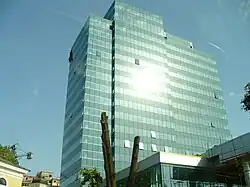
The cabinet is composed of the prime minister and the heads of the sixteen ministries. The National Assembly also selects two deputy prime ministers from among the ministers from different constituent peoples (Serbs, Croats, and Bosniaks) on the recommendation of the prime minister.
The law requires that eight ministers be elected from the Serb population, five from the Bosniak population, and three from the Croat population. The prime minister may also appoint one minister from among the "others" population (out of the largest constituent ethnic group).
Under the Law on Ministries adopted in October 2002, the "tasks of the administration" of Republika Srpska are carried out by ministries, republican administrative units, and republican administrative organizations.[1]
| Position | Name | Party | Ethnicity | |
|---|---|---|---|---|
| Prime Minister | Radovan Višković | SNSD | Serb | |
| Deputy Prime Minister Minister for Justice |
Anton Kasipović | SNSD | Croat | |
| Deputy Prime Minister Minister for Spatial Planning, Civil Engineering and Ecology |
Srebrenka Golić | SNSD | Bosniak | |
| Minister for Internal Affairs | Dragan Lukač | SNSD | Serb | |
| Minister for Finance | Zora Vidović | SNSD | Serb | |
| Minister for Health and Social Welfare | Alen Šeranić | SNSD | Bosniak | |
| Minister for Education and Culture | Natalija Trivić | United Srpska | Serb | |
| Minister for Labour, Veterans and Disability Protection | Duško Milunović | Socialist | Serb | |
| Minister for Administration and Local Government | Senka Jujić | NPS | Bosniak | |
| Minister for Industry, Energy and Mining | Petar Đokić | Socialist | Serb | |
| Minister for European Integration and International Cooperation | Zlatan Klokić | SNSD | Bosniak | |
| Minister for Family, Youth and Sports | Sonja Davidović | Socialist | Bosniak | |
| Minister for Agriculture, Forestry and Water Management | Boris Pašalić | SNSD | Serb | |
| Minister for Transport and Communications | Nedeljko Ćorić | SNSD | Serb | |
| Minister for the Economy and Entrepreneurship | Vjekoslav Petričević | NDP | Croat | |
| Minister for Trade and Tourism | Suzana Gašić | DEMOS | Croat | |
| Minister for Science and Technology, Higher Education and Informatics | Srđan Rajčević | SNSD | Serb | |
Prime Ministers of Republika Srpska
- Branko Đerić (22 April 1992 – 20 January 1993) (SDS)
- Vladimir Lukić (20 January 1993 – 18 August 1994) (SDS)
- Dušan Kozić (18 August 1994 – 17 December 1995) (SDS)
- Rajko Kasagić (17 December 1995 – 18 May 1996) (SDS)
- Gojko Kličković (18 May 1996 – 18 January 1998) (SDS)
- Milorad Dodik (18 January 1998 – 12 January 2001) (SNSD) (1st term)
- Mladen Ivanić (12 January 2001 – 17 January 2003) (PDP)
- Dragan Mikerević (17 January 2003 – 17 February 2005) (PDP)
- Pero Bukejlović (17 February 2005 – 28 February 2006) (SDS)
- Milorad Dodik (28 February 2006 – 15 November 2010) (SNSD) (2nd term)
- Anton Kasipović (15 November 2010 – 29 December 2010) (Non-party)
- Aleksandar Džombić (29 December 2010 – 25 February 2013) (SNSD)
- Željka Cvijanović (12 March 2013 – 19 November 2018) (SNSD)
- Radovan Višković (18 December 2018 – 18 August 2025) (SNSD)
Ministries
There are sixteen ministries as follows:[2]
- Ministry for Economy, Energy and Development
- Ministry of Finance
- Ministry of Education and Culture
- Ministry of Justice
- Ministry of Defense
- Ministry of Internal Affairs
- Ministry of Administration and Local Self-Governance
- Ministry of Health and Social Protection
- Ministry of Agriculture, Forestry and Water Resources
- Ministry of Transport and Communications
- Ministry of Trade and Tourism
- Ministry of Urban Planning, Civil Engineering and Ecology
- Ministry of Labor and Soldiers and Invalid Protection
- Ministry of Economic Relations and Coordination
- Ministry of Refugees and Displaced Persons
- Ministry of Science and Technology
Administrative services
Administrative services in RS are administrative bodies within the ministries, and are established for the purpose of performing certain activities from within the sphere of activity of the administration, which, due to their nature, entirety and way of performing, require independence and special organization (administration, inspectorates, and other forms). Administrative services are under the direct supervision of the ministry to which they belong.[2]
The following are the administrative units and the ministries to which they belong:[2]
- Administrative Service for Geodetic and Legal-Property Issues (responsible to the Government of Republika Srpska)
- Administrative Service for the RS Customs (Ministry of Finance)
- Revenue Service (Ministry of Finance)
- Foreign Currency Inspectorate (Ministry of Finance)
- Civil Defense Service (Ministry of Administration and Local Self-Governance)
Administrative organizations
Administrative organizations in the RS are established for the purpose of performing professional duties and duties of the republic's administration (institutions, directorates, secretariats, agencies, commissariats, funds, centers and other forms). Administrative organizations may have the attributes of a legal entity.[2]
Administrative divisions
Republika Sprska operates as a centralised unitary state, in contrast with a federalism-based Federation of Bosnia and Herzegovina.[a]
Current situation
A proposed secession of Republika Srpska from Bosnia and Herzegovina has remained a consistent topic of conversation in the entity, particularly driven by Milorad Dodik, the long-time President of Republika Srpska who has advocated for a referendum on independence.[13] Meanwhile, Bosniak politicians like Haris Silajdžić, party leader of Party for Bosnia and Herzegovina, have repeatedly stated that he wishes to see the RS dismantled.[14][15] Miroslav Lajčák, former High Representative of Bosnia-Herzegovina, has responded to this by saying that "Republika Srpska does not have the right to secede from BiH, at the same time no one can unilaterally abolish Republika Srpska."[16]
In 2025, The Court of Bosnia and Herzegovina sentenced Dodik in a first-instance verdict to one year in prison and imposed a six-year ban on him serving the post of president of the country’s Republika Srpska (RS) entity. Dodik was found guilty of non-compliance with the decisions of the High Representative of the international community in the country.[17] His prison sentence was subsequently commuted to a fine but his appeal was rejected.[18][19]
Serbia-Republika Srpska relations
In 1997, the Agreement on Special Parallel Relations was signed between the two on February 28, 1997. A council has been established to bolster relations, in which presidents and prime ministers participate. The Agreement was implemented December 15, 2010.[20] So far, four councils have been held.
On July 26, 2010, the Serbian Minister of Finance Diana Dragutinović and her Republika Srpska counterpart Aleksandar Džombić signed an Agreement on Cooperation in the Financial Sector, which will further develop mutual relations in the financial system. It will bolster the already good cooperation between the two, and help to maintain special parallel relations and enable exchange of experience, also discussing other sections. The working groups will convene at least twice a year.[21]
Kosovo's unilateral proclamation of independence
On July 31, 2011, President Milorad Dodik said that the concept of a multi-ethnic state in Kosovo has failed, and that the solving of the Kosovo question has not been dealt with, stressing that Republika Srpska does not accept Kosovo as an independent country. Dodik said "The peaceful solution is evidently not a possible solution [...] We support Belgrade." in relation to the Kosovo Police operation trying to take control of border crossings located in North Kosovo on July 25.[22]
Notes
References
- ↑ "Bosnia and Herzegovina - Administrative Law & Procedure". Foreign Law Guide. 2018.
- 1 2 3 4 "Republika Srpska". ohr.int. Office of the High Representative.
- ↑ Vladimir Mikić (2025). "ON THE CONSTITUTIONAL IDENTITY OF THE REPUBLIC OF SRPSKA**" (PDF). Institute for Comparative Law.
Unlike the fragmented FBH, the RS is characterized by a unitary system of organization. The political-territorial organization of the FBH is based on the existence of "federal units – cantons" (Ustav Federacije Bosne i Hercegovine 1994, Art. 2), which, nota bene, were not mentioned in the Constitution of the Republic of Bosnia and Herzegovina, which was a unitary state until 1994 ... These solutions introduced a simpler structure of the RS than the one which was prescribed by the provision of Art. 2 of the original text of the RS, which stipulated that the territory of the RS "consists of areas of autonomous regions, municipalities and other Serbian ethnic entities" – that is, two, and potentially three or more special types of local self-government units. Thus, subsequent amendments to the CRS established a "highly centralized and unitary system" (Bonifati 2023, 233), the first step of which was reflected in the abolition of "regions" and "districts," back in August 1992 (Nešković 2013, 211).
- ↑ Damir Banović; Sasa Gavric; Mariña Barreiro Mariño (January 2021). "The Political System of Bosnia and Herzegovina, Institutions – Actors – Processes". ResearchGate. doi:10.1007/978-3-030-54387-7.
The two entities were conceptualized very differently. While the Republika Srpska resembles a unitary autonomous republic dominated by the Serbian ethnic group, the Federation was established as a highly decentralized autonomous republic with ten cantons (Markert 2003, p. 88).
- ↑ Aleksandar Kaslyovski (2021-11-06). "The politics of Bosnia and Herzegovina: A bureaucratic labyrinth". debatmagazine.nl.
Where the differences lie is that Republika Srpska is much more centralized resembling a unitary state like Serbia. It is split in municipalities and has a single unicameral legislature in the National Assembly of Republika Srpska. It can make laws, approve budgets and elect an executive cabinet for the Council of Ministers.
- ↑ Daniela Stanojlovic (September 1999). "HELSINKI COMMITTEE FOR HUMAN RIGHTS IN REPUBLICA SRPSKA". cilevics.eu.
Bosnia and Herzegovina defined through this constitutional-legal position represents a kind of confederate regulated state, while the Federation BH, according to the legal provisions on local administration and territorial organization, is a federal entity, and Republika Srpska according to its constitutional definition is a unitary ordered entity.
- ↑ "Speaking notes for the rapporteur Carla DEJONGHE (Belgium, ILDG)" (PDF). rm.coe.int. Council of Europe. 2019-10-31.
In contrast, the Republika Srpska is a unitary, two-tier entity, with the entity government that interacts directly with municipalities and cities.
- ↑ Marta Szpala. "In the Footsteps of Ukraine? Republika Srpska's Challenge to Bosnia and Herzegovina. Future Scenarios for Bosnia and Herzegovina". iemed.org.
The institutional structure of BiH was established by the constitution, which is an annex to the Dayton Peace Agreement. The country is divided into two constituent parts (entities): Republika Srpska (RS), mainly inhabited by Serbs, and the Federation of Bosnia and Herzegovina (FBiH), dominated by the Bosniak and Croat populations. Additionally, the strategically located multi-ethnic Brčko District, which divides the Republika Srpska, has been an independent administrative unit since 2000. RS is unitary and highly centralized, while FBiH is divided into 10 cantons with significant autonomy. The central government of BiH has competencies limited to foreign policy, security, fiscal-budgetary matters and the judiciary. Furthermore, the Dayton Agreement established the institution of the Office of the High Representative (OHR) with broad legislative and executive powers, which were further strengthened in 1997.
- ↑ "Republika Srpska". epthinktank.eu. European Parliamentary Research Service. 2014-01-09.
The Republika Srpska (RS) has a centralised structure, with its own National Assembly, Government and Constitutional Court. In October 2013, according to preliminary results of the 2013 census, RS had an estimated population of 1 326 991, data on ethnicity will be published in 2014. The net average salary in 2012 was about 400 euros. In 2012 the activity rate was 47.4% and the unemployment rate 25.6%.
- ↑ "OECD Reviews of Evaluation and Assessment in Education: Bosnia and Herzegovina". oecd.org. OECD. 2022-03-31.
Republika Srpska (RS) is a centralised self-government entity within Bosnia and Herzegovina that contains 64 local self-government units (i.e. municipalities). With a surface area that makes up nearly half of BiH (Table 8.1), the entity's socio-economic development is primarily driven by industry, agriculture and services, which respectively employ 28%, 24% and 48.5% of the entity's population (Republika Srpska Institute of Statistics, 2021[1]).
- ↑ Paulina Wankiewicz-Kłoczko (2025-07-25). "Bosnia and Herzegovina's European integration at an impasse". osw.waw.pl. Centre for Eastern Studies.
Bosnia and Herzegovina consists of two parts, the so-called entities: The Federation of Bosnia and Herzegovina (FBiH), which is divided into 10 cantons, and the unitary and strongly centralised Republika Srpska (RS).
- ↑ "Government and society". britannica.com. Britannica.
The Federation of Bosnia and Herzegovina is decentralized; it is administratively divided into 10 cantons, which in turn are divided into dozens of municipalities (općine). The Republika Srpska is relatively centralized and is administratively divided into dozens of municipalities (opštine). Citizens of both entities directly elect mayors and representatives to municipal and cantonal assemblies. Arbitration in 1997 established Brčko, in the northeast, as a self-governing special district.
- ↑ Ker-Lindsay, James (2016). "The Hollow Threat of Secession in Bosnia and Herzegovina: Legal and Political Impediments to a Unilateral Declaration of Independence by Republika Srpska" (PDF). lse.ac.uk.
- ↑ "Bosnian Sackings". BBC. 2004-07-13. Retrieved 2007-04-19.
- ↑ "Bosnian Elections". BBC News. 2006-10-13. Retrieved 2007-04-19.
- ↑ "Existence of Bosnia and Herzegovina cannot be questioned". EUSR / OHR. 2008-01-30. Retrieved 2009-01-07.
- ↑ "Dodik sentenced to a year in prison and banned from serving as RS president". N1 info. February 26, 2025.
- ↑ Melez, Selma (12 August 2025). "Bosnian Court Commutes Milorad Dodik's Jail Sentence to a Fine". Balkan Insight.
- ↑ "Milorad Dodik više nije predsjednik Republike Srpske, Sud BiH odbio njegovu žalbu". Klix. 18 August 2025.
- ↑ "Successful implementation of agreement on special, parallel relations :: EMG :: Business news from Serbia 2010". Archived from the original on 2011-08-15. Retrieved 2011-02-25.
- ↑ "Serbia, Republika Srpska improve relations in financial sector". Archived from the original on 2012-03-21. Retrieved 2011-07-31.
- ↑ "Dodik: Kosovsko pitanje nije rešeno". B92.net.
Republika Srpska articles | |||
|---|---|---|---|
| History | | ||
| Geography | |||
| Politics | |||
| Economy | |||
| Culture | |||
| Other | |||
