Politics of Piedmont
 |
|---|
|
The politics of Piedmont, a region of Italy, takes place in the framework of an "anomalous presidential"[1][2] representative democracy or prime-ministerial system with an executive presidency, whereby the president of Piedmont is the head of government, and of a pluriform multi-party system. Executive power is exercised by the regional government. Legislative power is vested in both the government and the Regional Council of Piedmont.
Executive branch
The Regional Government (Giunta Regionale) is presided by the President of the Region (Presidente della Regione), who is elected for a five-year term and is composed by the President and the Ministers, who are currently 14, including a Vice President (Vice Presidente).[3]
List of presidents
| President | Term of office | Party | Coalition | Administration | Legislature | |||
|---|---|---|---|---|---|---|---|---|
| Presidents elected by the Regional Council of Piedmont (1970–1995) | ||||||||
| 1 |  |
Edoardo Calleri di Sala (1927–2002) |
23 July 1970 |
21 December 1973 |
DC | DC • PSI • PSDI • PRI | Calleri di Sala | I (1970) |
| 2 | |
Gianni Oberto Tarena (1902–1980) |
21 December 1973 |
21 July 1975 |
DC | DC • PSI • PSDI • PRI | Tarena | |
| 3 | |
Aldo Vigilone (1923–1988) |
21 July 1975 |
28 July 1980 |
PSI | PSI • PCI | Vigilone I | II (1975) |
| 4 | |
Ezio Enrietti (1936–2020) |
28 July 1980 |
15 July 1983 |
PSI | PSI • PCI | Enrietti | III (1980) |
| 3 | |
Aldo Vigilone (1923–1988) |
15 July 1983 |
1 August 1985 |
PSI | DC • PSI • PSDI • PRI • PLI | Vigilone II | |
| 5 | |
Vittorio Beltrami (1926–2012) |
1 August 1985 |
25 July 1990 |
DC | DC • PSI • PSDI • PRI • PLI | Beltrami | IV (1985) |
| 6 | |
Gian Paolo Brizio (1929–2008) |
25 July 1990 |
16 March 1993 |
DC | DC • PSI • PSDI • PRI • PLI | Brizio I | V (1990) |
| 16 March 1993 |
12 June 1995 |
DC • PSI • FdV • PDS • RI | Brizio II | |||||
| Directly-elected presidents (since 1995) | ||||||||
| 7 |  |
Enzo Ghigo (b. 1953) |
12 June 1995 |
17 April 2000 |
FI | FI • AN • CCD | Ghigo I | VI (1995) |
| 17 April 2000 |
27 April 2005 |
FI • AN • LN • CCD | Ghigo II | VII (2000) | ||||
| 8 |  |
Mercedes Bresso (b. 1944) |
27 April 2005 |
9 April 2010 |
DS PD |
DS • DL • PRC • FdV | Bresso | VIII (2005) |
| 9 |  |
Roberto Cota (b. 1968) |
9 April 2010 |
9 June 2014[a] |
LN | PdL • LN | Cota | IX (2010) |
| 10 | 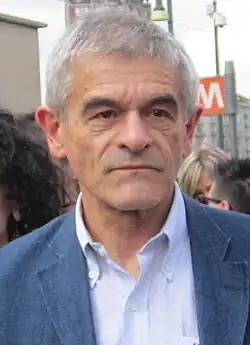 |
Sergio Chiamparino (b. 1948) |
9 June 2014 |
6 June 2019 |
PD | PD • SEL | Chiamparino | X (2014) |
| 11 |  |
Alberto Cirio (b. 1972) |
6 June 2019 |
21 June 2024 |
FI | LN • FI • FdI | Cirio I | XI (2019) |
| 21 June 2024 |
In office | FdI • FI • LN | Cirio II | XII (2024) | ||||
- ↑ Election invalidated for irregularities.
Legislative branch
The Regional Council of Piedmont (Consiglio Regionale del Piemonte) is composed of 60 members. 48 councilors are elected in provincial constituencies by proportional representation using the largest remainder method with a Droop quota and open lists, while 12 councillors (elected in bloc) come from a "regional list", including the President-elect. One seat is reserved for the candidate who comes second. If a coalition wins more than 50% of the total seats in the council with PR, only 6 candidates from the regional list will be chosen and the number of those elected in provincial constituencies will be 54. If the winning coalition receives less than 40% of votes, special seats are added to the council to ensure a large majority for the President's coalition.[4]
The council is elected for a five-year term, but, if the President suffers a vote of no confidence, resigns or dies, under the simul stabunt, simul cadent clause introduced in 1999 (literally they will stand together or they will fall together), also the council is dissolved and a snap election is called.[5]
Current composition
The Regional Council of Piedmont is currently composed of the following political groups:[6]
| Party | Seats | Status | |
|---|---|---|---|
| Brothers of Italy (FdI) | 13 / 51 |
Government | |
| Democratic Party (PD) | 13 / 51 |
Opposition | |
| Forza Italia (FI) | 7 / 51 |
Government | |
| League (Lega) | 6 / 51 |
Government | |
| Cirio for President (CP) | 5 / 51 |
Government | |
| Greens and Left Alliance (AVS) | 3 / 51 |
Opposition | |
| Five Star Movement (M5S) | 3 / 51 |
Opposition | |
| United States of Europe (SUE) | 1 / 51 |
Opposition | |
By coalition:
| Party | Seats | Status |  | |
|---|---|---|---|---|
| Centre-right coalition | 31 / 51 |
Government | ||
| Centre-left coalition | 17 / 51 |
Opposition | ||
| Five Star Movement | 3 / 51 |
Opposition | ||
Local government
Provinces
| Province | Inhabitants | President | Party | Election | |
|---|---|---|---|---|---|
| Metropolitan City of Turin | 2,282,197 | Stefano Lo Russo (metropolitan mayor) |
PD | 2021 | |
| Alessandria (list) | 428,826 | Luigi Benzi | FdI | 2024 | |
| Asti (list) | 217,574 | Maurizio Rasero | FI | 2022 | |
| Biella (list) | 179,685 | Emanuele Ramella Pralungo | PD | 2021 | |
| Cuneo (list) | 590,421 | Luca Robaldo | Ind. (FI) | 2022 | |
| Novara (list) | 370,525 | Marco Caccia | FdI | 2025 | |
| Verbano-Cusio-Ossola (list) | 160,114 | Giandomenico Albertella | Ind. | 2025 | |
| Vercelli (list) | 174,904 | Davide Gilardino | FdI | 2022 | |
Municipalities
- Provincial capitals
| Municipality | Inhabitants | Mayor | Party | Election | |
|---|---|---|---|---|---|
| Turin (list) | 890,529 | Stefano Lo Russo (metropolitan mayor) |
PD | 2021 | |
| Novara (list) | 104,380 | Alessandro Canelli | LN | 2021 | |
| Alessandria (list) | 93,943 | Giorgio Abonante | PD | 2022 | |
| Asti (list) | 76,202 | Maurizio Rasero | FI | 2022 | |
| Cuneo (list) | 56,081 | Patrizia Manassero | PD | 2022 | |
| Vercelli (list) | 46,754 | Roberto Scheda | FI | 2024 | |
| Biella (list) | 44,733 | Marzio Olivero | FdI | 2024 | |
| Verbania (list) | 30,827 | Giandomenico Albertella | Ind. | 2024 | |
- Other municipalities
Cities with more than 45,000 inhabitants.
| Municipality | Inhabitants | Mayor | Party | Election | |
|---|---|---|---|---|---|
| Moncalieri | 57,294 | Paolo Montagna | Democratic Party | 2020 | |
| Collegno | 49,905 | Francesco Casciano | Democratic Party | 2019 | |
| Rivoli | 48,791 | Andrea Tagaroli | Lega Nord Piemont | 2019 | |
| Nichelino | 48,123 | Giampietro Tolardo | Italian Left | 2021 | |
| Settimo Torinese | 47,669 | Elena Piastra | Democratic Party | 2019 | |
Parties and elections
Latest regional election
The latest regional election took place on 8–9 June 2024. Incumbent president Alberto Cirio of Forza Italia, supported also by Brothers of Italy (FdI), Lega Piemonte and other parties, was re-elected. FdI was the most voted party, ahead of the Democratic Party.
 | |||||||||
| Candidates | Votes | % | Seats | Parties | Votes | % | Seats | ||
|---|---|---|---|---|---|---|---|---|---|
| Alberto Cirio | 1,055,752 | 56.13 | 6 | Brothers of Italy | 403,954 | 24.43 | 11 | ||
| Cirio for President | 202,294 | 12.23 | 5 | ||||||
| Forza Italia | 162,888 | 9.85 | 4 | ||||||
| League | 155,522 | 9.40 | 4 | ||||||
| Us Moderates | 11,441 | 0.69 | – | ||||||
| Total | 936,098 | 56.60 | 24 | ||||||
| Gianna Pentenero | 630,853 | 33.54 | 1 | Democratic Party | 395.710 | 23.93 | 12 | ||
| Greens and Left Alliance | 107,095 | 6.48 | 3 | ||||||
| United States of Europe | 40,223 | 2.43 | 1 | ||||||
| Pentenero for President | 24,835 | 1.5 | – | ||||||
| Environmentalist and Solidary Piedmont | 14,536 | 0.88 | – | ||||||
| Total | 582,399 | 35.22 | 16 | ||||||
| Sarah Disabato | 144,420 | 7.68 | – | Five Star Movement | 99,806 | 6.04 | 3 | ||
| Francesca Frediani | 28,191 | 1.50 | – | Popular Piedmont | 19,377 | 1.17 | – | ||
| Alberto Costanzo | 21,565 | 1.15 | – | Freedom | 16,064 | 0.97 | – | ||
| Total candidates | 1,880,781 | 100.00 | 6 | Total parties | 1,653,744 | 100.00 | 43 | ||
| Blank and invalid votes | 170,048 | 8.49 | |||||||
| Registered voters/turnout | 3,621,101 | 55.30 | |||||||
| Source: Ministry of the Interior – Election in Piedmont | |||||||||
| Regional elections | |
|---|---|
| General elections |
|
| European Parliament elections | |
References
- ↑ Palermo, Francesco (31 October 2019). "The Erosion of Italian Regionalism". Verfassungsblog. doi:10.17176/20191031-163150-0. ISSN 2366-7044.
The attention given to the regional elections in Umbria didn't change when the direct election of regional presidents was introduced in 1995 (and constitutionalized in 1999), making Italy the only European country with a presidential system at regional level. For the past two decades, the only electoral thrill in the region was the amount of votes and the broader or smaller margin in favour of the presidential candidate from the leftist coalition.
- ↑ Vampa, Davide (2021). "Translating votes into seats and offices: Changing representation and government in the Italian Regions (2018-2020)". Contemporary Italian Politics. 13 (4): 485–505. doi:10.1080/23248823.2021.1969490.
The rationale of the index is the same as that of the general ENP, with a score of 1 meaning that the opposition is formed by just one party, 2 meaning that there are two opposition parties of exactly the same size, and so on. In this article the same index is also applied to the ruling coalition to determine whether it is more or less fragmented than its opposition. In an anomalous presidential system like the one existing in Italian regions, government formation is still linked to parliamentary dynamics (i.e.the composition of regional councils). Therefore, rather than focusing on vote shares, this time we only consider how seats are distributed within the government and opposition camps (ENPSM; ENPSO).
- ↑ "Sito Ufficiale della Regione Piemonte: Giunta regionale". Archived from the original on 18 February 2010. Retrieved 9 June 2008.
- ↑ La Repubblica – Regional electoral law (in Italian)
- ↑ "Regional Council of Lombardy – 1999 Constitutional law" (PDF). Archived from the original (PDF) on 6 March 2009. Retrieved 6 March 2009.
- ↑ "Gruppi consiliari". www.cr.piemonte.it (in Italian). Retrieved 4 July 2019.
External links
 Politics of Italian regions | |
|---|---|