Path integral molecular dynamics
Path integral molecular dynamics (PIMD) is a method of incorporating quantum mechanics into molecular dynamics simulations using Feynman path integrals. In PIMD, one uses the Born–Oppenheimer approximation to separate the wavefunction into a nuclear part and an electronic part. The nuclei are treated quantum mechanically by mapping each quantum nucleus onto a classical system of several fictitious particles connected by springs (harmonic potentials) governed by an effective Hamiltonian, which is derived from Feynman's path integral. The resulting classical system, although complex, can be solved relatively quickly. There are now a number of commonly used condensed matter computer simulation techniques that make use of the path integral formulation including centroid molecular dynamics (CMD),[1][2][3][4][5] ring polymer molecular dynamics (RPMD),[6][7] and the Feynman–Kleinert quasi-classical Wigner (FK–QCW) method (named after Richard Feynman and Hagen Kleinert).[8][9] The same techniques are also used in path integral Monte Carlo (PIMC).[10][11][12][13][14]
There are two ways to calculate the dynamics calculations of PIMD. The first one is the non-Hamiltonian phase space analysis theory[15], which has been updated to create an "extended system" of isokinetic equations of motion which overcomes the properties of a system that created issues within the community. The second way is by using Nosé–Hoover chain,[16] which is a chain of variables instead of a single thermostat of variable.
Ring-polymer representation of the partition function
Consider a single distinguishable particle of mass moving in one dimension, with Hamiltonian


Its canonical partition function is

The Boltzmann operator can be divided into imaginary-time slices,


Inserting complete sets of position eigenstates between the factors gives

The condition follows from the trace and makes the discretized path cyclic. For sufficiently large , the symmetric Suzuki–Trotter factorization gives


The free-particle imaginary-time propagator is obtained by inserting momentum eigenstates:

Defining the ring-polymer frequency

the short-time density matrix becomes

A set of auxiliary momenta can be introduced using the Gaussian identity

Applying this identity to every imaginary-time slice gives

where

and

Thus the quantum canonical partition function is mapped onto the classical partition function of a cyclic polymer containing beads. Adjacent beads are connected by harmonic springs of frequency , and each bead experiences the physical potential . The variables are auxiliary sampling momenta and should not be identified with measurements of the quantum momentum. Path integral molecular dynamics samples this ring-polymer distribution using classical molecular-dynamics trajectories.[17][18]


For the symmetric factorization above, the leading finite- discretization error scales as , subject to the usual regularity conditions on the potential.[19]

Equilibrium estimators and molecular-dynamics sampling
The ring-polymer construction establishes a classical isomorphism for equilibrium statistical mechanics: the quantum system at inverse temperature is represented by a classical ring polymer whose phase-space weight contains .[18] Although the auxiliary ring polymer is sampled with the factor , the physical temperature remains ; its dependence is contained in both and the spring frequency .


For an observable represented by an operator , the canonical quantum expectation value is

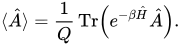
If the observable depends only on position, , its ring-polymer representation is


where

is the bead-averaged estimator. Thus the observable is first averaged over the beads and then over the canonical distribution of the ring polymer.[17]
Path integral molecular dynamics
Path integral molecular dynamics uses fictitious classical dynamics to sample the ring-polymer canonical distribution. If the sampling dynamics are ergodic and preserve this distribution, the phase-space ensemble average may be evaluated as a long-time average along a trajectory.[20]
Writing the ring-polymer Hamiltonian as

where

the corresponding Hamilton equations are

Unthermostatted Hamiltonian dynamics conserves and therefore samples a microcanonical rather than a canonical distribution. In addition, energy exchange between weakly coupled ring-polymer modes can be inefficient, and unthermostatted PIMD can be nonergodic for some systems.[21]

Normal-mode representation
Efficient PIMD algorithms frequently transform the free ring polymer into its normal modes. For an even number of beads, relabeled as , a real orthogonal transformation is

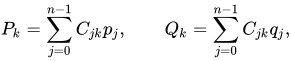
where

In these coordinates, the free ring-polymer Hamiltonian is diagonal:

with normal-mode frequencies
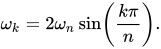
The mode has zero spring frequency and corresponds to the ring-polymer centroid,


PILE thermostat
The path integral Langevin equation (PILE) thermostat applies a frequency-dependent Langevin thermostat to the ring-polymer normal modes. Including the physical potential, the continuous-time equations can be written as


where
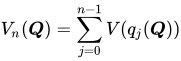
and the independent Gaussian white noises satisfy

For the internal modes, the PILE choice that minimizes the autocorrelation time of the free ring-polymer energy is

Since , this prescription does not thermostat the centroid. In the local version, PILE-L, the centroid is assigned an independent friction coefficient


where is a user-selected thermostat time scale. In the global version, PILE-G, the centroid is instead coupled to a global stochastic velocity-rescaling thermostat.[22] The stochastic velocity-rescaling method generates the canonical distribution by rescaling all selected momenta with a common random factor.[23]

Relation to real-time dynamics
The ring-polymer isomorphism is an equilibrium statistical-mechanical relation. The fictitious trajectories used in PIMD are therefore sampling trajectories and are not, in general, the exact real-time quantum dynamics of the original system. Configurational equilibrium averages are unchanged by a consistent choice of positive fictitious masses for the ring-polymer beads.
Ring-polymer molecular dynamics (RPMD) makes an additional dynamical approximation. It assigns the physical particle masses to the ring-polymer beads and propagates the ring-polymer Hamiltonian dynamics without a thermostat in order to approximate Kubo-transformed quantum time-correlation functions.[24]
Combination with other simulation techniques
The simulations done my PIMD can broadly characterize the biomolecular systems, covering the entire structure and organization of the membrane, including the permeability, protein-lipid interactions, along with "lipid-drug interactions, protein–ligand interactions, and protein structure and dynamics."
Applications
PIMD is "widely used to describe nuclear quantum effects in chemistry and physics".[25]
Path Integral Molecular Dynamics can be applied to polymer physics, both field theories, quantum and not, string theory, stochastic dynamics, quantum mechanics, and quantum gravity. PIMD can also be used to calculate time correlation functions[26]
References
- ↑ Cao, J.; Voth, G. A. (1994). "The formulation of quantum statistical mechanics based on the Feynman path centroid density. I. Equilibrium properties" (PDF). The Journal of Chemical Physics. 100 (7): 5093. Bibcode:1994JChPh.100.5093C. doi:10.1063/1.467175. Archived from the original on September 24, 2017. Retrieved April 29, 2018.
- ↑ Cao, J.; Voth, G. A. (1994). "The formulation of quantum statistical mechanics based on the Feynman path centroid density. II. Dynamical properties". The Journal of Chemical Physics. 100 (7): 5106. Bibcode:1994JChPh.100.5106C. doi:10.1063/1.467176.
- ↑ Jang, S.; Voth, G. A. (1999). "A derivation of centroid molecular dynamics and other approximate time evolution methods for path integral centroid variables". The Journal of Chemical Physics. 111 (6): 2371. Bibcode:1999JChPh.111.2371J. doi:10.1063/1.479515.
- ↑ RamíRez, R.; LóPez-Ciudad, T. (1999). "The Schrödinger formulation of the Feynman path centroid density". The Journal of Chemical Physics. 111 (8): 3339. arXiv:cond-mat/9906318. Bibcode:1999JChPh.111.3339R. doi:10.1063/1.479666. S2CID 15452314.
- ↑ Polyakov, E. A.; Lyubartsev, A. P.; Vorontsov-Velyaminov, P. N. (2010). "Centroid molecular dynamics: Comparison with exact results for model systems". The Journal of Chemical Physics. 133 (19): 194103. Bibcode:2010JChPh.133s4103P. doi:10.1063/1.3484490. PMID 21090850.
- ↑ Craig, I. R.; Manolopoulos, D. E. (2004). "Quantum statistics and classical mechanics: Real time correlation functions from ring polymer molecular dynamics". The Journal of Chemical Physics. 121 (8): 3368–3373. Bibcode:2004JChPh.121.3368C. doi:10.1063/1.1777575. PMID 15303899.
- ↑ Braams, B. J.; Manolopoulos, D. E. (2006). "On the short-time limit of ring polymer molecular dynamics". The Journal of Chemical Physics. 125 (12): 124105. Bibcode:2006JChPh.125l4105B. doi:10.1063/1.2357599. PMID 17014164.
- ↑ Smith, Kyle K. G.; Poulsen, Jens Aage; Nyman, Gunnar; Rossky, Peter J. (June 28, 2015). "A new class of ensemble conserving algorithms for approximate quantum dynamics: Theoretical formulation and model problems". The Journal of Chemical Physics. 142 (24): 244112. Bibcode:2015JChPh.142x4112S. doi:10.1063/1.4922887. hdl:1911/94772. ISSN 0021-9606. PMID 26133415.
- ↑ Smith, Kyle K. G.; Poulsen, Jens Aage; Nyman, Gunnar; Cunsolo, Alessandro; Rossky, Peter J. (June 28, 2015). "Application of a new ensemble conserving quantum dynamics simulation algorithm to liquid para-hydrogen and ortho-deuterium". The Journal of Chemical Physics. 142 (24): 244113. Bibcode:2015JChPh.142x4113S. doi:10.1063/1.4922888. hdl:1911/94773. ISSN 0021-9606. OSTI 1237171. PMID 26133416.
- ↑ Berne, B. J.; Thirumalai, D. (1986). "On the Simulation of Quantum Systems: Path Integral Methods". Annual Review of Physical Chemistry. 37: 401–424. Bibcode:1986ARPC...37..401B. doi:10.1146/annurev.pc.37.100186.002153.
- ↑ Gillan, M. J. (1990). "The path-integral simulation of quantum systems, Section 2.4". In C. R. A. Catlow; S. C. Parker; M. P. Allen (eds.). Computer Modelling of Fluids Polymers and Solids. NATO ASI Series C. Vol. 293. pp. 155–188. ISBN 978-0-7923-0549-1.
- ↑ Trotter, H. F. (1959). "On the Product of Semi-Groups of Operators". Proceedings of the American Mathematical Society. 10 (4): 545–551. doi:10.1090/S0002-9939-1959-0108732-6. JSTOR 2033649.
- ↑ Chandler, D. (1981). "Exploiting the isomorphism between quantum theory and classical statistical mechanics of polyatomic fluids". The Journal of Chemical Physics. 74 (7): 4078–4095. Bibcode:1981JChPh..74.4078C. doi:10.1063/1.441588.
- ↑ Marx, D.; Müser, M. H. (1999). "Path integral simulations of rotors: Theory and applications". Journal of Physics: Condensed Matter. 11 (11): R117. Bibcode:1999JPCM...11R.117M. doi:10.1088/0953-8984/11/11/003. S2CID 250913547.
- ↑ "Non-Hamilton Theory".
- ↑ "Nose-Hoover Chains" (PDF). 1992.
- 1 2 Berne, B. J.; Thirumalai, D. (1986). "On the Simulation of Quantum Systems: Path Integral Methods". Annual Review of Physical Chemistry. 37: 401–424. doi:10.1146/annurev.pc.37.100186.002153.
- 1 2 Chandler, David; Wolynes, Peter G. (1981). "Exploiting the isomorphism between quantum theory and classical statistical mechanics of polyatomic fluids". The Journal of Chemical Physics. 74 (7): 4078–4095. doi:10.1063/1.441588.
- ↑ Trotter, H. F. (1959). "On the Product of Semi-Groups of Operators". Proceedings of the American Mathematical Society. 10 (4): 545–551. doi:10.1090/S0002-9939-1959-0108732-6.
- ↑ Parrinello, Michele; Rahman, Aneesur (1984). "Study of an F center in molten KCl". The Journal of Chemical Physics. 80 (2): 860–867. doi:10.1063/1.446740.
- ↑ Hall, Randall W.; Berne, B. J. (1984). "Nonergodicity in path integral molecular dynamics". The Journal of Chemical Physics. 81 (8): 3641–3643. doi:10.1063/1.448112.
- ↑ Ceriotti, Michele; Parrinello, Michele; Markland, Thomas E.; Manolopoulos, David E. (2010). "Efficient stochastic thermostatting of path integral molecular dynamics". The Journal of Chemical Physics. 133 (12): 124104. doi:10.1063/1.3489925.
- ↑ Bussi, Giovanni; Donadio, Davide; Parrinello, Michele (2007). "Canonical sampling through velocity rescaling". The Journal of Chemical Physics. 126 (1): 014101. doi:10.1063/1.2408420.
- ↑ Craig, Ian R.; Manolopoulos, David E. (2004). "Quantum statistics and classical mechanics: Real time correlation functions from ring polymer molecular dynamics". The Journal of Chemical Physics. 121 (8): 3368–3373. doi:10.1063/1.1777575.
- ↑ Hirshberg, Barak (2019). "PIMD for bosoms - PNAS". Proceedings of the National Academy of Sciences of the United States of America. 116 (43): 21445–21449. doi:10.1073/pnas.1913365116. PMC 6815177. PMID 31591226.
- ↑ Cao, J.; Voth, G. A. (1996). "Semiclassical approximations to quantum dynamical time correlation functions". The Journal of Chemical Physics. 104 (1): 273–285. Bibcode:1996JChPh.104..273C. doi:10.1063/1.470898.
Further reading
- Feynman, R. P. (1972). "Chapter 3". Statistical Mechanics. Reading, Massachusetts: Benjamin. ISBN 0-201-36076-4.
- Morita, T. (1973). "Solution of the Bloch Equation for Many-Particle Systems in Terms of the Path Integral". Journal of the Physical Society of Japan. 35 (4): 980–984. Bibcode:1973JPSJ...35..980M. doi:10.1143/JPSJ.35.980.
- Wiegel, F. W. (1975). "Path integral methods in statistical mechanics". Physics Reports. 16 (2): 57–114. Bibcode:1975PhR....16...57W. doi:10.1016/0370-1573(75)90030-7.
- Barker, J. A. (1979). "A quantum-statistical Monte Carlo method; path integrals with boundary conditions". The Journal of Chemical Physics. 70 (6): 2914–2918. Bibcode:1979JChPh..70.2914B. doi:10.1063/1.437829.
- Ceperley, D. M. (1995). "Path integrals in the theory of condensed helium". Reviews of Modern Physics. 67 (2): 279–355. Bibcode:1995RvMP...67..279C. doi:10.1103/RevModPhys.67.279.
- Chakravarty, C. (1997). "Path integral simulations of atomic and molecular systems". International Reviews in Physical Chemistry. 16 (4): 421–444. Bibcode:1997IRPC...16..421C. doi:10.1080/014423597230190.
External links
- "Density matrices and path integrals". SMAC-wiki. Archived from the original (computer code) on May 1, 2016. Retrieved May 12, 2012.
- John Shumway; Matthew Gilbert (2008). "Path Integral Monte Carlo Simulation". doi:10.4231/D3T43J39D.
{{cite journal}}: Cite journal requires|journal=(help)CS1 maint: multiple names: authors list (link)