Park Chu-young
 Park with FC Seoul in 2016 | |||
| Personal information | |||
|---|---|---|---|
| Date of birth | 10 July 1985 | ||
| Place of birth | Daegu, South Korea | ||
| Height | 1.82 m (6 ft 0 in)[1] | ||
| Position | Forward | ||
| Youth career | |||
| 2001–2003 | Cheonggu High School | ||
| 2002 | → Zico Football Center | ||
| College career | |||
| Years | Team | Apps | (Gls) |
| 2004–2005 | Korea University | ||
| Senior career* | |||
| Years | Team | Apps | (Gls) |
| 2005–2008 | FC Seoul | 68 | (23) |
| 2008–2011 | Monaco | 91 | (25) |
| 2011–2014 | Arsenal | 1 | (0) |
| 2012–2013 | → Celta Vigo (loan) | 22 | (3) |
| 2014 | → Watford (loan) | 2 | (0) |
| 2014–2015 | Al-Shabab | 7 | (1) |
| 2015–2021 | FC Seoul | 186 | (42) |
| 2022–2024 | Ulsan HD | 8 | (1) |
| International career | |||
| 2003–2005 | South Korea U20 | 26 | (18) |
| 2006–2012 | South Korea U23 | 30[α] | (12) |
| 2005–2014 | South Korea | 68 | (24) |
Medal record | |||
| * Club domestic league appearances and goals | |||


| Park Chu-young | |
| Hangul | 박주영 |
|---|---|
| Hanja | 朴主永 |
| RR | Bak Juyeong |
| MR | Pak Chuyŏng |
Park Chu-young (Korean: 박주영; Hanja: 朴主永; Korean pronunciation: [pak̚.t͈ɕu.jʌŋ]; also romanised as Park Ju-young; born 10 July 1985) is a South Korean retired footballer who played as a forward.[3]
Early life
Park was born and raised in Daegu. He began playing organized football in fourth grade after the local coach convinced Park's parents.[4] He later attended Cheonggu Middle School and Cheonggu High School.[5]
In March 2001, during his first year at Cheonggu High, Park began a one-year training spell in Brazil at the Zico Football Center, funded by Pohang Steelers as part of the club's program for promising young players.[6] He credited the spell with teaching him to play the ball economically, without unnecessary exertion.[7] At Cheonggu, coach Byun Byung-joo moved Park from a wide attacking role in his first year to midfield in his second and centre-forward in his third.[8] By the end of his high-school career, Park had scored 47 goals in 33 matches and won the scoring title at four national tournaments. He was also the only high-school player chosen for South Korea's squad at the 2003 FIFA World Youth Championship; although he did not play, he was its youngest South Korean squad member.[9]
Park entered Korea University in 2004. In his first year he scored 10 goals as Korea University won a national university tournament, finishing as the competition's top scorer.[10] Later that year, he scored six goals—including both goals in the final against China—as South Korea won the 2004 AFC Youth Championship; he received both the tournament's top-scorer and most valuable player awards and was subsequently named the AFC Youth Player of the Year.[11][12] His reputation grew further at an eight-nation under-20 tournament in Qatar in January 2005, where he recorded nine goals and one assist in four appearances as South Korea won the title, and again received the top-scorer and most valuable player awards. Korean media labelled him a "football genius", while the surge of public interest became known as the "Park Chu-young syndrome"; amid the attention, the Korea Football Association announced that it would form what contemporary reporting described as its first management committee devoted to a single player.[13]
Club career
FC Seoul
On 28 February 2005, after one season at Korea University, Park signed a three-year contract with FC Seoul. Under regulations introduced for the 2005 season, he received no signing bonus and was paid the maximum rookie salary of ₩50 million in his first year. His contract allowed him to pursue a move to Europe during the season and provided for him to receive a share of any transfer fee; Park said he chose Seoul because he regarded the club as the quickest route towards his ambition of playing in Europe.[14]
The move led to a dispute with Pohang Steelers, which had financed Park's year at the Zico Football Center in Brazil. Pohang said that its agreement with Park required him to negotiate with the club first if he entered the K League and to reimburse the training costs if he joined another team. After he signed for Seoul without such negotiations, Pohang announced that it would seek approximately ₩50 million from him.[15] Seoul said it had been unaware of the agreement, maintained that it did not oblige Park to join Pohang, and treated reimbursement as a matter between Park and Pohang.[16]
Park made his professional debut as a half-time substitute in a 1–0 League Cup defeat by Daegu FC on 9 March, watched by approximately 25,000 spectators.[17] Four days later, he scored his first professional goal in a 2–1 defeat by Seongnam Ilhwa Chunma.[18] On 18 May, he scored his first professional hat-trick—from a direct free kick, a header and a penalty—in a 5–3 loss to Gwangju Sangmu. Aged 19 years and 10 months, he became the youngest player to score a K League hat-trick at the time.[19] On his twentieth birthday, 10 July, he scored another hat-trick in a 4–1 victory over Pohang before 48,375 spectators, then a K League single-match attendance record.[20]
Across the league and League Cup, Park finished his debut season with 18 goals and four assists in 30 appearances.[21] His popularity generated what the press called the "Park Chu-young syndrome": Seoul's average attendance increased from 12,418 in 2004 to a league-leading 25,478 in 2005, while other clubs promoted Seoul's visits around his appearances.[22] Seoul nevertheless missed the playoffs. Park received all 73 votes in the press ballot for Rookie of the Year, becoming the first unanimous winner in league history, and was selected for the K League Best XI.[23]
In 2006, Park scored ten goals in 32 appearances in all competitions but lost his regular starting place amid what Korean coverage described as a "second-year slump."[24][25] After returning from the 2006 FIFA World Cup, he scored the winner against Incheon United on 22 July, taking Seoul to within one point of the League Cup title.[26] Seoul secured the trophy four days later, its first title since 2000.[27]
Under new manager Şenol Güneş, Park began 2007 by scoring a hat-trick in a 4–1 League Cup victory over Suwon Samsung Bluewings on 21 March.[28] A recurring injury to his left foot then sidelined him from late May until September, and he finished the season with five goals in 15 appearances.[29][30] He recorded two goals and four assists in 17 league and League Cup appearances in 2008 before Monaco submitted a formal offer at the end of August. Seoul agreed to facilitate his departure despite losing one of its leading players during the season.[31][32]
Monaco
On 1 September 2008, Park joined Monaco on a four-year contract for a reported €2 million transfer fee and was given the number 10 shirt.[33] He made his Ligue 1 debut against Lorient on 13 September, scoring the opening goal and assisting Frédéric Nimani in a 2–0 victory.[34] Park immediately became a regular and finished his first season in France with five goals in 31 league appearances.[35]
Park's scoring output increased under new manager Guy Lacombe in 2009–10. Monaco generally deployed him as the lone centre-forward in a 4–2–3–1 formation, with players including Nenê operating behind him; contemporary analysis credited the system with making better use of Park's movement and combination play.[36] In October 2009, Monaco extended his contract by one year, through June 2013.[37]
On 24 January 2010, Park headed the winning goal in a 2–1 victory over Lyon in the round of 32 of the 2009–10 Coupe de France.[38] Six days later, he scored twice in a 3–2 league victory over local rivals Nice, his first multi-goal match in France. The goals raised his season totals to eight in the league and nine in all competitions.[39] A right-thigh injury sustained during a Coupe de France victory over Bordeaux in February subsequently sidelined him for nearly a month.[40] Park returned and played the full 120 minutes as Monaco lost the Coupe de France final 1–0 after extra time to Paris Saint-Germain on 1 May.[41] He aggravated the thigh injury during the final and missed the remainder of the season, which he ended with eight league goals and one goal in the Coupe de France.[42]
Park's final season at Monaco was his most productive in France. On 22 December 2010, he scored a stoppage-time winner in a 2–1 victory over Sochaux. During his customary kneeling prayer celebration, his teammates piled onto him and he damaged cartilage in his right knee. The injury sidelined him for approximately a month and forced him to withdraw from the 2011 AFC Asian Cup.[43]
After returning, Park reached ten league goals with a volley against Arles-Avignon on 2 April 2011.[44] The following week, he scored the only goal in a surprise victory over league leaders Lille, temporarily lifting Monaco out of the relegation zone.[45] He finished the season with 12 goals in 33 league appearances, becoming the first South Korean to score 12 goals in a Ligue 1 season.[46] Monaco nevertheless finished 18th and were relegated following a 2–0 final-day defeat by Lyon, ending their 34-season stay in the top flight.[47] Park subsequently stated that he wanted to join a stronger club capable of competing in European competition.[48] Across his three seasons at Monaco, he scored 25 goals in 91 Ligue 1 appearances.[49]
Arsenal
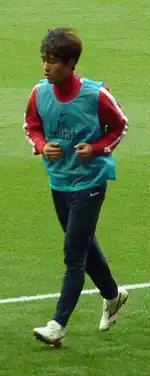
On 30 August 2011, Park joined English Premier League club Arsenal for a reported fee of between £3 million and £5 million and was assigned the number 9 shirt. Park had already agreed terms and begun a medical with French champions Lille, but did not return for its second part after Arsenal made a late approach. Lille president Michel Seydoux said that the club had received no notice of Park's change of plans.[50]
Park made his Arsenal debut by starting a 3–1 League Cup victory over Shrewsbury Town on 20 September. In his second appearance, on 25 October, he curled Andrey Arshavin's pass into the far corner to score the winning goal in a 2–1 League Cup victory over Bolton Wanderers. Manager Arsène Wenger praised Park's movement and finishing and said that he was ready to play in the league.[51]
On 1 November, Park made his UEFA Champions League debut by starting a goalless draw with Marseille, before being replaced by Robin van Persie after 62 minutes.[52] He nevertheless remained a peripheral member of the squad. Wenger acknowledged in December that he had not given Park sufficient opportunities, while also saying that some players required time to adjust to the intensity and physical demands of English football.[53] Park's only Premier League appearance came as a late substitute in a 2–1 home defeat by Manchester United on 22 January 2012.[54] He finished his first season with one goal in six appearances across all competitions.[55]
Loan to Celta Vigo
On 31 August 2012, following the arrivals of forwards Lukas Podolski and Olivier Giroud, Park joined newly promoted Spanish club Celta Vigo on a season-long loan.[56] He made his La Liga debut as a substitute in a 2–1 defeat by Valencia on 15 September.[57] On his home debut a week later, Park entered against Getafe in the 66th minute and scored the winning goal with his first touch two minutes later, volleying in a cross from Michael Krohn-Dehli. The goal, which gave Celta a 2–1 victory, made him the first South Korean to score in La Liga.[58]
Park subsequently scored league goals against Mallorca and Deportivo de La Coruña and a Copa del Rey goal against Almería. His header against Almería opened the scoring in a 3–0 extra-time victory which overturned a two-goal first-leg deficit.[59] He did not establish himself as a regular under either Paco Herrera or Abel Resino, starting 12 of his 26 appearances in all competitions and scoring four goals.[60] In May 2013, Celta announced that an MRI had revealed a small fracture in his right foot, causing him to miss the closing stages of the season.[61]
Return to Arsenal and loan to Watford
After returning to Arsenal, Park's only appearance of the 2013–14 season came as a substitute in a 2–0 League Cup defeat by Chelsea on 29 October 2013. It proved to be his final appearance for Arsenal.[62]
On 31 January 2014, Park joined Championship club Watford on loan for the remainder of the season.[63] He made his debut as a stoppage-time substitute in a 2–0 victory over Brighton & Hove Albion on 2 February.[64] His only start came in a 2–0 defeat by Bolton Wanderers on 22 February.[65] A condition affecting his right foot subsequently curtailed the loan spell. Park returned to South Korea in early April and, with the approval of Watford's and Arsenal's medical staffs, remained there to rehabilitate, having made two appearances for Watford without scoring.[66]
Arsenal announced in June 2014 that Park would leave when his contract expired on 30 June. He finished his Arsenal career with seven first-team appearances across all competitions, including one in the Premier League, and one goal.[67]
Al-Shabab
Despite his intention to stay in Europe after being released by Arsenal,[68] Park joined Saudi Arabian side Al-Shabab on 1 October 2014, signing a one-year contract.[69] Park scored on his debut, in a 1–0 victory against Al-Hilal on 17 October 2014.[70]
Return to FC Seoul
Park returned to FC Seoul on 10 March 2015.[71][72] On 6 November 2016, he scored the only goal for FC Seoul in a 1–0 away victory against Jeonbuk Hyundai Motors in the final round of the season, helping his team to win the 2016 K League 1.[73]
International career
Youth and Olympic teams
Park was the youngest member and only high-school player in South Korea's squad for the 2003 FIFA World Youth Championship, but did not appear at the tournament.[74] The following year, he scored six goals at the 2004 AFC Youth Championship, including both goals in the 2–0 final victory over China, as South Korea won the title; he finished as the tournament's top scorer and most valuable player.[75] At the 2005 FIFA World Youth Championship, Park missed a penalty and dislocated his left elbow against Nigeria but continued playing. He equalised with a 23-metre free kick in the 89th minute, before his stoppage-time shot was parried to Baek Ji-hoon, who scored the winner in a 2–1 comeback victory. South Korea nevertheless went out in the group stage after losing their final match to Brazil.[76][77]
Park scored twice in South Korea's opening match of the 2006 Asian Games, a 3–0 win over Bangladesh, but did not score again as the team finished fourth.[78] At the 2008 Summer Olympics, his direct free kick put South Korea ahead against Cameroon in their opening match, which ended 1–1.[79] South Korea later beat Honduras but were eliminated in the group stage.[80]
Manager Hong Myung-bo selected Park as one of two over-age players for the 2010 Asian Games.[81] Park scored four goals in the tournament, including an extra-time winner against Uzbekistan in the quarter-finals. After South Korea lost 1–0 to the United Arab Emirates with the final kick of extra time in the semi-finals, he scored to begin a late comeback from 3–1 down against Iran; two subsequent goals by Ji Dong-won completed a 4–3 victory and secured the bronze medal.[82]
Park's selection as an over-age player for the 2012 Summer Olympics was preceded by a national controversy over his military service. A ten-year Monaco residence permit had enabled him to obtain a lawful deferment of conscription until the end of 2022, but its disclosure in March 2012 prompted criticism that maintaining the arrangement could allow him to avoid active service.[83] After being omitted from the senior team's June World Cup qualifiers, Park apologised for delaying a public explanation, denied intending to evade his obligation and promised to serve. Hong appeared alongside him at the press conference and subsequently selected him despite both the controversy and his lack of playing time at Arsenal.[84][85]
At the Olympics, Park headed the opening goal in a 2–1 group-stage win over Switzerland.[86] In the bronze-medal match against Japan, he collected a long clearance near the halfway line, evaded several defenders and scored the opener in a 2–0 victory, giving South Korea its first Olympic football medal.[87] The medal qualified Park for South Korea's sports-personnel alternative-service programme in place of ordinary active-duty conscription; he entered a four-week basic military-training course in 2013.[88]
Senior national team
National-team manager Jo Bonfrère initially resisted calls to promote Park, questioning whether his slight build was ready for senior football and reportedly saying that he appeared light enough to be blown away by the wind. Park's form after joining FC Seoul changed Bonfrère's view, and he selected him for two decisive World Cup qualifiers in June 2005.[89][90] On 3 June, Park started on the left wing against Uzbekistan and scored a stoppage-time equaliser in a 1–1 draw on his senior debut. Five days later, he opened the scoring and won a penalty in a 4–0 victory over Kuwait that secured South Korea's sixth consecutive World Cup appearance.[91]
Park was selected for the 2006 FIFA World Cup, but appeared only in the final group match against Switzerland. He started and was replaced in the 66th minute as South Korea lost 2–0 and were eliminated.[92] Recurring foot trouble and reduced club form contributed to his omission from the 2007 AFC Asian Cup, and he did not play a senior international that year.[93] Recalled by Huh Jung-moo in 2008, Park scored twice in a 3–2 victory over China as South Korea won the 2008 East Asian Football Championship; he shared the tournament's top-scorer award.[94] He then scored four goals during South Korea's unbeaten qualification campaign for the 2010 World Cup, establishing himself as the team's first-choice centre-forward.[95]
Park started all four of South Korea's matches at the 2010 FIFA World Cup. In the second group match, Lionel Messi's free kick deflected off his leg for an own goal as Argentina won 4–1.[96] In the decisive final group match against Nigeria, he curled a direct free kick inside the far post to give South Korea a 2–1 lead. The match finished 2–2, sending the country to the World Cup knockout stage for the first time outside South Korea.[97] His fifth-minute free kick struck the post in the round of 16 against Uruguay, who won 2–1.[98]
A right-knee cartilage injury suffered while celebrating a stoppage-time winner for Monaco ruled Park out of the 2011 AFC Asian Cup, his second successive absence from the tournament.[99] After Park Ji-sung retired from international football, coach Cho Kwang-rae appointed Park Chu-young as the new captain in February 2011.[100] He scored eight recognised goals in nine internationals that year, including a hat-trick against Lebanon and six goals in South Korea's first four third-round qualifiers for the 2014 World Cup. Park also scored both Korean goals in a 2–2 friendly against Poland, but the Korea Football Association excluded the match and goals from its official A-international records because South Korea used seven substitutes, one more than the FIFA limit.[101]
Park's lack of club football subsequently reduced his role in the senior team. Hong recalled him after thirteen months for a March 2014 friendly against Greece, acknowledging that the decision departed from his normal selection criterion.[102] Park scored the opening goal in a 2–0 win.[103] Hong then selected him for the 2014 FIFA World Cup despite his continued shortage of club appearances, citing Park's experience and the absence of a satisfactory replacement.[104]
Park started against Russia and Algeria but managed only one shot, none on target, in approximately 114 minutes.[105] A thumbs-up to Lee Chung-yong after failing to reach his pass in the Russia match became the subject of an online meme that summarised Park's performance as "zero goals, zero assists, zero shots, one thumbs-up".[106] Hong left him on the bench for the final group match against Belgium, and South Korea finished last in their group.[107] Park returned for friendlies against Jordan and Iran that November, with the Iran defeat becoming his 68th and final senior international; he finished with 24 goals.[108][109]
Style of play
Park was a mobile and technically skilled forward who played primarily as a centre-forward, but could also operate behind another striker, as an attacking midfielder or as a wide forward. A 2005 tactical analysis attributed his versatility to his dribbling, shooting and passing, while regarding centre-forward as the role that best exploited his movement and goalscoring ability; his movement could also draw defenders away and create space for teammates.[110] Arsène Wenger later praised Park's technical quality, mobility and aerial ability, describing him as adaptable enough either to lead the attack or play behind another striker. Former South Korea assistant coach Afshin Ghotbi identified Park's instinctive positioning and final touch as trademarks.[111][112]
Park was noted for his first touch, short bursts of acceleration and ability to release shots quickly.[113] Despite standing 1.82 m (6 ft 0 in), he was effective in the air; World Soccer reported that an FC Seoul test measured his vertical jump at 91 cm (36 in), compared with a squad average of 62.6 cm (24.6 in).[114]
He was also a specialist right-footed free-kick taker. Sports Illustrated reported before the 2010 FIFA World Cup that Park took most of South Korea's free kicks, and he later served as FC Seoul's principal free-kick and corner taker.[115] Rather than relying primarily on power, he varied curling direct attempts with indirect deliveries and rehearsed routines.[116]
Personal life
Park is a devout Christian. He has described football as a means of sharing his faith and was known for writing "Jesus Christ" alongside his autograph.[117] His signature goal celebration was to drop to both knees, interlock his fingers and pray.
Park maintained a guarded relationship with the Korean sports media and frequently declined post-match interviews. A 2015 Yonhap retrospective described a decade-long estrangement and quoted an FC Seoul official who said that it began amid the intense coverage of Park's 2005 breakthrough, when he believed some remarks had been reported differently from their intended meaning.[118] In 2014, Park denied disliking journalists personally, explaining that he believed players should let their training and performances speak for them.[119] Yonhap contrasted his reserved public manner with his reputation among teammates as friendly, warm-hearted and dryly humorous.[120]
Park married his longtime partner, whom he met while studying at Korea University, in a private ceremony in June 2011.[121]
Career statistics
Club
| Club | Season | League | National cup[a] | League cup[b] | Continental | Other | Total | |||||||
|---|---|---|---|---|---|---|---|---|---|---|---|---|---|---|
| Division | Apps | Goals | Apps | Goals | Apps | Goals | Apps | Goals | Apps | Goals | Apps | Goals | ||
| FC Seoul | 2005 | K League | 19 | 12 | 2 | 0 | 11 | 6 | — | — | 32 | 18 | ||
| 2006 | K League | 25 | 7 | 2 | 2 | 4 | 1 | — | 1[c] | 0 | 32 | 10 | ||
| 2007 | K League | 11 | 2 | 1 | 0 | 3 | 3 | — | — | 15 | 5 | |||
| 2008 | K League | 13 | 2 | 0 | 0 | 4 | 0 | — | — | 17 | 2 | |||
| Total | 68 | 23 | 5 | 2 | 22 | 10 | — | 1 | 0 | 96 | 35 | |||
| Monaco | 2008–09 | Ligue 1 | 31 | 5 | 3 | 0 | 1 | 0 | — | — | 35 | 5 | ||
| 2009–10 | Ligue 1 | 27 | 8 | 5 | 1 | 1 | 0 | — | — | 33 | 9 | |||
| 2010–11 | Ligue 1 | 33 | 12 | 0 | 0 | 2 | 0 | — | — | 35 | 12 | |||
| Total | 91 | 25 | 8 | 1 | 4 | 0 | — | — | 103 | 26 | ||||
| Arsenal | 2011–12 | Premier League | 1 | 0 | 0 | 0 | 3 | 1 | 2[d] | 0 | — | 6 | 1 | |
| 2013–14 | Premier League | 0 | 0 | 0 | 0 | 1 | 0 | 0 | 0 | — | 1 | 0 | ||
| Total | 1 | 0 | 0 | 0 | 4 | 1 | 2 | 0 | — | 7 | 1 | |||
| Celta Vigo (loan) | 2012–13 | La Liga | 22 | 3 | 4 | 1 | — | — | — | 26 | 4 | |||
| Watford (loan) | 2013–14 | Championship | 2 | 0 | 0 | 0 | — | — | — | 2 | 0 | |||
| Al-Shabab | 2014–15 | Saudi Pro League | 7 | 1 | 0 | 0 | — | — | — | 7 | 1 | |||
| FC Seoul | 2015 | K League Classic | 23 | 7 | 1 | 2 | — | 0 | 0 | — | 24 | 9 | ||
| 2016 | K League Classic | 34 | 10 | 5 | 0 | — | 10[e] | 1 | — | 49 | 11 | |||
| 2017 | K League Classic | 34 | 8 | 1 | 0 | — | 4[e] | 2 | — | 39 | 10 | |||
| 2018 | K League 1 | 20 | 3 | 0 | 0 | — | — | 2[f] | 1 | 22 | 4 | |||
| 2019 | K League 1 | 35 | 10 | 1 | 2 | — | — | — | 36 | 12 | ||||
| 2020 | K League 1 | 23 | 4 | 2 | 1 | — | 6[e] | 4 | — | 31 | 9 | |||
| 2021 | K League 1 | 17 | 0 | 0 | 0 | — | — | — | 17 | 0 | ||||
| Total | 186 | 42 | 10 | 5 | — | 20 | 7 | 2 | 1 | 218 | 55 | |||
| Ulsan HD | 2022 | K League 1 | 6 | 0 | 1 | 0 | — | 4[e] | 1 | — | 11 | 1 | ||
| 2023 | K League 1 | 0 | 0 | 0 | 0 | — | 0 | 0 | — | 0 | 0 | |||
| 2024 | K League 1 | 2 | 1 | 0 | 0 | — | 0 | 0 | — | 2 | 1 | |||
| Total | 8 | 1 | 1 | 0 | — | 4 | 1 | — | 13 | 2 | ||||
| Career total | 385 | 95 | 28 | 9 | 30 | 11 | 26 | 8 | 3 | 1 | 472 | 124 | ||
- ↑ Includes Korean FA Cup, Coupe de France, FA Cup, Copa del Rey
- ↑ Includes Korean League Cup, Coupe de la Ligue, EFL Cup
- ↑ Appearance in K League Championship
- ↑ Appearances in UEFA Champions League
- 1 2 3 4 Appearances in AFC Champions League
- ↑ Appearances in K League promotion-relegation playoffs
International
| National team | Year | Apps | Goals |
|---|---|---|---|
| South Korea | 2005 | 6 | 2 |
| 2006 | 14 | 3 | |
| 2008 | 9 | 5 | |
| 2009 | 9 | 3 | |
| 2010 | 10 | 2 | |
| 2011 | 9 | 8 | |
| 2012 | 3 | 0 | |
| 2013 | 1 | 0 | |
| 2014 | 7 | 1 | |
| Career total | 68 | 24 | |
- Scores and results list South Korea's goal tally first, score column indicates score after each Park goal.
| No. | Date | Venue | Cap | Opponent | Score | Result | Competition |
|---|---|---|---|---|---|---|---|
| 1 | 3 June 2005 | Tashkent, Uzbekistan | 1 |  Uzbekistan | 1–1 | 1–1 | 2006 FIFA World Cup qualification |
| 2 | 8 June 2005 | Kuwait City, Kuwait | 2 |  Kuwait | 1–0 | 4–0 | 2006 FIFA World Cup qualification |
| 3 | 21 January 2006 | Riyadh, Saudi Arabia | 8 |  Greece | 1–1 | 1–1 | Friendly |
| 4 | 25 January 2006 | Riyadh, Saudi Arabia | 9 |  Finland | 1–0 | 1–0 | Friendly |
| 5 | 1 March 2006 | Seoul, South Korea | 15 |  Angola | 1–0 | 1–0 | Friendly |
| 6 | 17 February 2008 | Chongqing, China | 23 |  China | 1–0 | 3–2 | 2008 EAFF Championship |
| 7 | 2–2 | ||||||
| 8 | 31 May 2008 | Seoul, South Korea | 25 |  Jordan | 2–0 | 2–2 | 2010 FIFA World Cup qualification |
| 9 | 7 June 2008 | Amman, Jordan | 26 | Jordan | 1–0 | 1–0 | 2010 FIFA World Cup qualification |
| 10 | 19 November 2008 | Riyadh, Saudi Arabia | 29 |  Saudi Arabia | 2–0 | 2-0 | 2010 FIFA World Cup qualification |
| 11 | 6 June 2009 | Dubai, United Arab Emirates | 33 |  United Arab Emirates | 1–0 | 2–0 | 2010 FIFA World Cup qualification |
| 12 | 12 August 2009 | Seoul, South Korea | 36 |  Paraguay | 1–0 | 1-0 | Friendly |
| 13 | 5 September 2009 | Seoul, South Korea | 37 |  Australia | 1–0 | 3–1 | Friendly |
| 14 | 24 May 2010 | Saitama, Japan | 39 |  Japan | 2–0 | 2–0 | Friendly |
| 15 | 23 June 2010 | Durban, South Africa | 44 |  Nigeria | 2–1 | 2–2 | 2010 FIFA World Cup |
| 16 | 25 March 2011 | Seoul, South Korea | 50 |  Honduras | 3–0 | 4–0 | Friendly |
| 17 | 3 June 2011 | Seoul, South Korea | 51 |  Serbia | 1–0 | 2–1 | Friendly |
| 18 | 2 September 2011 | Goyang, South Korea | 54 |  Lebanon | 1–0 | 6–0 | 2014 FIFA World Cup qualification |
| 19 | 2–0 | ||||||
| 20 | 4–0 | ||||||
| 21 | 7 September 2011 | Kuwait City, Kuwait | 55 | Kuwait | 1–0 | 1–1 | 2014 FIFA World Cup qualification |
| 22 | 11 October 2011 | Suwon, South Korea | 56 | United Arab Emirates | 1–0 | 2–1 | 2014 FIFA World Cup qualification |
| 23 | 11 November 2011 | Dubai, United Arab Emirates | 57 | United Arab Emirates | 2–0 | 2–0 | 2014 FIFA World Cup qualification |
| 24 | 5 March 2014 | Athens, Greece | 62 | Greece | 1–0 | 2–0 | Friendly |
Honours
FC Seoul
Monaco
- Coupe de France runner-up: 2009–10
Ulsan HD
- K League 1: 2022, 2023, 2024
South Korea U20
South Korea U23
- Summer Olympics bronze medal: 2012[124]
- Asian Games bronze medal: 2010
South Korea
Individual
- AFC Youth Championship Most Valuable Player: 2004[123]
- AFC Youth Championship top goalscorer: 2004[123]
- AFC Youth Player of the Year: 2004[125]
- K League All-Star Game Most Valuable Player: 2005[126]
- K League All-Star: 2005, 2006, 2007, 2019[127][128][129][130]
- K League Rookie of the Year: 2005[131]
- K League 1 Best XI: 2005[131]
- EAFF Championship top goalscorer: 2008[132]
- Korean FA Goal of the Year: 2008, 2012[133][134]
Notes
- ↑ Includes fourteen appearances and eight goals as an overage player.[2]
References
- ↑ "Player Profile: Chu-Young Park". Premier League. Archived from the original on 17 February 2020. Retrieved 31 January 2012.
- 1 2 "Park Chu-young at Korea Football Association" (in Korean). KFA. Retrieved 6 March 2022.
- ↑ Paik, Ji-hwan (14 November 2024). "Park Chu-young, the only Korean ever to play for Arsenal, announces retirement". Korea JoongAng Daily. Retrieved 10 December 2024.
- ↑ Park, Sang-kyung (12 May 2014). [축사부일체]①반야월초 은사 "박주영부모 설득 3개월 걸렸다". Sports Chosun (in Korean). Retrieved 26 August 2026.
- ↑ '황제의 스승' 시덕준 감독이 말하는 반야월초등 시절의 박주영. The Yeongnam Ilbo (in Korean). 18 June 2010. Retrieved 26 August 2026.
- ↑ 포항 스틸러스, 박주영 영입 공식 천명. Maeil Shinmun (in Korean). 13 October 2004. Retrieved 26 August 2026.
- ↑ Yang, Jong-gu (17 October 2003). [대표팀]드리블-패싱력 갖춘 '18세 킬러' 떴다. The Dong-A Ilbo (in Korean). Retrieved 26 August 2026.
- ↑ Lee, Chang-hwan (28 January 2005). '애니 골' 박주영 그는 누구인가. Maeil Shinmun (in Korean). Retrieved 26 August 2026.
- ↑ Bae, Jin-nam (2 September 2008). 박주영 '축구천재'에서 佛무대 오르기까지 (in Korean). Yonhap News Agency. Retrieved 26 August 2026.
- ↑ [축구]고려대, 헴멜코리아배 축구 우승. The Dong-A Ilbo (in Korean). 15 June 2004. Retrieved 26 August 2026.
- ↑ 득점왕 박주영, 11번째 우승견인 (in Korean). Yonhap News Agency. 10 October 2004. Retrieved 26 August 2026.
- ↑ "One to watch: Park Chu-young (KOR)". Asian Football Confederation. Retrieved 26 August 2026.
- ↑ [축구]‘박주영 신드롬’… 그의 묘기에 한국은 행복했다. The Dong-A Ilbo (in Korean). 27 January 2005. Retrieved 26 August 2026.
- ↑ 박주영 FC서울 전격 입단…올 연봉 5000만원에 계약 [Park Chu-young makes surprise move to FC Seoul on ₩50 million salary]. Seoul Shinmun (in Korean). 1 March 2005. Retrieved 26 August 2026.
- ↑ 포항, “박주영과 우선협상 없었다” [Pohang: “There were no prior negotiations with Park Chu-young”]. Maeil Shinmun (in Korean). Yonhap News Agency. 1 March 2005. Retrieved 26 August 2026.
- ↑ Jang, Won-gu (2 March 2005). FC서울, “유학비는 포항과 박주영의 문제” [FC Seoul: “Study costs are a matter between Pohang and Park Chu-young”]. OSEN (in Korean). Retrieved 26 August 2026.
- ↑ 본프레레 감독 앞에서 데뷔전 치른 박주영 [Park Chu-young makes debut in front of Bonfrère]. Yonhap News Agency (in Korean). 9 March 2005. Retrieved 26 August 2026.
- ↑ 박주영, 프로 데뷔골 폭발 [Park Chu-young scores first professional goal]. Yonhap News Agency (in Korean). 13 March 2005. Retrieved 26 August 2026.
- ↑ 박주영, 첫 해트트릭 [Park Chu-young scores his first hat-trick]. Yonhap News Agency (in Korean). 18 May 2005. Retrieved 26 August 2026.
- ↑ 부산, 7년 만의 우승…박주영 해트트릭 [Busan win title after seven years; Park Chu-young scores hat-trick]. Yonhap News Agency (in Korean). 10 July 2005. Retrieved 26 August 2026.
- ↑ "Player Details: Chuyoung Park". K League. Retrieved 26 August 2026.
- ↑ 박주영, 2만관중 몰고 다녔다 [Park Chu-young drew 20,000 spectators wherever he went]. The Dong-A Ilbo (in Korean). 6 December 2005. Retrieved 26 August 2026.
- ↑ Kim, Se-hoon (12 December 2005). 박주영 첫 ‘만장일치’ 신인왕 [Park Chu-young becomes first unanimous Rookie of the Year]. Kyunghyang Shinmun (in Korean). Retrieved 26 August 2026.
- ↑ Paik, Ji-hwan (14 November 2024). "Park Chu-young, the only Korean ever to play for Arsenal, announces retirement". Korea JoongAng Daily. Retrieved 26 August 2026.
- ↑ FC서울 귀네슈 사단 ‘체력왕’은 박주영 [Park Chu-young is the fitness king of Güneş's FC Seoul squad] (in Korean). MBC News. Yonhap News Agency. 11 January 2007. Retrieved 26 August 2026.
- ↑ 박주영, 득점포 폭발…FC서울 우승 눈앞 [Park Chu-young scores as FC Seoul close in on title]. Yonhap News Agency (in Korean). 22 July 2006. Retrieved 26 August 2026.
- ↑ Kim, Seok; Kim, Se-hoon (26 July 2006). FC서울 적지서 우승잔치 ‘기쁨 두배’ [FC Seoul celebrate title on rival territory]. Kyunghyang Shinmun (in Korean). Retrieved 26 August 2026.
- ↑ Kim, Se-hoon (21 March 2007). 박주영 해트트릭…차범근 울렸다 [Park Chu-young's hat-trick leaves Cha Bum-kun disappointed]. Kyunghyang Shinmun (in Korean). Retrieved 26 August 2026.
- ↑ "Chu-young Comes Back Next Week". The Korea Times. 14 September 2007. Retrieved 26 August 2026.
- ↑ Paik, Ji-hwan (14 November 2024). "Park Chu-young, the only Korean ever to play for Arsenal, announces retirement". Korea JoongAng Daily. Retrieved 26 August 2026.
- ↑ "Player Details: Chuyoung Park". K League. Retrieved 26 August 2026.
- ↑ Kang, Seung-woo (31 August 2008). "FC Seoul Striker Park Close to Joining Monaco". The Korea Times. Retrieved 26 August 2026.
- ↑ Lee, Dong-chil (2 September 2008). 박주영, AS모나코와 4년 계약..이적료 200만유로 [Park Chu-young signs four-year contract with AS Monaco; €2 million transfer fee]. Yonhap News Agency (in Korean). Retrieved 26 August 2026.
- ↑ Kim, Young-mook (14 September 2008). 박주영, 데뷔전서 팀승리 견인..첫 골 신고 [Park Chu-young leads team to victory with goal on debut]. Yonhap News Agency (in Korean). Retrieved 26 August 2026.
- ↑ Lee, Jin-young (15 July 2009). 박주영 프랑스 출국, “새 시즌 목표는 유로파리그 출전” [Park Chu-young leaves for France: “Europa League is the goal for the new season”]. Sports Kyunghyang (in Korean). Retrieved 26 August 2026.
- ↑ 고공비행 박주영, 리그 적응·전술 변화 ‘합작’ [Park Chu-young's rise combines league adaptation and tactical change]. Kyunghyang Shinmun (in Korean). Yonhap News Agency. 31 January 2010. Retrieved 26 August 2026.
- ↑ Kang, Seung-woo (21 October 2009). "Park Gets 1-Year Deal With Monaco". The Korea Times. Retrieved 26 August 2026.
- ↑ "Park Chu-young Sends Monaco to Win Over Lyon". The Korea Times. 25 January 2010. Retrieved 26 August 2026.
- ↑ 박주영, 시즌 8ㆍ9호골 작렬 [Park Chu-young scores his eighth and ninth goals of the season]. Yonhap News Agency (in Korean). 31 January 2010. Retrieved 26 August 2026.
- ↑ 박주영 빠진 모나코, 리그 3경기 연속 패배 [Monaco lose third successive league match without Park Chu-young]. Yonhap News Agency (in Korean). 21 February 2010. Retrieved 26 August 2026.
- ↑ 박주영 120분 분전…모나코 프랑스컵 준우승 [Park Chu-young plays 120 minutes as Monaco finish Coupe de France runners-up]. Seoul Shinmun (in Korean). Yonhap News Agency. 2 May 2010. Retrieved 26 August 2026.
- ↑ 박주영도 비밀 입국…부상 치료에 전념 [Park Chu-young quietly returns home to undergo injury treatment]. Yonhap News Agency (in Korean). 7 May 2010. Retrieved 26 August 2026.
- ↑ "Injured footballer Park Chu-young to undergo rehab on knee". Yonhap News Agency. 4 January 2011. Retrieved 26 August 2026.
- ↑ Joo, Kyung-don (3 April 2011). "Park achieves double-digit glory with his 10th goal". Korea JoongAng Daily. Retrieved 26 August 2026.
- ↑ "Ten-man Lille falter in Monaco". UEFA. 9 April 2011. Retrieved 26 August 2026.
- ↑ Boxall, George (5 August 2025). "Every South Korean to play in Ligue 1 McDonald's". Ligue 1. Retrieved 26 August 2026.
- ↑ "Lyon finish third and relegate Monaco". UEFA. 29 May 2011. Retrieved 26 August 2026.
- ↑ Chong, Edwin (2 June 2011). "Park seeks Monaco exit". Sky Sports. Retrieved 26 August 2026.
- ↑ Boxall, George (5 August 2025). "Every South Korean to play in Ligue 1 McDonald's". Ligue 1. Retrieved 26 August 2026.
- ↑ Ornstein, David (30 August 2011). "Arsenal agree deal to sign Monaco's Chu Young Park". BBC Sport. Retrieved 26 August 2026.
- ↑ "Park gets 1st Arsenal goal in League Cup win". Fox Sports. Associated Press. 25 October 2011. Retrieved 26 August 2026.
- ↑ Hytner, David (1 November 2011). "Arsène Wenger admits it was hard going without Robin van Persie". The Guardian. Retrieved 26 August 2026.
- ↑ Butler, Matt (27 December 2011). "Chamberlain must now step up, says Wenger". The Independent. Retrieved 26 August 2026.
- ↑ Lillywhite, Jamie (22 January 2012). "Arsenal 1–2 Manchester United". BBC Sport. Retrieved 26 August 2026.
- ↑ "Park Chu-Young makes loan move to Celta Vigo from Arsenal". BBC Sport. 31 August 2012. Retrieved 26 August 2026.
- ↑ "Park Chu-Young makes loan move to Celta Vigo from Arsenal". BBC Sport. 31 August 2012. Retrieved 26 August 2026.
- ↑ Kang, Seung-woo (16 September 2012). "Park makes Celta debut". The Korea Times. Retrieved 26 August 2026.
- ↑ "Koreans shine in Euro leagues". Korea JoongAng Daily. 23 September 2012. Retrieved 26 August 2026.
- ↑ "El Celta remonta y se medirá al Real Madrid en octavos" [Celta come back and will face Real Madrid in the round of 16]. AS (in Spanish). EFE. 29 November 2012. Retrieved 26 August 2026.
- ↑ Vázquez Fraga, Míriam (18 September 2015). "¿Qué fue de Park Chu Young?" [What happened to Park Chu-young?]. La Voz de Galicia (in Spanish). Retrieved 26 August 2026.
- ↑ Bermejo: rotura del ligamento cruzado anterior y del menisco externo [Bermejo: torn anterior cruciate ligament and lateral meniscus] (in Spanish). RC Celta de Vigo. 9 May 2013. Retrieved 26 August 2026.
{{cite web}}: Invalid|script-title=: unknown language code (help) - ↑ Magowan, Alistair (29 October 2013). "Arsenal 0–2 Chelsea". BBC Sport. Retrieved 26 August 2026.
- ↑ "Transfer Deadline Day: Watford sign Chu-Young & Diakite". BBC Sport. 31 January 2014. Retrieved 26 August 2026.
- ↑ "Watford 2–0 Brighton & Hove Albion". BBC Sport. 2 February 2014. Retrieved 26 August 2026.
- ↑ "Bolton Wanderers 2–0 Watford". BBC Sport. 22 February 2014. Retrieved 26 August 2026.
- ↑ Kwon, Sang-soo (24 April 2014). "Park recovering for World Cup". Korea JoongAng Daily. Retrieved 26 August 2026.
- ↑ McGeehan, Matt (26 June 2014). "Nicklas Bendtner exits Arsenal: Denmark international ends 10-year association with Gunners". The Independent. Retrieved 26 August 2026.
- ↑ "Out of favor with Arsenal, Park Chu-young seeks to stay in Europe: agent". Yonhap News Agency. 1 July 2014. Retrieved 29 July 2014.
- ↑ "South Korean striker Park joins Saudi side Al-Shabab". Al Arabiya News. 1 October 2014. Retrieved 20 December 2014.
- ↑ "Fifa match report website". FIFA. 17 October 2014. Archived from the original on 12 February 2015. Retrieved 12 February 2015.
- ↑ 박주영 친정팀 FC서울에서 '축구천재' 명성 되찾는다 (in Korean). FC Seoul. 10 March 2015. Archived from the original on 24 March 2015. Retrieved 10 March 2015.
- ↑ "Former Arsenal striker Park Chu-Young returning to South Korea". ESPN. 10 March 2015. Retrieved 10 March 2015.
- ↑ Joo, Kyung-don (7 November 2016). "Ex-Arsenal man Park Chu-young leads S. Korean football club to champions". Yonhap News Agency. Retrieved 29 November 2016.
- ↑ 박주영, '축구천재'에서 프랑스 무대에 오르기까지. Yonhap News Agency (in Korean). 1 September 2008. Retrieved 26 August 2026.
- ↑ 박주영 '스타 탄생'…우승컵·득점왕·MVP. Kyunghyang Shinmun (in Korean). 10 October 2004. Retrieved 26 August 2026.
- ↑ "Korea's youth team stuns Nigeria". Korea JoongAng Daily. 16 June 2005. Retrieved 26 August 2026.
- ↑ 박주영, 부상 투혼 (in Korean). MBC News. 16 June 2005. Retrieved 26 August 2026.
- ↑ "South Korea opens soccer tournament with win". China Daily. Associated Press. 29 November 2006. Retrieved 26 August 2026.
- ↑ 한국, 카메룬과 1–1 무승부…박주영 프리킥골. Yonhap News Agency (in Korean). 7 August 2008. Retrieved 26 August 2026.
- ↑ "Koreans win 1–0 over Honduras but fail to advance". Korea JoongAng Daily. 13 August 2008. Retrieved 26 August 2026.
- ↑ 박주영·김정우, 아시안게임 축구대표 합류. Yonhap News Agency (in Korean). 17 September 2010. Retrieved 26 August 2026.
- ↑ 한국 축구, 이란에 4–3 역전승…동메달. Yonhap News Agency (in Korean). 25 November 2010. Retrieved 26 August 2026.
- ↑ "Arsenal's Park Chu-young allowed to delay his military service". The Guardian. Associated Press. 16 March 2012. Retrieved 26 August 2026.
- ↑ "Arsenal striker Park Chu-young pledges to undertake military service for South Korea". The Independent. Reuters. 13 June 2012. Retrieved 26 August 2026.
- ↑ "Park Chu-young joins South Korea Olympic squad". NDTV Sports. Agence France-Presse. 29 June 2012. Retrieved 26 August 2026.
- ↑ "Korea beats Switzerland for first win in men's football". The Korea Times. Yonhap News Agency. 30 July 2012. Retrieved 26 August 2026.
- ↑ "S. Korea beats Japan for bronze in men's football". Yonhap News Agency. 11 August 2012. Retrieved 26 August 2026.
- ↑ 박주영, 논산훈련소 입소…4주간 기초군사훈련. Seoul Shinmun (in Korean). 22 June 2013. Retrieved 26 August 2026.
- ↑ 박주영 발탁 의사 밝힌 본프레레 감독. Yonhap News Agency (in Korean). 4 May 2005. Retrieved 26 August 2026.
- ↑ FIFA 선정 준비된 영웅들—한국 박주영. Seoul Shinmun (in Korean). 18 May 2006. Retrieved 26 August 2026.
- ↑ Yoo, Jee-ho (9 June 2005). "Korea clinches World Cup berth". Korea JoongAng Daily. Retrieved 26 August 2026.
- ↑ "Switzerland surge into last 16". UEFA. 23 June 2006. Retrieved 26 August 2026.
- ↑ 베어벡호 '이름보다 현재 실력'…박주영·김영광 탈락. Sports Kyunghyang (in Korean). 28 May 2007. Retrieved 26 August 2026.
- ↑ Kim, Tong-hyung (17 February 2008). "S. Korea survives China scare". The Korea Times. Retrieved 26 August 2026.
- ↑ "2010 World Cup profile: South Korea". Sports Illustrated. 25 February 2010. Retrieved 26 August 2026.
- ↑ "Higuaín hat-trick delights Argentina". UEFA. 17 June 2010. Retrieved 26 August 2026.
- ↑ "South Korea progress after entertaining tie with Nigeria". The Independent. 22 June 2010. Retrieved 26 August 2026.
- ↑ "Suarez stunner sends Uruguay to quarter-finals". ABC News. Reuters. 27 June 2010. Retrieved 26 August 2026.
- ↑ "Injured footballer Park Chu-young to undergo rehab on knee". Yonhap News Agency. 4 January 2011. Retrieved 26 August 2026.
- ↑ 새 '캡틴' 박주영 "동료에 도움주겠다". Seoul Shinmun (in Korean). 8 February 2011. Retrieved 26 August 2026.
- ↑ 박주영, 대표팀 5경기 8골 '파괴력'. Yonhap News Agency (in Korean). 12 November 2011. Retrieved 26 August 2026.
- ↑ 홍명보호, 그리스 평가전에 '박주영 첫 발탁'. Yonhap News Agency (in Korean). 19 February 2014. Retrieved 26 August 2026.
- ↑ "Opportunistic S. Korea beats Greece in pre-World Cup friendly". Yonhap News Agency. 6 March 2014. Retrieved 26 August 2026.
- ↑ 홍명보호, 박주영·이근호·김신욱 발탁…이명주 탈락. Yonhap News Agency (in Korean). 8 May 2014. Retrieved 26 August 2026.
- ↑ 홍명보의 고민…박주영 '침묵'·조커는 '펄펄'. Yonhap News Agency (in Korean). 23 June 2014. Retrieved 26 August 2026.
- ↑ "박주영 '따봉' 외엔 특별한 활약 없어" 쏟아진 외신들의 혹평. Asia Economy (in Korean). 19 June 2014. Retrieved 26 August 2026.
- ↑ "S. Korea falls to Belgium, exits World Cup". Yonhap News Agency. 27 June 2014. Retrieved 26 August 2026.
- ↑ 박주영, 중동 2연전에서 슈팅 1개로 침묵. Yonhap News Agency (in Korean). 19 November 2014. Retrieved 26 August 2026.
- ↑ "Park Chu-young at Korea Football Association" (in Korean). Korea Football Association. Retrieved 26 August 2026.
- ↑ Kim, Se-hoon (19 May 2005). ‘멀티’ 박주영 최적포지션 찾아라 [Finding versatile Park Chu-young's optimal position]. Kyunghyang Shinmun (in Korean). Retrieved 26 August 2026.
- ↑ Chong, Edwin (20 September 2011). "Wenger backs Park for success". Sky Sports. Retrieved 26 August 2026.
- ↑ Duerden, John (23 September 2011). "(Yonhap Feature) Debutant in England hoping to make his mark". Yonhap News Agency. Retrieved 26 August 2026.
- ↑ Shin, Jin-woo (27 July 2010). 女전사들 ‘오빠’ 닮았네! [Female footballers resemble their male counterparts]. The Dong-A Ilbo (in Korean). Retrieved 26 August 2026.
- ↑ Yoo, Yeon Sik (10 September 2011). "A brief history of Park Chu-Young". World Soccer. Retrieved 26 August 2026.
- ↑ Graham, Bryan Armen (25 February 2010). "2010 World Cup profile: South Korea". Sports Illustrated. Retrieved 26 August 2026.
- ↑ Seo, Ho-jung (11 May 2019). 변화무쌍한 패턴, 돌아온 명품 프리키커 박주영 [Varied patterns: Park Chu-young's free-kick ability returns]. Goal.com (in Korean). Retrieved 26 August 2026.
- ↑ "South Korea". The Guardian. 5 June 2006. Retrieved 26 August 2026.
- ↑ 복귀 박주영, 팬·언론과의 ‘애증관계’ 어찌하오리까 [Returning Park Chu-young and his difficult relationship with fans and the media]. Yonhap News Agency (in Korean). 10 March 2015. Retrieved 26 August 2026.
- ↑ "Controversial footballer Park Chu-young determined to let action speak". Yonhap News Agency. 24 April 2014. Retrieved 26 August 2026.
- ↑ Yoo, Jee-ho (28 June 2014). "(World Cup) Striker disappears from biggest stage with spotlight turned on". Yonhap News Agency. Retrieved 26 August 2026.
- ↑ 축구대표 박주영, 6월12일 정유정씨와 결혼 [South Korea forward Park Chu-young to marry on 12 June]. Yonhap News Agency (in Korean). 17 May 2011. Retrieved 26 August 2026.
- ↑ "Park Chu-young". Soccerway. Retrieved 2 September 2017.
- 1 2 3 "A brief history of Park Chu-Young". World Soccer. 10 September 2011. Retrieved 28 July 2020.
- ↑ "2012 Olympics - Soccer (Mens) - Bronze medal game". The New York Times. Retrieved 20 July 2014.
- ↑ "ONE TO WATCH: PARK CHU-YOUNG (KOR)". AFC. 22 June 2014.
- ↑ 박주영 '별중의 별' ‥ 프로축구 올스타전 MVP 영예 (in Korean). The Korea Economic Daily. 3 April 2006. Retrieved 21 June 2022.
- ↑ 차범근 감독, 수원 선수들과 함께 K리그 올스타전 참가! (in Korean). Suwon Samsung Bluewings. 10 August 2005. Retrieved 20 June 2024.
- ↑ '진공청소기' 김남일, 올스타전 최고 득표 (in Korean). OhmyNews. 9 August 2006. Retrieved 19 June 2024.
- ↑ K리그 올스타전에 나설 별들 확정 (in Korean). The Chosun Ilbo. 30 July 2007. Retrieved 19 June 2024.
- ↑ '호날두 차고 조현우 막는다'.. 팀 K리그, 유벤투스전 명단 공개 (in Korean). Financial News. 16 July 2019. Retrieved 23 June 2024.
- 1 2 2005 삼성 하우젠 K리그 대상 열려, MVP에는 이천수 (in Korean). Sportalkorea. 28 December 2005.
- ↑ "Match & Result". EAFF. Retrieved 28 July 2020.
- ↑ 올 최고의 골은 박주영 사우디전 쐐기골. The Dong-a Ilbo (in Korean). 31 December 2008.
- ↑ 팬들이 선정한 '올해의 베스트' 최고 경기는 일본전! (in Korean). KFA. 27 December 2012. Archived from the original on 5 March 2016.
External links

- Park Chuyoung – National Team Stats at KFA (in Korean)
- Park Chuyoung – K League stats at kleague.com (in Korean and English)
- Park Chuyoung – FIFA competition record (archived)
- Park Chuyoung at Olympics.com
- Park Chu-Young at Soccerbase
- Park Chu-Young at National-Football-Teams.com
- Park Ju-Yeong at Olympedia
Awards | |||||||||
|---|---|---|---|---|---|---|---|---|---|
| |||||||||


- 1985 births
- Living people
- Footballers from Daegu
- South Korean men's footballers
- South Korean expatriate men's footballers
- South Korea men's under-20 international footballers
- South Korea men's under-23 international footballers
- South Korea men's international footballers
- Men's association football forwards
- FC Seoul players
- AS Monaco FC players
- Arsenal F.C. players
- RC Celta de Vigo players
- Watford F.C. players
- Al Shabab Club players
- Ulsan HD FC players
- 2014 FIFA World Cup players
- K League 1 players
- Ligue 1 players
- Premier League players
- La Liga players
- English Football League players
- Expatriate men's footballers in Monaco
- Expatriate men's footballers in England
- Expatriate men's footballers in Spain
- Expatriate men's footballers in Saudi Arabia
- 2006 FIFA World Cup players
- 2010 FIFA World Cup players
- South Korean expatriate sportspeople in Monaco
- South Korean expatriate sportspeople in England
- South Korean expatriate sportspeople in Spain
- South Korean expatriate sportspeople in Saudi Arabia
- Korea University alumni
- Olympic footballers for South Korea
- Olympic medalists in football
- Olympic bronze medalists for South Korea
- Footballers at the 2008 Summer Olympics
- Footballers at the 2012 Summer Olympics
- Medalists at the 2012 Summer Olympics
- Asian Young Footballer of the Year winners
- Asian Games bronze medalists for South Korea
- Footballers at the 2006 Asian Games
- Footballers at the 2010 Asian Games
- Medalists at the 2010 Asian Games
- Saudi Pro League players
- South Korean Christians
- 21st-century South Korean sportsmen
- Asian Games bronze medalists in football